
Replacing every cartridge at the same time can waste money. Leaving an exhausted pretreatment pack in service can create a different problem: greater strain on downstream components and more frequent replacements.
Effective PURELAB Chorus 2 & 3 maintenance starts with knowing which components your system uses, what each component protects, and when replacement is actually due.
ELGA identifies several consequences of overdue consumables, including reduced resistivity, increased downstream treatment demand, and possible recontamination of stored water.
This guide covers the standard PURELAB Chorus 2 RO/DI and PURELAB Chorus 3 RO systems. It does not cover Chorus 2+ or Chorus 1 maintenance procedures.
Understand Your System Before Ordering Consumables
PURELAB Chorus 2 combines reverse osmosis and deionization to produce Type II laboratory water. PURELAB Chorus 3 uses reverse osmosis to produce Type III water.
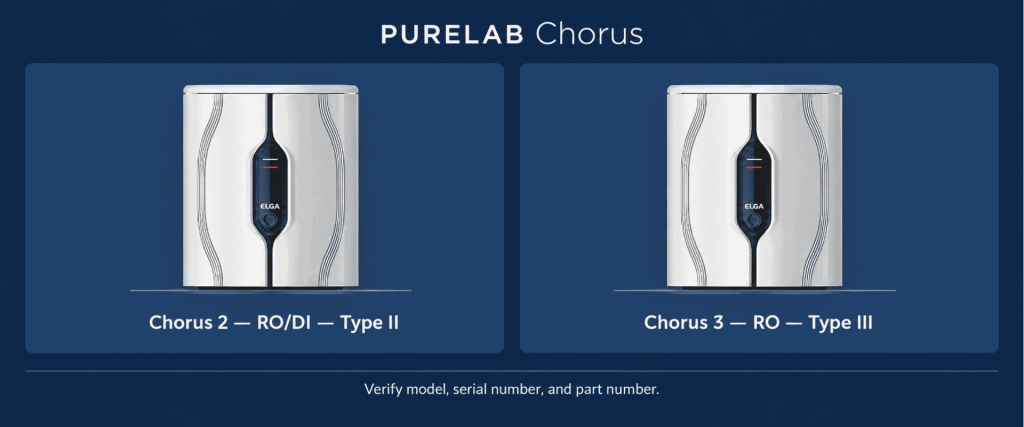
That distinction matters when buying replacement parts: the standard Chorus 3 does not use the Chorus 2’s LC234 DI purification pack as part of its RO treatment path.
Before ordering, record:
- The complete model and serial number.
- The installed consumable part numbers.
- The reservoir model and any optional treatment modules.
- Installation dates and previous replacement dates.
- Current water-quality readings, alarms, and production performance.
Match these details against the applicable operator manual or confirm them with the supplier. A part listed for another Chorus model should not be assumed compatible.
Common Consumable Mistakes and How to Avoid Them
Replacing Both Chorus 2 Packs Automatically
The pretreatment pack and DI purification pack perform different jobs and have different published replacement periods. They should not automatically be treated as one replacement set.
ELGA lists a six-month life expectancy for the LC241 pretreatment pack and twelve months for the LC234 DI pack. The Chorus 2 manual also describes separate replacement reminders for these components.
Track each pack independently. Replace both together when both are due or when the applicable service assessment calls for it, not simply because one reminder appears.
Delaying Pretreatment Replacement to Save Money
An overdue pretreatment pack can increase rather than reduce operating costs. ELGA warns that chlorine, chloramine, and organics remaining after pretreatment place an additional burden on downstream consumables, leading to more frequent and expensive changes.
Keep the pretreatment replacement date visible in the maintenance log. If downstream consumables begin lasting less time than expected, review pretreatment history and feedwater conditions before assuming the replacement parts are defective.
Replacing the RO Module Without Checking Performance
The Chorus 2 manual identifies inadequate permeate quality or flow, compared with predicted or previous performance, as reasons an RO module may need replacement.
Record normal production performance after commissioning and servicing. When output changes, compare it with that baseline and check that operating conditions meet the model’s requirements. Ask the supplier to assess an unexplained decline rather than replacing several components by trial and error.
A replacement membrane also requires proper preparation. The manual states that new RO modules contain preservative solution and must be rinsed before use. Follow the complete model-specific replacement and flushing procedure before returning water to laboratory applications.
Forgetting the Reservoir Vent Filter
Purification does not end at the RO module or DI pack. Storage conditions also affect the water delivered to the laboratory.
ELGA identifies an increased risk of airborne contamination and recontamination when the composite air vent filter is overused. Include the reservoir filter in the maintenance schedule rather than tracking only the cartridges inside the main unit.
Treating Auto-Rinse as Sanitization
Chorus 3 includes auto-rinse to help maintain water purity during periods of low use. That feature should not be treated as a replacement for the applicable sanitization and reservoir-maintenance procedures.
Likewise, fitting a new cartridge does not establish that the complete water system has been sanitized. Use the approved procedure for the installed system, reservoir, and connected equipment. Do not borrow chemical concentrations, contact times, or flushing instructions from another Chorus model.
PURELAB Chorus 2 & 3 Consumable Replacement Guide
The following manufacturer-listed life expectancies are useful for maintenance planning. They are not guarantees of service life or permission to ignore declining performance. Follow the documentation supplied for your exact system.
| Component | Standard system applicability | Main purpose | Published planning guidance | Risk of leaving it overdue |
|---|---|---|---|---|
| LC241 pretreatment pack | Chorus 2 and Chorus 3 | Removes chlorine, chloramine, and organics before downstream treatment | ELGA product pages list approximately 6 months | Greater contaminant burden and more frequent downstream consumable changes |
| LC240 RO module | Chorus 2 and Chorus 3 | Reduces dissolved contaminants before storage or further purification | ELGA product pages list 24–36 months; confirm the model-specific manual | Water quality or production flow may no longer meet requirements |
| LC234 DI purification pack | Chorus 2 RO/DI | Removes residual ionic contamination | ELGA lists approximately 12 months | Ion release and declining resistivity |
| LC216 composite air vent filter | Compatible reservoir configurations used with either system | Limits airborne contamination entering stored water | ELGA lists approximately 6 months | Greater risk of recontaminating purified water |
Source: ELGA’s standard Chorus 2 and Chorus 3 product information. The Chorus 2 operator manual reviewed gives a two-year RO service-life recommendation, illustrating why the applicable manual must take priority over a general planning table.
How Feedwater and Optional Modules Affect Running Costs
Consumable planning should account for the water entering the system, not just the number of months since installation.
Both Chorus 2 and Chorus 3 offer optional post-RO CO₂ removal. ELGA states that this can extend the life of downstream consumables. The manufacturer also offers an option to reduce water consumption with suitable low-hardness feedwater.
If running costs are higher than expected, ask the supplier to review:
- Feedwater quality and suitability.
- Pretreatment replacement history.
- Actual water demand.
- Whether optional degassing is appropriate.
- Whether the installation qualifies for a water-saving configuration.
These options already exist, but they are not automatically necessary or suitable for every laboratory.
A Practical Maintenance Routine
Assign responsibility for the system and maintain one shared service record.
- During routine operation: Check displayed water quality, reservoir status, active warnings, and visible signs of leakage. Investigate unexpected changes before using water for work with defined purity requirements.
- Before replacement: Confirm the correct part, review the applicable procedure, and prepare for any required interruption, isolation, flushing, or recommissioning. Isolation requirements vary by task; do not assume that every cartridge change follows the same sequence.
- After maintenance: Check for leaks, complete the prescribed rinse or commissioning cycle, verify water quality against the laboratory’s acceptance criteria, and record the work. Reset a consumable reminder only after completing the corresponding maintenance.
The Chorus 2 manual directs users to an approved supplier or distributor for maintenance outside the tasks covered in the operator manual.
Conclusion
Avoiding costly PURELAB Chorus 2 & 3 consumable mistakes does not mean extending every replacement interval.
It means replacing the correct component at the right time, protecting downstream treatment, and confirming that maintenance has restored acceptable performance.
Track consumables separately, include reservoir filters in the schedule, and investigate changes in water quality or output before ordering parts.
Above all, use the maintenance instructions for the exact installed model, not a general guide for the wider Chorus range.
Frequently Asked Questions (FAQs)
1. Do both Chorus 2 packs need replacing together?
Not automatically. ELGA lists different life expectancies for the pretreatment and DI packs. Follow each component’s maintenance requirements and the applicable manual.
2. Does standard PURELAB Chorus 3 use an LC234 DI pack?
No. Standard Chorus 3 is an RO system. The LC234 DI purification pack is listed for standard Chorus 2 RO/DI.
3. How often should the RO module be replaced?
ELGA’s product pages list a 24–36-month life expectancy, while the Chorus 2 manual reviewed recommends two years. Follow your model-specific instructions and investigate inadequate quality or flow sooner.