



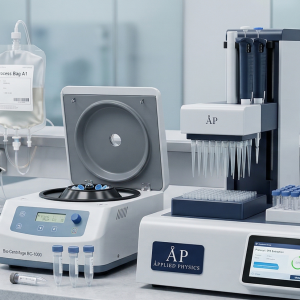

Medical & Clinical Validation Equipment
Verify airflow, workflow separation and contamination-control assumptions in sterile processing, clinical laboratories and medical-device manufacturing environments.
Three environments. One underlying question: can contamination reach the protected process?
Sterile Processing Departments
Evaluate separation between decontamination, preparation, packaging and protected storage workflows.
- Instrument transport paths
- Washer unloading
- Assembly workstations
- Pass-through sterilizers
Clinical & Hospital Laboratories
Observe controlled handling zones and containment behavior around sample preparation and laboratory work areas.
- Biological safety cabinets
- Sample handling stations
- Transfer zones
- Specimen preparation
Medical-Device Manufacturing
Support process qualification and contamination-control studies around assembly, packaging and controlled work zones.
- Assembly stations
- Sterile packaging
- Clean benches
- Operator interaction
Written workflow is not the same thing as physical airflow.
Healthcare and laboratory environments often depend on procedural separation, pressure relationships and controlled operator movement. Visualization can reveal behavior that is difficult to infer from procedures or downstream monitoring alone.
Common failure mechanisms
Air entrainment from adjacent areas, contaminated air drawn across protected items, operator movement, workstation placement and weak separation of dirty and clean pathways can all change the real contamination path.
Build evidence around the process you are responsible for.
Applied Physics validation tools support documented evaluation of contamination-control behavior. Requirements remain specific to the facility, quality system, accreditation program and validation protocol.
Sterile Processing
Use visualization and workflow verification to evaluate dirty/clean separation and protection of processed instruments before storage or use.
- Workflow separation
- Transfer points
- Protected zones
Medical-Device Quality
Support documented process-control and repeatability studies where airflow or contamination pathways can affect product handling and packaging.
- Process qualification
- Controlled areas
- Investigation evidence
Clinical Laboratory Quality
Evaluate containment and cross-contamination pathways around handling, transfer and preparation areas.
- Sample integrity
- Containment behavior
- Workflow review
Without physical verification, contamination may only be discovered after the process has already failed.
Turn an invisible contamination pathway into something the team can review and document.
Physical behavior
Validation studies can be structured to observe and document the behavior that affects protected work.
- Visualize airflow movement
- Confirm dirty-to-clean separation
- Evaluate workstation protection
- Assess operator interaction
- Create recorded documentation
Who reviews the results
The evidence typically supports teams responsible for quality, facilities, sterile processing and controlled laboratory operations.
- Sterile processing leadership
- Infection prevention
- Clinical laboratory leadership
- Biomedical engineering
- Quality assurance
- Validation specialists
Validation equipment is one part of a broader medical and laboratory portfolio.
Applied Physics Medical includes AP-branded OEM medical/laboratory equipment and HealthForge Instruments, the Applied Physics OEM surgical-instrument brand, alongside selected third-party systems.
HealthForge Instruments
Applied Physics-owned OEM surgical-instrument line, contract manufactured for Applied Physics and positioned within the broader Applied Physics Medical portfolio.
Explore AP MedicalClinical & Laboratory Equipment
Core laboratory, pathology, sterilization, sample-processing and controlled-environment equipment for healthcare and laboratory workflows.
Browse core lab equipmentMedical validation questions.
Why verify airflow in sterile processing?
Physical airflow can cross procedural boundaries. Visualization helps evaluate whether air movement can carry contamination toward cleaned or protected instruments.
Can written procedures replace physical verification?
Procedures define the intended workflow, but airflow, equipment placement and operator motion can behave differently in practice. Physical verification adds evidence of actual conditions.
When should a medical or clinical workflow be evaluated?
Common triggers include facility design, equipment relocation, investigation, process change, qualification and facility-specific periodic review.
What can visualization add to an investigation?
It can make contamination transport, entrainment and operator-related airflow effects visible so the team has physical evidence to evaluate.
Who typically owns the study?
Responsibility varies by facility, but sterile processing leadership, quality assurance, biomedical engineering, infection-prevention and validation teams may be involved.
Describe the workflow you need to verify.
Tell us the room, workstation or process, what must remain protected, and what you need to demonstrate. We can help identify the appropriate validation approach and equipment.
