Select the particle standard by material, size, form and measurement objective
The fastest path to the right quote is to specify what the instrument is measuring and the physical form the workflow actually requires.
Material
Choose PSL, silica or another material required by the method.
Nominal size
Provide target diameter or size set and the tolerance/certificate requirement.
Delivery form
Specify suspension, dry powder, deposited wafer or another prepared reference.
Instrument / application
- SSIS / wafer inspection
- Particle-counter calibration or verification
- Microscopy / imaging calibration
- Contamination / process-control study
- Research / assay development
RFQ data
- Instrument/tool model
- Particle material and nominal size(s)
- Concentration or deposition requirement
- Required certificate / traceability
- Quantity and target delivery date
Send a quote-ready particle-standard request
- Instrument / tool manufacturer and exact model
- Particle material and nominal size or size set
- Suspension, dry powder, deposited wafer or other required form
- Concentration / quantity and certificate or traceability requirement
- Application, SOP/specification and target delivery date
What AP should return
- Recommended reference configuration
- Any compatibility assumptions requiring customer confirmation
- Certificate / traceability scope
- Lead time and commercial quote
Use the product quote control. Your selected product, variation and quantity will remain attached to the request while you add application and technical details.
Questions engineers and validation teams ask
What information is needed to select a particle size standard?
Provide the instrument or application, particle material, nominal size or size set, delivery form, certificate or traceability requirement, quantity and target delivery date.
Should PSL and silica standards be treated as interchangeable?
No. Select the particle material required by the instrument, SOP or study objective rather than substituting only by nominal diameter.
Can particle standards be supplied on wafers?
For a deposited wafer, specify wafer diameter/substrate, particle material and size, deposition geometry and inspection-tool/recipe objective.
Choose particle material from the method—not from the product name
| Material / family | Start here when the requirement is… | Quote variables |
|---|---|---|
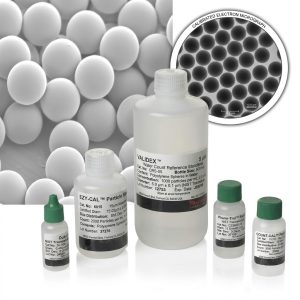
| PSL / polystyrene latex | Monodisperse particle-size references, particle-counter/optical calibration, aerosol work, or deposited wafer references. | Instrument/application, nominal size(s), form/concentration, quantity, certificate/traceability. |
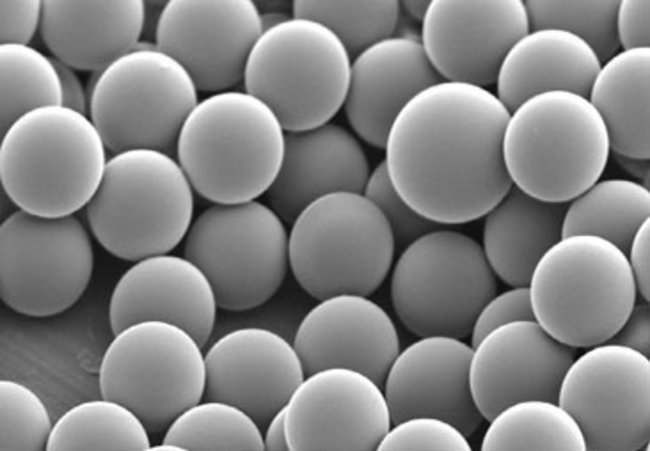
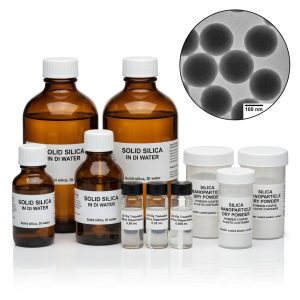
| Silica / SiO₂ | Silica reference behavior, contamination-wafer work, optical/material research, or functionalized silica formulations. | Size, surface treatment/functionalization, powder vs suspension, solvent/concentration, quantity. |
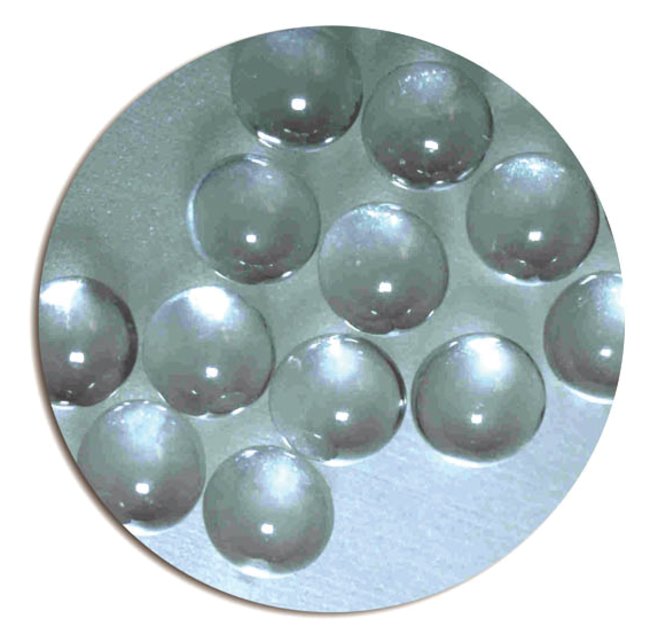
| Borosilicate / glass | Powder/particle-size measurement and methods where glass material properties and available size ranges are appropriate. | Method/instrument, nominal size/range, quantity, sample preparation and documentation. |
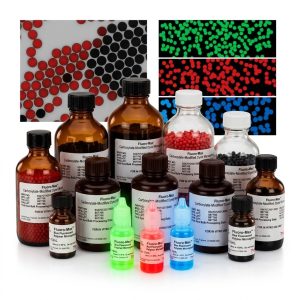
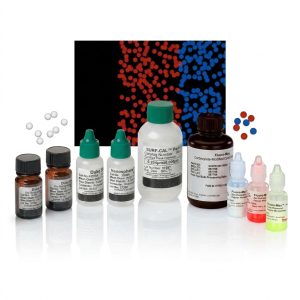
| Fluorescent / dyed polymer | Imaging, tracking, optical method development, method visibility or research requiring a colored/fluorescent signal. | Size, color/excitation-emission, surface chemistry, dry/suspension form, concentration/quantity. |
| Functionalized / assay particles | Conjugation, binding, lateral-flow, diagnostic or assay-development workflows. | Core material, size, functional group/coating, concentration, conjugation target and assay conditions. |
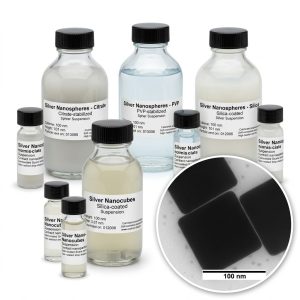
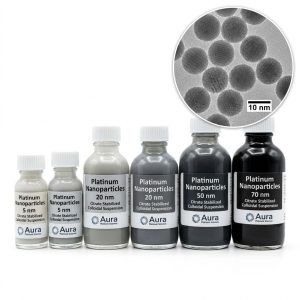
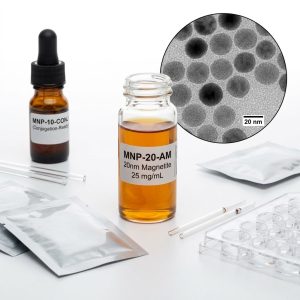
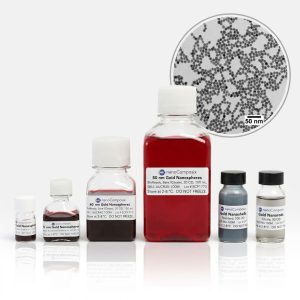
| Magnetic / metallic nanoparticles | Research workflows where magnetic response, plasmonic/optical properties or specialized surface chemistry are part of the method. | Composition, size, morphology, coating/functionalization, concentration and application. |

Route the buyer from application to the right particle family
Particle-counter calibration
Start with PSL or another method-specified reference size. Capture the instrument/model, channel or target diameter, procedure and documentation requirement.
Particle Counter StandardsSemiconductor / SSIS
Use particle suspensions or deposited wafers according to the inspection tool, substrate, recipe and calibration objective.
Wafer StandardsHEPA / aerosol challenge
Separate the particle reference from the aerosol-generation/dilution method. Specify the test method, target size and equipment context.
PSL Aerosol GeneratorsFluorescent imaging / tracking
Choose size plus fluorescent properties, surface chemistry and form around the imaging or tracking method.
Fluorescent MicrospheresAssays / diagnostics
Choose functional group, particle size, material and concentration around conjugation chemistry and assay architecture.
Functionalized ParticlesMaterials & nanoparticle research
Choose core composition, size, coating/functionalization, concentration/form and method-specific documentation.
Silica & GlassMake the particle inquiry quote-ready
- Instrument, method or end application
- Particle material / composition
- Nominal size or multi-size set
- Dry powder, suspension, concentration or deposited format
- Surface chemistry / fluorescence / coating when relevant
- Package size / quantity and needed date
- Certificate, traceability or other documentation requirement
Do not let the catalog make the engineering decision
Applied Physics has overlapping particle families and many individual size SKUs. The correct quote should be driven by the customer's method and required reference properties—not by whichever product title happens to rank first.
For an accurate quote: use the product quote control so the selected product, variation and quantity remain attached to your request.
Choose the standard by material, physical form and measurement method
The same nominal diameter can serve very different purposes. Start with the instrument and the physical reference it can actually use.
PSL / polystyrene
Low-density, optically useful reference spheres available across nanometer and micron-scale families.
Explore PSL →Silica & glass
Higher-density materials with different optical, surface and handling behavior.
Explore silica & glass →Fluorescent / dyed
Particles selected by optical response as well as diameter for imaging, flow and tracer work.
Explore optical particles →Functionalized
Surface-modified particles for coupling, assay, diagnostic and research-development workflows.
Explore surface chemistry →Ready for compatible liquid, microscopy, aerosol-generation or deposition workflows.
Requires a defined dispersion, handling and agglomeration-control method.
Adds substrate, surface and deposition geometry for SSIS or wafer-inspection work.
Adds a defined concentration for liquid particle-counter counting or volumetric checks.
Common applications
- Airborne or liquid particle-counter calibration and verification
- Aerosol and filter-challenge method development
- SSIS and wafer-inspection response checks
- Microscopy, imaging and flow applications
- Assay, diagnostic and surface-chemistry development
- Powder, dispersion and particle-characterization work
Method-specific guardrail
ISO 21501-4 addresses calibration and verification of light-scattering airborne particle counters, including size setting, counting efficiency and related performance characteristics. It does not make every microsphere a universal standard.
Confirm the exact instrument, medium, nominal channel, concentration, certificate and acceptance procedure before ordering.