
Citrate gold nanospheres can remain dispersed in their supplied solution yet aggregate after transfer into a buffer, mixing with proteins, or a change in handling conditions.
A red dispersion may become purple or blue, its optical spectrum may broaden, or visible sediment may appear. These changes can interfere with measurements and make experiments difficult to reproduce.
Reducing aggregation starts with understanding how citrate stabilizes the gold surface and what happens when the surrounding solution changes.
For researchers using citrate gold nanospheres from 5 to 100 nm, the main considerations are buffer composition, pH, surface modification, purification, and storage.
How Citrate Stabilizes Gold Nanospheres
Citrate molecules associate with the gold surface and provide a negative charge. Under suitable conditions, electrostatic repulsion helps keep neighboring particles apart. This stabilization works well in water and many low-ionic-strength aqueous solutions, but citrate does not provide a substantial physical barrier between particles.
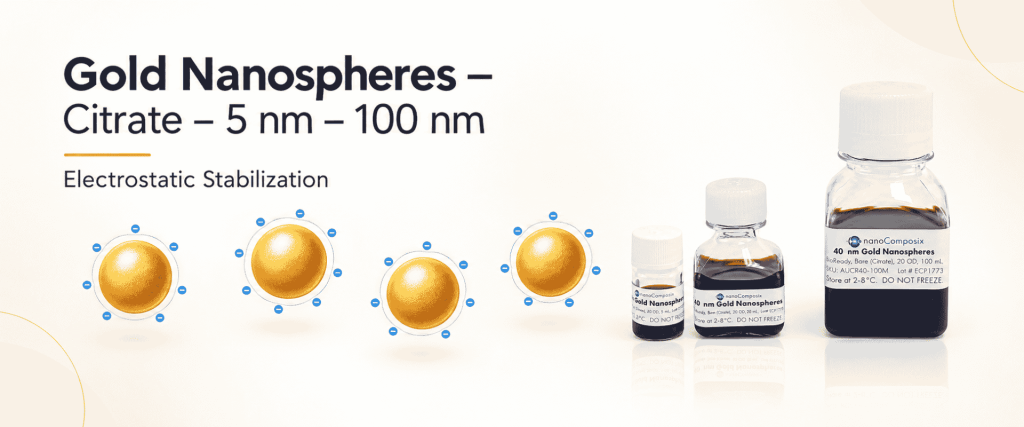
Citrate also binds relatively weakly compared with some other surface ligands. That makes the gold surface accessible for protein adsorption and ligand exchange, a useful feature for research, but one that requires control during surface modification.
A dispersion that is stable in its original formulation is not automatically stable in the final assay medium. Stability must be checked under the conditions in which the particles will actually be used.
Why Citrate Gold Nanospheres Aggregate
1) Salt Can Weaken Electrostatic Repulsion
Increasing ionic strength screens surface charge and compresses the electrical double layer around the particles. This reduces the repulsive interaction that helps maintain separation, allowing particles to approach and aggregate.

PBS compatibility is a common concern. NIST reports rapid precipitation of tested citrate-stabilized gold nanoparticles in PBS. This does not establish a universal failure threshold for every formulation, but it shows why direct transfer into a physiological buffer should not be assumed safe.
2) pH Changes Can Alter Surface Charge
Citrate’s charge depends on pH. Acidification can reduce the magnitude of the negative surface charge and weaken stabilization. NIST observed time-dependent aggregation of citrate-stabilized gold nanoparticles under the acidic conditions tested.

There is no single pH range that guarantees stability across all particle sizes, concentrations, and media. Buffer composition and ionic strength must be considered alongside pH.
3) Proteins and Ligands Can Change the Surface
Proteins can adsorb onto citrate-coated gold, while ligands with stronger affinity for gold can displace citrate. These interactions may stabilize or destabilize the dispersion depending on the molecule and experimental conditions.
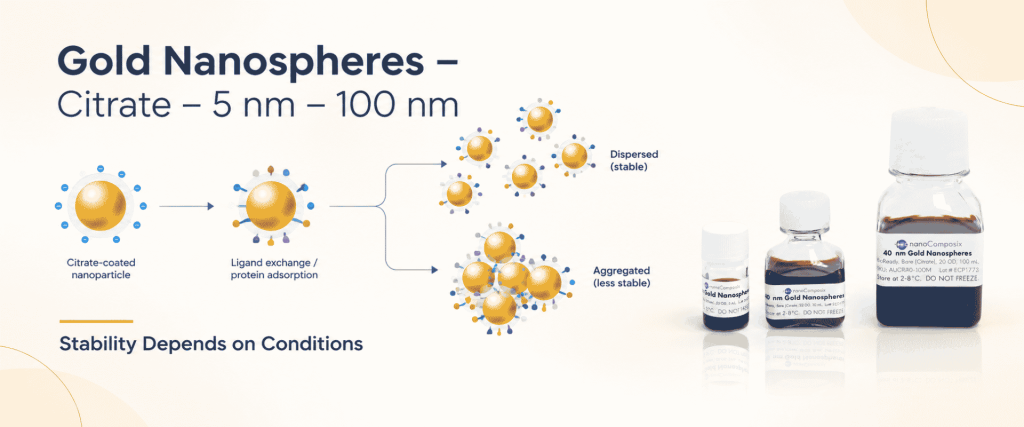
A study of protein conjugation starting with citrate-capped gold nanoparticles found that stability was strongly protein-dependent. A procedure that works for one protein therefore should not be transferred to another without validation.
4) Purification Can Introduce Instability
Centrifugation, resuspension, and buffer exchange can change both the local particle concentration and the surrounding medium. Researchers studying protein-gold nanoparticle conjugates observed partial aggregation after centrifugation and resuspension, and investigated size-exclusion chromatography as an alternative purification method.
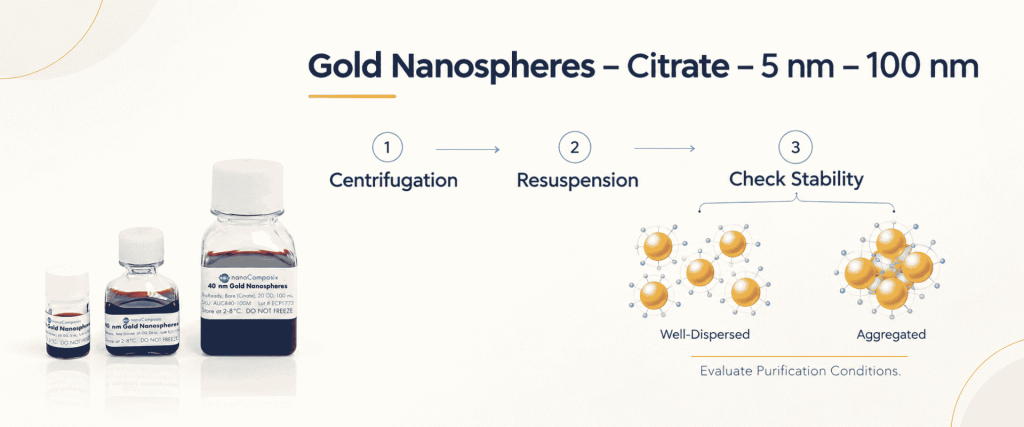
These findings support testing purification conditions for the specific conjugate rather than applying one washing procedure to every preparation.
5) Freezing and Improper Handling Can Damage the Dispersion
The storage and handling document linked from our product page warns against freezing nanoparticle dispersions because irreversible aggregation can occur. It also recommends checking materials before use for changes in color, intensity, and visible particulates.
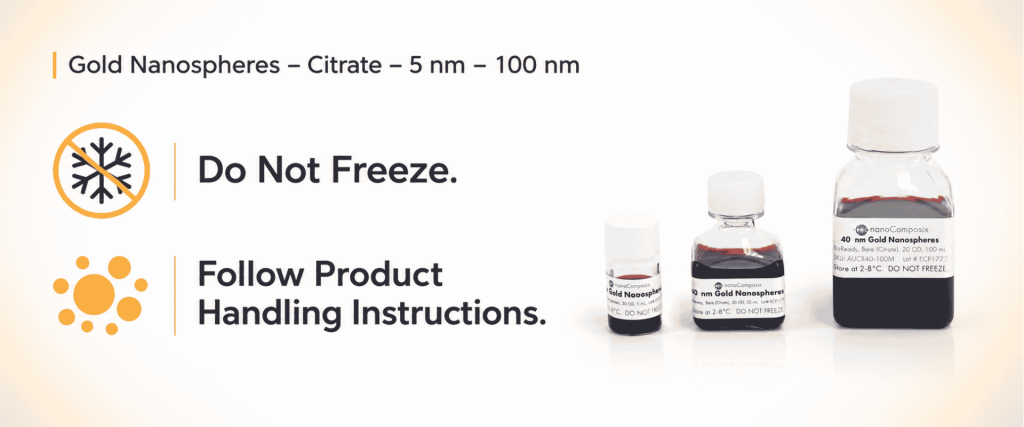
Settling alone does not prove aggregation. The same document notes that particles can settle during storage, particularly larger particles. Follow the applicable mixing instructions and verify whether the dispersion returns to a uniform state.
Common Aggregation Risks and Practical Checks
| Risk factor | What may happen | How to reduce the risk |
|---|---|---|
| Increased salt concentration | Charge screening weakens colloidal stabilization | Test the intended buffer on a small aliquot before transferring the full sample |
| Acidic conditions | Reduced surface charge can promote aggregation | Evaluate pH together with ionic strength and exposure time |
| Protein adsorption or ligand exchange | Surface changes may destabilize particles | Optimize the modification process and verify stability after each stage |
| Centrifugation and buffer exchange | Aggregation may occur during washing or resuspension | Validate recovery and dispersion quality; assess alternative purification methods where appropriate |
| Freezing | Irreversible aggregation may occur | Follow the supplied storage instructions and avoid freezing unless explicitly permitted |
| Changing particle size or formulation | A previously successful protocol may no longer perform consistently | Recheck compatibility for the selected size and concentration |
These checks reflect documented stability mechanisms and handling concerns; they are not universal operating limits for every citrate gold formulation.
How to Reduce Aggregation Risk Before an Experiment
Start with the Exact Product Configuration
Our Gold Nanospheres, Citrate, 5 nm,100 nm listing offers selectable sizes, volumes, and concentrations of 0.05 mg/mL and 1 mg/mL. It also provides links to example certificates of analysis, safety data sheets, and handling guidance.
Confirm the documentation for the selected configuration. The page includes 50 nm-specific information, so those values should not be treated as specifications for every size in the range.
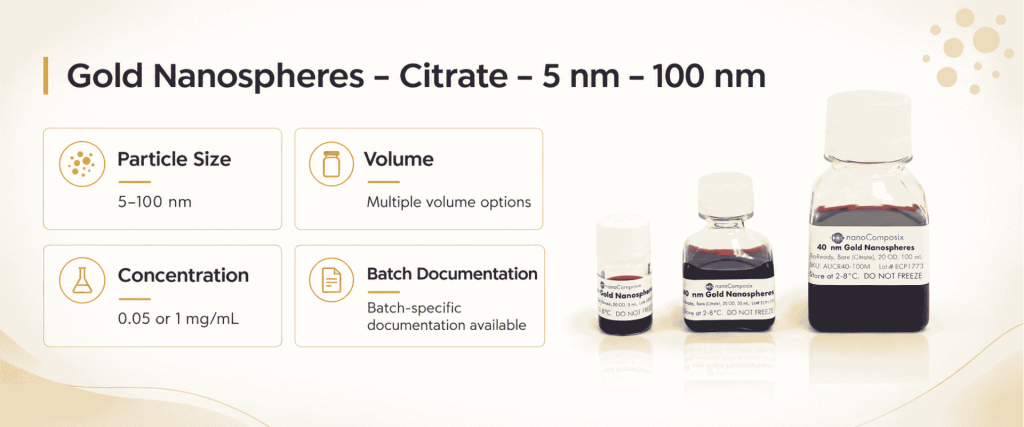
Particle size also affects how concentration should be interpreted. At the same gold mass concentration, smaller particles represent a greater number of individual particles than larger ones. Optical density also depends on particle size, so equal mg/mL values do not mean equal particle counts or optical responses.
Test the Final Medium on a Small Aliquot
Before committing the full sample, compare particles in their original dispersion with particles exposed to the intended buffer or assay medium. Include the relevant salts, proteins, reagents, temperature, and exposure time.

NIST recommends assessing stability in application-relevant media and following changes over time using complementary measurements such as DLS and UV–Vis spectroscopy.
A useful screening approach is to:
- Record the starting appearance and UV–Vis spectrum.
- Change one experimental variable at a time where practical.
- Check immediately after preparation and over the intended experiment duration.
- Retain an unmodified control for comparison.
Validate Conjugation and Purification Separately
Do not assume that a visually unchanged sample confirms successful conjugation. Evaluate whether the intended surface modification occurred and whether the resulting dispersion remains stable.
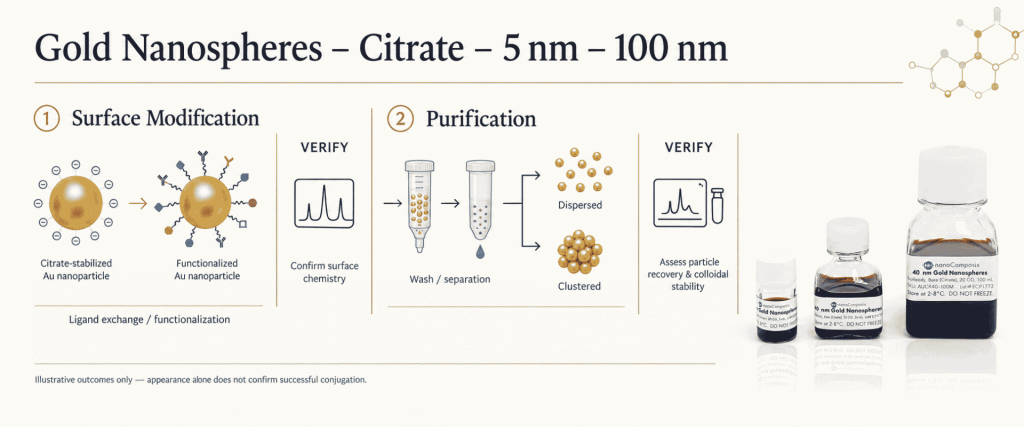
Research on protein-gold nanoparticle conjugates supports combining analytical methods to assess attachment, purification, and colloidal stability rather than relying on one measurement alone.
Consider Whether Citrate Is the Right Surface
Citrate is useful when surface accessibility and subsequent modification are priorities. If the application requires greater tolerance to salts or a different biological environment, another surface chemistry may be worth evaluating.

Polymer coatings can provide steric stabilization, but they also change surface accessibility and interactions with biomolecules. A coating should therefore be selected for the complete application, not simply because it is described as more stable.
How to Check Whether Aggregation Has Occurred
Use Visual Inspection as an Early Warning
Unexpected color changes, reduced color intensity, visible particulates, or persistent sediment warrant further investigation.
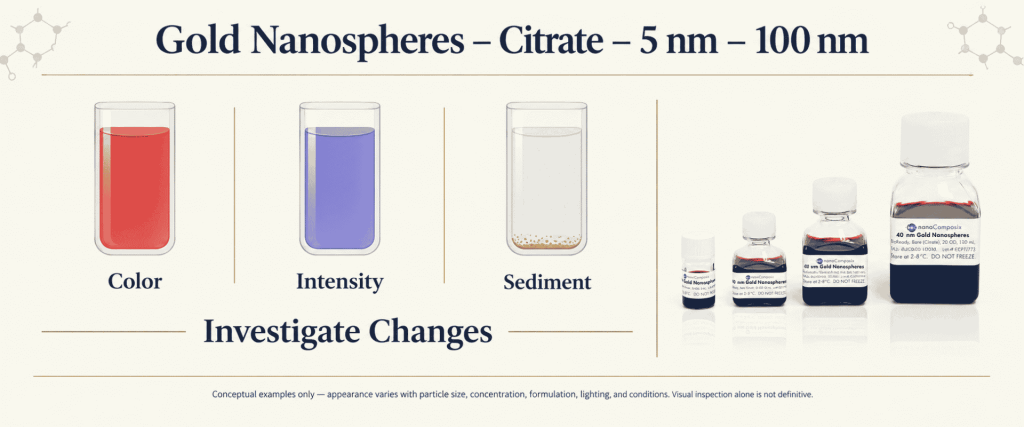
However, compare the sample with a baseline for the same particle size and formulation: gold nanoparticle optical properties themselves vary with size.
Compare UV–Vis Spectra
Aggregation can reduce or broaden the original plasmon peak and increase extinction at longer wavelengths because neighboring particles interact optically.
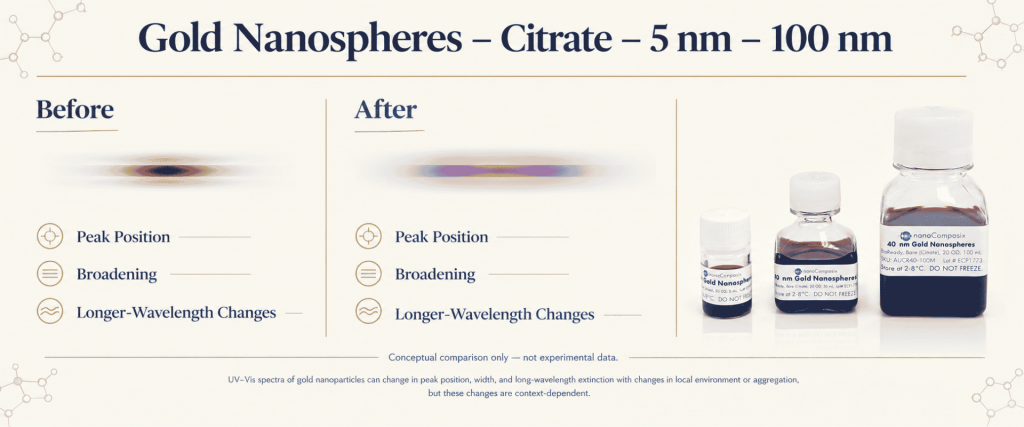
Compare the full spectrum before and after the experimental change rather than judging stability from color alone.
Use DLS Where Appropriate
DLS can help detect changes in hydrodynamic size and the appearance of larger populations. Its results should be interpreted alongside UV–Vis data and, when needed, microscopy.
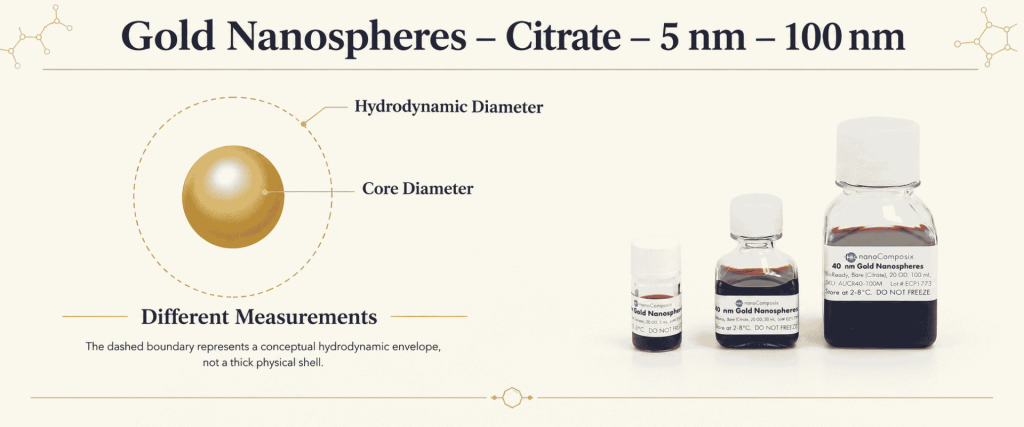
A hydrodynamic diameter is not the same measurement as the gold core diameter obtained by TEM.
Conclusion
Citrate gold nanospheres offer an accessible surface for modification, but their electrostatic stabilization is sensitive to the surrounding solution. Salts, pH changes, protein interactions, purification, and freezing can all affect dispersion quality.
The most reliable way to reduce aggregation risk is to verify the selected formulation, test the final medium on a small scale, and check stability throughout the workflow. For 5–100 nm products, validate each relevant size and configuration rather than assuming one protocol will work across the full range.
Frequently Asked Questions (FAQs)
1. Why do citrate gold nanospheres turn purple or blue?
Aggregation can change the particles’ optical response through plasmon coupling. An unexpected color shift should be investigated with UV–Vis spectroscopy and, where appropriate, DLS.
2. Can citrate gold nanospheres be added directly to PBS?
Do not assume compatibility. PBS can destabilize citrate-stabilized gold nanoparticles, so test the selected formulation under the intended conditions first.
3. Can citrate gold nanospheres be frozen?
The handling document linked from this product page advises against freezing dispersions because irreversible aggregation can occur. Follow the instructions supplied for the exact product.
4. Does sediment mean the particles have aggregated?
Not necessarily. Particles can settle during storage. Follow the applicable resuspension instructions and investigate persistent sediment or changes in appearance and measured properties.
5. Will one conjugation protocol work for every protein?
Not reliably. Protein identity can affect conjugate stability, so each protein-particle system needs appropriate optimization and verification.