
Last Updated: October 29, 2026
Quick Summary
Particulate matter measurement quantifies solid particles and liquid droplets suspended in air, defined by the metric, size range, and instrument method used. Before comparing instruments, define your sample matrix, measurand, size range, instrument method, calibration reference, uncertainty and reporting format, and application with your qualified team and OEM.
- Mass concentration reports particle mass per air volume in µg/m³; number concentration counts particles per volume.
- There is no universal conversion between mass concentration, number concentration, and particle size distribution.
- Ambient work centers on PM10 and PM2.5 mass with gravimetric filter sampling reported in µg/m³.
- Cleanroom work centers on counts per volume at specified size thresholds and ISO 14644 classification.
- Compare datasets only after confirming matrix, measurand, size range, averaging time, and units match.
Table of Contents
- What Particulate Matter Measurement Must Specify Before You Compare Instruments
- Mass Concentration, Particle Number Concentration, and Particle Size Distribution
- Ambient-Air PM Metrics Versus Cleanroom Particle Counting
- Frequently Asked Questions
What Particulate Matter Measurement Must Specify Before You Compare Instruments
Particulate matter measurement quantifies solid particles and liquid droplets suspended in air, defined by the metric, size range, and instrument method used (the EPA). Buyers often request “a particle counter” without stating which they need, so quotes are not comparable.
Before comparing instruments, define the sample matrix, measurand, size range, instrument method, calibration reference, uncertainty, reporting format and application with your qualified team and the manufacturer. Use these requirements to compare quotations on a consistent basis.

Illustrative generated image of a measurement-planning workspace; not actual Applied Physics staff or a verified laboratory.
|
Requirement |
What to state |
Why it changes the quote |
|---|---|---|
|
Matrix |
Ambient air, indoor air, cleanroom, process gas |
Determines sampler and inlet type |
|
Measurand |
Mass concentration, number concentration, size distribution |
Different detector, different output |
|
Size range |
PM10, PM2.5, ultrafine, sub-micron cut points |
Sets the inlet and detection limits |
Mass Concentration, Particle Number Concentration, and Particle Size Distribution
Mass concentration reports particle mass per air volume (µg/m³); particle number concentration counts particles per volume; particle size distribution describes how count or mass spreads across diameter bins. There is no universal conversion between them.
For a number-concentration application, ask your qualified team and OEM which instrument method and size range suit the intended measurement. Confirm the current manufacturer documentation before comparing models.
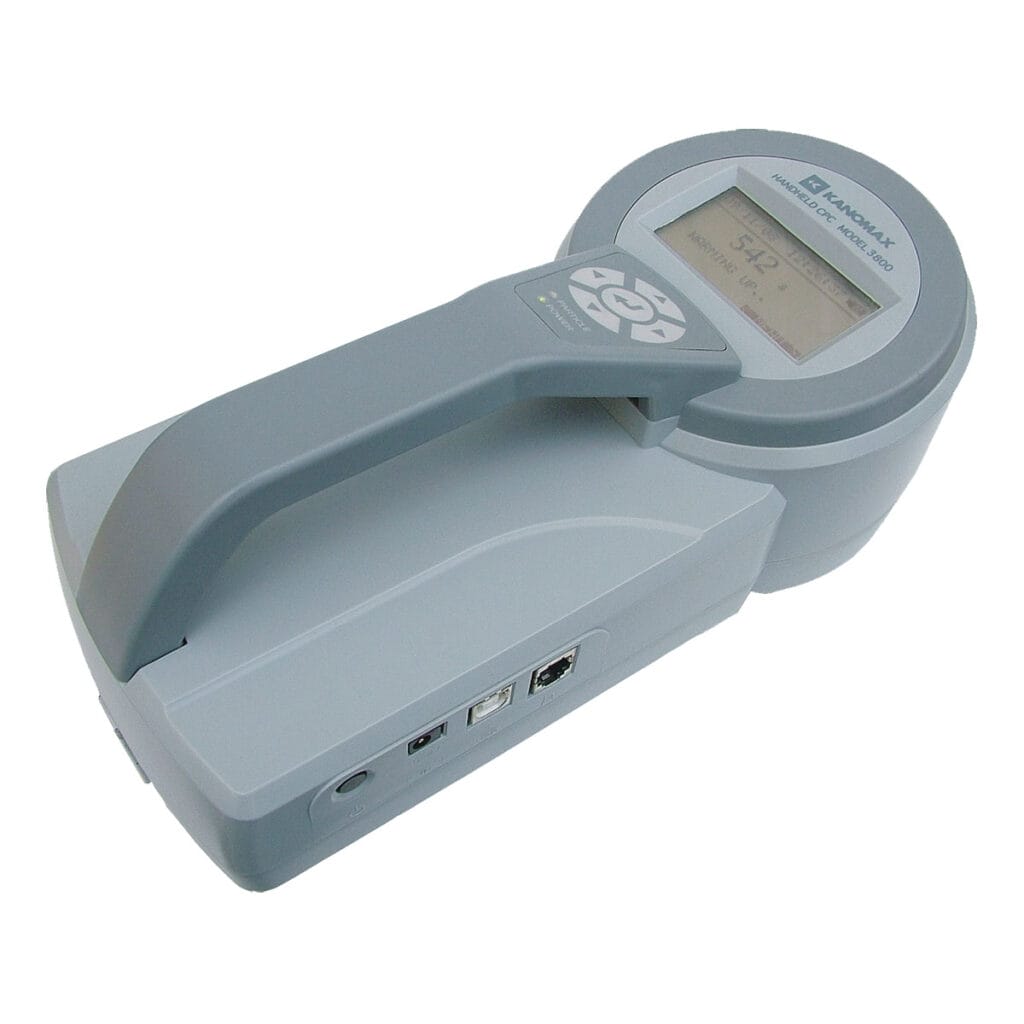
Handheld Condensation Particle Counter – Model 3800
Ambient-Air PM Metrics Versus Cleanroom Particle Counting
Ambient work centers on PM10 and PM2.5 mass, gravimetric filter sampling, and reporting in µg/m³ over defined averaging periods. Cleanroom work centers on counts per volume at specified size thresholds and classification schemes such as ISO 14644. Surface and wafer standards sit in a third bucket, addressing contamination deposited on a surface or substrate, not particles suspended in air.
Ambient air comprehensive sampler (Customized) →
Confirm that the proposed measurement method is suitable for your stated application with your qualified team and OEM.
Evaluate each candidate instrument against your stated application and reporting requirements. Confirm the exact configuration, measurement capabilities, calibration documentation and limitations with the manufacturer before requesting a final quotation.

What should a particulate measurement instrument quote include?
A quote should state the measurand, size range, calibration reference, uncertainty, reporting format, and application. Define these with your qualified team and OEM.
How do you compare two datasets from different instruments?
Compare only after confirming matrix, measurand, size range, averaging time, and units match. Where they differ, treat the datasets as separate series rather than converting one into the other. EPA’s national PM2.5 trend data illustrates how a long-running series stays useful only when the measurement basis is held consistent.
Confirm method suitability before purchase
The hard part of particulate matter measurement is not buying an instrument. It is specifying the measurand, size range, method, calibration reference, and reporting format precisely enough that two quotes describe the same thing. Applied Physics supplies contamination control and particle metrology equipment, including ambient air samplers, condensation particle counters, and cleanroom monitoring systems. Request pricing and availability.
Frequently Asked Questions
What is the difference between particle number concentration and mass concentration?
Particle number concentration counts how many particles occupy a given volume, while mass concentration reports the mass of particulate matter per volume, usually in micrograms per cubic meter (µg/m³). The two answer different questions. No universal conversion exists between them.
Can particle number concentration be converted to particulate mass concentration?
Not with a single universal factor. There is no universal conversion between particle number concentration and mass concentration.
What should an RFQ for a particulate measurement instrument include?
State the matrix (ambient air, indoor air, cleanroom, or process gas), the measurand (mass concentration, particle number concentration, or size distribution), the required size range, the instrument method, the calibration reference, and the uncertainty and reporting format you need. Add the application. Define these with your qualified team and OEM.