
Last Updated: September 27, 2026
Most cleanroom compliance audit failures do not come from broken equipment. They come from documentation gaps, inconsistent gowning behavior, and monitoring data that cannot survive a paper trail review. At Applied Physics, we have watched facilities with excellent particle counts still receive observations because their records told a different story than their cleanroom.
The stakes are rising. Industry analysis from Cleanroom Technology’s 2025 compliance outlook identifies airflow and pressure management as one of four critical pillars for 2025 compliance, while Cleanetics’ 2025 industry trends report notes a clear shift toward treating documentation as a primary audit requirement rather than a supporting metric. Auditors in 2026 are specifically prioritizing gowning procedures, sticky mats, ESD protocols, specialized wipes, documentation accuracy, and chemical management, according to MTE Solutions’ 2026 cleanroom compliance checklist.
That is the real thesis of this guide: a cleanroom compliance audit tests whether your facility can prove control, not just achieve it. Below, we break down exactly how to pass a cleanroom compliance audit, from pre-audit walkthroughs to post-audit CAPA planning.
A cleanroom audit checklist works best when it is built around what auditors physically do during an inspection, not around what your facility already does well. Nuaire’s 2026 cleanroom inspection guidance recommends a preparation strategy with three components: a physical walkthrough of the facility, a collaborative review of certification reports with area leadership, and direct observation of staff behavior against established protocols. What most guides leave out is the sequence, the evidence standard, and the mock-audit mechanics that turn those three components into a passing inspection.
A 30-14-7-1 cadence keeps preparation from collapsing into a fire drill the week of the audit. Most practitioners find that facilities which compress preparation into the final week generate more findings than facilities that spread the same work across a month.
| Window | Task | Owner | Evidence Produced |
|---|---|---|---|
| 30 days out | Full facility walkthrough in gowning, following the product and personnel route | Cleanroom Manager | Walkthrough log with photos and room-by-room notes |
| 30 days out | Certification report reconciliation against current room classifications | QA Officer | Signed reconciliation memo listing every discrepancy |
| 21 days out | Documentation gap audit: SOPs, training files, calibration certificates, monitoring logs | QA Officer | Gap register with severity and due dates |
| 14 days out | Mock audit with a staff member who did not build the system | QA Manager | Mock audit report with observations and responses |
| 7 days out | Corrective action close-out on mock audit findings | Area Supervisor | Objective evidence per closed finding |
| 1 day out | Final walkthrough, gowning stock check, and document staging | Cleanroom Manager | Pre-audit readiness sign-off |
Walk the facility as an auditor would, in full gowning, following the same route product and personnel take. Check that certification reports match current room classifications, that HEPA filter test dates are current, and that any equipment moved since the last certification has been re-qualified. Pay attention to the seams auditors probe: pass-throughs, airlock interlocks, and the transition zones where gowning levels change. Those are where documentation and reality most often disagree.
Records must be contemporaneous, legible, and traceable. Auditors cross-reference environmental monitoring data against calibration records, training logs, and standard operating procedures. If a particle counter was out of calibration during a monitoring run, that data is a finding waiting to happen. The same logic applies to gowning qualification records, cleaning logs, and maintenance work orders: any record that cannot be tied to a specific person, date, and procedure is a gap.
The single highest-value preparation step is a mock audit run by someone who did not build the system. Internal owners defend their own work; a peer from another department or a qualified consultant does not. Give the mock auditor the same document request list a real auditor would send, let them interview operators without a script, and require written responses to every observation within five business days. Facilities that treat the mock audit as a rehearsal for the real thing close far more findings before the inspection begins.
If part of your record-keeping is still paper and part is electronic, reconcile the two before the audit. Auditors will ask how a paper cleaning log relates to an electronic monitoring record for the same shift, and “they are separate systems” is not an answer. Either migrate the paper logs into your electronic system with a documented transfer procedure, or maintain a written cross-reference that shows how the two records describe the same event. This is where the digital audit trail discussion later in this guide becomes a preparation task, not just a technology choice.
Pro Tip Schedule the mock audit at least two weeks before the real one. That gap is the minimum time most facilities need to investigate root causes, not just close symptoms, before the auditor arrives.
Watch Out Do not back-date, re-write, or “clean up” records during preparation. Auditors are trained to spot ink changes, inconsistent handwriting, and entries that appear in a single sitting. A documentation integrity finding is far worse than the original gap.
ISO 14644 cleanroom standards define how cleanrooms are classified, tested, and monitored, and auditors expect your facility to demonstrate ongoing compliance rather than a one-time certification. A CDMO validated its cleanroom manufacturing areas against ISO 14644 and EU Annex 1 requirements using a tailored room recovery testing solution, per Performance Validation’s case study.
Each classified room must meet particulate count limits for its ISO class at rest and in operation. Auditors verify sampling locations, sample volumes, and that monitoring frequency matches your written procedures.
HEPA filter integrity testing and air change rate verification are non-negotiable. The Aerosol Photometer BAP-350 from Applied Physics performs HEPA validation with a 0.0001% to 100.0% measuring scope and 1 cfm flow rate, meeting NSF49, IEST, and ISO 14644 standards.
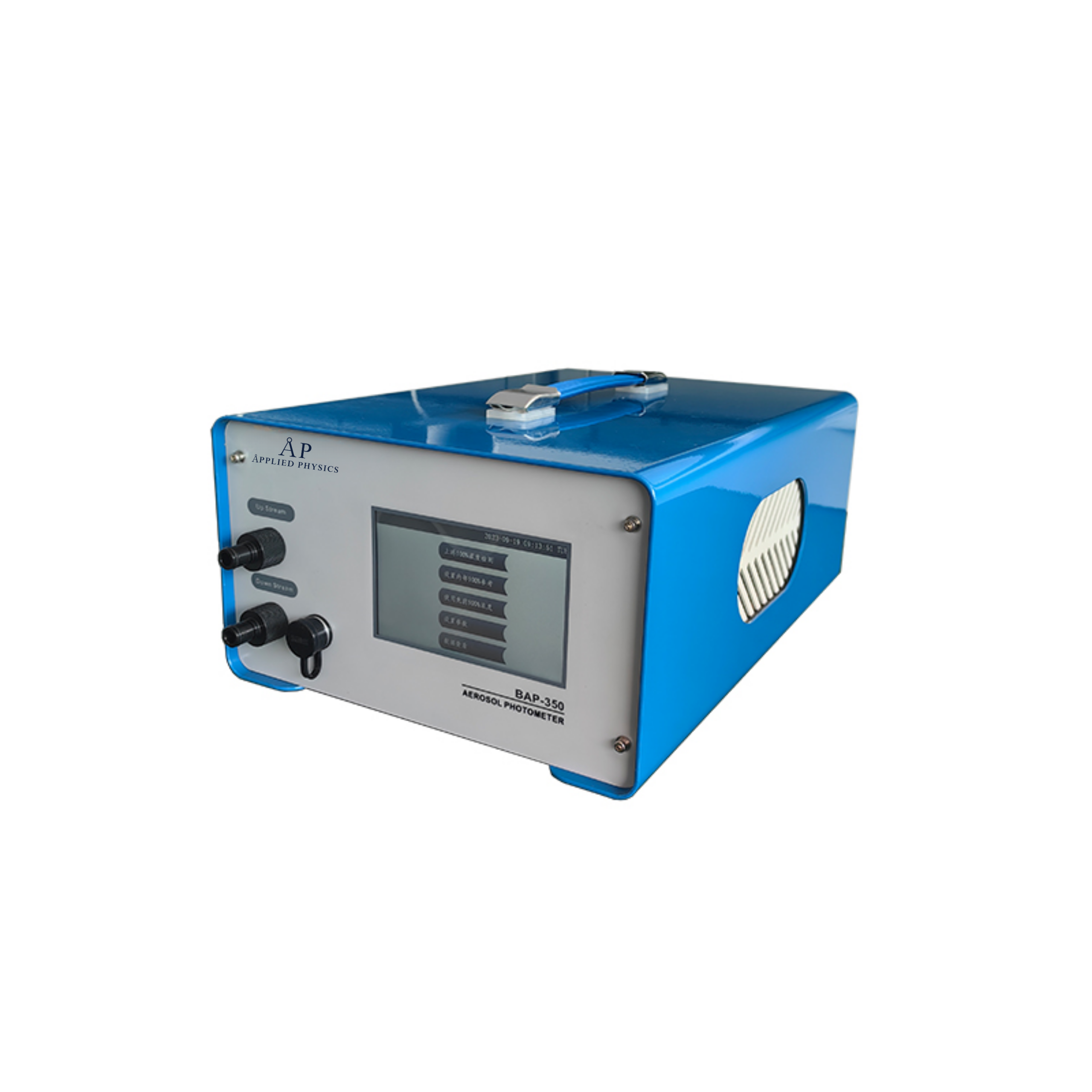
Aerosol Photometer BAP-350
GMP compliance in a cleanroom is fundamentally a human performance problem. Equipment fails predictably; people drift. A network of compounding pharmacies achieved full USP compliance by strengthening cleanroom monitoring, personnel training, and contamination control protocols, according to Trinity Consultants’ featured projects.
Gowning qualification must be documented per person, per gowning level. Auditors watch whether staff actually follow the sequence they were trained on, including glove changes, sleeve checks, and sticky mat discipline.
Watch Out The most common personnel finding is a qualified operator skipping a gowning step under production pressure. One missed glove change can trigger a full environmental monitoring review and delay your audit close-out.
Cleanroom airflow visualization testing is the practice of using visible fog or tracer particles to confirm that air moves through a space exactly as your design drawings and validation documents claim. It is one of the fastest ways to prove airflow control during an audit.
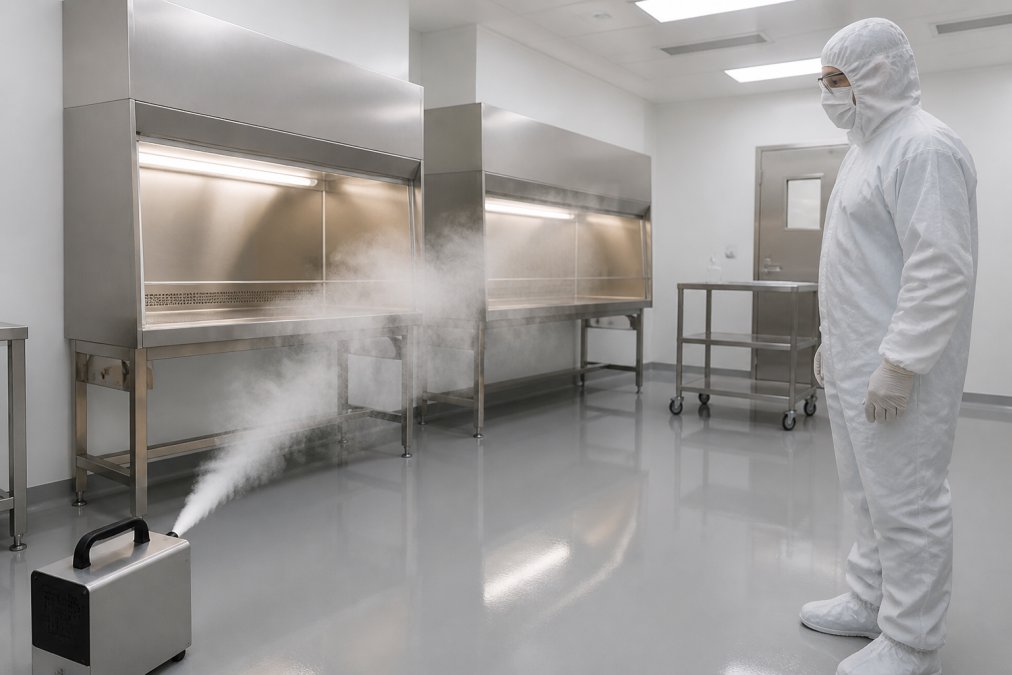
A cleanroom technician in full gowning observes airflow patterns from a fogger inside an ISO Class 7 cleanroom, with laminar flow hoods and stainless steel surfaces visible in the background
Applied Physics has supplied LN2 ultrapure and ultrasonic cleanroom foggers since 1992 specifically for this purpose. What most guides miss is that fog quality matters: non-neutral fog output can itself disturb the airflow you are trying to document, producing misleading results and a red flag during GMP audits.
Contamination control strategies should tie every monitoring point to a documented risk. Environmental monitoring covers airborne particulates, microbial counts, pressure differentials, temperature, and humidity, and each parameter needs a defined action limit. The depth most guides miss is in the mechanics: how sampling locations are justified, how excursions are handled, and how the data connects to corrective and preventive action.
Every monitoring point should trace back to a written risk assessment. The standard approach is to map the facility by contamination risk, then place sample locations where product, personnel, and airflow converge. Typical categories:
If an auditor asks why a location is sampled at a given frequency, the answer should be a document, not a habit.
Alert limits and action limits are not the same number. Alert limits signal a drift that warrants investigation; action limits trigger a formal response. Set alert limits below action limits so you have time to investigate before a non-conformance occurs. Limits should be based on your own historical data and the applicable ISO 14644 classification, not copied from another facility’s SOP.
Pro Tip Set your alert limits below your action limits, not equal to them. That gap gives you time to investigate a drift before it becomes a non-conformance.
When a monitoring result exceeds an action limit, the response should follow a documented sequence: immediate notification, containment of affected product or area, investigation of root cause, impact assessment, and corrective action. Auditors will pull a recent excursion and ask to see the full record. The facilities that pass are the ones whose excursion records show a real investigation, not a one-line note that says “re-sampled, within limits.”
Point-in-time results are not enough. Auditors expect periodic trend review that looks across rooms, shifts, and seasons to detect gradual drift. Trend reports should be dated, signed, and linked to any resulting actions. This is also where digital audit trails matter: an electronic monitoring system that time-stamps every reading, records the operator, and prevents after-the-fact edits gives an auditor a defensible record. Paper logs cannot demonstrate that a value was not changed after the fact, which is why remote and virtual auditors increasingly request electronic exports.
The Kanomax Cleanroom Monitoring System (CRMS) from Applied Physics continuously monitors airborne particle counts, differential pressure, temperature, and humidity, and supports compliance with ISO 14644, GMP, and USP requirements. For microbial monitoring under ISO 14698-1 protocols, the Microbial Air Sampler 3080 Series draws air at a stable 100 L/min with ±2.5% accuracy.
Every excursion, trend, or repeat finding should feed the CAPA system. A monitoring program that generates data but never generates corrective actions is a red flag on its own. The connection is straightforward: an excursion triggers an investigation, the investigation identifies a root cause, and the CAPA closes the loop with objective evidence. When an auditor asks how your monitoring program drives improvement, the CAPA log is the answer.
Key Takeaway Monitoring data that never becomes a corrective action is a finding waiting to happen. Auditors read your CAPA log as proof that the monitoring program is alive.
Digital audit trail management is the practice of maintaining tamper-evident, time-stamped electronic records of every monitoring event, calibration, and personnel action so auditors can reconstruct exactly what happened and when. Remote and virtual audits have made this a competitive advantage rather than a nice-to-have.
Paper logs fail remote audits. Electronic systems with role-based access, secure user authentication, and exportable CSV records let a remote auditor pull data without a site visit. The Microbial Air Sampler 3080 Series, for example, stores up to 10,000 measurement records in CSV format and supports USB and RS-485 communications, which means your data is audit-ready the moment it is generated.
Audit red flags cluster around three areas: records that do not match reality, equipment that is out of calibration, and behavior that contradicts written procedures.
Key Takeaway Auditors do not fail facilities for finding problems. They fail facilities for problems that were never documented, investigated, or corrected.
Post-audit CAPA planning is where most facilities lose the goodwill they earned during the inspection. A corrective and preventive action plan must address root cause, not just the symptom, and every action needs an owner, a due date, and objective evidence of completion.
Separate corrections from corrective actions. Replacing a failed HEPA filter is a correction. Investigating why the filter failed early, and updating your maintenance schedule as a result, is a corrective action. Preventive actions then extend that fix across similar equipment or processes before the same failure recurs.
Passing a cleanroom compliance audit comes down to proving control across airflow, documentation, personnel behavior, and monitoring data, and most facilities have at least one weak link. Applied Physics has supported cleanroom, semiconductor, and healthcare operations since 1992 with precision contamination control and airflow visualization tools built for exactly this work, including cleanroom foggers, the Kanomax CRMS monitoring system, and the Aerosol Photometer BAP-350 for HEPA validation. Contact Applied Physics to get your facility audit-ready with equipment your auditors can trust.
The most frequent failures involve incomplete documentation, inadequate personnel training records, and airflow or pressure differential issues. Auditors in 2026 are specifically prioritizing gowning procedures, sticky mat use, ESD protocols, and chemical management according to MTE Solutions. Portable vacuum cleaners are a common red flag because exhaust can disrupt airflow and particle counts during GMP audits. Facilities that treat documentation as a primary audit requirement rather than an afterthought pass more consistently, per Cleanetics 2025 industry analysis.
Airflow visualization testing shows auditors that your cleanroom maintains unidirectional flow and proper pressure differentials. Cleanroom Technology identified airflow and pressure management as one of four critical pillars for 2025 compliance. When a fogger reveals turbulence, dead zones, or non-neutral output, auditors flag it as a contamination control risk. Applied Physics provides LN2 ultrapure and ultrasonic cleanroom foggers that generate visible airflow patterns without introducing particles, helping facilities demonstrate compliance during ISO 14644 and GMP inspections.
Cleanroom certification is a technical test confirming your facility meets ISO 14644 cleanliness classification limits, including particulate count, HEPA filter integrity, and air change rates. A compliance audit is broader: it reviews documentation, standard operating procedures, personnel training, environmental monitoring records, and corrective action history against GMP or USP requirements. A CDMO working with Performance Validation in 2024 developed a testing package that validated cleanroom areas against both ISO 14644 and EU Annex 1 standards, illustrating how certification data feeds into the larger compliance audit.
ISO 14644 cleanroom standards recommend recertification every 6 to 12 months depending on your cleanliness classification and industry. USP 797 requires compounding pharmacies to recertify sterile compounding areas every 6 months. GMP facilities typically undergo internal audits annually with regulatory inspections on a 2 to 3-year cycle. The 2026 Internal Audit Collective benchmarking survey found that 47% of corporate audit plans now focus on compliance, reflecting increased scrutiny. Between formal audits, continuous environmental monitoring systems like the Kanomax CRMS help maintain audit-ready documentation.

Enter your details below to save your shopping cart for later. And, who knows, maybe we will even send you a sweet discount code :)
Allow notifications to get real-time updates about your shopping cart and who knows, you may even receive a sweet discount code 😊