
Enclosed wall-mounted UV air sterilizers operate on an internal flow-through principle.
An enclosed unit draws room air through an internal UV treatment zone and returns treated air. The reduction in viable microorganisms depends on the delivered UV dose and operating conditions; this process does not establish sterile exhaust or sterile room air.
A fan circulates air through the unit. BIOBASE describes filtration of dust particles above 5 µm for the BKZII-B models; this is not a HEPA rating or a demonstrated fine-aerosol removal efficiency. Confirm the supplied filter configuration rather than assuming every model includes activated carbon.
Dust on lamps or other optical surfaces can reduce the UV delivered to the air. Follow the unit’s approved inspection and cleaning procedure; do not assume that every model has a quartz sleeve or that visible cleanliness verifies UV output.
The lamps irradiate air inside the treatment zone. Conventional low-pressure mercury germicidal lamps emit mainly near 254 nm; confirm the wavelength, lamp specification and assembly supplied with the exact model.
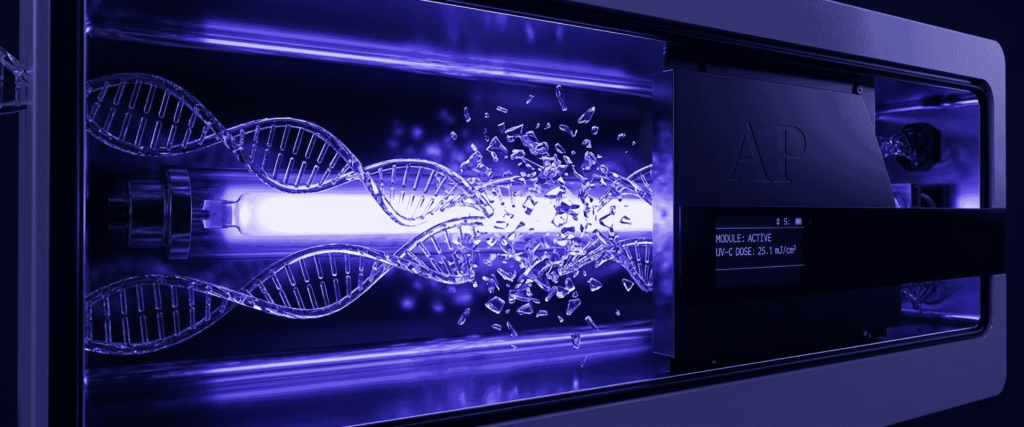
UV-C can damage microbial genetic material and prevent replication. Susceptibility varies among microorganisms, and effectiveness depends on dose and exposure conditions. Do not assume the same treatment inactivates every bacterium, virus or fungal spore.
The unit returns treated air to the room. UV inactivation does not itself remove particles, allergens or chemical pollutants from that air.
An ion-generation specification is not a clean-air delivery rating or proof of clinical benefit. EPA notes that ionizers can deposit particles on room surfaces, where they may be resuspended, and can produce ozone as a byproduct. Confirm the exact unit’s configuration and emissions.
Use in occupied rooms requires manufacturer instructions that cover the intended application, correct installation and a documented assessment of accessible UV exposure and emissions for the supplied configuration. An enclosure alone does not establish safety for continuous use around staff or patients.
Assess UV exposure, ozone and other relevant emissions, electrical and service hazards, noise, and the room’s airflow requirements. This is not an exhaustive commissioning checklist; use the exact device instructions and the facility’s safety and infection-control assessment.
Unprotected UV-C exposure can cause painful eye injury, including photokeratitis, and skin burns. Avoid direct exposure and never look into an operating UV source.
Have a qualified assessor evaluate UV irradiance at accessible eye and skin positions, using the source spectrum, exposure duration and the applicable current exposure limits. A catalogue leakage value without measurement distance, direction and test conditions cannot establish occupant exposure or safe continuous operation.
For the installed unit, confirm the following:
Ozone is a severe respiratory irritant that can trigger asthma, reduce lung function, and damage mucosal linings. In air treatment equipment:
Noise can affect whether staff keep a unit running at the intended setting. Assess noise and air-cleaning performance together; lowering fan speed or changing the schedule can change the treatment delivered.
BIOBASE lists ≤55 dB(A) for these models. Treat this as a manufacturer specification, not a universal patient-room or laboratory noise limit. Confirm the measurement conditions and assess the installed unit at the settings needed for the application.
The table summarizes BIOBASE’s published BKZII-B specifications, not an independent performance or safety assessment. Request the test organism, exposure time, airflow, room or chamber conditions and measurement methods behind efficacy and leakage claims. Published room volumes and percentages alone do not establish clinical effectiveness.
Technical Parameter | Model: BKZII-B-800 | Model: BKZII-B-1000 | Model: BKZII-B-1200 |
Manufacturer-listed room volume (confirm intended use) | ≤80 m³ | ≤100 m³ | ≤120 m³ |
Manufacturer-listed circulation flow (not clean-air delivery) | ≥800 m³/h | ≥1000 m³/h | ≥1200 m³/h |
Manufacturer-reported S. albus reduction | ≥99.9%; test protocol not supplied | ≥99.9%; test protocol not supplied | ≥99.9%; test protocol not supplied |
Manufacturer-reported natural-bacteria reduction | ≥90%; test protocol not supplied | ≥90%; test protocol not supplied | ≥90%; test protocol not supplied |
Manufacturer-reported UV leakage (test geometry unconfirmed) | ≤1 µW/cm² | ≤3 µW/cm² | ≤1 µW/cm² |
Ozone emission data | Confirm unit and test method; public listing uses mg/cm³ | Confirm unit and test method; public listing uses mg/cm³ | Confirm unit and test method; public listing uses mg/cm³ |
Manufacturer-listed noise level (confirm test conditions) | ≤55 dB(A) | ≤55 dB(A) | ≤55 dB(A) |
Filtration description (not HEPA certification) | Dust particles above 5 µm; confirm supplied elements | Dust particles above 5 µm; confirm supplied elements | Dust particles above 5 µm; confirm supplied elements |
Manufacturer-listed power (not measured routine consumption) | ≤180 W | ≤235 W | ≤300 W |
Manufacturer-listed negative-ion output (not a removal rating) | ≥5 × 10⁶ PCS/cm³; confirm configuration | ≥5 × 10⁶ PCS/cm³; confirm configuration | ≥5 × 10⁶ PCS/cm³; confirm configuration |
Manufacturer-rated lamp life (not a verified alarm setpoint) | ≥5,000 hours | ≥5,000 hours | ≥5,000 hours |
Dividing circulation flow by room volume gives a nominal recirculation rate. Equivalent clean air changes per hour require a documented effective clean-air delivery rate for the target contaminant and operating conditions; gross fan flow alone is insufficient.

For example, using 800 m³/h and a room volume of 80 m³ gives 800 ÷ 80 = 10 nominal recirculation air changes per hour. This arithmetic does not establish 10 equivalent clean ACH.

Actual reduction depends on treatment effectiveness, the selected setting and room air distribution. Recirculating air treatment supplements required ventilation and infection-control measures; it does not demonstrate compliance with hospital ventilation, outdoor-air or pressure requirements.
Assess placement with the manufacturer’s installation instructions and the room’s airflow pattern. Avoid short-circuiting of treated outlet air back into the intake and unintended transport of air from one occupant toward another.
UV-C output can decline with lamp age or fouling even while a lamp still operates. Maintenance should address lamp output, cleanliness and airflow according to the unit’s instructions.
Visible glow does not verify germicidal UV output or delivered dose. Use only the specified indicators and authorized checks; do not open the unit or look at an operating lamp to judge its condition.
An enclosed UV air cleaner may provide supplemental microbial reduction when its performance, installation and use are suitable for the application. It does not create a sterile occupied room.
Before occupied use, confirm the exact unit’s instructions, accessible UV exposure and emissions data. The public BKZII-B leakage entries alone do not establish safety, and the ozone units require manufacturer clarification.
Select and maintain the unit using documented air-cleaning performance, room conditions and the facility’s risk assessment. Do not equate the 10 nominal recirculation ACH calculation with verified equivalent clean air delivery or replace required ventilation measures.
Only where the exact device is intended for occupied use and its installation, operation, accessible UV exposure and emissions have been assessed for that application. An enclosure or the listed 1–3 µW/cm² leakage figures alone cannot establish safety for staff and patients. Do not operate with damaged shielding or outside the manufacturer’s instructions.
The public listing does not establish a verified safe ozone concentration. Its ozone values use mg/cm³, which must be clarified rather than silently changed to mg/m³. Confirm the exact unit’s lamp and any ion-generation components, emissions test and applicable requirements. A nominal 254 nm rating does not prove zero ozone.
BIOBASE lists a lamp life of ≥5,000 hours, run-time accumulation and maintenance prompts. Follow the exact model’s instructions for lamp checks and replacement, filter care and any alarm settings. Confirm the fitted filter elements; the public listing does not establish a universal carbon filter or replacement interval. Isolate the unit as instructed before authorized maintenance.
APPLIED PHYSICS TECHNICAL RESOURCE
Pathology workflow, containment, sterilization, biological safety and clinical-laboratory equipment selection. Product and standards references should be interpreted for the actual instrument, facility, protocol and configuration.

Enter your details below to save your shopping cart for later. And, who knows, maybe we will even send you a sweet discount code :)
Allow notifications to get real-time updates about your shopping cart and who knows, you may even receive a sweet discount code 😊