Cleanroom environments, such as those in semiconductor manufacturing and pharmaceutical production, require extremely precise airflow mapping without introducing any contamination.
Our AP35 Ultrapure Fogger handles this exact requirement.
The system operates using Liquid Nitrogen (LN2) and high‑purity water, generating a highly dense, neutrally buoyant fog.
This allows facilities to perform full 3D airflow modeling, identify dead zones, and verify cleanroom dynamics, all while leaving zero residue behind.
Technical Mechanics of the AP35 Ultrapure Fogger
High-Density Output and Visual Distance
The system vaporizes LN2 and combines it with heated Deionized (DI), Sterile, or Water for Injection (WFI). The resulting reaction produces 5.5 cubic meters of fog per minute.
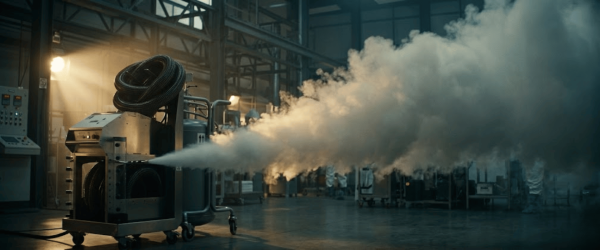
Because the AP35 operates with a continuous fog density of 571 ml per minute, operators gain 20 to 30 feet of visual airflow. The resulting fog droplets measure 2-3 microns in diameter, allowing them to float neutrally within the existing air stream rather than dropping to the floor.
Zero-Residue Evaporation
Standard foggers often rely on glycol or ultrasonic methods that can leave films or particulate matter on cleanroom surfaces. The AP35 runs strictly on LN2 and pure water.
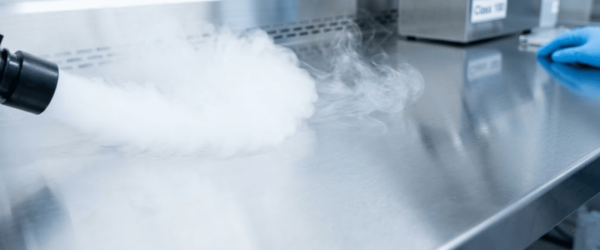
Once the fog dissipates, it reverts completely to natural air components: nitrogen, oxygen, and hydrogen. Facility managers do not need to pause production or schedule equipment cleanup after conducting smoke studies.
Regulatory Compliance for Cleanrooms
Airflow visualization requires strict adherence to international testing guidelines. The high-purity output of the AP35 supports direct compliance.
- USP 797 In-Situ Airflow Analysis
- ISO 14644-3, Annex B7
- Federal Standards 209E
- ISO Standards 14644-1 and 14644-2
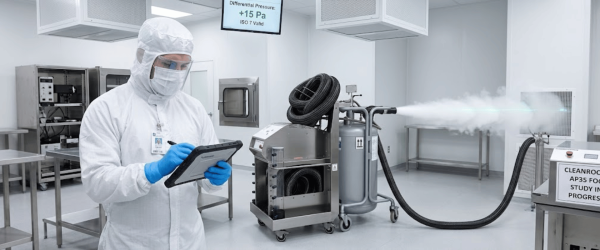
By providing uninterrupted, dense smoke studies, auditors and facility engineers can track air infiltration, balance air pressure across ISO suites, and accurately document airflow direction via standard video recording.
Key Specifications and Performance Data
The hardware is designed for extended testing cycles across large facilities. Below is a breakdown of the core operational metrics for the AP35 system.
| System Specification | Performance Metric |
|---|---|
| Fog Volume | 5.5+ cubic meters per minute |
| Fog Density | 571 ml per minute |
| Visual Airflow Distance | 20 to 30 feet |
| Continuous Operation Time | ≈ 70 minutes |
| Total Liquid Capacity | 40 liters (35 L LN2 + 5 L DI/WFI water) |
| Base Construction | 316L electro‑polished stainless steel |
| Mobility | Rolling stainless‑steel frame (trolley) with wheel casters |
Practical Applications in Regulated Industries
Semiconductor Manufacturing
Semiconductor fabs operate Class 1 to 10,000 cleanrooms, where a single standing vortex can introduce particles to sensitive wafers.
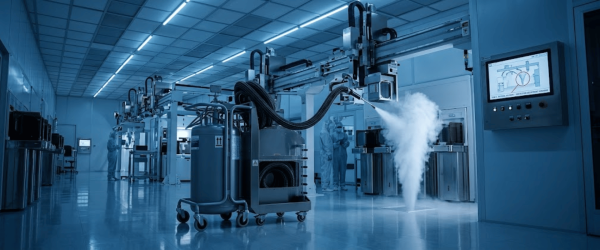
The AP35 visually highlights these vortices, allowing engineers to correct ventilation issues near automated wafer transport systems, tool enclosures, and personnel entryways.
Pharmaceutical ISO Suites and Medical Rooms
Barrier isolators and sterile compounding rooms rely on balanced airflow to prevent biological contamination.
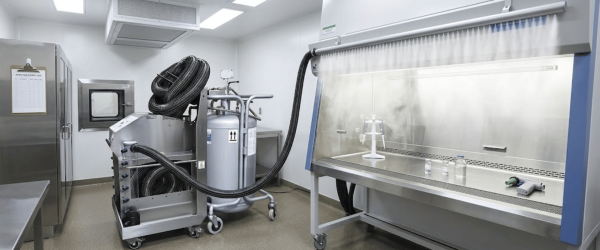
The dual 80mm fog outputs of the AP35 spread a wide curtain of vapor across biosafety cabinets. This makes it easy to map turbulence over workbenches without halting long-term sterile processes.
System Configuration and Controls
The AP35 ships in a modular rolling stainless steel cart, keeping the power and liquid systems consolidated. Operators manage fog volume and velocity via manual flow valves or an optional wireless remote control.
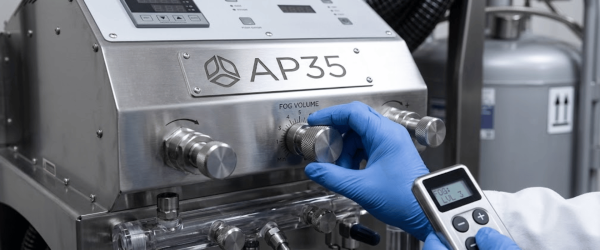
To sustain performance over the full 70-minute testing window, the system includes built-in LN2 flow controls that prevent valve freezing.
Conclusion
The AP35 Ultrapure Fogger provides a high-volume, contamination-free solution for critical airflow mapping in sterile environments.
Its ability to generate dense, neutrally buoyant fog ensures full compliance with international standards without risking surface residue.
This system remains an essential tool for facility managers prioritizing precision and long-term production uptime.
Frequently Asked Questions (FAQs)
1. How long does the AP35 operate on a single fill?
The system provides approximately 70 minutes of continuous, high-density fog. This duration allows technicians to conduct thorough 3D airflow mapping across large cleanroom suites without needing to stop for refills.
2. Is the fog safe for sensitive electronic equipment?
Yes, the AP35 uses only Liquid Nitrogen and purified water (DI or WFI). Because the fog reverts to natural air components upon evaporation, it leaves no film or particulate matter on semiconductor wafers or sensitive laboratory hardware.
3. What fluids are required for standard operation?
The unit requires 35 liters of Liquid Nitrogen (LN2) and 5 liters of high-purity water. The combination of these two elements creates the ultrapure vapor necessary for ISO Class 1 through Class 10,000 environments.
4. Can the fog output be adjusted during a smoke study?
Operators can control both the fog volume and velocity using manual flow valves or an optional wireless remote. This flexibility is vital when switching between testing small biosafety cabinets and large open-floor cleanroom areas.