
Decontaminating a compact isolator with Vaporized Hydrogen Peroxide is routine; scaling that protocol past 100,000 cubic feet is where engineering teams hit a wall.
Extended pre-dehumidification cycles, condensation risks on critical electronics, and massive multi-generator costs turn large-scale VHP deployment into an operational bottleneck.
Sub-micron dry fogging changes this dynamic entirely, using 7.5-micron non-wetting droplets that disperse like a gas to treat massive production halls without surface pooling.
Here is how Dry Fog and VHP compare when facility downtime, utility infrastructure, and 6-log sporicidal validation are on the line.
Understanding the Physical Mechanisms: Dry Fog vs. VHP
The primary distinction between Dry Fog and VHP lies in how the chemical agent transitions from the liquid reservoir into the room atmosphere.
How VHP Works
VHP systems vaporize concentrated hydrogen peroxide (typically 30% to 35% liquid $\text{H}_2\text{O}_2$) by flashing it over a heated element.
The resulting gas is injected into the target area, circulated, held for a specified dwell time, and then passed through catalytic converters to break the peroxide down into oxygen and water vapor.
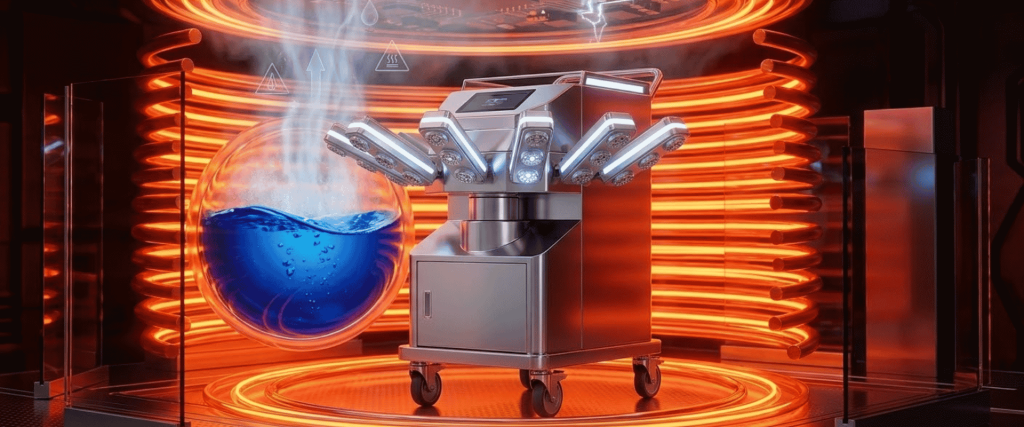
Because VHP functions as a true gas, it distributes effectively inside sealed, restricted volumes. However, maintaining true vapor phase requires tight environmental control.
If the relative humidity (RH) in the room rises to the dew point, the peroxide vapor rapidly condenses onto surfaces.
Micro-condensation can accelerate material degradation, corrode unpassivated metals, and trigger short circuits in active equipment.
Consequently, VHP cycles require an extensive pre-dehumidification phase to drive room RH down (often below 30–40%) before chemical injection can begin.
How Dry Fog Works
Sub-micron dry fogging systems, such as the DF4S DryFog Decontamination Fogger, use high-velocity compressed air to shear liquid sterilant mechanically, typically stabilized peracetic acid (PAA) and hydrogen peroxide solutions, into uniform aerosol droplets averaging 7.5 microns in diameter.

At 7.5 microns, the physical behavior of the droplet changes fundamentally:
- Brownian Motion: The mass of the droplet is small enough that ambient air currents keep it suspended, preventing rapid gravitational settling.
- Elastic Collisions: When these micro-droplets contact walls, process vessels, or cleanroom workstations, surface tension causes them to bounce off rather than rupture and pool into liquid film.
- Rapid Evaporation: The high surface-area-to-mass ratio allows the droplets to vaporize quickly into the air, permeating hard-to-reach dead zones without creating wet spots or puddles.
Because dry fogging does not require boiling a liquid, it does not mandate aggressive pre-dehumidification cycles before deployment.
Operational Considerations: Utilities, Cycle Times, and Aeration
Facility downtime directly affects production yield. When planning a bio-decontamination cycle, three phases must be calculated: conditioning/injection, dwell time, and aeration.
1) Pre-Conditioning and Dwell
- VHP: Requires significant time to pull moisture out of the air before injection can start. If the air is too humid, the chemical capacity of the air volume is constrained, prolonging the cycle.
- DF4S Dry Fog: Injection begins immediately at ambient cleanroom conditions. The fine 7.5-micron droplets disperse through the volume within minutes, holding biocidal concentrations uniformly across both horizontal and vertical planes.

2) Aeration and Re-Entry
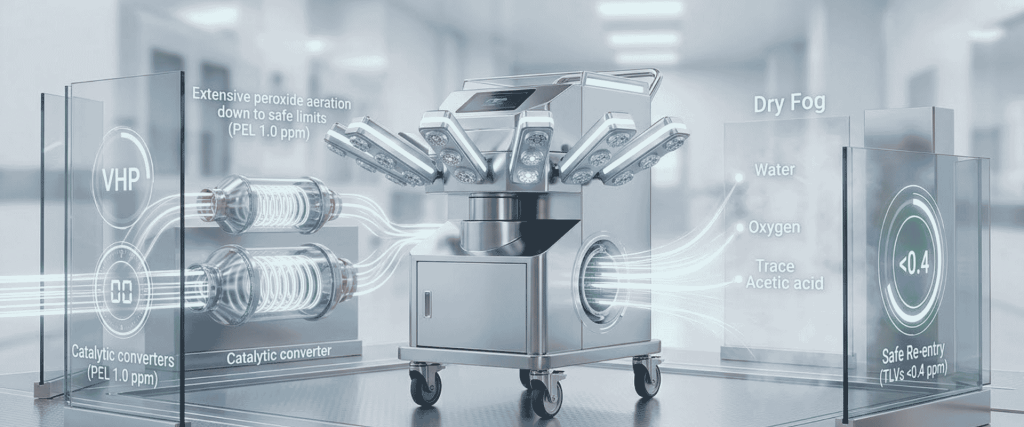
- VHP: Decomposes into water and oxygen. Aeration down to the OSHA permissible exposure limit (PEL) of 1.0 ppm for $\text{H}_2\text{O}_2$ is accomplished via building exhaust or catalytic aeration units. However, $\text{H}_2\text{O}_2$ can desorb slowly from porous cleanroom materials (such as silicone seals and epoxy coatings), extending the tail end of the aeration cycle.
- DF4S Dry Fog: Chemical formulations utilizing stabilized peracetic acid and dilute hydrogen peroxide break down into water, oxygen, and trace acetic acid. Re-entry requires purging PAA down to threshold limit values (<0.4 ppm). While this requires adequate cleanroom air exchange rates (ACH) through normal HVAC purging, the absolute chemical quantity introduced per square foot is minimized due to high aerosol dispersion efficiency.
3) Utility Requirements
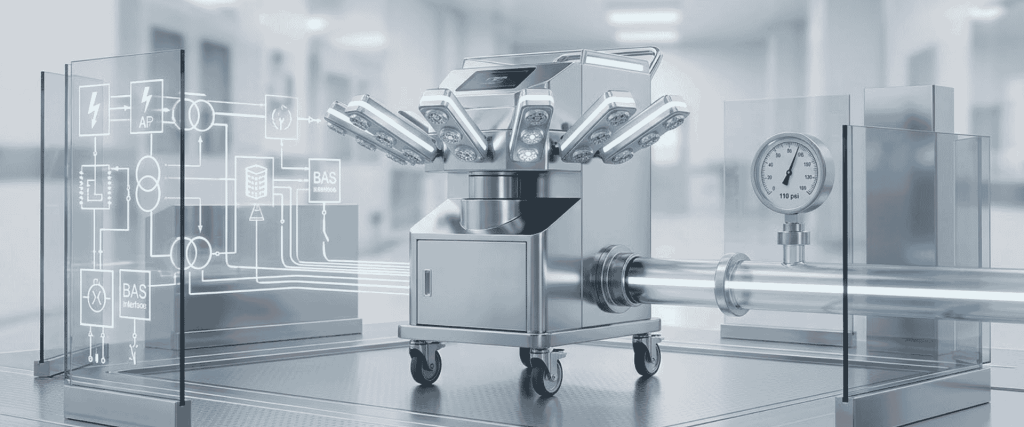
- VHP: Needs reliable electrical infrastructure and often ties into the building automation system (BAS) to control dedicated dampers and heaters.
- DF4S: Requires an industrial supply of clean, dry, oil-free compressed air capable of delivering sustained pressure at 110 psi. If a facility already has high-capacity plant air or portable oil-free compressor skids, setup is straightforward.
Scalability and Facility Footprint: The 100,000+ Cubic Feet Barrier
Scale is where the gap between these two technologies becomes most pronounced.
The Limits of VHP in Enormous Enclosures
VHP generators are mechanically complex. A single mobile VHP unit generally maxes out its effective coverage between 10,000 and 35,000 cubic feet.

To decontaminate an industrial production floor measuring 200,000 to 1,000,000 cubic feet, a facility must either:
- Purchase and synchronize multiple VHP generators operating in parallel, with running costs in the hundreds of thousands of dollars.
- Hard-pipe the VHP supply directly into the facility’s central HVAC ductwork, which requires specialized duct materials, automated isolation dampers, and rigorous balancing to avoid condensation within supply trunks.
How the DF4S Solves Large-Scale Delivery
The DF4S DryFog system was specifically engineered for large footprints, scaling from 100,000 up to 3,000,000 cubic feet in a single integrated operational framework.
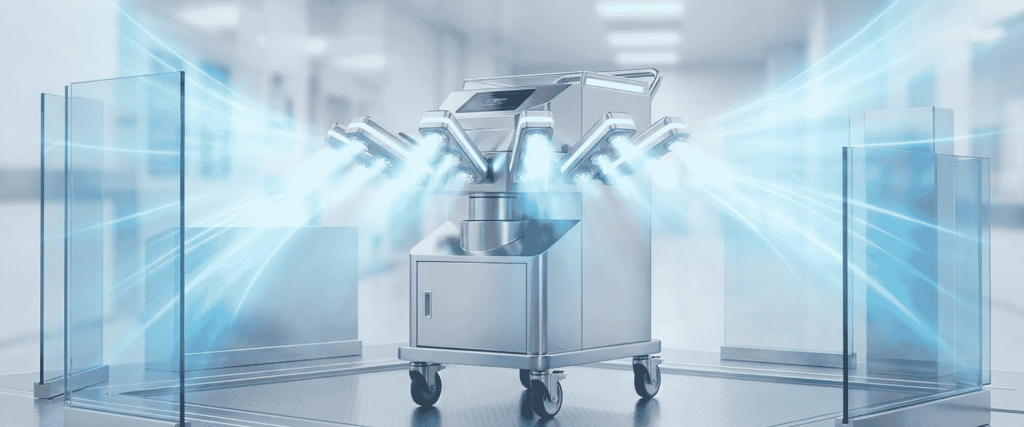
Constructed from 316L electro-polished stainless steel, the DF4S relies on an array of high-output atomizing nozzles driven by dry, oil-free compressed air (60 to 250 SCFM at ~110 psi). Instead of relying on heat, the system drives immense volumetric flow rates, filling large processing halls evenly.
With options for automated reservoir replenishment, continuous cycle execution, and remote wireless control, operators can treat massive facilities from central staging areas without entering the active chemical zone.
Technical Comparison: Dry Fog vs. VHP
The table below outlines key engineering, operational, and capital parameters:
| Engineering Parameter | Traditional VHP Systems | DF4S DryFog System |
| Primary Mechanism | Thermal flash vaporization ($\text{H}_2\text{O}_2$ gas) | Pneumatic cold atomization (7.5 µm dry aerosol) |
| Typical Working Volume | 5,000 – 35,000 cu. ft. per generator | 100,000 – 3,000,000 cu. ft. |
| Pre-Conditioning Phase | Required (dehumidify to 30–40% RH) | Minimal (tolerates standard ambient RH) |
| Capital Equipment Cost | High to Very High ($$$$) \vert{} Moderate ($$) | |
| Utility Dependencies | Dedicated high-amperage power, HVAC integration | Clean, dry compressed air (60–250 SCFM at 110 psi) |
| Surface Wetting Risk | Moderate (if dew point is crossed during dwell) | Low (droplets bounce due to surface tension) |
| Chemical Delivery Agents | Concentrated $\text{H}_2\text{O}_2$ (typically 35%) | EPA-registered sterilants (e.g., PAA / $\text{H}_2\text{O}_2$ blends) |
| Maintenance Profile | Complex (heating elements, vapor sensors, blowers) | Low (nozzles, passive fluid paths, no heating parts) |
| Regulatory Validation | 6-log reduction (G. stearothermophilus) | 6-log reduction (G. stearothermophilus) |
Validation and Compliance: Achieving 6-Log Bioburden Reduction
Regulatory compliance under USP <1072> (Disinfectants and Antiseptics) and EU GMP Annex 1 requires consistent, documented microbial reduction regardless of the delivery method.
Biological Indicator (BI) Challenges
Both technologies are evaluated using Geobacillus stearothermophilus biological indicators (typically $10^6$ spore populations).
In spaces with complex architectural layouts, such as mezzanines, return air plenums, and dense process piping, standard VHP flow paths can produce shadow zones where gas velocity drops, leading to incomplete kill rates on shadowed BIs.
Because the DF4S releases billions of micro-droplets that float on room air currents via Brownian motion, the fog acts much like a natural gas, spreading evenly into low-flow areas and dead corners.
When operated with appropriate biocides, dry fogging consistently delivers a 6-log sporicidal kill (>99.9999%), meeting the requirements for aseptic processing areas and biosafety facilities.
Which System Should You Choose for Your Facility?
Select VHP When
- The space is small and modular: Isolators, restricted access barrier systems (RABS), pass-through boxes, and rooms under 15,000 cu. ft. are well-suited for standard VHP units.
- Exhaust air is completely closed-loop: You have dedicated catalytic converters built into your ventilation circuits and cannot exhaust air outdoors.
- Your facility SOP strictly dictates $\text{H}_2\text{O}_2$ vapor only: Some legacy regulatory filings lock facilities into specific VHP parameters.
Select DF4S Dry Fog When
- You are treating large footprints: Cleanroom suites, warehouse-scale facilities, and processing halls from 100,000 to 3,000,000 cu. ft.
- Capital expenditure matters: You need an enterprise-scale solution without spending hundreds of thousands of dollars on multiple networked vapor generators.
- Fast deployment is essential: You need a mobile, 316L stainless steel cart system that connects to house compressed air without requiring major ductwork modifications.
- Moisture sensitivity is high: You require rapid aerosol evaporation that will not cause surface pooling, condensation, or corrosion on electronic housings and analytical balances.
Conclusion
Both VHP and Dry Fog are effective, validated methods for facility bio-decontamination.
However, when cleanroom operations scale past the 100,000 cubic foot threshold, standard VHP systems become complex and cost-prohibitive.
The DF4S DryFog Decontamination Fogger bridges this gap.
By combining cold pneumatic atomization, non-wetting 7.5-micron droplet physics, and high-volume output, it delivers 6-log sporicidal decontamination across massive facilities without the high capital investment, long pre-dehumidification cycles, or condensation hazards of traditional vapor systems.
Frequently Asked Questions (FAQs)
1. Does dry fog cause surface wetting or condensation on electronics?
No. The DF4S produces droplets averaging 7.5 microns in size. Droplets this small bounce off surfaces due to surface tension rather than bursting. They evaporate rapidly into the surrounding air, avoiding the liquid condensation and pooling associated with ordinary sprayers or oversaturated vapor cycles.
2. What compressed air specifications are required to operate the DF4S?
The DF4S requires clean, dry, oil-free compressed air delivering between 60 and 250 SCFM at approximately 110 psi, depending on the nozzle configuration. Using instrument-grade air prevents contamination of cleanroom HEPA filter networks.
3. Can dry fogging achieve a full 6-log sporicidal reduction?
Yes. When paired with EPA-registered sporicides (such as Minncare or hydrogen peroxide formulations), the DF4S validates to a 6-log ($>99.9999\%$) kill rate against resistant bacterial endospores like Geobacillus stearothermophilus, satisfying USP <1072> and GMP standards.