
Last Updated: September 29, 2026
The best cleanroom fogger for GMP is an essential tool for validating airflow patterns in controlled manufacturing environments. Without them, you cannot verify that your facility meets the regulatory standards you claim to follow. A failed airflow validation during an FDA inspection can shut down production, trigger product recalls, or result in significant regulatory penalties.
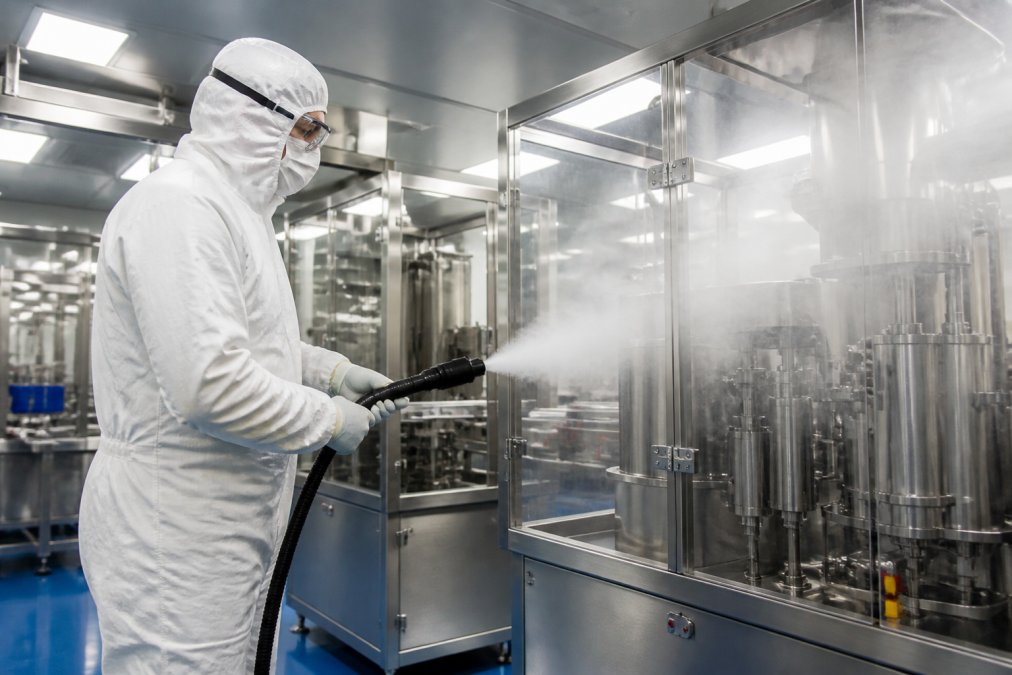
Cleanroom technician in full protective gear conducting a smoke study with a handheld fogger wand, observing fog patterns in a pharmaceutical manufacturing cleanroom with bright overhead lighting
The cleanroom technology market is valued at USD 5.42 billion in 2026, reflecting the critical importance of contamination control across pharmaceutical, semiconductor, and biotech industries, according to Coherent Market Insights 2026 market analysis. GMP regulations require documented evidence that your facility maintains proper airflow patterns. A smoke study using the right fogger provides exactly that evidence.
Key Takeaway Cleanroom foggers enable airflow visualization smoke studies, which are the primary method for validating contamination control in GMP-regulated manufacturing environments.
A smoke study is a validation procedure that visualizes airflow patterns using fog particles. The fog must meet specific technical requirements to produce reliable results. The choice of fogger depends on your specific application: isolators, RABS (Restricted Access Barrier Systems), or biosafety cabinets, according to Applied Physics Cleanroom Fogger Buying Guide.
Most facility managers compare foggers based on cubic meters per minute alone, ignoring critical factors like particle size distribution, residue potential, and whether the fog will reach the areas you need to test. Fog particle size directly impacts study validity. Ultrapure LN₂ systems deliver droplets in the 2 to 8 micron range, while ultrasonic cleanroom fogger systems produce a mass median diameter between 5 and 10 microns, according to Applied Physics technical specifications (2024). These size ranges are specifically chosen because they visualize airflow patterns without contaminating your environment or settling too quickly.
Watch Out Using the wrong fog medium (glycol-based instead of ultrapure water) can leave residue that contaminates your cleanroom and triggers re-validation requirements. The industry has shifted decisively toward residue-free, ultrapure water fogging for GMP environments.
Airflow visualization smoke studies are critical for verifying airflow patterns and maintaining compliance in controlled environments, according to GMP Insiders Airflow Visualization Report. The primary standards governing cleanroom airflow validation are ISO 14644-3 and USP 797. ISO 14644-3 defines the methodology for airflow visualization in cleanrooms. USP 797 applies specifically to sterile compounding pharmacies and sets stringent requirements for contamination control.
Federal Standard 209E, while superseded by ISO 14644, is still referenced in many legacy GMP requirements. Understanding which standard applies to your facility is the first step in selecting the right fogger. A fogger validated for ISO 14644-3 testing may not meet the specific requirements of USP 797 applications, particularly in smaller compounding environments.
The regulatory audit process typically includes a request to demonstrate that your facility maintains proper airflow patterns. This means you need documented evidence from a recent smoke study, preferably within the last 12 months. If your fogger doesn’t meet the standards applicable to your facility type, the audit fails.
The shift toward residue-free, ultrapure water fogging has become industry standard for GMP environments. Ultrapure water foggers eliminate the contamination risk associated with glycol-based systems while providing superior visibility for airflow validation.
Applied Physics offers both LN₂ ultrapure and ultrasonic systems, including the best cleanroom fogger for GMP compliance testing. The AP50 Ultrapure Cleanroom Fogger delivers consistent fog output, extended runtime, and residue-free performance, making it suitable for comprehensive facility validation studies. Ultrapure water fog doesn’t leave residue, doesn’t require special disposal procedures, and won’t trigger contamination alerts during your study.
Ultrasonic fogging technology uses high-frequency vibrations to atomize water into fine particles. For facilities with sensitive surfaces or tight spaces, ultrasonic systems offer advantages that high-pressure systems cannot match. The choice between LN₂ and ultrasonic depends on your facility geometry and application. Isolators and RABS systems often benefit from LN₂ systems’ higher output and denser fog visualization. Biosafety cabinets and tighter spaces may perform better with ultrasonic systems that produce less turbulence.
:::pro tip When selecting between ultrapure fogger technologies, test both systems in your actual cleanroom environment before committing. What works in one facility may not optimize results in another due to differences in airflow design, equipment placement, and contamination control priorities.
Understanding fogger specifications requires looking beyond marketing claims to actual performance metrics. The metrics that matter most are particle size distribution, fog output consistency, runtime, and residue potential.
Particle size distribution directly affects study validity. The ideal range for airflow visualization is 2 to 10 microns, which provides visible fog without settling too quickly or contaminating surfaces. Fog output consistency matters because uneven output can create false impressions of airflow patterns. A fogger that delivers 7 cubic meters per minute on startup but drops to 3 cubic meters after 20 minutes will produce misleading results. Applied Physics equipment is designed for consistent output throughout the runtime.
Runtime on a single fill determines how large an area you can test without refilling. Applied Physics equipment is designed for consistent output throughout the runtime. Residue potential is critical. Glycol-based systems leave visible residue that contaminates equipment and triggers re-validation requirements. Ultrapure water systems eliminate this risk entirely.
| Metric | Importance | Why It Matters |
|---|---|---|
| Particle size (2-10 microns) | Critical | Ensures visible fog without contamination |
| Output consistency | High | Prevents false airflow pattern readings |
| Runtime (45+ minutes) | High | Enables comprehensive facility testing |
| Residue potential | Critical | Avoids contamination and re-validation |
| Pressure stability | Medium | Maintains consistent fog delivery |
The selection process begins with understanding your specific application. A pharmaceutical manufacturing facility has different requirements than a semiconductor fab, which differs from a compounding pharmacy. Start by identifying which regulatory standards apply to your facility: ISO 14644-3 for general cleanrooms, USP 797 for compounding pharmacies, or both.
Next, map your cleanroom layout and identify the critical areas requiring airflow validation. Consider the physical constraints of your environment. Tight glove box spaces require smaller fogger units and flexible hose configurations. Large manufacturing floors need high-output systems capable of generating visible fog across extensive distances. The Support Rod/Arm Extender (80mm) from Applied Physics is designed to stabilize fog wands in elevated ceiling-level zones, removing the need for operators to hold equipment overhead during extended studies.
Operator experience matters. A fogger with intuitive controls and wireless remote capability reduces study variability. Applied Physics’s Wireless Remote Control allows adjustable control over fog volume, airflow velocity, and power, enabling operators to optimize fog delivery without physically repositioning equipment.
Key Takeaway Fogger selection should be based on your specific smoke-study route and application environment rather than generic output numbers. A fogger optimized for your facility’s geometry will produce more reliable results than a higher-output system that doesn’t match your specific needs.
Cleanroom foggers require regular maintenance to ensure consistent performance and regulatory compliance. Maintenance frequency depends on usage intensity, but most facilities should implement monthly inspections and quarterly deep cleaning.
The maintenance cycle includes checking fog output consistency, inspecting hoses for damage or residue buildup, and verifying that pressure regulators function properly. Regular cleaning prevents residue degradation. For ultrapure water systems, flushing with distilled water after each use extends component life and prevents mineral buildup.
Calibration is distinct from routine maintenance and carries direct regulatory weight. ISO 14644-3 requires that fog output be verified before each validation study. This verification typically involves measuring fog delivery rate at the hose outlet using a calibrated anemometer or flow meter and comparing results to the equipment’s original performance data.
The baseline specification becomes your control point. If your AP50 originally delivered 7.1 cubic meters per minute at standard pressure, subsequent studies must confirm output remains within 10 percent of that baseline (6.4 to 7.8 cubic meters per minute). Output drift beyond this tolerance indicates the fogger requires professional recalibration or component replacement.
USP 797 facilities face stricter timelines. Compounding pharmacies must document airflow validation annually, which means your fogger must be recalibrated at least once per year to maintain audit compliance. Many facilities recalibrate every six months to build a safety margin.
Recertification is the formal validation that your entire smoke study methodology, equipment, procedure, operator training, and documentation, meets regulatory standards. This typically occurs annually for GMP facilities.
During recertification, auditors review calibration records for the fogger, maintenance logs showing routine inspections and cleaning, operator training documentation, smoke study reports from the past 12 months, and any equipment modifications or repairs performed since the last recertification. A single missing calibration record can trigger a failed recertification audit. The FDA expects to see evidence that your fogger was validated before each study.
Ultrapure water systems have lower consumable costs than glycol-based systems. Component replacement costs should be factored into your budget. Hoses, nozzles, and pressure regulators typically require replacement every 18-24 months depending on usage.
:::pro tip Maintain a separate equipment file for each fogger containing purchase date, baseline calibration data, maintenance records, and all service reports. This file becomes your evidence of compliance during regulatory audits. Digital records with timestamps are preferable to paper logs.
Monthly inspections should include visual inspection of all hose connections for leaks or corrosion, pressure gauge verification, nozzle spray pattern observation, and fog medium level check. Quarterly deep cleaning involves disassembling nozzles and pressure regulators, flushing all internal passages with distilled water, and inspecting seals for degradation.
Fogger operation presents specific safety considerations that must be addressed through training and documented procedures. Water-based fog is non-toxic, but prolonged inhalation in high concentrations can cause respiratory irritation. Operators should wear appropriate respiratory protection during extended studies, particularly in confined spaces like isolators or RABS.
Pressure systems in high-output foggers operate at significant pressures. Hose connections, regulators, and nozzles must be inspected regularly for leaks or damage. A hose rupture under pressure can create safety hazards. Training programs should cover proper equipment setup, safe operation procedures, emergency shutdown, and cleanup protocols. Documentation of operator training is required during regulatory audits.
Foggers occasionally fail to perform as expected during validation studies. Understanding common failure modes and their root causes helps you diagnose problems quickly and minimize study delays.
Reduced fog output is the most common issue and can stem from multiple causes. Step 1: Verify fog medium level. Check the reservoir or tank. If depleted, refill with ultrapure water. Step 2: Check pressure gauge readings. Normal operating pressure for most ultrapure systems is 40-60 PSI. If the gauge reads below 30 PSI, pressure loss is occurring. Step 3: Inspect hose connections for leaks. Listen for hissing sounds near the pressure regulator, hose connections, and nozzle assembly. Tighten all fittings by hand. Step 4: Examine nozzles for blockage. Mineral deposits or residue can accumulate in nozzle orifices, restricting flow. Remove the nozzle assembly and hold it up to light. If openings appear cloudy or partially blocked, soak the nozzle in distilled water for 30 minutes. Step 5: Verify pressure regulator function. If pressure gauge reads normal but fog output is still low, the regulator may be stuck or partially closed. Slowly turn the adjustment screw counterclockwise to increase pressure setting. Do not exceed the equipment’s maximum rated pressure.
Watch Out Never apply excessive force when tightening hose connections or adjusting pressure regulators. Over-tightening can strip threads or crack plastic components. If a connection won’t tighten by hand, the fitting is likely damaged and should be replaced.
Uneven fog distribution indicates pressure loss somewhere in the system. Common causes include kinked or crushed hoses, hose length exceeding design specifications, multiple nozzles on a single system, and pressure regulator set too low. Trace the entire hose path from the fogger to the nozzle and straighten any kinks. Most foggers are designed for hose runs up to 50 feet. If you’re using a splitter to run two nozzles from one fogger, pressure at each nozzle is reduced by approximately 30 percent. For comprehensive facility studies, using two separate foggers is more effective than splitting one fogger’s output.
Fog that disappears within seconds of exiting the nozzle suggests particle size is outside the optimal 2-10 micron range. Causes include contaminated fog medium, nozzle wear or damage, ultrasonic transducer degradation, and pressure setting too high. Replace the fog medium with fresh ultrapure water from a sealed container. If fog dissipation improves after nozzle replacement, the original nozzle was the cause. For ultrasonic foggers, the piezoelectric transducer can lose efficiency over time and may require replacement.
A fogger that won’t power on requires systematic troubleshooting. Check electrical power supply. Verify that the outlet is functioning by plugging in another device. Verify safety interlocks. Common interlocks include pressure relief valve stuck in open position, fog medium reservoir empty or not properly seated, pressure regulator in the “off” position, and thermal overload protection activated. Check pressure relief valve function. Some foggers have a manual pressure relief valve that must be in the “closed” position for normal operation.
Watch Out Never attempt to force a fogger to operate if it’s exhibiting safety-related failures. A pressure relief valve that’s stuck closed or a pressure regulator that’s malfunctioning can create dangerous conditions. Stop operation immediately and perform a complete safety inspection before resuming use.
A pressure gauge that bounces or fluctuates significantly during operation indicates instability in the pressure system. Slight fluctuations (±5 PSI) are normal, but larger swings suggest a problem. Causes include air in the pressure line, regulator diaphragm failure, and worn pressure relief valve. If the system was recently refilled or serviced, air pockets can become trapped in hoses or the pressure regulator. Bleed air from the system by slowly opening the nozzle valve without activating the fog trigger.
If fog is leaving visible residue or deposits on cleanroom surfaces, the fog medium is contaminated or you’re using the wrong medium type. Verify you’re using ultrapure water, not glycol-based medium. Check the fog medium container label. If glycol-based medium was used, flush the entire system with distilled water and refill with ultrapure water. Replace contaminated ultrapure water. Even ultrapure water can accumulate particles if stored improperly. Reduce fog concentration. If you’re using correct medium but still see light residue, reduce the pressure setting or shorten the fog duration.
After completing a smoke study, perform a final check: (1) Flush the system. Run distilled water through the nozzle for 30 seconds to clear any residual fog medium. (2) Check for leaks. With the system pressurized but the fog trigger off, inspect all connections for moisture or drips. (3) Document performance. Record the fog output rate, pressure readings, and any issues encountered. (4) Store properly. Empty the fog medium reservoir if the fogger won’t be used for more than one week.
The right cleanroom fogger for GMP compliance isn’t about choosing the highest output or the lowest price. It’s about selecting equipment that matches your specific regulatory requirements, facility geometry, and operational constraints. Applied Physics has been serving cleanroom, semiconductor, and healthcare industries since 1992 with precision equipment designed for validation and compliance. Our cleanroom foggers deliver consistent fog output, extended runtime, and residue-free performance, supporting the specifications GMP-regulated facilities require. Contact Applied Physics today to discuss which fogger system best fits your facility’s smoke study requirements and regulatory obligations.
GMP-compliant cleanroom foggers must meet ISO 14644-3 and USP 797 standards for airflow visualization. The fog must be non-toxic and residue-free to prevent contamination. Output volume alone does not determine compliance; pressure, hose losses, and smoke-study route geometry are critical factors.
Ultrapure water foggers produce residue-free fog ideal for sterile manufacturing. Unlike glycol-based systems, ultrapure foggers eliminate contamination risk and comply with pharmaceutical manufacturing standards. The AP50 Ultrapure Cleanroom Fogger enables high-density visualization across cleanroom areas without leaving residue.
Regulatory guidance requires validation during initial cleanroom certification and after any system modification, maintenance, or repair. Most facilities conduct annual or semi-annual recertification to maintain GMP compliance. Validation frequency depends on your facility’s risk profile: high-containment areas (ISO 5 or lower) may require more frequent validation than lower-grade spaces. USP 797 and ISO 14644-3 standards mandate documented airflow verification as part of the cleanroom’s ongoing qualification program. Your Quality Assurance team should establish a recertification schedule aligned with your regulatory audit requirements and facility risk assessment.
Inconsistent fog output typically stems from pressure loss in hose assemblies, water contamination, or nozzle blockage. First, inspect the hose for kinks or damage and verify that the inlet water meets purity standards. Check the nozzle or atomizer for particulate buildup and clean or replace it if necessary. Confirm that your equipment’s pressure regulator is set correctly for your specific smoke-study route and cleanroom geometry. If problems persist, recalibrate the fogger according to the manufacturer’s specifications and document all troubleshooting steps for your regulatory file. Equipment that cannot maintain consistent output should be removed from service until repaired or replaced.

Enter your details below to save your shopping cart for later. And, who knows, maybe we will even send you a sweet discount code :)
Allow notifications to get real-time updates about your shopping cart and who knows, you may even receive a sweet discount code 😊