
Last Updated: October 28, 2026
Quick Summary
A cleanroom fogger RFQ should describe your intended airflow-visualization application and the equipment documentation you need. Include study area, access, runtime, utilities, training and supplier confirmation. Distinguish equipment specifications and documentation from facility qualification: fog visualization alone does not certify filtration performance or particle classification.
- A cleanroom fogger shows airflow direction, turbulence and dead zones but does not certify filtration or particle classification.
- Decide which zones to observe and whether fog stays neutrally buoyant long enough to trace laminar flow.
- Ask suppliers how fog density is adjusted and what fog outlet and hose configuration looks like.
- Request relevant equipment certificates and documentation; have your qualified facility team define study acceptance criteria. Confirm commercial terms and equipment availability with the supplier.
Table of Contents
- What a Cleanroom Fogger Is Used For (and What It Is Not)
- Cleanroom Airflow Visualization: Questions to Ask Before You Buy
- Building Your Cleanroom Fogger RFQ Checklist
- Frequently Asked Questions
What a Cleanroom Fogger Is Used For (and What It Is Not)
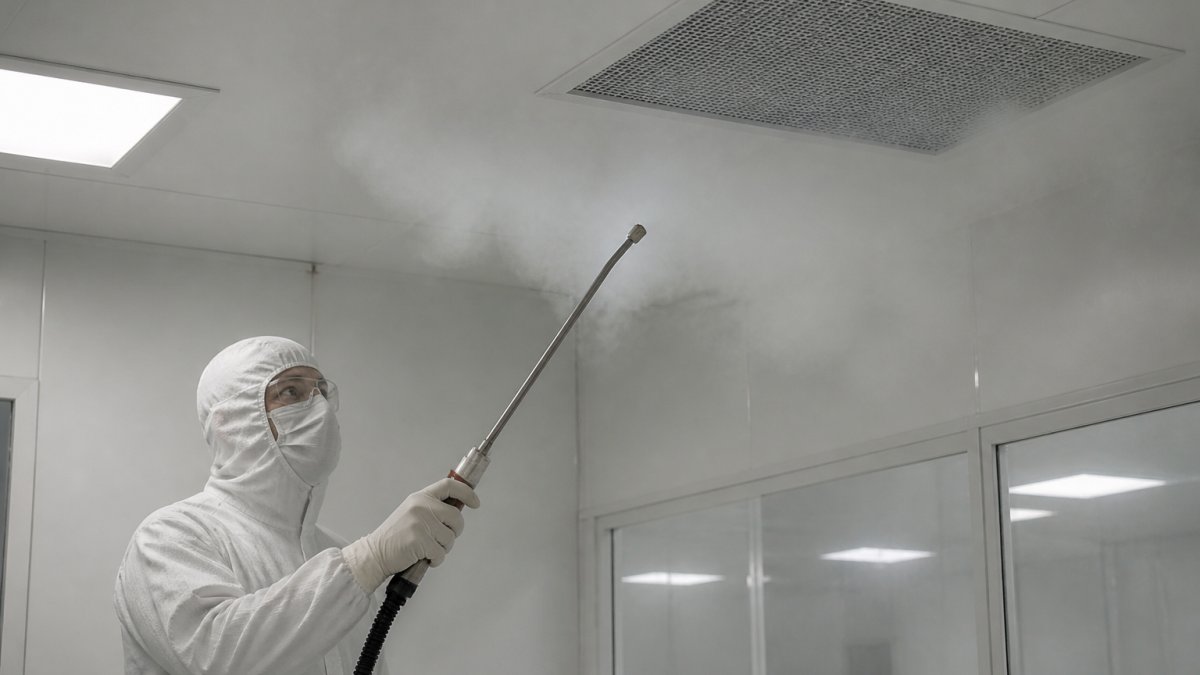
A cleanroom fogger generates visible, controlled fog so you can watch how air moves through a critical environment. It is a qualitative visualization tool: the fog shows direction, turbulence, and dead zones, but does not certify filtration performance or particle classification.
When drafting a cleanroom fogger RFQ, describe the observations and documentation you need. Request relevant equipment certificates and specifications, while keeping equipment documentation distinct from the facility qualification process.
Specify equipment intended for your airflow-visualization application rather than assuming that a disinfection or pesticide fogger is interchangeable.
Cleanroom Airflow Visualization: Questions to Ask Before You Buy
Before you buy, identify the zones to observe, access constraints and required operating time. Ask how fog density is adjusted, what outlet and hose configuration is proposed, and which technology suits your application. Consult the Applied Physics AP Series overview and request manufacturer confirmation for your study conditions.
Ask the manufacturer to explain fog behavior and performance limitations under your study conditions rather than assuming one visibility distance or behavior applies to every environment.
Building Your Cleanroom Fogger RFQ Checklist
A cleanroom fogger RFQ checklist should cover application, study area, access, runtime, utilities, documentation, training and supplier confirmation. Ask what power and utilities the proposed unit needs and what documentation is available. Confirm availability, lead time, warranty, freight and payment terms in the quotation.
Keep documentation scopes clear: Request applicable equipment certificates and documentation. Have your qualified facility team define the study protocol, acceptance criteria and any additional tests; fog visualization alone is not a facility compliance certificate.
|
RFQ Item |
Question to Ask |
Why It Matters |
|---|---|---|
|
Application |
Which zones and airflow patterns need visualizing? |
Defines scope |
|
Study area |
What room volume and access points exist? |
Sizes the unit |
|
Utilities |
What power and connections are required? |
Avoids setup delays |
Frequently Asked Questions
What information should I include in a cleanroom fogger RFQ?
Cover your application and study area, room dimensions and access points, available utilities, expected runtime, and the documentation and training you need. Ask the supplier to confirm what they can and cannot provide rather than assuming. Include whether the fog will be used only for qualitative airflow visualization, so the supplier frames their answers correctly.
Can fog visualization certify cleanroom filtration or particle classification?
No. A cleanroom fogger makes airflow patterns visible for visual inspection and smoke studies, but the output is qualitative. It does not certify HEPA filtration performance, particle counts, or ISO classification. Treat fog images as one input to your airflow review, not as a compliance certificate. Ask suppliers to describe what their equipment shows and to avoid implying certification.
What utilities and access details should I confirm with a cleanroom fogger supplier?
Ask the manufacturer to confirm power, consumables, handling requirements and suitable accessories for the proposed configuration. Provide doorway and pass-through dimensions, available floor space and access constraints. Follow the manufacturer’s operating instructions and your site’s safety procedures.
If your team is preparing an RFQ and wants a neutral conversation about which cleanroom fogger configuration fits your study areas, contact Applied Physics. We can walk through fog volume, utilities, and documentation questions so your specification reflects what you actually need to observe.