
Achieving accurate results in industrial inspection requires sharp visual differentiation between target reference particles and background substrates.
Translucent or standard white polymer calibration beads frequently blend into complex surfaces, resulting in operator fatigue, missed flaws, and compromised quality control data.
Black-dyed uniform polymer microspheres solve this limitation by delivering deep, internal coloration that produces intense optical contrast across diverse testing environments.
The Limitations of Conventional Translucent Particles
Standard calibration and test particles are typically manufactured from clear or white polystyrene. While effective for specific automated optical sizing instruments, these particles present significant challenges during manual visual inspection, flow tracing, or surface contamination analysis.
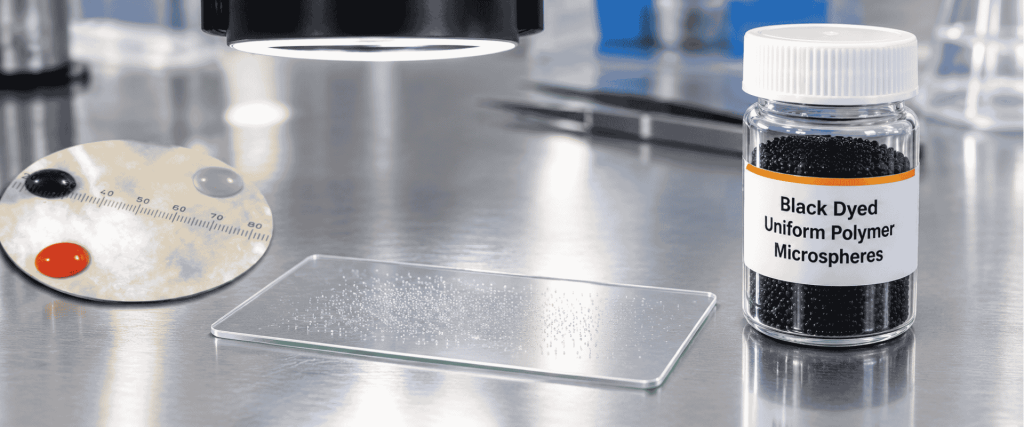
Under high-intensity lighting or reflective backgrounds, white microspheres lack the optical silhouette needed for rapid identification. Consequently, technicians face prolonged inspection cycles and higher error rates when verifying cleaning efficiency or filter retention.
Material Composition and Optical Properties
Constructed from cross-linked polystyrene divinylbenzene (PS-DVB) copolymer, black dyed microspheres maintain exceptional structural integrity compared to soft latex alternatives.
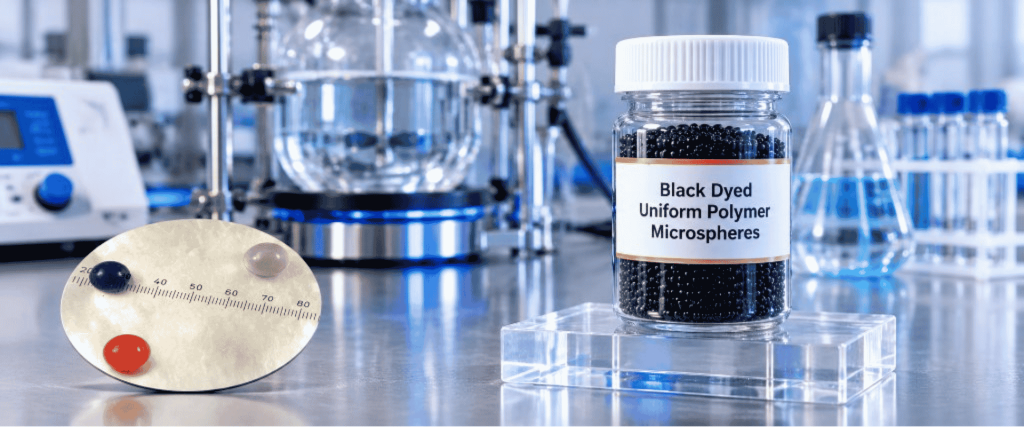
The internal dye encapsulation process ensures that the black pigmentation remains locked within the polymer matrix, preventing surface flaking or premature leaching during handling.
Uniformity and Particle Sizing Parameters
Reliable inspection standards demand predictable physical behavior. These microspheres are manufactured with a strict coefficient of variation, keeping particle size distribution under ten percent of the mean diameter.
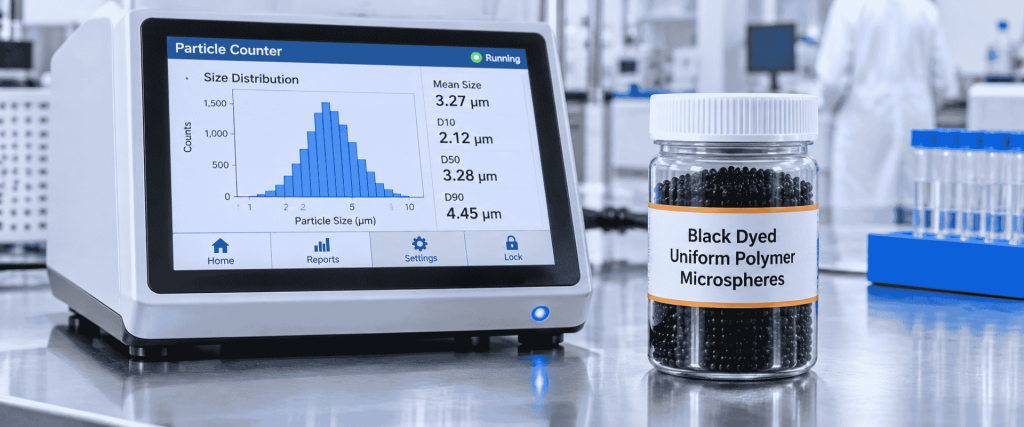
Available in nominal sizes spanning from 50 µm to 500 µm, each batch provides consistent volumetric mass and predictable settling rates, making them ideal for specialized mesh screening, filter validation, and fluid flow visualization.
Technical Specifications of Black Dyed Polystyrene DVB Microspheres
Review the physical and chemical parameters of dry black-dyed PS-DVB microspheres:
| Parameter | Specification |
| Material | Cross-linked Polystyrene Divinylbenzene (PS-DVB) |
| Color / Dye Type | Deep Black Internal Dye |
| Size Range | 50 µm to 500 µm (Nominal) |
| Particle Density | 1.05 g/cm³ |
| Refractive Index | 1.59 at 589 nm (25°C) |
| Size Uniformity | <10% Coefficient of Variation |
| Approximate Cell Count | ~1.5 x 10⁷ particles per gram |
| Form Factor | Dry Powder (1 g unit size) |
| Shelf Life Stability | Minimum 24 months at room temperature |
Preparation, Dispersion, and Solvent Compatibility
Dry-form microspheres require proper wetting agents to achieve a homogeneous suspension without particle clumping.

Because dry polymer particles naturally aggregate due to electrostatic forces, direct addition to water without preparation leads to uneven distribution.
Best Practices for Aqueous and Alcoholic Suspensions
Dispersing these particles successfully involves adding a trace amount of ionic or non-ionic surfactant to aqueous media to break surface tension.
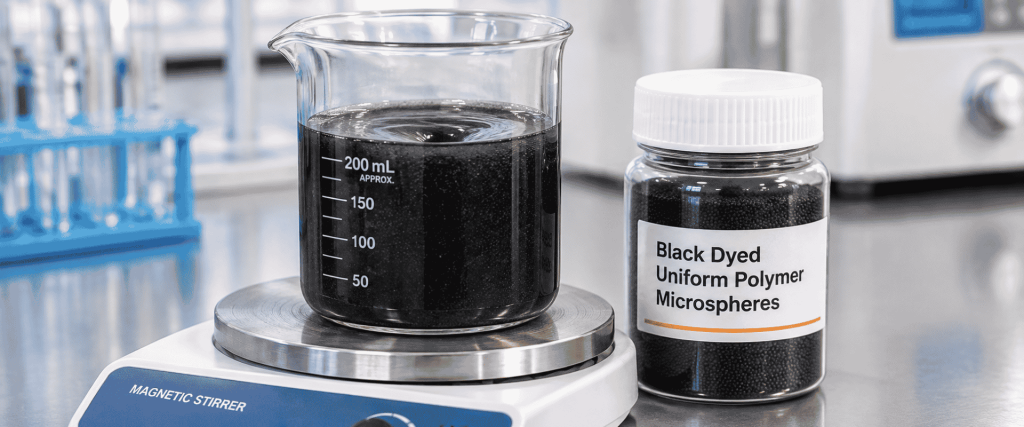
Alternatively, lower alcohols such as pure methanol or ethanol serve as effective suspension vehicles with minimal risk of dye extraction. Technicians must strictly avoid strong organic solvents, including ethers and chlorinated hydrocarbons, which cause the PS-DVB matrix to swell and permanently leach the internal dye.
Conclusion
Enhancing industrial quality control and visual inspection workflows depends on selecting reference materials that eliminate optical ambiguity.
Black-dyed polystyrene DVB microspheres deliver the high contrast, structural durability, and tight size uniformity required for demanding verification tasks.
Incorporating these specialized particles into inspection protocols ensures clearer data, reduced operator error, and higher confidence in contamination control standards.
For exact size configurations or technical documentation, request a direct quote through the Applied Physics USA product portfolio.
Frequently Asked Questions (FAQs)
1. What are black-dyed polystyrene DVB microspheres used for?
Black-dyed polystyrene DVB microspheres are used for industrial visual inspection, filter validation, mesh screening, fluid flow visualization, and contamination control. Their dark coloration provides strong optical contrast against light or reflective backgrounds.
2. What material are black-dyed polymer microspheres made from?
These microspheres are manufactured from cross-linked polystyrene divinylbenzene (PS-DVB) copolymer. This material provides structural durability and helps maintain particle integrity during handling and testing.
3. What particle sizes are available for black dyed PS-DVB microspheres?
Black-dyed PS-DVB microspheres are available in nominal sizes ranging from 50 µm to 500 µm. Their particle size distribution has a coefficient of variation below 10%, supporting consistent inspection and screening applications.
4. Why are black dyed microspheres better than translucent calibration particles for visual inspection?
Black dyed microspheres provide stronger visual contrast than translucent or white particles, making them easier to identify against complex or reflective surfaces. This improves manual inspection efficiency and helps reduce the risk of missed particles.