
Surface chemistry dictates whether a colloidal nanomaterial succeeds or fails during downstream functionalization.
Researchers and process engineers working with noble metal colloids frequently encounter stalled bioconjugation, blocked catalytic active sites, and irreversible particle clumping when attempting to replace strongly bound polymeric capping agents.
Selecting a weakly bound, electrostatically stabilized surface eliminates this bottleneck before assay development begins.
Our Supplies offers high-purity, monodisperse citrate-capped platinum nanoparticles (SKU: AP-PTC) across discrete diameters from 5 nm to 70 nm and scalable volumes from 1 mL research vials to 1 L production bottles.
Suspended in a 4 mM sodium citrate buffer, these nanomaterials provide the exact surface charge and labile ligand architecture required for rapid molecular displacement in biosensors, fuel cell catalysis, and diagnostic assays.
Why Polymeric Stabilizers Complicate Platinum Nanoparticle Functionalization
Many commercial platinum colloids rely on steric stabilizers such as polyvinylpyrrolidone (PVP), cetyltrimethylammonium bromide (CTAB), or polyethyleneimine (PEI) to prevent clumping during chemical reduction.
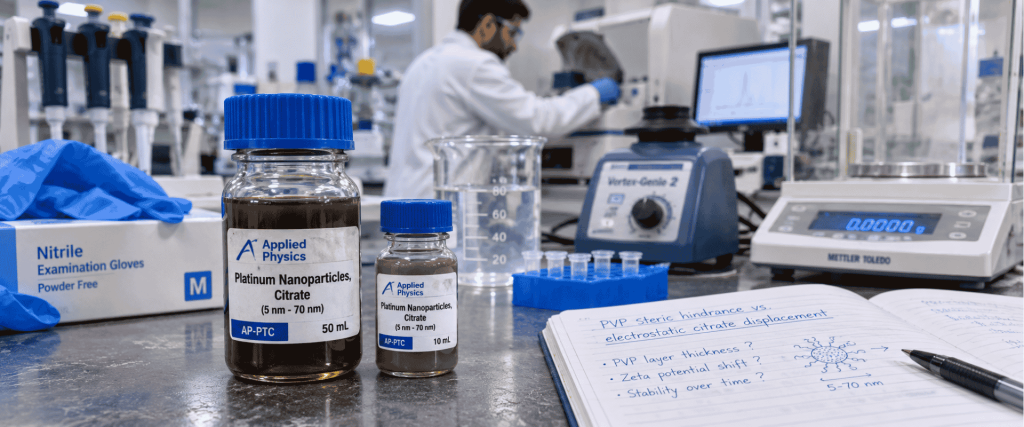
While steric polymers keep particles separated in storage, they create severe obstacles during application workflows:
- Steric Blocking of Catalytic Sites: Dense polymer chains wrap around the metallic core and block reactants from reaching the platinum crystal facets, reducing electrocatalytic current density and nanozyme activity.
- Incomplete Ligand Displacement: Removing high-molecular-weight PVP requires harsh thermal washing, acid treatment, or repeated ultracentrifugation steps that strip away yield and trigger irreversible core fusion.
- Slow Exchange Rates: Research on noble metal ligand exchange kinetics demonstrates that platinum surfaces operate under strong kinetic control. Once a high-affinity ligand or polymer occupies the platinum surface, subsequent displacement by unmodified DNA, antibodies, or catalytic substrates becomes slow and uneven.
How 4 mM Sodium Citrate Solves the Displacement Bottleneck
Citrate ions ($\text{C}_6\text{H}_5\text{O}_7^{3-}$) coordinate weakly to the platinum surface through carboxylate groups rather than forming permanent covalent or dense polymeric bonds. According to surface chemistry studies on citrate surface coverage, this low binding energy allows incoming molecules with higher affinity, such as thiolated oligonucleotides, antibodies, proteins, or aminated polymers, to displace the citrate layer rapidly at room temperature.
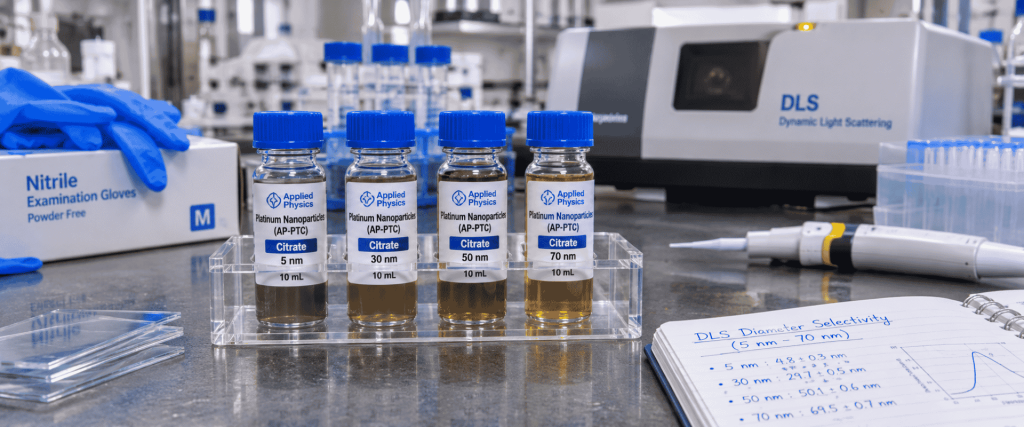
At the same time, the 4 mM sodium citrate solvent maintains a negative surface charge (zeta potential of -15 mV or more negative) across a controlled solution pH of 5.5 to 8.0. This electrostatic repulsion keeps individual particles separated prior to conjugation while contributing minimally to the hydrodynamic radius.
Technical Specifications of AP-PTC Citrate Platinum Nanoparticles
Reproducible ligand exchange requires predictable surface area per unit volume. Variations in particle diameter or broad polydispersity shift the total surface area available for biomolecule binding, causing batch-to-batch drift in lateral flow strips and electrochemical sensors. Reviewing established particle measurement standards helps laboratory teams align incoming nanomaterial specifications with internal quality assurance protocols.
| Parameter | AP-PTC Specification | Analytical Method | Primary Workflow Benefit |
| Core Diameter | 5 nm, 30 nm, 50 nm, 70 nm | TEM ($\pm$ 4 nm) | Matches catalytic or optical size needs |
| Monodispersity | CV within 15% | TEM Imaging | Consistent surface area per batch |
| Hydrodynamic Size | TEM diameter + 0 to 20 nm | DLS Analysis | Confirms absence of pre-aggregation |
| Zeta Potential | -15 mV or more negative | Electrophoretic Light Scattering | Electrostatic colloidal stability |
| Concentration Grades | 0.05 mg/mL and 1 mg/mL | Gravimetric / ICP | Supports screening and bulk production |
The table above outlines the core physical parameters verified on every batch-specific Certificate of Analysis (CoA). Keeping the Coefficient of Variation (CV) within 15% ensures that ligand-to-nanoparticle stoichiometry remains constant across production runs, while the narrow gap between TEM core diameter and DLS size distributions confirms that the citrate layer adds minimal hydrodynamic drag.
Selecting the Right Particle Size and Concentration Grade
Different downstream applications demand distinct surface-to-volume ratios and mass concentrations. Engineers consulting Applied Physics USA’s technical publications can match physical particle geometry directly to their analytical instrument or reaction vessel.
1) Diameter Selection: 5 nm vs. 30 nm, 50 nm, and 70 nm
- 5 nm Platinum Nanoparticles: Maximize specific surface area and corner/edge atom density. Ideal for proton exchange membrane (PEM) fuel cell catalyst inks, hydrogen evolution reactions, and high-turnover peroxidase-mimicking nanozyme assays. Teams working at this dimensional threshold can also reference sub-5nm particle detection methodologies to understand electron-beam and scattering behavior at the lower nanometer limit.
- 30 nm and 50 nm Platinum Nanoparticles: Balance catalytic surface activity with higher optical extinction and faster centrifugation recovery during washing steps. Widely used in antibody bioconjugation, colorimetric biosensors, and cellular uptake studies.
- 70 nm Platinum Nanoparticles: Provide strong optical contrast and scattering cross-sections for lateral flow immunoassays, Surface-Enhanced Raman Spectroscopy (SERS) substrates, and electron microscopy calibration alongside broader particle size standards.
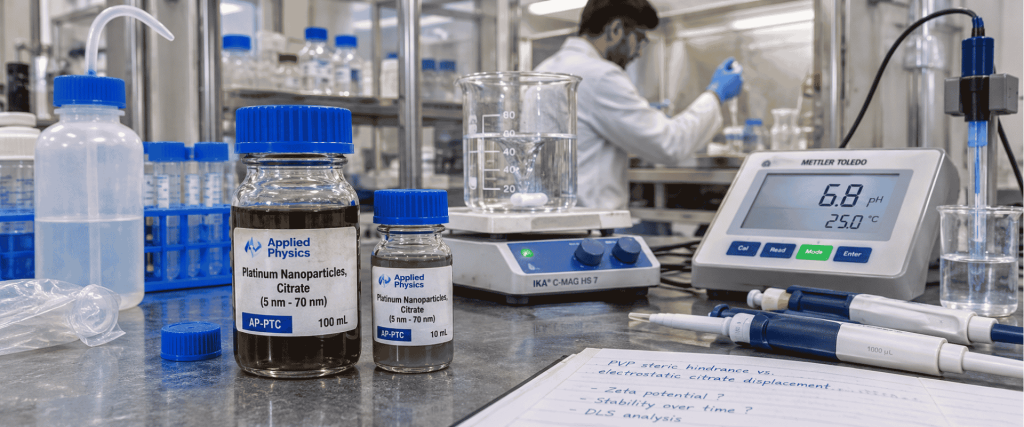
2) Concentration Grades: NanoXact (0.05 mg/mL) vs. BioPure (1 mg/mL)
- NanoXact Grade (0.05 mg/mL): Formulated for direct analytical screening, protocol optimization, and spectroscopy without requiring heavy dilution that could disrupt the 4 mM sodium citrate buffer equilibrium.
- BioPure Grade (1 mg/mL): High-concentration stock engineered for bioconjugation scale-up, catalyst coating deposition, and biological assays where minimal solvent volume and strict purity are required.
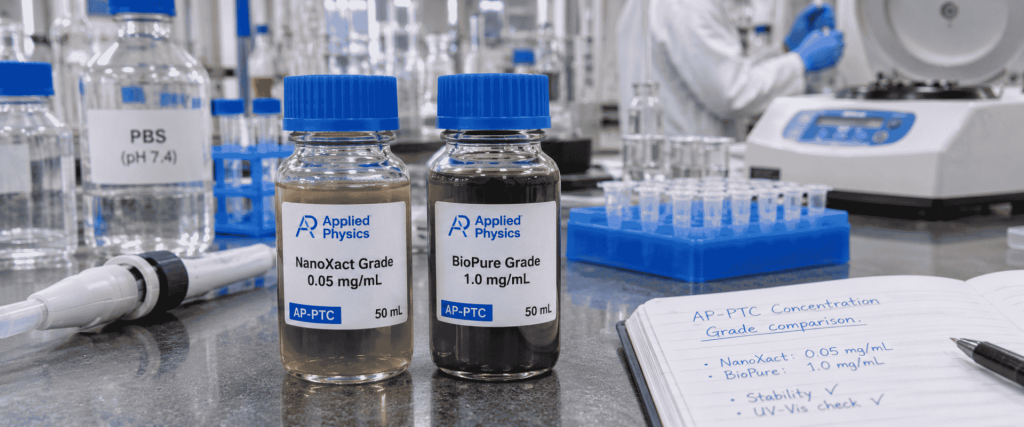
Best Practices to Prevent Aggregation During Ligand Exchange
Because citrate-stabilized platinum nanoparticles rely on electrostatic repulsion rather than steric bulk, introducing high concentrations of sodium chloride or divalent cations ($\text{Mg}^{2+}$, $\text{Ca}^{2+}$) before surface passivation screens the negative surface charge and triggers rapid precipitation. Follow these operational controls to maintain dispersion integrity:
- Pre-Condition in Low-Ionic-Strength Buffer: Perform initial antibody, protein, or thiol-DNA incubation in deionized water or low-salt buffer (less than 10 mM monovalent salt) within the 5.5 to 8.0 pH window.
- Verify Surface Charge Shifts: Monitor electrophoretic mobility against NIST zeta potential standards before and after ligand addition to confirm complete surface saturation.
- Backfill Unoccupied Sites: After primary antibody or aptamer attachment, introduce a secondary blocking agent such as thiolated polyethylene glycol (mPEG-SH) or bovine serum albumin (BSA) to impart steric stability prior to transferring the conjugate into physiological PBS buffer.
- Maintain Traceable Metrology: Cross-check hydrodynamic radius shifts via DLS after passivation, following the same verification discipline outlined in Applied Physics USA’s particle metrology guide.
Frequently Asked Questions (FAQs)
1. What are citrate-capped platinum nanoparticles used for?
Citrate-capped platinum nanoparticles are used in biosensors, fuel cell catalysis, diagnostic assays, nanozyme research, and antibody bioconjugation. Their weakly bound citrate coating allows researchers to replace surface ligands with functional molecules.
2. Why are citrate-capped platinum nanoparticles easier to functionalize than PVP-coated particles?
Citrate forms a relatively weak surface interaction compared with polymeric stabilizers such as PVP. This makes ligand displacement easier under suitable conditions, allowing DNA, antibodies, proteins, and other molecules to attach to the platinum surface.
3. What is the purpose of 4 mM sodium citrate in platinum nanoparticle suspensions?
The 4 mM sodium citrate buffer helps maintain a negatively charged particle surface and reduces aggregation through electrostatic repulsion. It also provides a relatively labile ligand layer that supports subsequent surface functionalization.
4. Which platinum nanoparticle size is best for catalytic applications?
The 5 nm platinum nanoparticles offer a higher specific surface area and greater surface atom availability, making them suitable for catalytic research and nanozyme assays. Larger sizes, including 30 nm, 50 nm, and 70 nm, support applications requiring different optical and recovery characteristics.