
Last Updated: August 8, 2026
Selecting the right cleanroom fogger for your pharmacy isn’t just about picking equipment, it’s about ensuring your facility meets USP 797 and GMP compliance standards while maintaining operational efficiency. A cleanroom fogger for pharmacies serves a critical function: visualizing airflow patterns to validate that your sterile compounding environment genuinely protects patient safety.
The difference between adequate and exceptional airflow visualization comes down to fog density, particle size, and how well the equipment integrates into your existing validation protocols. Some foggers leave residue that contaminates your cleanroom; others operate at volumes too low to reveal turbulence patterns in larger spaces. Applied Physics has been solving this problem since 1992, offering both ultrasonic and LN2-based solutions designed specifically for pharmaceutical validation workflows.
This comparison examines the specifications that actually matter: CFM output, fog particle diameter, run time, and compliance alignment. You’ll see why a cleanroom fogger for pharmacies requires different engineering than general-purpose smoke machines, and which technologies work best for different facility sizes.
| Equipment Type | Fog Output | Particle Size | Best For | Run Time |
|---|---|---|---|---|
| Applied Physics CRF2 Ultrasonic | 9 CFM | 8-10 microns | Small glove boxes, fume hoods | 50-60 minutes |
| Applied Physics AP35 LN2 Fogger | 177 CFM | 2-3 microns | Large ISO suites, sterile rooms | 75 minutes |
| Minncare Dry Fog System | Variable | 7.5 microns | Whole-room bio-decontamination | <3 hours |
Not every smoke machine is appropriate for pharmaceutical cleanrooms. The equipment you choose must generate fog that behaves predictably, leaves no residue, and provides visibility across the specific airflow patterns in your facility.
ISO 14644 defines cleanroom classifications by particle count per cubic meter. Your pharmacy’s ISO rating determines the fog density you need to visualize airflow effectively. An ISO 5 cleanroom (used for sterile compounding) requires fog that travels far enough to show laminar flow disruption and turbulence zones without leaving deposits on work surfaces.
Fog particle size directly affects visibility and behavior. Particles smaller than 5 microns remain suspended longer and reveal subtle airflow patterns. Particles larger than 10 microns settle quickly, limiting the distance you can observe. For pharmaceutical validation, the ideal range is 2-10 microns depending on whether you’re testing a small isolator or a large ISO suite.
Density matters equally. A fogger producing 177 CFM of ultrapure fog (like the AP35) can fill a 3,000-cubic-foot room in minutes, making turbulence visible throughout the space. A 9 CFM ultrasonic unit works perfectly for a 50-cubic-foot fume hood but won’t provide meaningful visualization in a 500-square-foot cleanroom.
Airflow visualization reveals what instruments cannot: the actual three-dimensional movement of air through your cleanroom. This is fundamentally different from particle counting, which tells you the result but not the mechanism.
When you release fog into a laminar-flow environment, it should move in straight lines toward the return air grilles. Deviation from this pattern indicates turbulence, dead zones, or recirculation, conditions that compromise sterility assurance. The fog acts as a tracer, showing you exactly where air stagnates or swirls unexpectedly.
Effective visualization requires fog that behaves like air itself. Ultrapure fog (generated from LN2 and DI water) is neutrally buoyant and doesn’t settle or rise, following actual airflow patterns. Water-based ultrasonic fog is slightly heavier and settles over time, useful for small-space testing but less reliable for large-area studies. Dry fog systems use chemical sterilants and are designed for decontamination, not visualization, a different application entirely.
USP 797 requires that compounding pharmacies validate their ISO 5 environment through in-situ airflow analysis. This isn’t optional; it’s a direct compliance mandate. The chapter specifies that facilities must demonstrate unidirectional airflow from the compounding workspace toward the room exhaust, with no turbulence or bypass.
The standard doesn’t mandate a specific fogger brand or model, but it does require that your visualization method be documented, repeatable, and capable of revealing airflow anomalies. Most auditors expect to see evidence of smoke studies performed at installation, after maintenance, and annually, with written protocols and photographic or video documentation.
Applied Physics equipment aligns with these requirements because it produces consistent, non-contaminating fog that leaves no residue to compromise your cleanroom environment. The CRF2 works for smaller compounding areas, while the AP35 provides the volume needed for larger facilities or multiple ISO 5 workstations.
A proper smoke study follows a structured sequence. Rushing this process or skipping steps defeats the purpose, you might miss critical airflow defects that compromise patient safety.
Before releasing any fog, verify that your cleanroom is in its normal operating state. This means all HVAC systems running, all equipment in place, and all personnel absent from the space. Your validation must reflect real-world conditions, not an empty room.
Inspect your fogger for proper water fill level. For ultrasonic units like the CRF2, use only DI or WFI water, tap water will leave mineral deposits on your work surfaces. For LN2 systems like the AP35, verify that the liquid nitrogen reservoir is adequately filled and the system has been allowed to stabilize for at least 10 minutes before testing.
Check your documentation setup. You’ll need a camera or phone capable of recording video or taking time-sequenced photographs. Position it to capture the full depth of the space you’re testing, not just a single angle. Lighting matters, use natural light or overhead fluorescents to make fog patterns clearly visible.
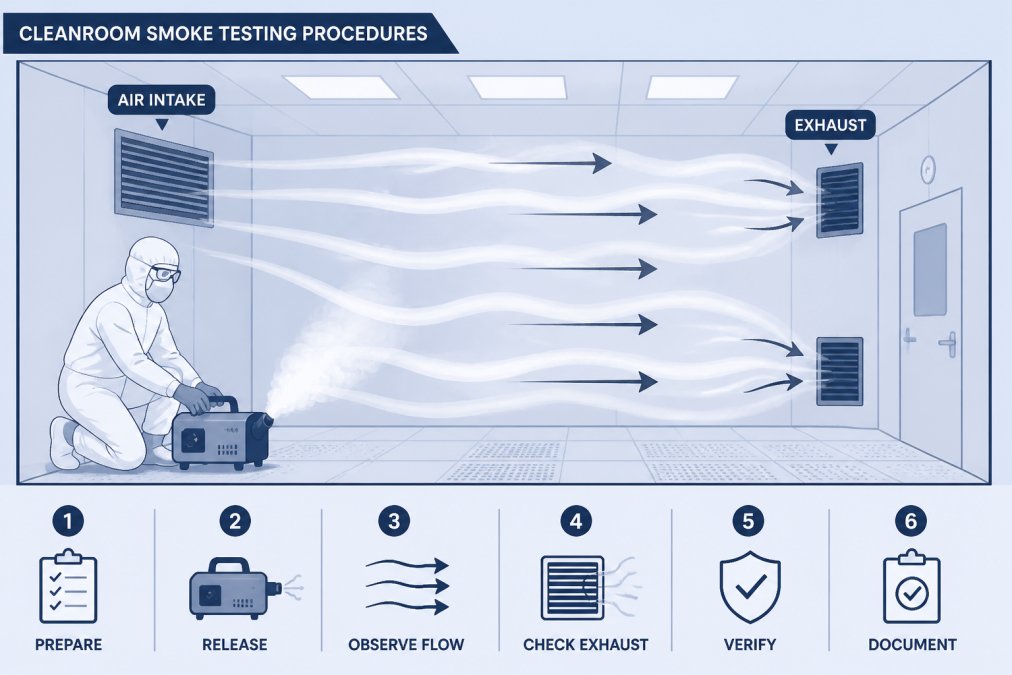
Pharmacy technician in full protective gear and clean suit conducting smoke testing inside a modern cleanroom, releasing visible fog from a portable fogger device positioned near the air intake, with fog patterns clearly showing laminar airflow movement toward exhaust grilles
Release fog slowly and steadily into the airstream. Don’t dump it all at once, controlled release shows you how fog (and theoretically, contamination) moves through your space. Begin near the work surface and move toward areas where you suspect turbulence, such as corners, equipment edges, and exhaust locations.
Observe the fog behavior for at least 5-10 minutes. Laminar flow should show fog moving in parallel lines toward the return air. Any swirling, eddying, or deviation indicates a problem. Pay particular attention to areas behind equipment, under work surfaces, and near personnel entry points, these are common turbulence sources.
Document everything. Photograph or video-record the fog patterns from multiple angles. Note the time, date, fogger model, water source, and any anomalies observed. If you discover airflow defects, document their location precisely. This record becomes part of your GMP validation file and is critical if a regulatory inspection occurs.
After testing, allow the cleanroom to run undisturbed for 15-30 minutes. The fog will dissipate, and your HEPA filters will return the space to its normal particle count. Verify this with a particle counter if you have one, though most pharmacies rely on the visual confirmation that fog clears completely.
Two distinct fogger categories serve pharmaceutical cleanrooms: water-based systems (ultrasonic and LN2) for airflow visualization, and dry fog systems for bio-decontamination. Confusing the two leads to wrong equipment purchases.
Ultrasonic foggers vibrate a piezoelectric element at high frequency, breaking water into fine droplets. The CRF2 uses this approach, producing 8-10 micron particles that evaporate completely, leaving zero residue. This makes ultrasonic technology ideal for cleanrooms where any deposit could compromise product or testing.
The advantage is simplicity: fill with DI water, turn on, and fog appears instantly. No cryogenic supply chain, no special handling. The disadvantage is output volume, ultrasonic units top out around 9-15 CFM, sufficient for small spaces but inadequate for large ISO suites.
LN2-based systems like the AP35 achieve much higher output (177 CFM) by cooling compressed air through liquid nitrogen, then mixing it with DI water. The result is 2-3 micron particles that remain suspended longer and travel farther. This technology reveals airflow patterns in large spaces that ultrasonic systems cannot adequately visualize.
LN2 systems require infrastructure: a cryogenic supplier, proper storage and handling, and trained operators. But for facilities validating large cleanrooms or multiple workstations, the superior visualization capability justifies the added complexity.
Dry fog systems like the Minncare unit serve a different purpose entirely. They disperse chemical sterilants (typically peracetic acid) as fine aerosol particles to decontaminate entire rooms rapidly. The fog is designed to kill microorganisms, not visualize airflow.
Dry fog systems are appropriate for:
They are NOT appropriate for airflow visualization because the chemical fog may deposit residue, the particles behave differently than water-based fog, and the purpose is sterilization, not pattern analysis.
The fog output you need depends entirely on your cleanroom volume and validation objectives.
Contact Us →
CFM (cubic feet per minute) determines how quickly you can fill a space with visible fog. A 9 CFM ultrasonic unit fills a 50-cubic-foot fume hood in about 5 minutes. The same unit would take 50+ minutes to adequately fog a 500-cubic-foot room, by which time the initial fog has already dissipated, making visualization nearly impossible.
The AP35’s 177 CFM output fills a 3,000-cubic-foot ISO suite in under 20 minutes, allowing you to observe airflow patterns throughout the entire space while fog remains visible. This is the difference between adequate testing and comprehensive validation.
For smaller facilities, compounding pharmacies with a single ISO 5 workstation in a glove box or fume hood, the CRF2 is appropriate and cost-effective. For larger operations or facilities with multiple compounding areas, the AP35 provides the volume necessary for thorough airflow visualization.
Water quality affects fog consistency. DI (deionized) water produces clean fog with no mineral deposits. WFI (water for injection, USP grade) is even purer and is preferred for pharmaceutical environments. Never use tap water, minerals will deposit on surfaces and may compromise your cleanroom certification.
Foggers require regular maintenance to remain reliable. For ultrasonic units, clean the piezoelectric element monthly to prevent mineral buildup. For LN2 systems, inspect hoses and connections for frost or damage, and verify that the liquid nitrogen supply is fresh (it evaporates over time).
Calibration isn’t a traditional concern for foggers the way it is for particle counters, but you should verify performance annually. This means testing that your fogger produces fog of the expected density and particle size, and that it operates for the documented duration. Many facilities document this by running a test in a known-good cleanroom and photographing the results, comparing them to baseline images from previous years.
Keep maintenance records as part of your validation documentation. Regulatory inspectors want to see that you’ve maintained your equipment properly and validated that it still performs as intended. A fogger that’s been sitting in storage for two years without inspection is less trustworthy than one with documented quarterly checks.
Applied Physics has specialized in cleanroom validation since 1992, serving pharmaceutical, semiconductor, and biotech industries. Their fogger lineup addresses the specific needs of sterile compounding pharmacies.
The CRF2 is purpose-built for compact cleanroom environments: fume hoods, glove boxes, biosafety cabinets, and small ISO 5 workstations. It produces 9 CFM of fog using only DI or WFI water, with 8-10 micron particles that evaporate completely, leaving no residue.
The unit operates for 50-60 minutes on a 3.75-liter fill, enough time to conduct a thorough airflow study in a small space. The lightweight polypropylene enclosure is easy to clean and resists fingerprints, important in a cleanroom environment where contamination control is paramount.
Cost is significantly lower than LN2 systems, making the CRF2 accessible for smaller compounding pharmacies. Setup is immediate, no cryogenic supply chain, no special handling. For a pharmacy validating a single compounding workstation, this equipment delivers appropriate visualization capability at a practical price point.
The limitation is volume. In a 500-square-foot cleanroom, the CRF2 produces fog that clears too quickly to observe full-space airflow patterns. It’s optimized for small-area testing, not large-room validation.
The AP35 generates 177 CFM of ultrapure fog using liquid nitrogen and DI water. The 2-3 micron particles remain suspended longer and travel 20-30 feet, making them ideal for visualizing airflow in large ISO suites, multiple-workstation compounding areas, and complex cleanroom geometries.
The unit runs for up to 75 minutes per charge, sufficient to conduct comprehensive three-dimensional airflow studies. The wireless remote control and mobile cart design make it easy to position and operate within your cleanroom without introducing contamination.
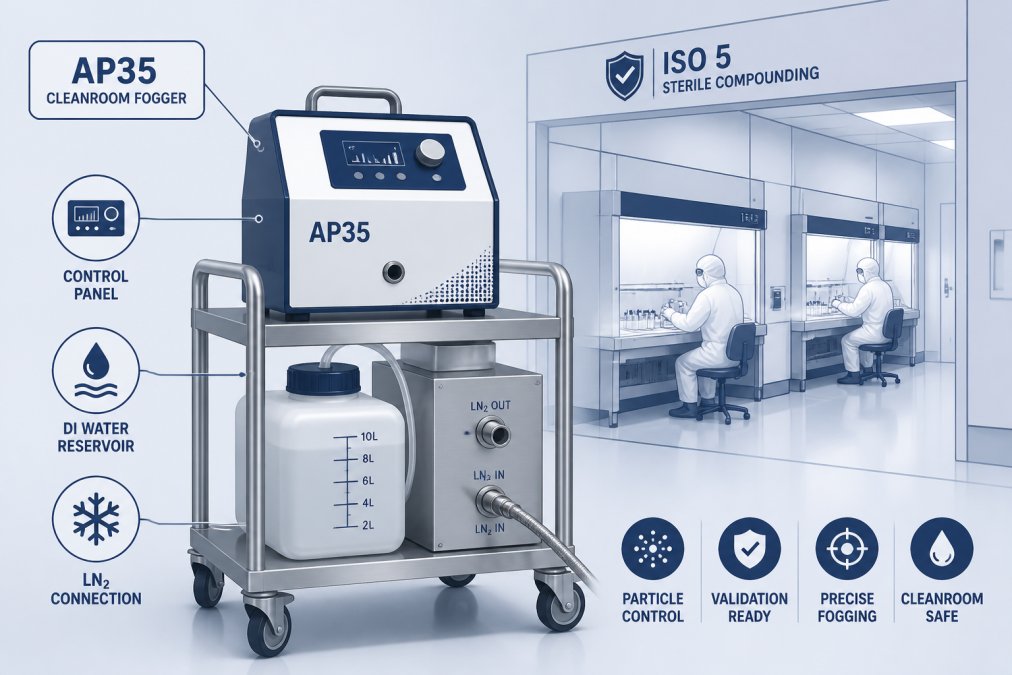
Close-up of Applied Physics AP35 cleanroom fogger equipment on a mobile stainless steel cart with DI water reservoir, control panel, and LN2 connection ports positioned in a modern pharmaceutical sterile compounding facility with ISO 5 workstations visible in background
The AP35 requires LN2 infrastructure, a supplier relationship and proper handling training, but for facilities validating large cleanrooms, the superior visualization capability justifies the added complexity. GMP auditors recognize the AP35 as a professional-grade validation tool, and the equipment’s track record in pharmaceutical manufacturing facilities provides confidence in your compliance documentation.
Applied Physics provides technical support for equipment setup and validation protocol design, helping your team integrate smoke studies into your ongoing GMP compliance program.
Your cleanroom fogger is only valuable if your testing is documented properly. USP 797 requires written protocols, and GMP regulations expect your validation records to be thorough, traceable, and retained for the life of your facility’s certification.
A proper smoke study protocol should include:
Document the date, time, and personnel conducting the test. If you discover defects, document your corrective actions and follow-up testing. This creates an audit trail that demonstrates your commitment to ongoing compliance.
Many compounding pharmacies struggle with regulatory documentation because they lack templates or clear guidance. Applied Physics can provide protocol templates and validation documentation support, helping you establish a repeatable, compliant testing process.
The decision comes down to three factors: cleanroom size, validation frequency, and budget.
Choose the CRF2 if:
Choose the AP35 if:
Consider dry fog systems (like Minncare) only if:
The right choice isn’t about picking the most expensive or most sophisticated equipment, it’s about matching your equipment to your actual validation needs. A pharmacy with a single compounding workstation in a glove box will get better value from a CRF2 than from an AP35. A large compounding facility with multiple ISO 5 workstations will find the AP35’s superior visualization capability essential for thorough compliance validation.
Cleanroom validation is non-negotiable for sterile compounding pharmacies. Your fogger choice directly impacts whether your airflow studies reveal actual contamination risks or miss critical defects. Applied Physics has been solving this problem since 1992, and their CRF2 and AP35 foggers are designed specifically for pharmaceutical validation workflows. Contact Applied Physics to discuss your facility’s cleanroom size, validation frequency, and compliance requirements, their technical team can help you select equipment that meets your needs and integrates seamlessly into your GMP compliance program.
USP 797 requires airflow visualization to confirm laminar flow patterns in sterile compounding areas. Ultrapure water foggers using DI or WFI water are preferred because they produce neutral-density fog that follows airflow without settling, and they leave no residue. The Applied Physics CRF2 (9 CFM output) works well for smaller pharmacy spaces like fume hoods and glove boxes, while the AP35 ultrapure fogger (5.0 cubic meters per minute) is ideal for larger compounding suites. Fog droplet size of 2-10 microns ensures visibility across the cleanroom without contaminating surfaces.
Smoke testing frequency depends on your cleanroom classification and regulatory requirements. USP 797 compounding pharmacies typically perform initial validation smoke studies before operations begin, then conduct periodic testing annually or after facility modifications. Many facilities also perform smoke studies when troubleshooting contamination issues or after HVAC maintenance. Documentation of all smoke studies is required for GMP audits. The specific schedule should be established in your facility’s standard operating procedures and validated during your initial cleanroom certification.
Ultrapure water foggers use DI or WFI water heated by ultrasonic or piezoelectric technology to create fine mist that follows airflow patterns without settling. They produce neutral-density fog ideal for visualizing laminar flow in pharmaceutical cleanrooms and require no cleanup. Dry ice foggers (like Minncare systems) produce denser fog using chemical sterilants for bio-decontamination rather than airflow visualization. Dry fog systems are designed for whole-room disinfection, not for airflow pattern testing. For USP 797 compliance and smoke testing procedures, ultrapure water foggers are the standard choice because they accurately show airflow movement without contaminating the environment.
Portable foggers like the Applied Physics CRF2 are ideal for smaller pharmacy operations, including fume hoods, glove boxes, and biosafety cabinets. The CRF2 produces 9 CFM with 8-10 micron droplets and operates for 50-60 minutes per fill, making it cost-effective and easy to deploy in compact spaces. If your pharmacy has larger compounding suites or multiple ISO-classified areas, a high-volume system like the AP35 (5.0 cubic meters per minute) provides better coverage and longer visible fog distance (20-30 feet). Assess your facility’s square footage, ceiling height, and airflow complexity to determine whether a portable or stationary system fits your validation needs and budget.
APPLIED PHYSICS TECHNICAL RESOURCE
Airflow visualization, smoke studies, tracer delivery, particle monitoring and controlled-environment validation. Product and standards references should be interpreted for the actual instrument, facility, protocol and configuration.

Enter your details below to save your shopping cart for later. And, who knows, maybe we will even send you a sweet discount code :)
Allow notifications to get real-time updates about your shopping cart and who knows, you may even receive a sweet discount code 😊