
Last Updated: July 28, 2026
Finding the best particle counter for semiconductor manufacturing requires understanding the specific contamination control demands of modern fabs. According to ISO 14644 cleanroom classification standards, semiconductor facilities operating at Class 1 or Class 2 levels face particle thresholds measured in parts per million, where even a single micron-sized contaminant can compromise wafer yields. At Applied Physics, we’ve spent over three decades helping semiconductor manufacturers select and deploy particle counters that deliver the precision their processes demand.
This guide walks you through the critical evaluation framework that separates an adequate particle counter from one that actually protects your process. We’ll examine portable versus fixed systems, flow rate considerations, calibration requirements for FDA cGMP and EU GMP Annex 1 compliance, and the total cost of ownership factors that most vendor comparisons skip.
| Counter Type | Best For | Key Advantage | Flow Rate |
|---|---|---|---|
| Portable/Handheld | Spot checks, process validation | Mobility, quick deployment | 0.1 CFM (2.83 LPM) |
| Fixed Remote | 24/7 continuous monitoring | Real-time FMS integration, no manual sampling | 0.1-1.0 CFM |
| Liquid Particle Counter | Ultrapure water, chemical purity | Detects sub-0.1 micron particles | Varies by model |
| Aerosol Generator | HEPA filter validation, leak detection | Confirms cleanroom integrity | Adjustable output |
We assessed each option against five critical dimensions: measurement accuracy at semiconductor-relevant particle sizes (0.1-0.5 micron), real-time data connectivity for facility monitoring system integration, compliance readiness for ISO 14644 and regulatory audit documentation, total cost of ownership, and ergonomic practicality in the cleanroom environment.
The semiconductor industry’s shift toward smaller node geometries has intensified particle control requirements. A 5nm process node demands detection capability that catches particles well below the visible threshold. We weighted equipment that demonstrated sub-0.1 micron detection capability and seamless integration with existing facility monitoring systems, because isolated particle counters create data silos that slow response to contamination events.
Pro Tip The most overlooked evaluation criterion is how quickly you can deploy a new counter into your existing FMS infrastructure. A technically superior counter that requires three weeks of IT configuration adds hidden costs that most procurement teams never calculate.
The choice between portable and fixed counters hinges on your monitoring strategy and the specific node processes you’re protecting. Portable counters offer flexibility for spot checks and rapid response; fixed remote counters provide continuous, unattended monitoring that catches contamination events in real time.
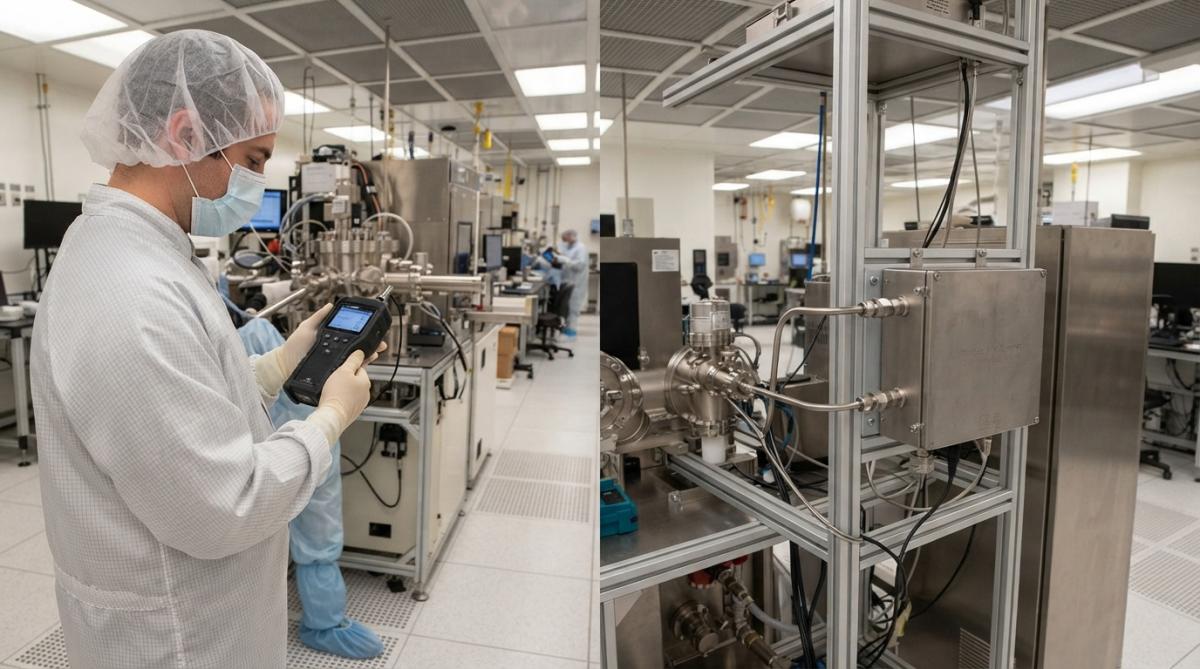
Side-by-side comparison of technician and cleanroom and garb concepts for best particle counter for semiconductor
Flow rate matters significantly. A 0.1 CFM (2.83 LPM) portable counter samples air slowly, requiring longer to accumulate statistically valid particle counts. A 1.0 CFM (28.3 LPM) fixed counter collects data ten times faster, reducing time required to confirm cleanroom classification or detect filter leaks. Higher flow rates demand stronger vacuum sources and consume more power, affecting total cost of ownership.
Semiconductor fabs typically use 0.1 CFM portables for hand-held verification and 1.0 CFM fixed systems for continuous monitoring of critical tool environments. The 100 LPM systems exist for rapid HEPA validation during qualification studies, but they’re overkill for routine fab monitoring.
Watch Out Mixing flow rates across your cleanroom network creates comparison problems. A 0.1 CFM reading cannot be directly compared to a 1.0 CFM reading without normalization, which introduces interpretation errors. Standardize on one flow rate across your monitoring network.
ISO 14644 defines nine cleanroom classes based on maximum allowable particle concentrations. A Class 5 cleanroom, typical for advanced semiconductor manufacturing, permits no more than 100,000 particles per cubic meter at 0.5 microns and larger. To verify compliance, you need a particle counter calibrated to detect particles at that size threshold with documented accuracy.
The standard requires that your counting equipment be traceable to National Institute of Standards and Technology standards. This means your particle counter must undergo periodic calibration against certified aerosol standards. Many semiconductor facilities overlook this requirement until an audit surfaces the gap.
Applied Physics offers calibration wafer standards in multiple formats (75mm, 100mm, 125mm, 150mm, 200mm, and 300mm) that support precision metrology validation across your fab. These standards enable you to verify that your particle counters remain accurate between formal calibration intervals.
Liquid particle counters measure contamination in ultrapure water, process chemicals, and other liquids used in semiconductor manufacturing. While aerosol counters detect airborne particles, liquid counters protect your process from dissolved and suspended contaminants that could deposit on wafers during cleaning, etching, or lithography steps.
Semiconductor fabs use liquid particle counters to qualify incoming chemical supplies, monitor recirculation systems in tool tanks, and validate water purification systems. A single batch of contaminated deionized water can ruin thousands of wafers. Liquid counters typically operate at lower flow rates than aerosol systems (often 1-2 mL/minute) and require different calibration standards.
Key Takeaway Liquid particle counters aren’t optional for semiconductor fabs handling ultrapure water or specialty chemicals. The cost of validation is far lower than the cost of a contamination incident that escapes detection until wafers reach the customer.
FDA cGMP regulations (21 CFR Part 11) require that particle counting data be traceable, auditable, and protected from unauthorized modification. Most semiconductor facilities treat this requirement as a compliance checkbox rather than a practical operational framework, resulting in audit gaps.
To satisfy 21 CFR Part 11 requirements, your particle counter system must capture and preserve four critical data elements:
Legacy particle counters that store data on internal memory cards or print paper reports cannot inherently capture this information. Modern particle counters with direct integration to facility monitoring systems or cloud-based data platforms handle audit trail requirements automatically. When a technician logs into the counter and initiates a measurement, the system records the user ID, timestamp, and equipment serial number in a tamper-evident database.
ISO 14644 and FDA cGMP both require that your particle counter be calibrated against a traceable standard. NIST traceability requires an unbroken chain: your particle counter is calibrated against a secondary standard, which is calibrated against a primary standard, which is calibrated against NIST reference materials.
Most semiconductor facilities calibrate particle counters annually through a third-party calibration lab at a cost of $500-$2,000 per counter per year. However, annual calibration alone does not satisfy audit requirements if you cannot demonstrate that the counter remained accurate between calibration intervals.
In-house calibration verification using calibration wafer standards or aerosol generators at regular intervals (monthly or quarterly) documents that your counter’s performance remained stable between formal calibrations. If an auditor questions whether a measurement from six months after the last calibration is reliable, you can produce verification records showing that the counter passed accuracy checks in the intervening months.
When preparing for an FDA or ISO audit, ensure your particle counter data system satisfies these requirements:
Key Takeaway Audit readiness must be built into your particle counter selection and data management workflow from day one. A counter that cannot integrate with your LIMS will create compliance gaps that manual documentation cannot fully remedy.
Applied Physics calibration wafer standards provide a reference method for verifying particle counter accuracy without sending equipment off-site for formal calibration. These standards are available in 75mm, 100mm, 125mm, 150mm, 200mm, and 300mm formats. By using calibration wafers regularly, you can detect measurement drift before it becomes a compliance issue.
In-house calibration verification is faster and cheaper than formal calibration labs. Instead of waiting weeks for processing, you can run a quick verification test and confirm that your counter remains within specification. Calibration wafers don’t replace formal NIST-traceable calibration, but they provide a practical middle ground that catches drift early.
Semiconductor manufacturing demands continuous vigilance over particle contamination. ISO 14644 requires that cleanrooms be monitored regularly and that monitoring results be documented to demonstrate sustained compliance. For a Class 5 cleanroom, this typically means sampling at least one location per 10 square meters of cleanroom floor space, with sampling intervals no longer than quarterly.
Most advanced fabs use a hybrid approach: fixed counters on critical tool locations and portable counters for periodic verification of secondary areas. Real-time monitoring via fixed particle counters connected to your facility monitoring system enables rapid response to contamination events. When a HEPA filter begins to fail, a real-time alert can trigger maintenance before particle counts exceed your cleanroom class limit.
Modern particle counters must integrate seamlessly with facility monitoring systems to provide the real-time visibility that semiconductor operations demand. Look for particle counters with Ethernet or wireless connectivity, standardized data formats (ideally compatible with your FMS platform), and cloud-based data storage options. These features enable automated alerts, historical trending, and compliance reporting without manual intervention.
Sensor sensitivity varies significantly across particle counters. Request test data from the manufacturer showing performance in conditions matching your fab environment, not just in controlled test chambers.
Pro Tip Before committing to a new particle counter, request a two-week trial in your actual cleanroom environment. Real-world performance in your facility’s temperature, humidity, and air velocity conditions is far more relevant than manufacturer specifications.
The purchase price of a particle counter is typically only 40-50% of its total cost of ownership over a ten-year lifecycle. Calibration, maintenance, replacement sensors, data management, and system integration costs add up quickly. Most procurement teams evaluate particle counters based on purchase price alone, leading to decisions that appear cost-effective initially but become expensive over time.
To compare particle counters fairly, calculate the total cost of ownership across the full equipment lifecycle:
Initial Capital Cost
Annual Operating Costs
Technician Labor Costs (for portable counters)
System Integration and Middleware Costs
Downtime and Opportunity Costs
Consider a semiconductor fab with 20 critical monitoring locations sampled quarterly.
Portable Counter Scenario (two technicians, four counters)
Fixed Counter Scenario (20 counters with FMS integration)
At first glance, the portable scenario appears cheaper. However, this comparison ignores contamination detection speed and downtime cost.
With portable counters sampled quarterly, a HEPA filter failure might not be detected for up to three months. If a wafer lot is exposed to elevated particle counts and the contamination is not detected until the next sampling event, the fab may not discover the problem until wafers reach the customer. A single customer return of contaminated wafers can cost $50,000-$500,000 in scrap, rework, and customer relationship damage.
With fixed counters connected to the FMS, a HEPA filter failure is detected within hours. An automated alert notifies the cleanroom manager, maintenance can be scheduled immediately, and the filter is replaced before significant contamination occurs. If the fixed counter system prevents even one contamination incident over ten years, the savings ($50,000-$500,000) far exceed the additional TCO cost ($242,500).
Before purchasing a particle counter, ask vendors these specific questions:
Does the counter support standard protocols? Counters that support Modbus, OPC-UA, or REST APIs can integrate with most modern FMS platforms with minimal custom development.
What is the data format? Standard formats (CSV, JSON) integrate more easily with LIMS and FMS systems than proprietary binary formats.
Is cloud connectivity included? Cloud-based data platforms eliminate the need for on-site middleware and reduce IT support costs.
What is the vendor’s track record with your FMS platform? Ask for references from other semiconductor fabs using the same FMS.
Who bears the integration cost? Clarify whether basic FMS integration is included in the equipment price or charged separately.
A particle counter that costs $8,000 but integrates seamlessly with your FMS may deliver better value than a $6,000 counter that requires $10,000 in custom integration work.
Pro Tip When evaluating TCO, include a “contamination detection speed” factor. Calculate the cost of a single contamination incident and compare it to the additional cost of faster detection via fixed counters. In most cases, the faster detection pays for itself.
Build a TCO model specific to your fab’s conditions. The difference between a $191,000 and $433,500 lifecycle cost is meaningful, but the difference between a $191,000 decision and a $50,000 contamination incident is transformative.
The best particle counter for semiconductor depends on your cleanroom classification, monitoring needs, and budget. Portable counters like the Lighthouse ApexZ excel for spot checks and troubleshooting with 0.3-10.0 µm detection. Fixed systems like the Beckman Coulter MET ONE 6000 provide continuous 24/7 monitoring with seamless facility monitoring system integration. For semiconductor applications requiring sub-micron detection, counters with 0.1 µm capability and laser diode sensors are essential for process tool monitoring and yield protection.
ISO 14644 defines cleanroom classes (Class 1 through Class 9) based on particle concentration limits. Class 1 fabs require counters detecting particles as small as 0.1 µm with high sampling efficiency. Class 5 and Class 6 cleanrooms typically use 0.3 µm detection. Your particle counter must match your cleanroom’s classification to ensure accurate monitoring and regulatory compliance. Flow rate (CFM or LPM) must also align with ISO 14644 sampling protocols for valid data integrity and audit readiness.
Airborne particle counters measure particles suspended in air using laser diode sensors and are used for fab environment monitoring, process tool validation, and ISO 14644 compliance. Liquid particle counters detect particles in process chemicals and ultra-pure water used in semiconductor manufacturing. Both are critical: airborne counters protect cleanroom integrity, while liquid counters prevent contamination of wafer processing fluids. Most semiconductor fabs require both types for comprehensive contamination control.
Particle counter calibration semiconductor applications typically require annual certification per FDA cGMP and EU GMP Annex 1 standards. However, high-criticality fabs may calibrate semi-annually or quarterly. Calibration wafer standards, like those offered by Applied Physics across 75 mm to 300 mm sizes, provide on-site verification of counter accuracy without full recalibration downtime. Regular calibration ensures data integrity, maintains 21 CFR Part 11 compliance, and protects your regulatory audit readiness.
Prioritize counters with seamless facility monitoring system (FMS) connectivity, real-time data logging, and remote monitoring capability. Key features include long-life laser diode sensors for continuous operation, flexible flow rate options (0.1 CFM or 1.0 CFM), optional RH/T sensors for environmental correlation, and 21 CFR Part 11-compliant data storage. Battery life and ergonomics matter for portable units used in tight fab spaces. Integration with your existing metrology infrastructure ensures consistent contamination control across all process tools.
APPLIED PHYSICS TECHNICAL RESOURCE
Airflow visualization, smoke studies, tracer delivery, particle monitoring and controlled-environment validation. Product and standards references should be interpreted for the actual instrument, facility, protocol and configuration.

Enter your details below to save your shopping cart for later. And, who knows, maybe we will even send you a sweet discount code :)
Allow notifications to get real-time updates about your shopping cart and who knows, you may even receive a sweet discount code 😊