
Last Updated: September 26, 2026
The global cleanroom equipment market will reach roughly USD 6 billion in 2026, climbing toward USD 10.8 billion by 2035, according to Global Market Insights cleanroom equipment analysis. If you need to buy sterile cleanroom fogger equipment, that growth matters less than one hard fact: the fogger you choose determines whether your next audit passes or stalls.
A cleanroom fogger is a diagnostic instrument that releases ultrapure fog into a controlled space so you can see how air actually moves. It does not clean anything. It proves your airflow works.
Applied Physics has built fogging hardware since 1992, and in that time the most common mistake we see is buyers treating foggers as interchangeable. They are not. Ultrasonic and liquid nitrogen units behave differently, document differently, and fail audits differently. Below, we break down the technology, the validation paperwork, and the real cost picture so your next purchase survives scrutiny.
Ultrasonic foggers suit most routine airflow studies, while liquid nitrogen foggers remain the better choice for large volumes and critical residue-sensitive environments. The right pick depends on room size, budget, and how strict your contamination limits are.
The two technologies diverge in how they make fog, and that difference drives everything downstream.
| Factor | Ultrasonic Fogger | LN2 Fogger |
|---|---|---|
| Fog source | Piezoelectric transducer | Liquid nitrogen + water |
| Residue risk | Low with DI water | Essentially none |
| Portability | High, battery-operated options | Lower, needs gas handling |
| Best for | Routine smoke studies, smaller rooms | Large fabs, residue-critical zones |
An ultrasonic cleanroom fogger uses a piezoelectric transducer to vibrate deionized (DI) water into microscopic droplets. Because the water is purified first, the resulting fog leaves minimal particulate behind. Feed the unit DI or WFI water and you get a clean, visible plume that traces laminar and turbulent flow without introducing contamination.
Liquid nitrogen foggers combine LN2 with water vapor to create dense, ultrapure fog with effectively zero residue. In semiconductor environments where a single stray particle ruins a wafer, that purity is worth the extra handling. The trade-off is logistics: LN2 needs safe storage and trained operators.
Watch Out Running an ultrasonic fogger on tap water instead of DI or WFI water is one of the fastest ways to fail a particulate count. The dissolved minerals in tap water become airborne contamination the moment the fog lands.
USP 797 cleanroom airflow testing requires documented visualization of unidirectional airflow in critical zones, and inspectors expect fog studies as part of that evidence. For compounding pharmacies, the fogger is not optional equipment.
Applied Physics Corp.
The standard focuses on ISO-classified spaces where sterile compounding happens. You must demonstrate that air moves predictably from clean to less clean areas, with no dead zones or reversals. A smoke study using sterile fog is the accepted way to show this visually. Smaller operations often worry their glove boxes are too tight for full-size gear. Portable, battery-operated foggers with adjustable output handle those confined spaces well, and Applied Physics offers a wireless remote control so an operator can adjust fog volume and velocity without breaking gowning protocol.
ISO 14644-3 sets the test methods for cleanroom classification, and airflow visualization is one of them. Your fogger validation protocols must generate evidence an auditor can trace from raw data to final report.
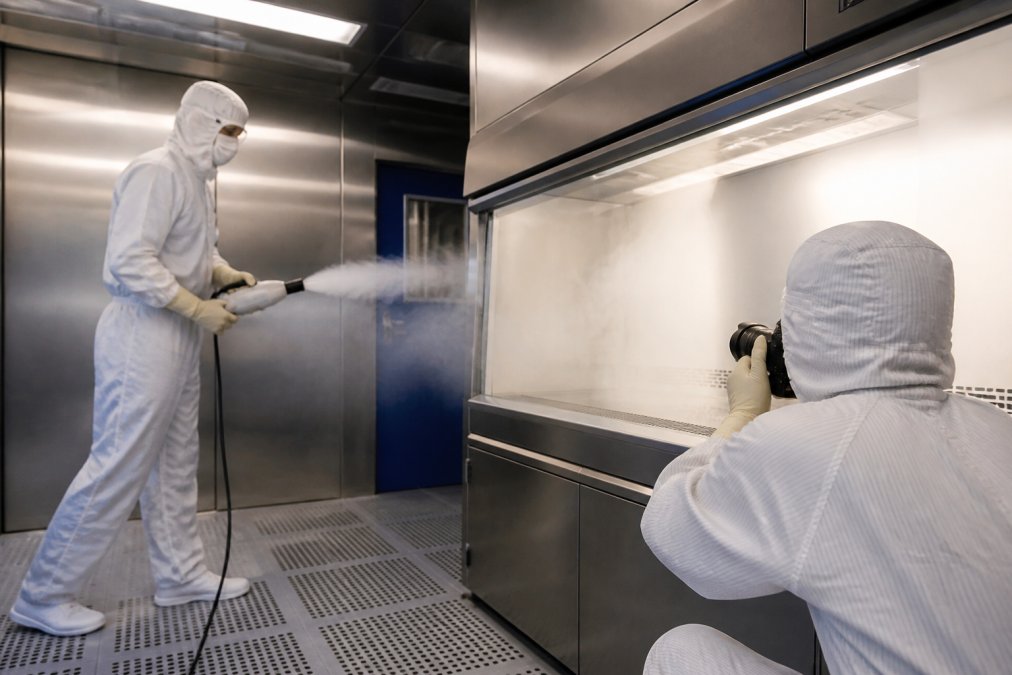
A cleanroom technician in full gowning, including hood and gloves, operating a portable fogger inside a stainless-steel ISO Class 7 cleanroom while a colleague photographs airflow patterns from a laminar flow hood
The practical sequence looks like this:
Auditors rarely ask whether you ran a smoke study. They ask for the record. A defensible package includes the equipment model and calibration status, the water source used, the date and room conditions, raw video, and the operator’s name. According to Applied Physics guidance on cleanroom fogger selection factors, buyers should evaluate droplet size, runtime, material compatibility, and regulatory compliance before purchase, not after an inspection goes sideways.
Pro Tip Film every smoke study in one continuous take with a visible timestamp. Edited clips raise questions about what was cut, and auditors notice.
Portable fogger systems win for most facilities because they move between rooms and reach awkward zones, while stationary units make sense only where a single large space is tested constantly. The real decision is a math problem: match fogger output to room volume and air-change rate, then decide whether that output needs to travel.
A portable fogger runs on battery or standard power and rolls or carries into position. That flexibility matters when you validate multiple rooms on one schedule. Stationary systems deliver higher fog output volume but lock you to one location. For ceiling-level zones that are hard to reach, a support rod or arm extender holds the wand overhead so the operator does not have to, which keeps the study steady and repeatable.
Fog output is measured in cubic meters per minute (or cubic feet per minute on U.S. spec sheets). To fill a room fast enough to see a stable flow path, you want the fogger to displace a meaningful fraction of the room volume within the first minute or two of the test. A small compounding hood or glove box may need only a fraction of a cubic meter per minute; a large open fab bay or a full sterile suite can demand several times that. The Applied Physics CRF3 moves 0.89 cubic meters per minute and the CRF4 moves 1.25 cubic meters per minute, per Applied Physics fogger performance benchmarks, useful reference points when you estimate fill time for your largest room.
A practical rule most validation teams use: pick the smallest unit that still fills your largest test space within a couple of minutes, then confirm it can throttle down for small enclosures. Oversized foggers flood tight spaces and obscure the very flow lines you are trying to record; undersized units leave you waiting while the room’s air changes dilute the plume before it travels.
Portability is not just about wheels. Ask these questions before you buy:
Stationary units earn their place when one large space is tested on a fixed cadence, a single ballroom-style fab, a large aseptic filling suite, or a facility that runs airflow visualization on a monthly schedule. In those cases, a permanently mounted fogger with higher output and a fixed nozzle position removes setup time and improves repeatability, because the fog always enters from the same point. The trade-off is capital cost and the loss of flexibility: a stationary unit cannot be redeployed to a second room when your validation calendar shifts.
For most facilities testing more than two or three rooms per year, a portable unit with adequate output and a remote control is the better economic and operational fit. Reserve stationary systems for the single-room, high-frequency case.
Pro Tip Before you commit, map your rooms on paper: list each space, its approximate volume, and how often it is tested. The room with the largest volume and the highest test frequency usually dictates whether you need one high-output stationary unit or one portable unit that travels.
The layout of the room matters as much as its size. Unidirectional (laminar) flow zones, such as those under a HEPA filter or inside a biological safety cabinet, need a fogger that produces a tight, low-turbulence plume so the flow lines stay readable. Turbulent mixed-flow rooms tolerate a denser, faster plume because you are looking for dead zones and recovery patterns rather than straight-line flow. A portable unit with adjustable output handles both; a fixed-output stationary unit may be too aggressive for a small laminar zone and too slow for a large turbulent bay.
If your facility spans both types of spaces, the practical answer is usually one portable fogger sized for the largest room, paired with a low-output setting or a smaller nozzle for the tightest zones.
Total cost of ownership for a cleanroom fogger includes labor, consumables, maintenance, training, and downtime, not just the sticker price, per Gulf Scientific Equipment’s cleanroom fogger total-cost model. The purchase price is often the smallest line item. Most competitors stop there, they list a price and move on. The useful exercise is to build a five-year cost model before you sign a purchase order, because the hardware decision and the operating decision are the same decision.
1. Capital cost. The unit itself, plus any required accessories: remote control, support rod or arm extender, spare nozzles, transport cart, and carrying case. Accessories are frequently quoted separately and can add a meaningful percentage to the headline price.
2. Consumables. Ultrasonic units consume deionized (DI) or WFI water, and the cost is not the water itself, it is the water system, the filters, and the labor to produce and verify it. LN2 units consume liquid nitrogen, which carries delivery, storage dewar rental, boil-off loss, and handling labor. LN2 logistics are the single most underestimated line item in fogger ownership; a unit that looks cheap on the quote can cost more per test than an ultrasonic unit once gas delivery is factored in.
3. Maintenance and replacement parts. Ultrasonic foggers rely on piezoelectric transducers, which are wear items. Piezo replacement frequency depends on water quality and run hours, feed the unit DI water and they last far longer than if the unit is run on tap water. Budget for at least one transducer replacement cycle over five years, plus periodic cleaning and seal replacement. LN2 units have fewer wear parts but more safety-related maintenance: relief valves, hose inspection, and dewar recertification.
4. Labor and downtime. This is usually the largest bucket and the one buyers ignore. Every hour a sterile suite is out of production for a smoke study has a cost, and a fogger that takes an hour to set up burns budget before the first plume appears. A unit that deploys in minutes and runs on readily available water beats a cheaper unit that demands special handling. When suppliers now ship cleanroom foggers in under 48 hours to meet urgent leak-testing needs, according to Degree Controls on rapid cleanroom equipment deployment, speed of deployment is itself a cost factor, a fogger that arrives late can push a validation window and delay a production start.
5. Training and compliance. LN2 handling requires formal instruction and, in many facilities, documented operator qualification. Ultrasonic units need less safety training but still require training on water quality, cleaning, and documentation. Add the recurring cost of refresher training and the administrative time to keep calibration and qualification records current.
Build a five-year table with one column per candidate unit and one row per bucket above. Fill in what you know and flag what you do not. The unit with the lower sticker price frequently loses once you load consumables, transducer replacement, and setup labor. The unit with the higher sticker price can win if it deploys faster, runs on DI water you already produce, and needs fewer replacement parts.
Two questions separate the real contenders:
Key Takeaway TCO is not an accounting exercise, it is the buyer’s guide competitors skip. Model five years, weight labor and downtime heavily, and treat deployment speed and water compatibility as cost factors, not conveniences.
The costs that surprise buyers most are the ones not on any quote: the labor to produce and verify DI water, the storage and handling of LN2, the downtime to swap a failed transducer mid-validation, and the administrative time to assemble a documentation package an auditor will accept. Ask each supplier for a written list of consumables, wear parts, and recommended replacement intervals before you buy. A supplier who cannot provide that list is telling you something about the ownership experience.
Airflow visualization in semiconductor and pharma applications serves two different masters. Fabs need it to protect sub-10nm processes from particles. Pharma needs it to prove GMP compliance in sterile suites.
In semiconductor work, residue-free fog generation is non-negotiable. A fogger that leaves any film on a tool or wafer creates the exact defect you are trying to prevent. Applied Physics built its AP series ultrapure foggers specifically for this, generating fog that evaporates without a trace, as noted by Applied Physics on residue-free fog generation. In pharma, the priority shifts to documentation and repeatability across validation cycles.
Both industries share one requirement: the fog must be sterile and the flow path must be verifiable.
Safety and contamination control come down to three controls: the water you feed the unit, the residue it leaves, and the way you handle liquid nitrogen if you use it. Get these right and the fogger becomes a reliable audit tool rather than a contamination risk.
The CRF3 Cleanroom Fogger generates 0.89 cubic meters per minute of fog, while the CRF4 produces 1.25 cubic meters per minute, according to Applied Physics fogger performance benchmarks. Those output figures determine how quickly you can fill a room and how well the fog reveals slow-moving flow paths.
Key Takeaway Residue-free fog is not a premium feature. In semiconductor and sterile pharma environments, it is the baseline requirement that separates a usable fogger from a liability.
Selecting the right fogger is a compliance decision as much as a purchase. Applied Physics has supplied precision contamination control and airflow visualization equipment since 1992, offering both LN2 ultrapure and ultrasonic cleanroom foggers built for GMP and ISO environments. With calibration wafer standards, particle metrology, and deployment support under one roof, the team helps facilities move from purchase to validated study without the guesswork. Get started with Applied Physics and walk into your next audit with documentation that holds up.
Ultrasonic foggers use a piezoelectric transducer to convert DI water or WFI water into ultrapure fog droplets, producing residue-free output at rates like 0.89 cubic meters per minute (CRF3) or 1.25 cubic meters per minute (CRF4). Liquid nitrogen foggers flash-boil LN2 to create dense, visible fog with strong neutral buoyancy, which is useful for airflow visualization in large or high-ceiling rooms. Ultrasonic units are typically easier to deploy and leave no condensate residue, while LN2 systems require venting and cryogenic handling.
USP 797 and 800 require compounding pharmacies to verify that ISO-classified buffer areas and primary engineering controls maintain unidirectional airflow. A sterile cleanroom fogger lets you perform smoke studies that reveal turbulent flow, dead zones, and pressure differential problems before they contaminate sterile preparations. Documented airflow visualization is a core part of the certification evidence inspectors review during a GMP audit, so the fogger you buy must produce residue-free fog that will not introduce particulate into the compounding space.
Verification combines a cleanroom fogger, a video record, and a written protocol. You introduce ultrapure fog at supply diffusers, work heights, and doorways, then record the flow path to confirm laminar flow across critical zones and no reverse flow at pressure boundaries. Fog output volume, air velocity measurements, and cleanroom recovery time are logged alongside the video. ISO 14644-3 outlines the airflow visualization method, and the resulting smoke study becomes part of your cleanroom certification file.
Routine maintenance covers the fluid path, the transducer or heating element, and the seals. Ultrasonic foggers need DI water or WFI water only, since minerals in tap water will foul the piezoelectric transducer and shorten its life. You should flush the reservoir after each use, inspect hoses and wands for residue, and replace filters on the schedule the manufacturer specifies. Budget for consumables, training refreshers, and downtime in your total cost of ownership model, not just the acquisition price.

Enter your details below to save your shopping cart for later. And, who knows, maybe we will even send you a sweet discount code :)
Allow notifications to get real-time updates about your shopping cart and who knows, you may even receive a sweet discount code 😊