
Last Updated: August 24, 2026
USP 797 cleanroom contamination control represents one of the most critical compliance frameworks in pharmaceutical manufacturing and sterile compounding. The United States Pharmacopeia established these standards to ensure that compounded sterile preparations meet rigorous safety and efficacy requirements. At Applied Physics, we work directly with quality assurance teams who understand that contamination isn’t just a regulatory checkbox, it’s the difference between patient safety and potential harm.
The USP 797 standard mandates specific environmental controls, personnel practices, and monitoring protocols for any facility preparing compounded sterile preparations. The regulation requires facilities to maintain ISO-classified cleanroom environments with defined pressure differentials, airflow patterns, and particle counts. Personnel must follow strict garbing procedures, hand hygiene protocols, and behavioral standards within the controlled environment. Environmental monitoring, both viable air sampling and non-viable particle counting, must occur at defined intervals with documented acceptance criteria.
Beyond the physical environment, USP 797 requires comprehensive standard operating procedures, personnel training, and root cause analysis protocols for any contamination excursions. Facilities must validate their cleanroom design through smoke testing and particle visualization techniques. The standard also specifies cleaning and disinfection protocols, including primary engineering control maintenance and terminal cleaning schedules. Documentation must be thorough and audit-ready, with digital tracking systems increasingly becoming the standard across compliant operations.
Microbial contamination in compounded sterile preparations can lead to serious patient infections, sepsis, or even death. A single viable organism introduced during preparation can multiply rapidly, especially in injectable medications stored at body temperature. This isn’t theoretical, contamination events have triggered recalls affecting thousands of patients. The cost of a single contamination incident extends far beyond regulatory penalties: reputation damage, loss of patient trust, and potential litigation create cascading operational disruptions.
Effective cleanroom contamination control prevents these outcomes by establishing multiple barriers to contamination. ISO-classified environments with controlled pressure differentials ensure that air flows from clean to less clean areas, preventing contamination migration. HEPA filtration removes airborne particulates before they reach the compounding area. Personnel garbing and hygiene procedures eliminate human-introduced contamination, statistically the leading source of failures. Environmental monitoring catches contamination early, allowing facilities to identify root causes before patient harm occurs.
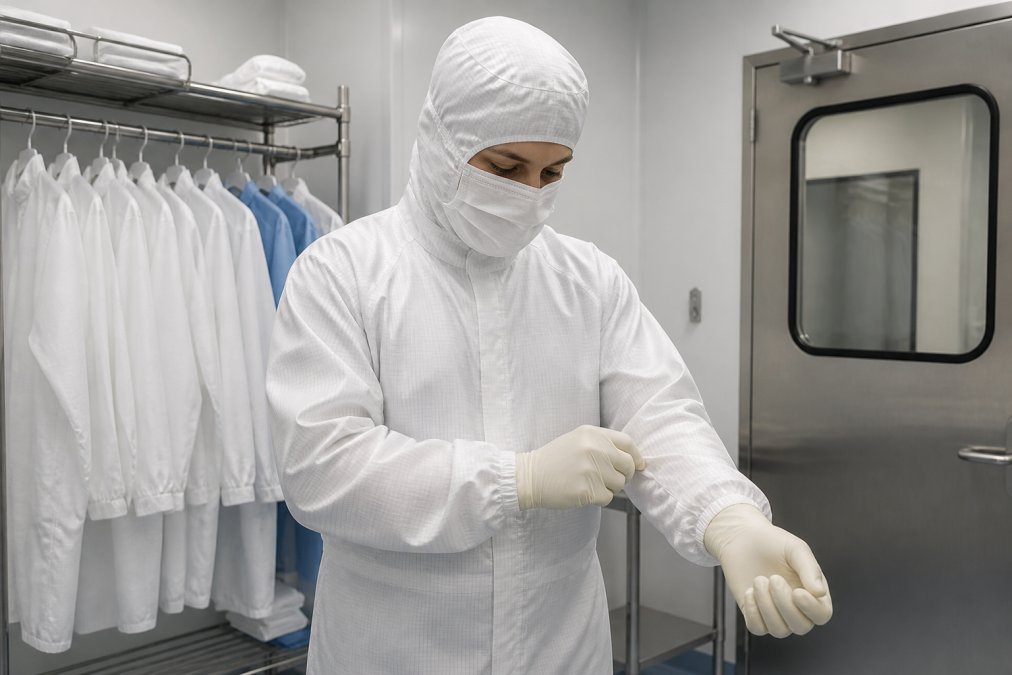
Technician in full cleanroom gown, hood, face mask, and sterile gloves performing proper gowning procedure in a USP 797 compliant facility, demonstrating correct layering and fit with careful attention to sealing
Personnel represent the largest single source of contamination in cleanroom environments. Human skin sheds approximately 1,000 to 10,000 particles per minute, and respiratory activity releases viable organisms continuously. Proper garbing and hygiene procedures create a barrier between personnel and the compounding environment, reducing contamination risk dramatically.
USP 797 requires personnel to don sterile, non-shedding garments in a specific sequence to minimize contamination risk. The gowning process typically begins outside the cleanroom with hand hygiene, followed by donning of shoe covers, gown, hood, mask, and finally sterile gloves. The sequence matters, gloves must be donned last to prevent contamination of the glove exterior during gowning. Many facilities use a dedicated gowning room with staged areas to maintain control throughout the process.
Cleanroom behavior extends beyond initial gowning. Personnel must avoid unnecessary movement, touching their face or body, and speaking directly over compounding areas. Hand movements should be deliberate and controlled. Personnel should never eat, drink, apply cosmetics, or engage in activities that compromise the integrity of garbing. Gowning requirements vary based on ISO classification, ISO Class 5 environments (where direct compounding occurs) require more rigorous garbing than ISO Class 7 or 8 buffer areas.
Hand hygiene is the single most effective contamination control measure available. USP 797 requires personnel to wash hands with soap and water, then perform an alcohol-based hand antiseptic before donning gloves. The hand washing step removes soil and organic material that can reduce the efficacy of alcohol-based products. The alcohol step kills vegetative microorganisms on the skin surface. Together, these steps reduce hand bioburden by several logarithmic units.
Surface preparation begins before personnel enter the compounding area. All materials and equipment must be disinfected with appropriate agents before introduction into the ISO Class 5 primary engineering control. Personnel must wipe down gloved hands and forearms with sterile, lint-free wipes saturated with 70% isopropyl alcohol. This step removes any contamination acquired during gowning or material handling. The timing matters, hand antisepsis should occur immediately before compounding begins, not hours earlier. Many facilities implement timed reminders to ensure personnel refresh hand antisepsis between different compounding tasks.
Cleanroom classification under ISO 14644-1 defines the maximum allowable particle concentration at different sizes. An ISO Class 5 environment (used for direct compounding of sterile preparations) allows no more than 3,520 particles ≥0.5 microns per cubic meter during dynamic operations (iso.org). This extraordinarily low particle count requires precise environmental controls: HEPA filtration, pressure differentials, controlled airflow patterns, and continuous environmental monitoring.
Pressure differentials drive airflow from clean to less clean areas, preventing contamination migration. An ISO Class 5 compounding area must maintain positive pressure relative to surrounding spaces. Typical pressure differentials range from 0.02 to 0.05 inches of water column, maintained continuously during operations (the FDA). This positive pressure ensures that if any doors or seals leak, air flows outward, carrying potential contaminants away from the compounding zone.
Airflow patterns within the cleanroom must be laminar and unidirectional, typically flowing from ceiling to floor or in horizontal patterns depending on equipment configuration. Laminar airflow means all air moves in parallel lines at uniform velocity, without turbulence or eddies that could trap particles. Velocity must be maintained within specified ranges, typically 80 to 120 linear feet per minute for vertical laminar flow in ISO Class 5 areas. Airflow visualization using smoke testing reveals whether patterns meet design specifications. Applied Physics provides cleanroom foggers that generate consistent, neutral-density aerosols for accurate airflow visualization without introducing contamination or thermal disturbances.
HEPA (High-Efficiency Particulate Air) filters remove 99.97% of particles 0.3 microns and larger, making them essential for achieving ISO Class 5 conditions (the EPA). Fan Filter Units (FFUs) combine HEPA filters with dedicated fans, providing localized high-efficiency filtration. Primary engineering controls like biological safety cabinets incorporate HEPA filtration in both supply and exhaust streams. Secondary engineering controls, such as ISO Class 7 buffer rooms, provide additional protection through their own HEPA filtration and pressure control.
The maintenance of HEPA filters directly impacts cleanroom performance. Filters accumulate particles over time, increasing pressure drop and reducing airflow velocity. Facilities must monitor differential pressure across filters and replace them when pressure drop exceeds manufacturer specifications. A clogged filter reduces airflow velocity below the 80 linear feet per minute minimum, compromising laminar flow characteristics and particle removal efficiency. Many facilities implement preventive replacement schedules, typically every 12 to 24 months depending on facility activity levels, to ensure consistent performance.
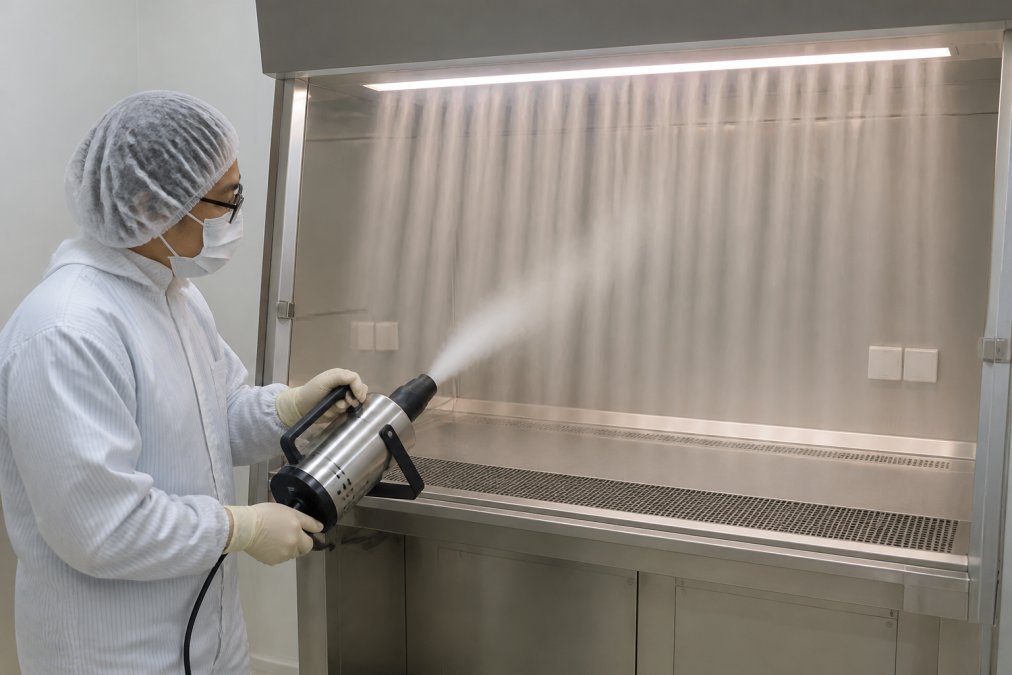
Cleanroom technician using smoke visualization equipment to demonstrate laminar airflow patterns across a biological safety cabinet, with visible white particulate flow moving from ceiling downward in smooth, parallel lines without turbulence
Airflow visualization provides direct evidence that cleanroom design meets specifications. Smoke testing reveals flow patterns, identifies dead zones, and confirms that pressure differentials function as designed. This validation step occurs during initial cleanroom certification and must be repeated periodically to ensure continued compliance.
Smoke testing uses visible aerosol particles to trace airflow patterns throughout the cleanroom. The aerosol must be non-toxic, non-reactive, and uniform in particle size to provide accurate visualization. Traditional smoke generators can introduce thermal disturbances that create artificial air currents, masking true flow patterns. Applied Physics cleanroom foggers generate ultrapure aerosols with consistent particle size distribution and neutral thermal properties, ensuring accurate visualization without contaminating the environment.
Technicians release aerosol at multiple points within the cleanroom, near walls, corners, equipment surfaces, and potential dead zones, and observe flow direction and velocity. Proper laminar flow carries aerosol smoothly from source to exhaust without eddies or reversals. Areas where aerosol lingers or reverses indicate dead zones where contamination could accumulate. These observations guide remediation efforts: adjusting diffuser positions, sealing gaps, or modifying equipment placement to restore proper airflow patterns.
Non-viable particle counting measures the concentration of particles suspended in air without identifying their biological nature. Particle counters sample air continuously or at defined intervals, counting particles at multiple size thresholds, typically 0.5, 1.0, and 5.0 microns. Results must fall below ISO classification limits during dynamic operations (when personnel are present and compounding occurs). Applied Physics provides the Cleanroom Monitoring System (Model CRMS) and Aerosol Photometer (BAP-350), enabling real-time particle monitoring with data logging for audit documentation.
Dynamic particle counts typically run 2-3 times higher than static counts (when the cleanroom is unoccupied) because personnel activity generates particles. A facility achieving static counts of 1,000 particles per cubic meter might see 5,000-10,000 during dynamic operations. As long as dynamic counts remain below the ISO Class 5 limit of 3,520 particles ≥0.5 microns, the environment remains compliant. Trending data reveals whether contamination control effectiveness is improving or degrading over time.
Environmental monitoring serves as the primary mechanism for detecting contamination and validating that cleanroom controls function effectively. Monitoring data drives corrective actions and provides evidence of compliance during regulatory inspections.
Viable air sampling collects airborne microorganisms on culture media, allowing identification and quantification of microbial contamination. Samplers like the Microbial Air Sampler (3080 Series) from Applied Physics use inertial impaction to deposit microorganisms onto agar plates. After incubation, colonies are counted and identified, revealing the types and quantities of microorganisms present. ISO Class 5 areas typically allow no more than 1 CFU (colony-forming unit) per cubic meter during dynamic operations, an extraordinarily stringent standard reflecting the critical nature of direct compounding.
Surface sampling uses contact plates or swabs to detect contamination on work surfaces, equipment, and environmental surfaces. Samples are incubated and colonies counted. Surface sampling occurs at defined locations and frequencies, with results tracked over time. Trending data reveals whether cleaning and disinfection protocols maintain adequate microbial control. A single positive surface sample doesn’t necessarily trigger shutdown, context matters. A positive result on a high-touch surface during high-activity periods might represent normal microbial presence. Multiple positives or positives in unexpected locations indicate contamination control failures requiring investigation.
USP 797 specifies minimum monitoring frequencies: viable air sampling at least monthly in ISO Class 5 areas, surface sampling at defined locations on defined schedules. Many facilities implement more frequent monitoring, weekly or even daily, to detect excursions early. Acceptance criteria are zero tolerance for most facilities: any positive viable air sample or unexpected surface positive triggers investigation and corrective action.
Acceptance criteria must account for the specific environment. A pharmaceutical manufacturing facility with continuous compounding activity might establish baseline data showing that certain surfaces consistently yield 1-2 CFU despite rigorous cleaning. These baselines become the acceptance criteria, deviations from baseline trigger investigation. Digital compliance software tracks all monitoring results, flags excursions automatically, and generates reports for regulatory review.
Cleaning removes visible soil and organic material. Disinfection kills microorganisms. Both steps are essential, disinfectants cannot penetrate organic material effectively, and cleaning alone leaves viable organisms behind. USP 797 requires both daily cleaning and periodic terminal cleaning with specific protocols and documented disinfectants.
Daily cleaning occurs at the end of each operating day or between compounding sessions, removing visible soil and reducing microbial bioburden. Personnel use appropriate cleaning agents (typically detergent-based) followed by disinfectants. The sequence matters: cleaning first removes soil, then disinfection kills remaining organisms. Daily cleaning typically takes 30-60 minutes depending on facility size and complexity.
Terminal cleaning occurs periodically, typically monthly or quarterly, and involves more intensive disinfection and environmental remediation. Terminal cleaning includes high-touch surfaces, equipment exteriors, walls, and floor areas. Some facilities implement terminal cleaning protocols that include fogging with disinfectant aerosols to reach areas difficult to access manually. The frequency of terminal cleaning depends on contamination history: facilities with positive environmental monitoring results might increase terminal cleaning frequency to weekly or bi-weekly until contamination is controlled.
Primary engineering controls like biological safety cabinets and compounding aseptic isolators require specialized maintenance. PEC maintenance includes HEPA filter inspection, airflow velocity verification, and surface disinfection. Many facilities perform monthly PEC maintenance, checking that airflow velocity remains within specification and that no visible damage compromises filter integrity. Airflow velocity testing uses calibrated anemometers to measure velocity at multiple points across the work surface, ensuring laminar flow characteristics are maintained.
PEC disinfection uses surface-safe disinfectants that won’t damage equipment or leave residues. Alcohol-based disinfectants are common for interior surfaces. Some facilities use hydrogen peroxide vapor or ozone-based disinfection for deeper decontamination during terminal cleaning. The choice depends on PEC design and material compatibility, a decision best made in consultation with equipment manufacturers and quality assurance teams.
Disinfectant selection directly impacts contamination control effectiveness. The wrong disinfectant, or rotating disinfectants improperly, can lead to microbial resistance and contamination failures.
USP 797 requires facilities to use EPA-registered disinfectants effective against the specific microorganisms likely to contaminate the environment. Common disinfectants include 70% isopropyl alcohol (for hand hygiene and equipment surfaces), quaternary ammonium compounds (for general surface disinfection), and phenolic compounds (for terminal cleaning). Each disinfectant has specific efficacy profiles: some work better against gram-positive bacteria, others against gram-negative organisms or fungi.
Disinfectant rotation prevents microbial resistance, using the same disinfectant continuously can select for resistant strains. A typical rotation might alternate between two disinfectants with different mechanisms of action on a weekly or monthly basis. Rotation schedules must be documented in standard operating procedures and tracked in cleaning logs. The key principle: use disinfectants with proven efficacy against documented contaminating organisms, rotate to prevent resistance, and maintain contact times specified by manufacturers.
Bioburden testing quantifies the total number of viable microorganisms on a surface or material before sterilization. For compounded sterile preparations, bioburden testing of equipment and environmental surfaces provides baseline data. Elevated bioburden indicates inadequate cleaning or disinfection. Trending bioburden data reveals whether cleaning protocols are maintaining adequate microbial control or whether contamination is increasing.
Bioburden testing typically occurs during initial cleanroom qualification and periodically thereafter, perhaps quarterly or annually depending on regulatory requirements and facility risk assessment. Samples are collected using sterile swabs or contact plates, incubated under conditions favoring microbial growth, and colonies counted. Results are compared to acceptance criteria established during initial validation. An increasing trend in bioburden suggests that disinfection protocols are losing effectiveness, potentially indicating disinfectant resistance or inadequate contact times.
The ultimate goal of cleanroom contamination control is producing sterile compounded preparations safe for patient use. Aseptic technique, the set of practices that prevent contamination during compounding, depends entirely on the cleanroom environment and personnel compliance.
Aseptic processing occurs within an ISO Class 5 primary engineering control, typically a biological safety cabinet or compounding aseptic isolator. All materials introduced into the PEC must be sterilized or disinfected. Vials, syringes, and other components are wiped with 70% isopropyl alcohol before use. Personnel perform all manipulations using sterile technique: minimal hand movement, no touching of sterile surfaces, and continuous awareness of contamination risk. preventing laboratory contamination.
The compounding process itself introduces contamination risk at every step. Needle punctures through vial septa can introduce microorganisms. Handling of sterile components outside the PEC introduces environmental contamination. Improper technique, touching sterile surfaces, working outside the laminar airflow zone, or failing to maintain aseptic conditions, directly increases contamination risk. Many facilities implement competency-based training where personnel demonstrate proper aseptic technique before working independently in the cleanroom.
Sterility testing verifies that compounded preparations meet sterility requirements. USP requires 14-day incubation in appropriate culture media, with no growth indicating sterility. However, sterility testing is destructive, samples must be incubated, so results aren’t available until after the preparation has been dispensed. This creates a significant quality assurance challenge: facilities must ensure aseptic technique is so reliable that contamination is virtually impossible, rather than relying on end-product testing to catch failures.
Quality assurance extends beyond sterility testing. Personnel competency assessments, environmental monitoring results, and process validation data all contribute to quality assurance. Many facilities implement media fill studies, running the complete compounding process with sterile media instead of active pharmaceutical ingredients, to validate that aseptic technique consistently produces sterile results. A media fill study demonstrating zero contamination in 100 or more replicate runs provides strong evidence that the process is under control.
Contamination excursions are inevitable in cleanroom operations; the difference between facilities that maintain compliance and those that fail is how systematically they investigate excursions and prevent recurrence. Root cause analysis (RCA) is the structured process that transforms a contamination event into organizational learning and process improvement.
An excursion is any environmental monitoring result that exceeds established acceptance criteria or deviates from expected performance. Excursions include: viable air samples yielding ≥1 CFU in ISO Class 5 areas, surface samples exceeding baseline contamination levels, particle counts exceeding ISO classification limits, pressure differentials dropping below specification, or airflow velocity falling outside the 80-120 linear feet per minute range for laminar flow zones. Not all excursions represent equal risk; a single positive surface sample on a low-risk location requires investigation but may not necessitate production shutdown, while multiple positive viable air samples in the ISO Class 5 PEC represent critical failures requiring immediate action.
The first response to any suspected excursion is confirmation. Resampling the same location within 24 hours determines whether the initial result represents genuine contamination or sampling error. A single positive result followed by negative resampling might indicate transient contamination (a door opened briefly, a momentary airflow disruption) that self-corrected. Confirmed excursions, results that repeat on resampling or multiple locations showing contamination, trigger formal root cause analysis.
Systematic RCA follows a defined sequence: (1) data collection, (2) timeline reconstruction, (3) hypothesis generation, (4) investigation and testing, (5) root cause determination, and (6) corrective and preventive actions. This structure prevents jumping to conclusions and ensures that investigations are thorough and evidence-based.
Data Collection begins immediately upon excursion confirmation. Investigators gather: the specific monitoring result (organism identified, CFU count, location, date/time), environmental conditions at the time of sampling (temperature, humidity, pressure differential, particle counts), personnel present during the relevant time period, activities occurring (compounding, cleaning, equipment maintenance, personnel training), recent procedure changes, equipment maintenance or repairs, and any other facility events that might correlate with contamination.
Timeline Reconstruction maps events backward from the excursion. If viable air sampling on Tuesday detected contamination, when did that contamination actually enter the environment? Viable organisms can persist for hours or days, so contamination detected on Tuesday might have been introduced on Monday or even earlier. The timeline should include: when the cleanroom was last cleaned and disinfected, when personnel last worked in the area, when equipment was last serviced, when HEPA filters were last replaced, and any deviations from normal operating procedures. This timeline often reveals correlations: contamination detected after a specific person worked in the area, or after equipment maintenance, or after a procedure change.
Hypothesis Generation develops multiple potential explanations for the contamination. Common contamination sources include: (1) Personnel contamination, inadequate garbing, hand hygiene failure, or behavioral non-compliance; (2) Equipment failure, HEPA filter degradation, loss of pressure differential, airflow velocity reduction, or biological safety cabinet malfunction; (3) Procedural failure, inadequate cleaning, wrong disinfectant, insufficient contact time, or missed cleaning steps; (4) Environmental factors, temperature or humidity excursions affecting microbial growth or equipment performance; (5) Incoming material contamination, contaminated components or materials introduced into the cleanroom; (6) Cross-contamination, contamination migrating from adjacent areas due to pressure differential loss or door opening. Generating multiple hypotheses prevents premature closure on a single explanation and ensures that investigations consider all plausible mechanisms.
Investigation and Testing systematically tests each hypothesis. If personnel contamination is suspected, investigators review video surveillance (if available), interview personnel about their activities and garbing procedures, and observe their technique directly. If equipment failure is suspected, they perform airflow visualization to confirm laminar flow patterns, measure pressure differentials with calibrated manometers, test HEPA filter integrity using aerosol photometry, and review equipment maintenance logs. If procedural failure is suspected, they observe the procedure being performed, review cleaning logs and disinfectant records, and verify that contact times and disinfectant concentrations meet specifications. Investigation often reveals multiple contributing factors rather than a single root cause.
Scenario 1: Single Positive Viable Air Sample in ISO Class 5 PEC
Scenario 2: Multiple Positive Surface Samples Despite Rigorous Cleaning
Scenario 3: Particle Count Excursion (Non-Viable)
Scenario 4: Pressure Differential Loss
RCA findings must be documented in a formal investigation report that includes: the excursion description, confirmation results, data collected, timeline, hypotheses tested, investigation findings, root cause determination, and corrective/preventive actions. The report should be reviewed by quality assurance leadership and retained for regulatory inspection.
Corrective actions address the immediate contamination source and prevent recurrence. Immediate actions might include: disinfection of affected areas, equipment repair or replacement, or personnel retraining. Preventive actions strengthen the system to prevent similar failures: procedure revisions, equipment maintenance schedule changes, additional monitoring, or facility design modifications. The effectiveness of corrective actions should be verified through follow-up monitoring; if the same contamination recurs despite corrective actions, investigation must continue until the true root cause is identified and addressed.
Facilities that excel at contamination control treat excursions as opportunities for organizational learning. Trends across multiple excursions often reveal systemic weaknesses: if multiple excursions involve the same personnel, training is needed; if excursions cluster at specific times, activity-related factors need control; if excursions follow equipment maintenance, maintenance procedures need review. Digital compliance systems that track all excursions and RCA findings enable pattern recognition and trend analysis that guide strategic improvements. Facilities that systematically learn from excursions show declining contamination rates over time, demonstrating that their contamination control program is maturing and becoming more robust.
Modern cleanroom operations generate enormous amounts of data: environmental monitoring results, cleaning logs, personnel training records, equipment maintenance schedules, and trend analysis. Digital systems organize this data, flag excursions automatically, and generate audit-ready reports.
Standard operating procedures document every aspect of cleanroom operation: personnel garbing sequences, cleaning schedules, disinfectant rotation, environmental monitoring protocols, and corrective action procedures. Digital SOP management ensures that all personnel access current procedures and that procedure changes are tracked and communicated. Version control prevents confusion from outdated procedures.
Audit readiness depends on comprehensive documentation. Regulatory inspectors expect to see evidence that cleanroom controls are maintained consistently over time. Digital systems provide this evidence: environmental monitoring trends, cleaning logs with dates and personnel signatures, equipment maintenance records, and personnel training completion dates. Data integrity, ensuring that records cannot be altered retroactively, is critical. Many facilities implement electronic signatures and audit trails that document who accessed records and when.
Real-time monitoring systems provide immediate alerts when environmental conditions deviate from specification. Particle counters, temperature/humidity sensors, and pressure differential monitors feed data continuously to central systems. When a particle count exceeds limits or pressure differential drops below specification, alerts trigger immediately, allowing rapid corrective action before contamination occurs.
Data tracking enables trend analysis. Are particle counts gradually increasing, suggesting filter degradation? Is bioburden rising despite consistent cleaning protocols? Are excursions clustering at specific times or locations? Trend analysis reveals patterns that single data points might miss.
Contamination doesn’t originate only within the cleanroom, incoming materials and equipment can introduce contamination if not properly controlled.
All materials entering the cleanroom must be inspected and, where appropriate, disinfected before use. Vials, syringes, and other components arrive in non-sterile packaging. They’re removed from outer packaging in a non-classified area, inspected for damage or contamination, then transferred to storage areas. Storage conditions matter: components must be protected from environmental contamination and stored at appropriate temperature and humidity levels.
Many facilities implement a quarantine system where incoming materials are held pending inspection and testing. Materials are released to active use only after inspection confirms compliance with specifications. This approach prevents contaminated materials from entering the cleanroom and potentially compromising product quality.
Equipment introduced into the cleanroom must be validated to ensure it won’t introduce contamination. Validation includes surface inspection, bioburden testing, and sometimes sterilization. Large equipment like biological safety cabinets arrives pre-sterilized from manufacturers, but surfaces must still be disinfected before installation. Smaller components like hoses, connectors, and fittings may require gas sterilization or other decontamination methods.
Component validation extends to consumables. Sterile gloves, gowns, and other garments must meet cleanliness specifications. Glove powder, once common, is now recognized as a contamination source and has been largely eliminated. Modern sterile gloves are powder-free and low-particulate, reducing contamination risk. Facilities validate that incoming garments meet specifications and are stored to prevent contamination before use.
Cleanroom operations consume significant energy, continuous HEPA filtration, environmental controls, and pressure differential maintenance operate 24/7. Sustainability initiatives reduce environmental impact while maintaining contamination control.
HEPA filtration is energy-intensive, but efficiency can be improved through maintenance and design optimization. Regular filter inspection and replacement before excessive pressure drop develops maintains airflow velocity and reduces fan energy consumption. Fan Filter Units with variable-speed drives adjust fan speed based on actual air quality requirements, reducing energy use during low-activity periods. Some facilities implement demand-controlled ventilation that reduces airflow rates during non-operating hours, maintaining pressure differentials while reducing energy consumption.
FFU(Fan Filter Unit)
Equipment selection impacts long-term energy consumption. High-efficiency fans and motors reduce operating costs. Proper ductwork design minimizes pressure drop and associated fan energy. Applied Physics cleanroom foggers generate aerosols efficiently without requiring high-volume airflow or thermal disturbances, enabling more accurate validation with lower energy consumption than traditional smoke generators.
Cleanroom operations generate waste: spent HEPA filters, contaminated materials, disinfectant containers, and other consumables. Proper waste management protects environmental and worker health while ensuring regulatory compliance. Spent HEPA filters may contain concentrated microorganisms and require special handling, some facilities incinerate filters, others use specialized disposal services.
Disinfectant waste requires careful management. Many disinfectants are hazardous substances requiring proper disposal. Facilities must track disinfectant usage, maintain safety data sheets, and follow EPA and state regulations for hazardous waste disposal. Digital systems track disinfectant inventory, usage rates, and disposal documentation, ensuring compliance with environmental regulations.
Personnel training is foundational to contamination control. Even the most sophisticated equipment and facilities cannot compensate for inadequately trained personnel.
USP 797 requires initial training and periodic retraining for all personnel working in cleanroom environments. Training must cover aseptic technique, garbing procedures, cleanroom behavior, environmental monitoring, contamination response, and facility-specific procedures. Competency assessment, typically through media fill studies or direct observation, verifies that personnel understand and can perform required tasks correctly. Documentation of training and competency assessment is essential for regulatory compliance and audit readiness.
Regulatory compliance extends beyond training. Facilities must maintain documentation of all cleanroom operations: environmental monitoring results, cleaning logs, equipment maintenance, personnel training, and corrective actions. This documentation must be organized, accessible, and audit-ready. Digital systems organize this information and generate reports on demand. Regulatory inspectors expect to see evidence that contamination control is systematic, documented, and continuously improved over time.
Contamination control in cleanroom environments demands precision, discipline, and systematic attention to detail. The complexity of USP 797 requirements, from personnel garbing through environmental monitoring to root cause analysis, creates significant operational challenges. Applied Physics supports this mission through precision equipment designed specifically for cleanroom validation and monitoring. Our Cleanroom Monitoring System (Model CRMS) provides continuous environmental monitoring with audit-ready documentation. The Microbial Air Sampler (3080 Series) delivers precise microbial contamination data. Our cleanroom foggers generate neutral-density aerosols for accurate airflow visualization without introducing contamination. Contact Applied Physics to discuss how precision monitoring and validation equipment can strengthen your contamination control program and ensure consistent USP 797 compliance.
USP 797 establishes mandatory standards for cleanroom contamination control in sterile compounding. Key requirements include ISO-classified environments with proper pressure differentials, HEPA filtration systems, personnel garbing procedures, environmental monitoring through viable air sampling and surface sampling, and regular cleaning with validated disinfectants. Primary Engineering Controls (PECs) must be cleaned and disinfected before each shift and between different compounding operations. Facilities must maintain detailed documentation of all monitoring and remediation activities to demonstrate audit readiness and regulatory compliance.
USP 797 requires PEC cleaning and disinfection before each shift, between different compounding operations, and when environmental monitoring indicates potential contamination. Daily cleaning protocols must address all interior surfaces. Terminal cleaning (comprehensive ceiling-to-floor cleaning) is required at least monthly and more frequently if monitoring data suggests microbial or particulate contamination. The specific frequency depends on your facility’s risk assessment, compounding volume, and historical monitoring results. Documented standard operating procedures must outline exact cleaning schedules and the disinfectants used to ensure consistency.
Airflow visualization demonstrates that cleanroom pressure differentials and HEPA filtration systems function correctly to prevent contamination ingress. Using smoke or aerosol visualization during validation studies and periodic recertification shows whether airflow patterns protect the compounding area and move contaminated air away from critical zones. This technique confirms that secondary engineering controls, such as biological safety cabinets, maintain proper directional flow. Visualization also identifies dead zones or turbulent areas where particles might accumulate. Regular airflow validation provides evidence of continued compliance and helps detect equipment degradation before contamination events occur.
USP 797 environmental monitoring requirements include viable air sampling to detect airborne microorganisms and non-viable particle counting to measure airborne particulates. Viable air sampling must occur at rest (no personnel present) and during dynamic operations (normal compounding activity). Surface sampling validates disinfection effectiveness on work surfaces and equipment. Monitoring frequency depends on ISO classification: ISO Class 5 PECs require more frequent sampling than lower-risk areas. Acceptance criteria establish maximum viable and non-viable particle counts. Results must be documented, trended over time, and trigger investigation and remediation if excursions occur. This data supports regulatory inspections and demonstrates continuous contamination control.
Cleanroom disinfectant selection for USP 797 requires validation of disinfectant efficacy against the microorganisms most likely in your facility. USP 797 recommends rotating between two or more disinfectants with different mechanisms of action to prevent microbial resistance. Select disinfectants that are compatible with cleanroom surfaces, leave minimal residue, and meet contact time requirements in your compounding environment. Common choices include 70% isopropyl alcohol, quaternary ammonium compounds, and hydrogen peroxide-based solutions. Validate disinfectant effectiveness through surface sampling after cleaning. Document all disinfectants used, concentrations, contact times, and efficacy results. Rotation schedules and disinfectant selection should be reviewed during environmental monitoring excursions to identify whether microbial resistance is developing.
Upon detecting a contamination excursion, initiate a root cause analysis to identify the source: equipment failure, personnel error, environmental breach, or supply chain contamination. Document the excursion date, location, organism or particle count, and environmental conditions. Implement immediate corrective actions such as additional cleaning, equipment maintenance, or personnel retraining. Perform follow-up environmental monitoring to confirm remediation effectiveness. Assess whether any compounded sterile preparations prepared during the excursion period require quarantine or recall. Document all findings and corrective actions in your quality assurance records for regulatory review. Use the analysis to update standard operating procedures and prevent recurrence.
Digital systems automate environmental monitoring data collection, trend analysis, and alert generation when results approach or exceed acceptance criteria. Software tracks cleaning schedules, disinfectant rotations, personnel training records, and equipment maintenance, critical for demonstrating audit readiness. Real-time dashboards display facility status and flag non-compliance immediately. Digital records are more defensible during regulatory inspections than paper documentation and enable rapid retrieval of historical data for root cause analysis. Integration with laboratory information systems ensures that monitoring results link directly to compounding records. Automated workflows ensure that excursions trigger documented investigations without relying on manual follow-up.
Supply chain contamination risks include microbial or particulate contamination on incoming raw materials, components, and equipment. Contaminated supplies can introduce bioburden directly into compounding operations or compromise cleanroom surfaces during installation and maintenance. Mitigate these risks through incoming material inspection protocols, supplier qualification, and quarantine procedures for new equipment. Validate that equipment meets cleanroom compatibility standards before installation. Establish relationships with suppliers who understand USP 797 requirements and provide documentation of their quality assurance. Periodically audit supplier facilities and request certificates of analysis for critical materials. Include supply chain assessment in your root cause analysis when contamination events occur.
APPLIED PHYSICS TECHNICAL RESOURCE
Airflow visualization, smoke studies, tracer delivery, particle monitoring and controlled-environment validation. Product and standards references should be interpreted for the actual instrument, facility, protocol and configuration.

Enter your details below to save your shopping cart for later. And, who knows, maybe we will even send you a sweet discount code :)
Allow notifications to get real-time updates about your shopping cart and who knows, you may even receive a sweet discount code 😊