
Last Updated: September 24, 2026
The impact of cleanroom humidity on manufacturing yields is measurable, expensive, and often underestimated. According to Data Insights Reports market analysis, the low-humidity cleanroom market is projected to reach $8.85 billion by 2025, growing at a 6.6% CAGR as pharmaceutical, biotech, and electronics manufacturers confront the real cost of unstable ambient conditions. At Applied Physics, we’ve watched facilities treat humidity as a secondary parameter behind particle counts and pressure differentials, then wonder why batch rejection rates climb. Cleanroom humidity is not a comfort variable. It is a process variable, and it belongs in your validation protocol alongside airflow velocity and filter integrity. Below, we break down exactly how relative humidity moves yield, where the 30% to 65% band comes from, and what it takes to hold it there.
The 30% to 65% relative humidity range is the operating band most cleanroom standards converge on, balancing static control against condensation risk. According to PDA Letter Portal guidance on cleanroom environmental control, this range avoids both the electrostatic discharge problems of dry air and the microbial growth risks of saturated air. It is a compromise, not a universal answer.
Your actual setpoint depends on your process. A semiconductor fab running sub-10nm lithography may sit near the low end. A tablet compression suite often runs mid-band. The band exists because both extremes cause distinct, documented failures, and the cost of drifting outside it shows up in yield, not in comfort complaints.
| Humidity Condition | Primary Risk | Typical Impact |
|---|---|---|
| Below 30% RH | Electrostatic discharge | Particle attraction, microchip damage |
| 30-65% RH | Controlled balance | Stable process conditions |
| Above 65% RH | Condensation and microbial growth | Material degradation, batch loss |
A single percentage point of humidity drift can destroy a pharmaceutical batch, and the mechanism is straightforward: hygroscopic materials absorb or release moisture until they reach equilibrium with the air around them. According to Camali Corp analysis of cleanroom environmental stability, a 1% humidity fluctuation is enough to ruin a pharmaceutical batch when the product is moisture-sensitive.
Powder blending, tablet compression, and lyophilized product handling all sit on this knife edge. The material doesn’t care that your HVAC ran a normal cycle. It responds to the actual moisture in the air at the moment of processing.
Watch Out Chasing a tighter setpoint without verifying sensor accuracy is a common and costly mistake. A miscalibrated sensor reading 43% when the room is actually at 38% will send your HVAC system chasing the wrong target all shift, and you won’t know until a batch fails.
Excess moisture triggers condensation on cool surfaces, and that condensation becomes a growth medium for bacteria and mold. Research published through ScienceDirect study on humidity effects on medication stability determined that relative humidity significantly affects both the stability of medications during storage and the precision of powder weighing processes.
The failure modes stack up quickly. Condensation forms on chilled surfaces and equipment housings. Microbial growth follows wherever moisture persists, particularly in corners and dead zones with poor airflow. Material degradation shows up as caking, clumping, and altered flow properties that throw off volumetric filling and dosing accuracy.
Tablet hardness and dissolution rates shift measurably when ambient moisture rises, because granule moisture content directly affects compressibility and binding behavior. A batch compressed at elevated humidity may pass hardness testing but fail dissolution, or vice versa. This is why pharmaceutical manufacturers maintain strict humidity control: it is the only way to keep tablet hardness and dissolution rates inside their validated ranges batch after batch. When humidity drifts, both parameters move together, and the resulting waste is often caught only at quality release.
Electrostatic discharge prevention in cleanrooms depends on keeping relative humidity high enough to dissipate static charge before it accumulates. Dry air, typically below 30% RH, turns synthetic garments, wafer surfaces, and plastic components into charge reservoirs. The discharge that follows damages sensitive devices and attracts airborne particles to surfaces you just cleaned.
Semiconductor manufacturing facilities implement tight humidity control specifically to prevent moisture absorption in materials and mitigate static electricity, which protects microchip performance and improves product yields. The trade-off is real: pushing humidity higher reduces static but increases condensation risk, which is why the 30% to 65% band exists rather than a single universal setpoint.
Static electricity and airborne particles are linked problems in low-humidity environments. Charged surfaces attract particles from the surrounding air, so a dry cleanroom effectively pulls contamination toward the very products you’re trying to protect. This is why particle counts can look acceptable at the filter while localized contamination climbs at the work surface.
Pro Tip When troubleshooting unexplained particle excursions, check humidity logs before you re-certify the filters. A dry spell in the room will pull particles to charged surfaces and mimic a filtration failure that isn’t there.
ISO 14644 cleanroom standards govern particle classification and cleanliness levels, but the standard deliberately leaves humidity setpoints to the process owner. This is the point most engineers miss: ISO 14644 tells you how clean your air must be, not how humid. That distinction matters because auditors do not cite ISO 14644 for a humidity excursion, they cite the process validation and the quality system that was supposed to hold the setpoint.
ISO 14644 defines cleanroom classes by airborne particle concentration and specifies test methods for classification and monitoring. It does not mandate a specific relative humidity. That responsibility falls to your process requirements, your product’s moisture sensitivity, and the regulatory framework governing your facility. A semiconductor fab and a compounding pharmacy can both be ISO Class 7 and run completely different humidity setpoints, and both can be fully compliant. Your validation documentation needs to justify the setpoint you chose, not just record that you held it.
Because ISO 14644 is silent on humidity, the enforceable numbers come from elsewhere. In pharmaceutical and biotech operations, the operative frameworks are typically:
For electronics and semiconductor manufacturing, the reference points shift to internal process specifications and JEDEC/IPC standards tied to moisture sensitivity levels (MSL) for components, rather than a single government-mandated humidity number.
The practical takeaway: ISO 14644 gives you the particle classification framework, but your humidity setpoint is justified by your product, your stability data, and your process validation. When an auditor asks why your suite runs at 45% RH and not 55%, the answer is not ‘ISO 14644 says so.’ The answer is your validated process range, your stability studies, and your deviation history. Facilities that treat ISO 14644 as the humidity authority end up with setpoints that cannot be defended when a batch fails and the investigation turns to environmental conditions.
Pro Tip If your humidity setpoint cannot be traced to a specific stability study, process validation run, or product specification, treat that as a documentation gap before an auditor finds it for you.
Pharmaceutical batch humidity requirements flow from product characteristics and current good manufacturing practice, not from a single fixed number. A 2026 study published through Springer research on pharmaceutical cleanroom performance evaluated cleanroom operational performance using combined experimental methods and computational fluid dynamics to assess contamination control in sensitive manufacturing environments. But the study is the science; the compliance obligation is what turns that science into an enforceable setpoint.
There is no single federal regulation that states ‘pharmaceutical cleanrooms shall be held at X% relative humidity.’ Instead, humidity control is governed indirectly through several instruments that, together, create the enforceable requirement:
Regulatory compliance means demonstrating that your environmental monitoring program actually controls the conditions your process validation assumed. If your validation ran at 45% RH and your production floor drifts to 55%, you have a deviation, whether or not the batch fails. The investigation then follows a predictable path:
Sterile compounding operations face additional contamination control obligations, and facilities handling hazardous drugs must document environmental conditions as part of their quality system. The common thread is that the humidity number itself is less important than the documented chain from stability study to validated setpoint to monitoring data to deviation handling. Rigorous adherence to these protocols remains the primary defense against batch failure, particularly when preventing moisture contamination is essential for maintaining the integrity of sensitive lyophilized samples.
Watch Out A humidity excursion that is never logged is not a non-event, it is an undocumented deviation. If your monitoring system cannot show continuous data across the excursion window, the investigation defaults to worst-case assumptions about product impact.
The most common compliance failure is not an out-of-range reading; it is a setpoint that cannot be traced to a stability study or process validation. The second most common is a monitoring program that logs data but never reviews it in real time, so excursions are discovered weeks later during a batch record review. Both problems are fixable with the same investment: a validated setpoint backed by documentation, and continuous monitoring that alarms when the room drifts outside it.
Cleanroom airflow visualization reveals what your HVAC design intends and what your room actually does. Smoke studies and fogger-based visualization show whether air moves in the unidirectional patterns your design assumed, or whether turbulence, dead zones, and equipment obstructions are creating pockets where humidity and particles accumulate.
HVAC control strategies for humidity fall into two broad approaches. Desiccant dehumidification handles low-humidity targets and high latent loads. Chilled-water coil systems with reheat work for mid-band targets where sensible and latent loads are moderate. The choice depends on your setpoint, your climate, and your internal moisture generation from people, processes, and equipment.
Applied Physics has supplied cleanroom foggers for airflow visualization since 1992, including LN2 ultrapure and ultrasonic systems, so facilities can see actual airflow patterns rather than trusting a design drawing.
Sensor calibration frequency should follow your risk assessment and your drift history, not a calendar default. Most facilities calibrate humidity sensors every 6 to 12 months, but a sensor in a high-particulate or chemically aggressive area may need quarterly verification.
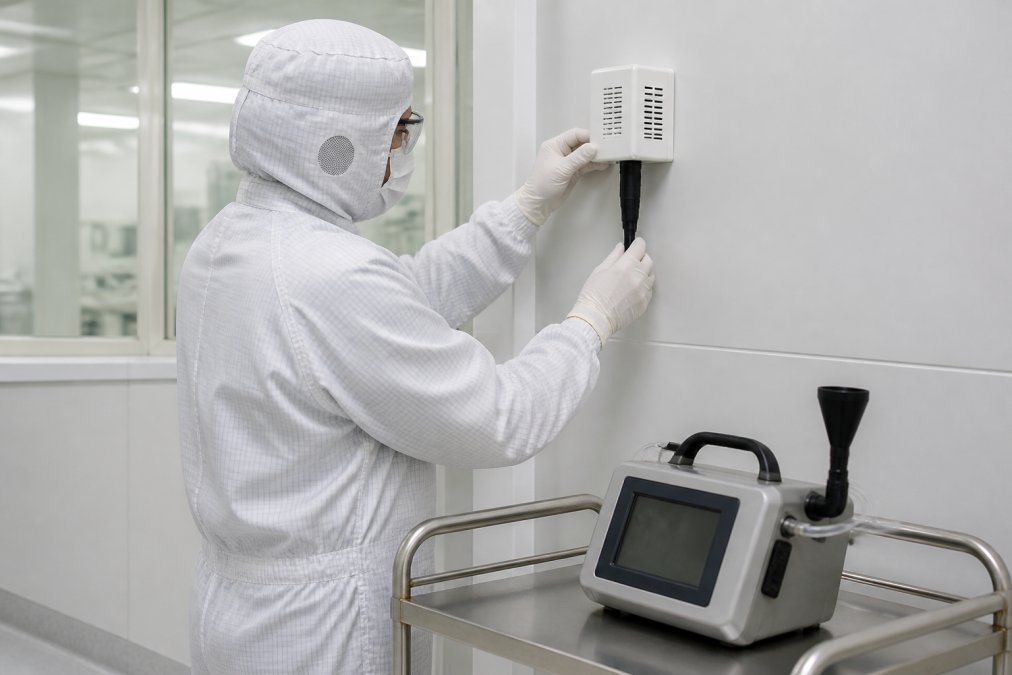
A cleanroom technician in full gowning calibrating a wall-mounted humidity and temperature sensor, with a handheld particle counter resting on a stainless steel cart nearby
Real-time monitoring versus periodic logging is the other decision that shapes your data quality. Periodic logging captures snapshots and misses excursions between readings. Real-time monitoring catches drift as it happens and triggers alarms before a batch is compromised. The Applied Physics Cleanroom Monitoring System, Model CRMS, continuously monitors airborne particle counts, differential pressure, temperature, and humidity to support ongoing ISO 14644 and GMP compliance, with modular hardware options for local server or cloud-based configurations.
The ROI of humidity control comes from three places: avoided batch waste, reduced energy consumption, and improved product yield. Research published in Nature Scientific Reports on cleanroom environmental impacts shows a 25% reduction in energy consumption is achievable through better management of cleanroom environmental parameters.
That energy figure matters because humidity control is one of the largest energy loads in a cleanroom. Overcooling to remove moisture, then reheating to hit temperature setpoints, wastes energy on every cycle. Optimizing the control sequence and right-sizing dehumidification cuts that waste without touching your setpoint.
The yield side is harder to quantify but often larger. A single rejected pharmaceutical batch or a scrapped semiconductor lot can exceed the annual energy cost of the humidity control system that would have prevented it. For facilities weighing the investment, the calculation should include batch rejection history, deviation investigation costs, and the labor hours spent on root-cause analysis when the actual cause was a drifting sensor.
Key Takeaway Humidity control pays back through avoided waste first and energy savings second. If you’re building the business case, lead with batch rejection and deviation costs, not utility savings.
Humidity drift is one of the few yield killers you can catch before it costs you a batch, but only if your monitoring actually sees it. Applied Physics has supported contamination control and metrology since 1992, with cleanroom foggers for airflow visualization, calibration wafer standards, and the Cleanroom Monitoring System Model CRMS for continuous particle, pressure, temperature, and humidity oversight. Get started with Applied Physics and turn your environmental data into a yield advantage instead of an audit finding.
Most cleanrooms target 30% to 65% relative humidity, according to the PDA Letter Portal (2024). The exact setpoint depends on your process: pharmaceutical manufacturing often runs at 35% to 50% to protect tablet hardness and dissolution rates, while semiconductor fabs may push lower to control oxidation. The goal is to stay inside a band that avoids both condensation and static discharge.
Dry air lets static electricity build on surfaces, gowning, and moving parts. When relative humidity drops below roughly 30%, charge accumulates faster than it can dissipate, raising the risk of electrostatic discharge that damages sensitive components and attracts airborne particles to wafers or boards. Electrostatic discharge prevention in cleanrooms depends on holding humidity high enough to bleed off charge while staying below the condensation threshold.
Watch for fogging on cold surfaces, sticky or clumping powders, rising particle counts near gowning areas, and static shocks when operators touch metal. In pharmaceutical work, changes in tablet hardness or dissolution rates during stability testing often trace back to humidity drift. A 1% fluctuation can ruin a pharmaceutical batch, so continuous monitoring beats periodic logging for catching these signals early.
Most quality systems calibrate humidity and temperature sensors every 6 to 12 months and verify accuracy against a reference before each critical batch campaign. Sensors drift with age, and a miscalibrated probe can hide a real deviation. Pair scheduled calibration with continuous data logging so you can prove to auditors that the environment stayed in band for the full production window.

Enter your details below to save your shopping cart for later. And, who knows, maybe we will even send you a sweet discount code :)
Allow notifications to get real-time updates about your shopping cart and who knows, you may even receive a sweet discount code 😊