Table of Contents
- Digital Airflow Modeling and Smoke Studies: Core Definitions
- How Computational Fluid Dynamics (CFD) Modeling Works for Cleanroom Design
- The Role of Smoke Studies in Cleanrooms and Regulatory Compliance
- Cleanroom Airflow Visualization Standards and Their Impact on Testing
- Speed and Setup: How Digital Modeling and Smoke Studies Compare
- Cost-Benefit Analysis: Digital Modeling vs. Physical Smoke Testing
- Common Mistakes in Smoke Study Execution and Digital Model Validation
- Can Digital Airflow Modeling Replace Smoke Studies for GMP Audits?
- The Case for Using Both Methods Together
- Conclusion
Last Updated: August 30, 2026
Digital Airflow Modeling and Smoke Studies: Core Definitions
The question of whether digital airflow modeling is better than smoke studies doesn’t have a simple yes-or-no answer. Both methods serve critical functions in cleanroom validation, but they work differently and often complement each other. Understanding what each approach does, and where they excel, is essential for anyone responsible for maintaining GMP compliance and contamination control in pharmaceutical, semiconductor, or biotech environments.
Digital airflow modeling, formally known as Computational Fluid Dynamics (CFD), uses mathematical algorithms to simulate airflow patterns, velocity distributions, and particle behavior within a cleanroom space. It’s a predictive tool that runs on computers before construction or modification occurs. Smoke studies, by contrast, are physical validation methods where actual fog is introduced into a cleanroom to visualize real airflow patterns, turbulence zones, and contamination risks in real time.
The tension between these two approaches is real. CFD modeling can predict problems before they exist, saving time and money. Smoke studies show you exactly what’s happening in your actual space, with all its real-world variables. The decision isn’t which one to use, it’s understanding when each one matters most and how they work together to ensure your cleanroom actually performs as designed.
Digital airflow modeling predicts airflow behavior using computer simulations; smoke studies physically visualize actual airflow patterns in real cleanrooms. Neither completely replaces the other, and most regulated facilities use both at different stages of validation.
How Computational Fluid Dynamics (CFD) Modeling Works for Cleanroom Design
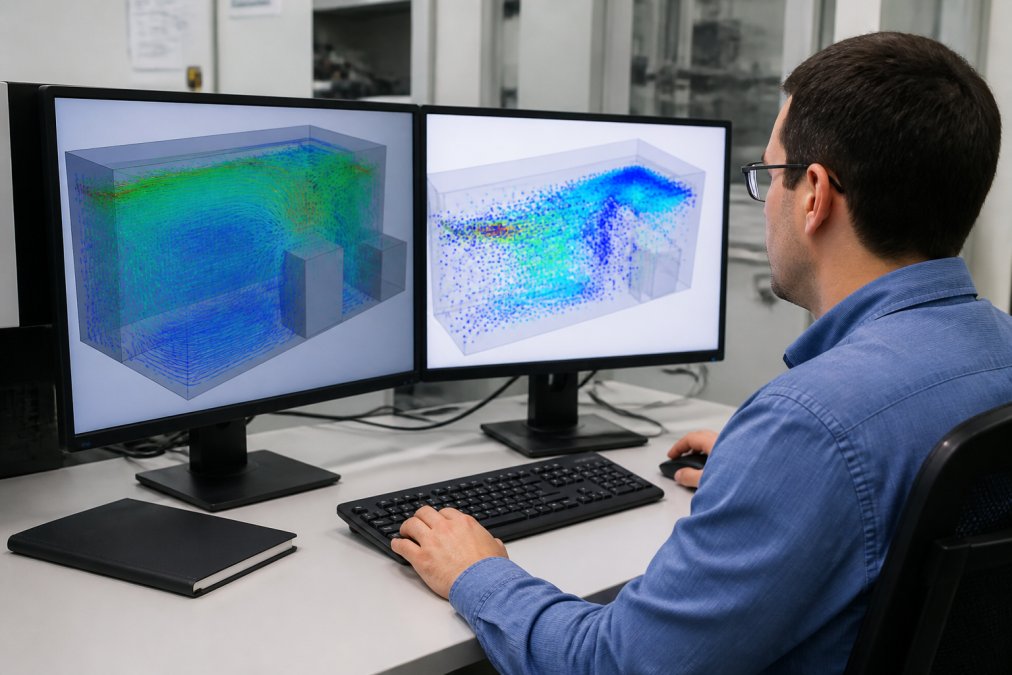
CFD modeling creates a virtual representation of your cleanroom geometry, walls, HEPA filters, equipment placement, door locations, and personnel positions. The software then calculates airflow velocity, pressure differentials, and particle dispersion patterns based on the physics of fluid dynamics. What makes this powerful is that it runs thousands of scenarios before you build anything or modify your existing space.
The process begins with a 3D model of your cleanroom. Engineers input specifications like filter locations, air velocity requirements, room dimensions, and heat load from equipment. The CFD software divides the space into millions of tiny cells and solves the Navier-Stokes equations across each cell to predict how air will move. The output is color-coded velocity maps, pressure contours, and particle tracking that show where contamination is likely to accumulate.
One major advantage of CFD is speed at the planning stage. You can test multiple configurations, moving a door, changing filter placement, adjusting personnel workflow, without touching your physical space. This is particularly valuable for new facility design or major renovations where changes are expensive. Applied Physics works with facilities engineers who need to validate designs before construction begins, and CFD modeling allows them to optimize airflow patterns on screen rather than discovering problems after the cleanroom is built.
:::pro
CFD modeling can test dozens of design variations in weeks. Physical smoke studies in an existing cleanroom take hours per configuration and require the room to be offline during testing, a significant operational cost for active manufacturing facilities.
:::
However, CFD has limitations. Real cleanrooms contain variables that models struggle to predict: actual human movement patterns, equipment vibration, thermal stratification, and the way real materials interact with airflow. A model assumes perfect filter uniformity, but your actual HEPA filter might have bypass leaks. The model assumes consistent air density, but thermal gradients near equipment create real-world variations. This is why CFD alone isn’t sufficient for regulatory compliance, you still need physical validation.
The Role of Smoke Studies in Cleanrooms and Regulatory Compliance
Smoke studies are the regulatory gold standard for validating that your cleanroom actually performs as designed. When regulators audit your facility for GMP compliance, they expect to see documented evidence of airflow validation. That evidence typically comes from smoke study videos showing unidirectional airflow, turbulence zones, and first-air protection around critical work areas.
A smoke study involves introducing fog (typically from an ultrasonic or LN2 fogger) at strategic points in your cleanroom and observing how the fog moves. The fog follows the actual airflow, making invisible air currents visible. Technicians record video evidence from multiple angles and document observations about airflow direction, velocity, turbulence patterns, and contamination risks. This physical evidence becomes part of your validation file, it’s what you show auditors to prove your cleanroom meets regulatory requirements.
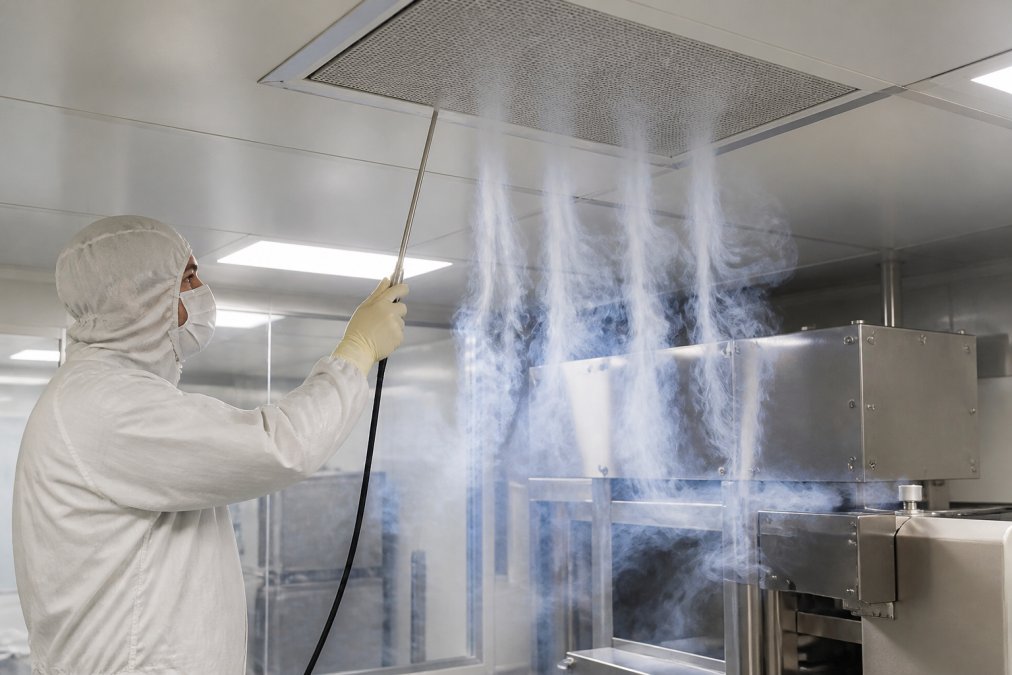
The regulatory requirement is clear: according to FDA guidance on aseptic processing, facilities must demonstrate that their cleanroom environment maintains the required air quality and unidirectional airflow patterns. Smoke studies provide visual, documented proof. For sterile compounding pharmacies operating under USP 797 standards, smoke studies are explicitly required to validate airflow patterns in ISO Class 5 environments. Semiconductor fabrication facilities use smoke studies to validate first-air protection around critical process tools.
What makes smoke studies invaluable is that they show real-world behavior. You see exactly where air stagnates, where turbulence forms, and where contamination might accumulate if personnel move incorrectly. You observe door effects, the disruption that occurs when someone enters the cleanroom. You watch how the airflow responds to equipment placement, personnel positioning, and operational conditions. This real-world evidence is what regulators want to see.
Smoke studies executed poorly produce worthless data. Common mistakes include using fog that’s too dense (obscuring airflow patterns), testing at incorrect velocity conditions, or failing to document observations systematically. Poor smoke study execution can actually hide problems rather than reveal them, giving false confidence in cleanroom performance.
The limitation of smoke studies is that they’re point-in-time snapshots. You test your cleanroom on a specific day, under specific conditions, with specific personnel and equipment placement. If you change anything, move equipment, add a new tool, alter personnel workflow, you may need to repeat the study. For active manufacturing facilities, this means production downtime. It’s also why smoke studies alone aren’t sufficient for design validation: you can’t run a smoke study in a cleanroom that doesn’t exist yet.
Cleanroom Airflow Visualization Standards and Their Impact on Testing
Regulatory standards define what constitutes acceptable airflow validation and directly influence how both CFD modeling and smoke studies are conducted. Understanding these standards clarifies why both methods exist and when each is required.
ISO 14644 is the international standard for cleanroom classification and control. It defines cleanroom classes based on particle concentration and establishes that cleanrooms must maintain unidirectional airflow, typically at velocities between 0.3 and 0.5 meters per second for ISO Class 5 environments (iso.org). The standard requires periodic revalidation of airflow patterns, which is where smoke studies come in. ISO 14644 doesn’t prescribe CFD modeling, but it does require documented evidence that your cleanroom meets its classification.
In the United States, GMP regulations (21 CFR Part 211) require that facilities validate their manufacturing environment and maintain that validation through ongoing monitoring. For aseptic processing, FDA guidance emphasizes the importance of demonstrating first-air protection, ensuring that uncontaminated air reaches critical work surfaces before any other air in the room. Smoke studies directly demonstrate this. CFD modeling can predict it, but regulators expect to see physical evidence.
The practical impact is this: CFD modeling helps you design a compliant cleanroom, but smoke studies prove it’s compliant. This is why most regulated facilities use both. You run CFD during design to optimize airflow patterns. Once the cleanroom is operational, you conduct smoke studies to validate that the design works in reality. Then you use periodic smoke studies to confirm that modifications, maintenance, or operational changes haven’t degraded performance.
ISO 14644 and GMP regulations don’t mandate CFD modeling, but they do require documented airflow validation, which comes from smoke studies. CFD is a design tool; smoke studies are a compliance tool.
Speed and Setup: How Digital Modeling and Smoke Studies Compare
Speed is where the comparison becomes practically relevant. If your question is "How fast can we validate airflow?" the answer depends on what stage you’re at and what you’re trying to achieve.
CFD modeling is faster for design exploration. Running a simulation takes hours to days, depending on complexity. You can test multiple configurations in parallel. The software produces results quickly, and you can iterate rapidly. For a facility planning a major renovation, CFD allows you to evaluate dozens of design options in weeks.
Smoke studies are slower for iteration but faster for immediate validation. A single smoke study takes 4-8 hours to execute properly, setting up equipment, introducing fog at multiple locations, recording from multiple angles, documenting observations. But once it’s done, you have physical evidence of how your cleanroom actually performs. You can’t speed up a smoke study without compromising data quality.
The practical trade-off: CFD is fast for "what if" questions during design. Smoke studies are fast for "does this work" questions after construction. If you’re already operating a cleanroom and need to validate a modification, a smoke study gives you answers in hours. If you’re designing a new cleanroom and want to optimize before construction, CFD gives you answers in days.
Setup time also differs. CFD requires a detailed 3D model of your cleanroom, geometry, filter specifications, equipment locations, thermal loads. Building an accurate model takes days to weeks. Smoke studies require physical access to your cleanroom, fog equipment, video recording capability, and trained personnel. Setup time is measured in hours.
:::pro
For active manufacturing facilities, CFD modeling during the design phase prevents costly modifications after construction. Smoke studies during operation validate that your cleanroom continues to meet requirements. The combination minimizes both design risk and operational risk.
:::
Cost-Benefit Analysis: Digital Modeling vs. Physical Smoke Testing
Cost is often the deciding factor in whether a facility invests in CFD modeling, smoke studies, or both. The costs are different, the benefits are different, and the decision depends on your facility’s stage and risk profile.
CFD modeling requires an upfront investment: hiring an engineering firm with CFD expertise, building an accurate 3D model, running simulations, and interpreting results. For a small cleanroom, this might cost between 15,000 and 30,000 dollars. For a large pharmaceutical manufacturing suite, it could exceed 50,000 dollars. The benefit is that you catch design problems before construction, avoiding expensive modifications later. If a design flaw would cost 100,000 dollars to fix after the cleanroom is built, the CFD investment pays for itself immediately.
Smoke studies are lower upfront cost but recurring. A single smoke study might cost 2,000 to 5,000 dollars, depending on cleanroom size and complexity. You might conduct one during initial validation and then annually or after modifications. The total cost of ownership is lower for small facilities with stable designs. For large facilities conducting frequent studies, costs accumulate.
The real question is: what’s the cost of getting it wrong? If your cleanroom fails validation and you discover airflow problems after construction, retrofitting is expensive and disruptive. If your cleanroom passes validation but actually has hidden airflow problems that lead to product contamination, the cost is regulatory action, product recalls, and loss of customer trust. Applied Physics has helped facilities avoid these scenarios by supporting both CFD analysis during design and providing fog equipment for smoke study validation.
The cost-benefit calculation also includes operational impact. Running a smoke study requires taking your cleanroom offline, no production during the test. For a high-volume manufacturing facility, this downtime has real cost. CFD modeling doesn’t require downtime. If you’re optimizing a design before construction, CFD is almost always cheaper than building, discovering problems, and retrofitting.
CFD modeling is expensive upfront but saves money by preventing design mistakes. Smoke studies are cheaper initially but represent recurring costs and operational downtime. Most facilities justify both by comparing the cost of validation against the cost of failure.
Common Mistakes in Smoke Study Execution and Digital Model Validation
Both methods produce unreliable results when executed poorly. Understanding common mistakes helps you avoid them.
Smoke study mistakes:
Fog density that’s too high obscures airflow patterns rather than revealing them. Thick fog looks impressive on video but actually hides the details you need to see. Technicians should use fog density that’s visible but transparent enough to observe airflow direction clearly.
Testing at incorrect velocity conditions produces misleading results. Your cleanroom operates at a specific air velocity, typically 0.3-0.5 m/s for ISO Class 5. If you conduct a smoke study at half that velocity to make the fog more visible, you’re not validating your actual operating conditions. The airflow patterns you observe won’t match what happens during normal operation.
Inadequate documentation makes smoke study data useless for regulatory purposes. You need video evidence from multiple angles, written observations about airflow direction and turbulence zones, and timestamps showing when observations were made. A single video from one angle, with no written notes, doesn’t meet regulatory expectations.
Failing to test all critical areas is another common error. Smoke studies should include testing near HEPA filters (to confirm unidirectional airflow), around equipment (to identify stagnation zones), near doors (to observe door effects), and at critical work surfaces (to validate first-air protection). Testing only one area gives an incomplete picture.
CFD modeling mistakes:
Oversimplifying the model produces results that don’t match reality. A model that assumes perfect HEPA filter uniformity, ignores thermal effects, and doesn’t account for equipment vibration will predict airflow patterns that don’t actually occur. The model must include enough detail to capture the physics that matters.
Using incorrect boundary conditions undermines the entire simulation. If you specify air velocity incorrectly, temperature assumptions don’t match your facility, or you model door opening incorrectly, the CFD results will be wrong. Boundary conditions must reflect your actual operating conditions.
Trusting the model without validation against physical data is a critical mistake. CFD is powerful, but it’s a prediction tool. You should validate CFD results against smoke study data to confirm that your model accurately represents your actual cleanroom. If the model predicts airflow patterns that don’t match what smoke studies show, the model needs refinement.
Failing to account for operational variability is another common error. Your cleanroom operates under different conditions: doors open and close, equipment runs at different power levels, personnel move around. A CFD model that only represents one static condition misses important dynamics. Good CFD modeling includes scenarios that represent your range of operating conditions.
Can Digital Airflow Modeling Replace Smoke Studies for GMP Audits?
This is the question that matters most for regulated facilities: Can CFD modeling alone satisfy regulatory requirements, or do you still need physical smoke studies?
The short answer: No. CFD modeling cannot replace smoke studies for regulatory compliance. Here’s why.
Regulators require documented evidence that your cleanroom actually performs as designed. CFD modeling is a prediction tool, it shows what should happen based on mathematical assumptions. Smoke studies provide physical evidence of what actually happens. Regulators want to see both: the design validation (CFD) and the operational validation (smoke studies).
According to FDA guidance on sterile drug products, facilities must demonstrate that their manufacturing environment maintains required environmental conditions. This guidance expects documented evidence, typically in the form of smoke study videos and observations, showing that airflow patterns and contamination control are adequate. A CFD simulation, no matter how sophisticated, doesn’t meet this requirement because it’s not evidence of actual performance.
The regulatory expectation is clear: you need physical validation. Whether that validation occurs during initial commissioning (smoke study after construction) or during ongoing operation (periodic revalidation studies), regulators expect to see documented evidence from your actual cleanroom, not predictions from a computer model.
However, CFD modeling serves a complementary role in regulatory strategy. When you have both CFD modeling and smoke study data, and they align, you have a stronger validation package. The CFD shows your design reasoning and optimization process. The smoke studies show that your design works in practice. Together, they demonstrate a rigorous, science-based approach to cleanroom validation, exactly what regulators want to see.
Some facilities attempt to use CFD modeling alone to satisfy regulatory requirements. This approach creates audit risk. Regulators conducting GMP inspections expect to see smoke study data. If your validation file contains only CFD simulations with no physical evidence, inspectors will likely identify this as a compliance gap and require you to conduct smoke studies as a corrective action.
The Case for Using Both Methods Together
The most effective cleanroom validation strategy combines CFD modeling and smoke studies. Each method addresses different questions, and together they provide comprehensive validation.
Use CFD modeling during the design phase to optimize your cleanroom before construction. Test multiple configurations, identify airflow problems before they’re built in, and finalize your design with confidence. This prevents expensive retrofits and ensures your cleanroom is designed for optimal performance.
Use smoke studies during commissioning to validate that your constructed cleanroom matches the design. This is your first physical evidence that the design works in reality. Document the results thoroughly, video, written observations, and measurements, because this becomes your baseline validation data.
Use periodic smoke studies during operation to confirm that your cleanroom continues to meet performance requirements. After major maintenance, equipment changes, or facility modifications, repeat smoke studies to ensure airflow patterns haven’t degraded. This ongoing validation demonstrates continuous compliance.
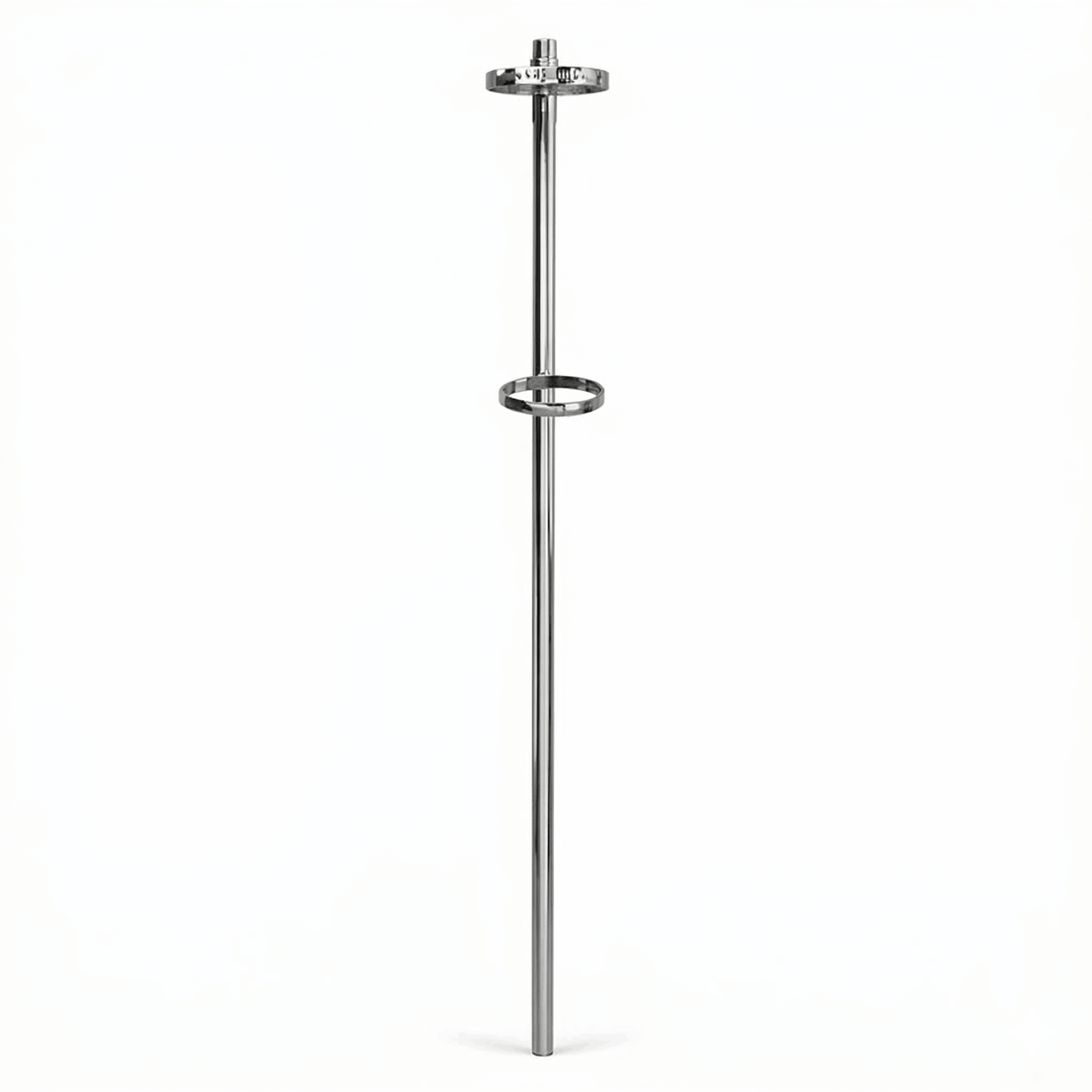
Applied Physics supports both approaches. Our cleanroom foggers, including LN2 ultrapure and ultrasonic models, enable high-quality smoke studies that produce reliable evidence for regulatory audits. Our support equipment, including the Support Rod/Arm Extender (80mm) for reaching elevated work areas, makes smoke study execution more efficient and accurate. For facilities conducting CFD modeling, our team understands the regulatory expectations and helps ensure that physical validation studies align with modeling predictions.
The combined approach also addresses a critical gap: CFD models assume ideal conditions, but real cleanrooms operate with variability. Personnel move, doors open, equipment cycles. Smoke studies conducted under these realistic operating conditions reveal how your cleanroom actually performs when in use. This real-world validation is what regulators ultimately care about.
CFD modeling optimizes design; smoke studies validate performance. Using both methods means you catch design problems before construction and confirm that your cleanroom works as intended during operation. This dual approach minimizes both design risk and operational risk.
Conclusion
The choice between digital airflow modeling and smoke studies isn’t either/or, it’s both/and. CFD modeling is invaluable for design optimization and rapid iteration during the planning phase. Smoke studies are essential for regulatory compliance and real-world performance validation. They serve different purposes at different stages of your cleanroom’s lifecycle.
For regulated facilities in pharmaceutical, semiconductor, and biotech manufacturing, the regulatory expectation is clear: you need documented physical evidence of airflow validation. That evidence comes from smoke studies. CFD modeling strengthens your validation package by demonstrating rigorous design methodology, but it cannot replace physical validation.
The most effective facilities use CFD to design their cleanrooms optimally, then use smoke studies to validate that the design works in their actual operating environment. This approach minimizes risk, satisfies regulatory requirements, and ensures your cleanroom maintains the contamination control your products and processes demand.
At Applied Physics, we’ve supported cleanroom validation for facilities across pharmaceutical, semiconductor, and biotech industries since 1992. Our cleanroom foggers and specialized equipment enable precise airflow visualization and smoke study execution that meets regulatory standards. Whether you’re designing a new cleanroom, validating an existing space, or preparing for regulatory audit, we help ensure your airflow validation is thorough, documented, and compliant. Contact us to discuss your cleanroom validation needs and how our solutions support both design optimization and operational compliance.
Frequently Asked Questions
What is the primary difference between digital airflow modeling and smoke studies?
Digital airflow modeling uses Computational Fluid Dynamics (CFD) software to simulate airflow patterns before or after construction, predicting how air moves through cleanroom spaces. Smoke studies involve releasing visible fog into an operating cleanroom to observe actual airflow behavior in real time. CFD provides predictive analysis and can model multiple scenarios; smoke studies show real-world conditions but only capture a single moment. Both serve different validation purposes under GMP compliance frameworks.
Can digital airflow modeling alone satisfy GMP audit requirements for smoke study validation requirements?
Digital modeling alone typically cannot fully replace smoke studies for regulatory approval. GMP guidance and ISO 14644 standards require physical evidence of airflow patterns in the actual operating environment. However, CFD modeling strengthens validation packages by demonstrating design intent and identifying risk zones before physical testing. Most facilities use digital modeling to guide smoke study placement and interpretation, then conduct smoke studies to confirm predictions. Regulators view this combined approach as more defensible than either method alone.
How much faster is digital modeling compared to conducting a full smoke study?
Digital CFD modeling can produce initial airflow simulations in days to weeks, depending on cleanroom complexity. Smoke studies typically require 2-5 days of setup, execution, video documentation, and analysis. However, digital modeling requires upfront investment in 3D room geometry and simulation time, while smoke studies can begin immediately in existing spaces. For facilities planning renovations or new construction, CFD saves time by identifying optimal HVAC configurations before installation. For validating existing cleanrooms, smoke studies deliver faster answers if you need results within days.
What are the main limitations of traditional smoke studies in cleanrooms?
Smoke studies depend on operator skill, fog placement, camera angle, and lighting significantly affect result quality. They capture only one moment in time and cannot easily model future scenarios or design changes. Smoke can interfere with sensitive processes, creating contamination risk in active manufacturing areas. Video interpretation is subjective, making audit defensibility harder. Additionally, smoke studies require the cleanroom to be fully operational, which means downtime costs. They also cannot reveal particle dispersion patterns or quantify air velocity precisely, only visualize directional flow.
Is digital airflow modeling worth the investment for a smaller pharma operation?
For smaller operations, the ROI depends on facility size and validation frequency. Digital modeling costs between $15,000 and $30,000 for a small cleanroom, but becomes cost-effective if you conduct multiple validations or plan facility expansions. If your cleanroom is stable and rarely changes, smoke studies may be more economical. However, if you face pressure to reduce downtime, need to defend designs to regulators, or plan to scale operations, CFD modeling justifies the investment. Many smaller pharmacies partner with contract validation firms that spread modeling costs across multiple clients, making it more affordable.