Validating Laminar Flow in BSCs and Isolators Using the Portable CRF2 Cleanroom Fogger
In controlled environments like Biosafety Cabinets (BSCs), isolators, and glove boxes, maintaining laminar airflow is critical for protecting both the product and the operator.
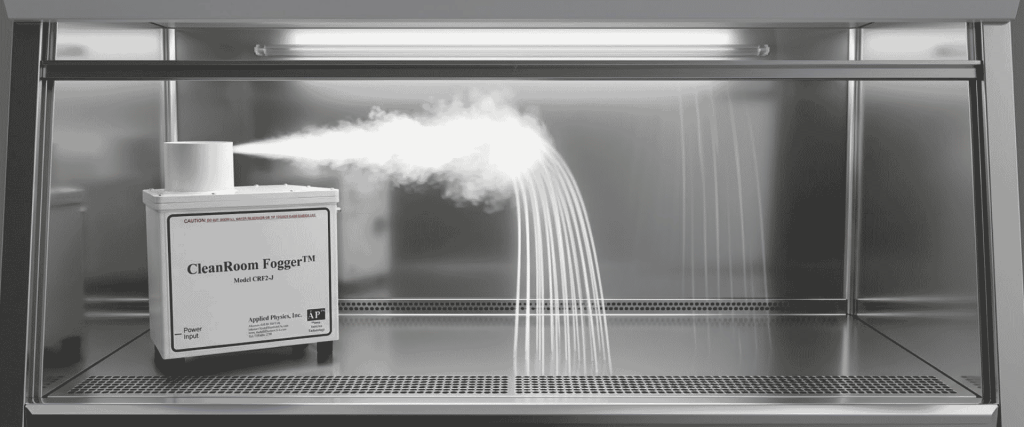
The CRF2 Cleanroom Fogger from Applied Physics has emerged as a standard tool for airflow visualization, allowing technicians to verify that air moves smoothly without turbulence or dead zones.
By generating a high-visibility fog from ultrapure water, this portable device provides a non-contaminating method to comply with ISO 14644-3 Annex B7 and USP <797> standards.
The Role of Airflow Visualization in Controlled Environments
Airflow visualization, commonly referred to as a smoke study, uses a visible medium to map the path of air.
In a BSC or an isolator, air must move in a unidirectional, laminar fashion. If turbulence occurs, contaminated air can recirculate, compromising the sterile field.
Key Features of the CRF2 Cleanroom Fogger
The CRF2 is engineered specifically for small- to medium-sized containment spaces where large-format foggers are impractical.
Validating Biosafety Cabinets and Isolators
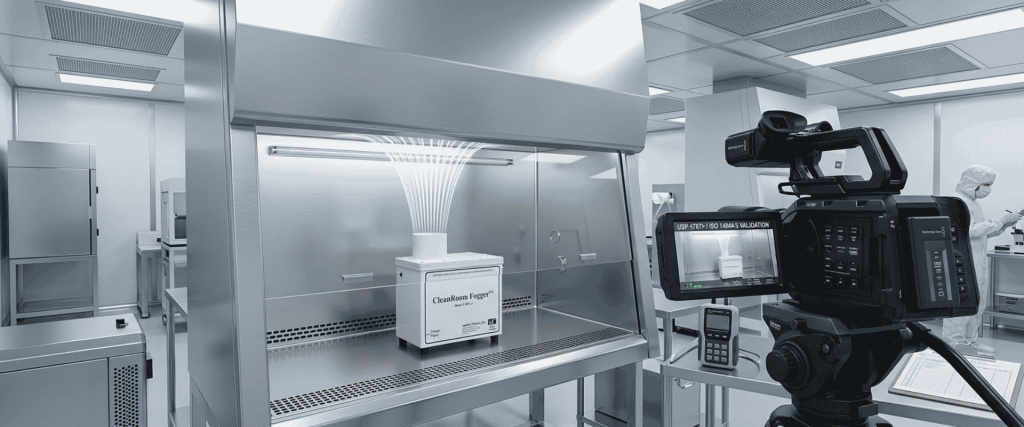
During BSC testing, technicians place the CRF2 either inside or outside the work zone depending on the protocol, directing the fog via a flexible delivery hose. Observing mist behavior along work surfaces and the sash opening confirms the laminar air curtain is intact and free of vortices.
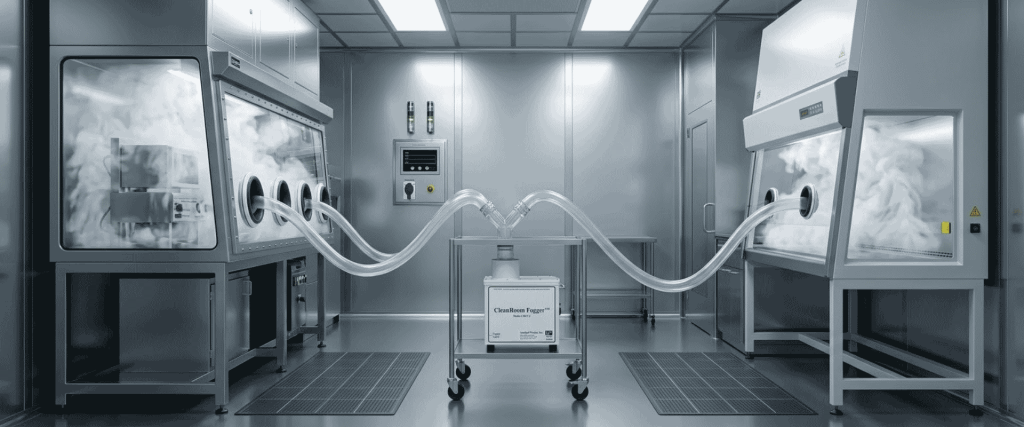
For isolators and glove boxes with restricted interior access, the CRF2’s compact footprint allows placement directly inside the chamber or connection via an external sanitary port. The dense mist highlights leaky perimeter seals, compromised glove ports, and disruptions along unidirectional airflow planes.
Technical Comparison: CRF2 vs. Alternative Foggers
Operational Efficiency and Compliance
Regulatory agencies such as the FDA, alongside USP standards, mandate verifiable documentation of airflow integrity. Because the CRF2 generates a crisp, dense white mist, airflow paths show clearly on high-definition video, simplifying audit documentation.
Furthermore, the ultrasonic transducer generates uniform droplets between 5 and 10 microns in diameter. At this size, the droplets remain neutrally buoyant long enough to trace airflow paths precisely rather than precipitating prematurely onto critical work surfaces.
The CRF2 Cleanroom Fogger provides an optimal balance of portability, pure-water safety, and optical clarity for regular smoke studies in containment equipment, supporting continuous compliance and contamination control.
Frequently Asked Questions (FAQs)
1. What type of water should be used in the CRF2?
Use Deionized (DI) water or Water for Injection (WFI). Standard tap water contains minerals that foul ultrasonic transducers and introduce unwanted particulates into sterile zones.
2. Does the CRF2 fog leave residue on sensitive electronics or instruments?
No. Because the fog is generated exclusively from high-purity water, it evaporates without oily, chemical, or salt residues, making it safe for electronics, optics, and pharmaceutical apparatus.
3. How long does a single water fill run?
Depending on the output volume setting, a full reservoir provides roughly 50 to 60 minutes of continuous fog generation, ample time to complete multi-angle video smoke studies.
4. Can the CRF2 validate large, open cleanrooms?
The CRF2 is tailored for localized volumes (BSCs, pass-throughs, isolators). For entire cleanroom suites, larger units like the CRF4 deliver the higher vapor volume required to fill macro spaces.
APPLIED PHYSICS TECHNICAL RESOURCE
Continue from the technical question to the application
Airflow visualization, smoke studies, tracer delivery, particle monitoring and controlled-environment validation. Product and standards references should be interpreted for the actual instrument, facility, protocol and configuration.