
Decontaminating a compact isolator with Vaporized Hydrogen Peroxide is routine; scaling that protocol past 100,000 cubic feet is where engineering teams hit a wall.
Extended pre-dehumidification cycles, condensation risks on critical electronics, and massive multi-generator costs turn large-scale VHP deployment into an operational bottleneck.
Sub-micron dry fogging changes this dynamic entirely, using 7.5-micron non-wetting droplets that disperse like a gas to treat massive production halls without surface pooling.
Here is how Dry Fog and VHP compare when facility downtime, utility infrastructure, and 6-log sporicidal validation are on the line.
The primary distinction between Dry Fog and VHP lies in how the chemical agent transitions from the liquid reservoir into the room atmosphere.
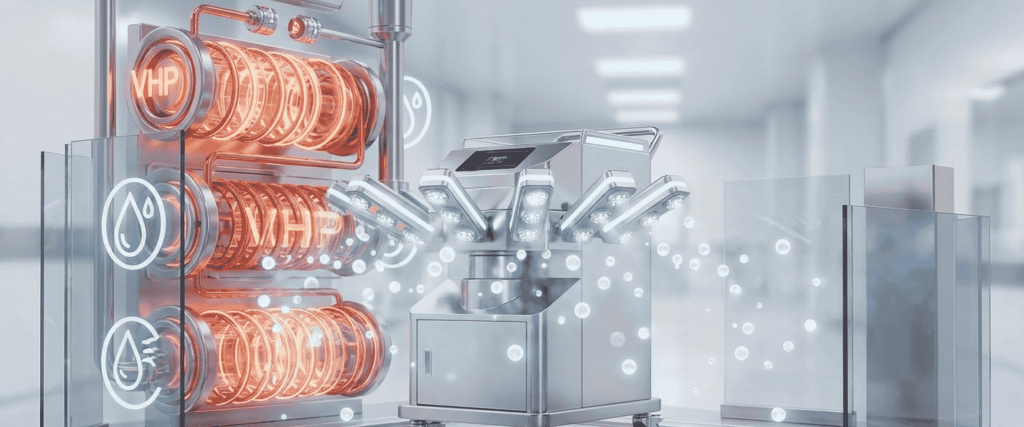
VHP systems vaporize concentrated hydrogen peroxide (typically 30% to 35% liquid $\text{H}_2\text{O}_2$) by flashing it over a heated element.
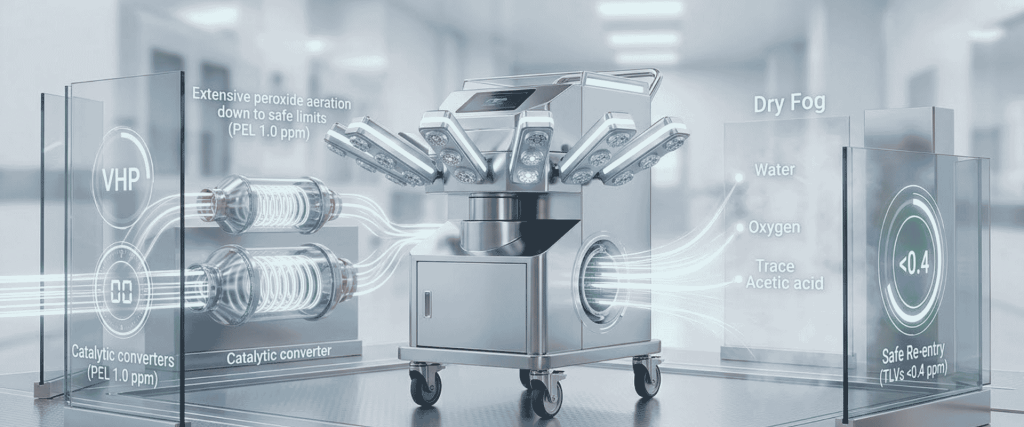
The resulting gas is injected into the target area, circulated, held for a specified dwell time, and then passed through catalytic converters to break the peroxide down into oxygen and water vapor.
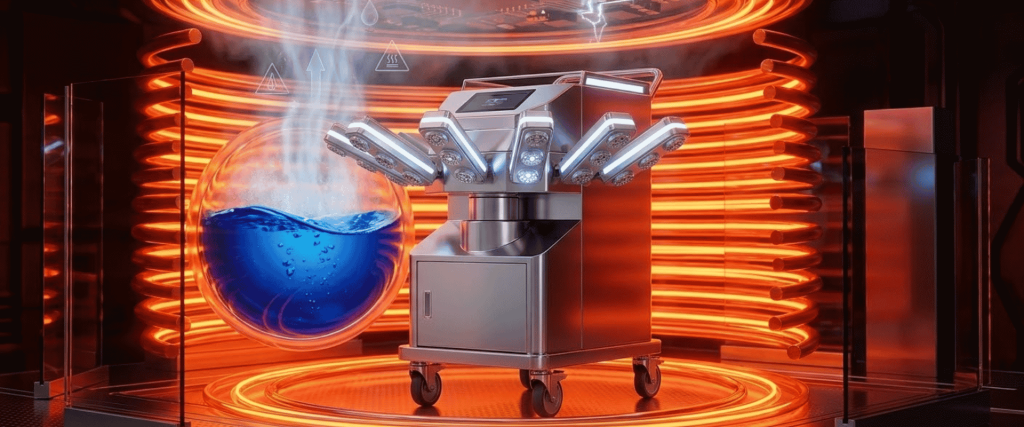
Because VHP functions as a true gas, it distributes effectively inside sealed, restricted volumes. However, maintaining true vapor phase requires tight environmental control.
If the relative humidity (RH) in the room rises to the dew point, the peroxide vapor rapidly condenses onto surfaces.
Micro-condensation can accelerate material degradation, corrode unpassivated metals, and trigger short circuits in active equipment.
Consequently, VHP cycles require an extensive pre-dehumidification phase to drive room RH down (often below 30–40%) before chemical injection can begin.
Sub-micron dry fogging systems, such as the DF4S DryFog Decontamination Fogger, use high-velocity compressed air to shear liquid sterilant mechanically, typically stabilized peracetic acid (PAA) and hydrogen peroxide solutions, into uniform aerosol droplets averaging 7.5 microns in diameter.

At 7.5 microns, the physical behavior of the droplet changes fundamentally:
Because dry fogging does not require boiling a liquid, it does not mandate aggressive pre-dehumidification cycles before deployment.
Facility downtime directly affects production yield. When planning a bio-decontamination cycle, three phases must be calculated: conditioning/injection, dwell time, and aeration.
Scale is where the gap between these two technologies becomes most pronounced.
VHP generators are mechanically complex. A single mobile VHP unit generally maxes out its effective coverage between 10,000 and 35,000 cubic feet.

To decontaminate an industrial production floor measuring 200,000 to 1,000,000 cubic feet, a facility must either:
The DF4S DryFog system was specifically engineered for large footprints, scaling from 100,000 up to 3,000,000 cubic feet in a single integrated operational framework.
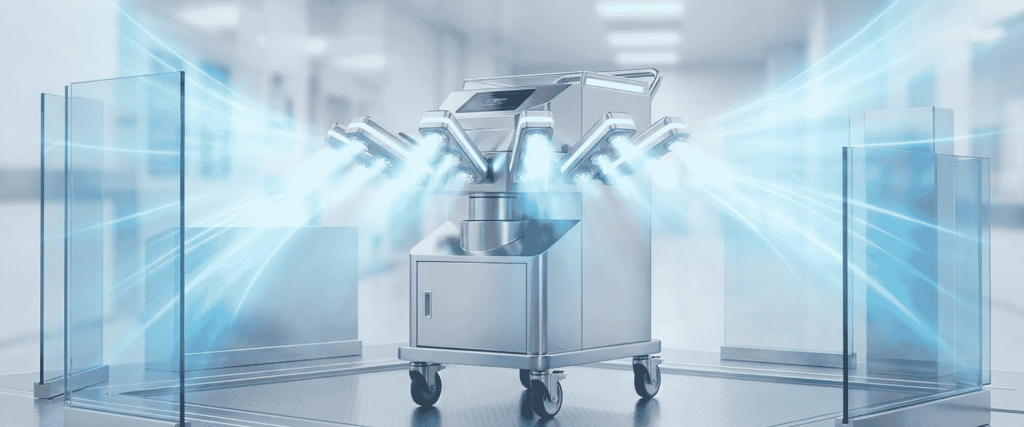
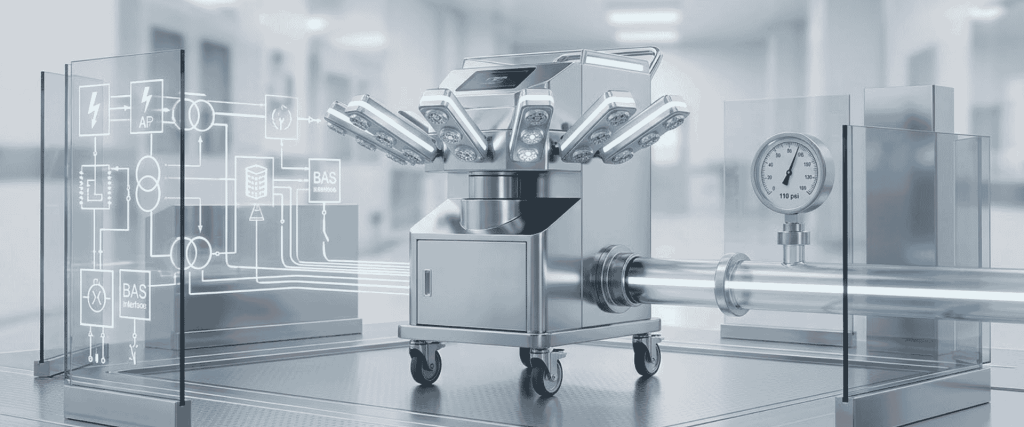
Constructed from 316L electro-polished stainless steel, the DF4S relies on an array of high-output atomizing nozzles driven by dry, oil-free compressed air (60 to 250 SCFM at ~110 psi). Instead of relying on heat, the system drives immense volumetric flow rates, filling large processing halls evenly.
With options for automated reservoir replenishment, continuous cycle execution, and remote wireless control, operators can treat massive facilities from central staging areas without entering the active chemical zone.
The table below outlines key engineering, operational, and capital parameters:
| Engineering Parameter | Traditional VHP Systems | DF4S DryFog System |
| Primary Mechanism | Thermal flash vaporization ($\text{H}_2\text{O}_2$ gas) | Pneumatic cold atomization (7.5 µm dry aerosol) |
| Typical Working Volume | 5,000 – 35,000 cu. ft. per generator | 100,000 – 3,000,000 cu. ft. |
| Pre-Conditioning Phase | Required (dehumidify to 30–40% RH) | Minimal (tolerates standard ambient RH) |
| Capital Equipment Cost | High to Very High ($$$$) \vert{} Moderate ($$) | |
| Utility Dependencies | Dedicated high-amperage power, HVAC integration | Clean, dry compressed air (60–250 SCFM at 110 psi) |
| Surface Wetting Risk | Moderate (if dew point is crossed during dwell) | Low (droplets bounce due to surface tension) |
| Chemical Delivery Agents | Concentrated $\text{H}_2\text{O}_2$ (typically 35%) | EPA-registered sterilants (e.g., PAA / $\text{H}_2\text{O}_2$ blends) |
| Maintenance Profile | Complex (heating elements, vapor sensors, blowers) | Low (nozzles, passive fluid paths, no heating parts) |
| Regulatory Validation | 6-log reduction (G. stearothermophilus) | 6-log reduction (G. stearothermophilus) |
Regulatory compliance under USP <1072> (Disinfectants and Antiseptics) and EU GMP Annex 1 requires consistent, documented microbial reduction regardless of the delivery method.
Both technologies are evaluated using Geobacillus stearothermophilus biological indicators (typically $10^6$ spore populations).
In spaces with complex architectural layouts, such as mezzanines, return air plenums, and dense process piping, standard VHP flow paths can produce shadow zones where gas velocity drops, leading to incomplete kill rates on shadowed BIs.
Because the DF4S releases billions of micro-droplets that float on room air currents via Brownian motion, the fog acts much like a natural gas, spreading evenly into low-flow areas and dead corners.
When operated with appropriate biocides, dry fogging consistently delivers a 6-log sporicidal kill (>99.9999%), meeting the requirements for aseptic processing areas and biosafety facilities.
Both VHP and Dry Fog are effective, validated methods for facility bio-decontamination.
However, when cleanroom operations scale past the 100,000 cubic foot threshold, standard VHP systems become complex and cost-prohibitive.
The DF4S DryFog Decontamination Fogger bridges this gap.
By combining cold pneumatic atomization, non-wetting 7.5-micron droplet physics, and high-volume output, it delivers 6-log sporicidal decontamination across massive facilities without the high capital investment, long pre-dehumidification cycles, or condensation hazards of traditional vapor systems.
No. The DF4S produces droplets averaging 7.5 microns in size. Droplets this small bounce off surfaces due to surface tension rather than bursting. They evaporate rapidly into the surrounding air, avoiding the liquid condensation and pooling associated with ordinary sprayers or oversaturated vapor cycles.
The DF4S requires clean, dry, oil-free compressed air delivering between 60 and 250 SCFM at approximately 110 psi, depending on the nozzle configuration. Using instrument-grade air prevents contamination of cleanroom HEPA filter networks.
Yes. When paired with EPA-registered sporicides (such as Minncare or hydrogen peroxide formulations), the DF4S validates to a 6-log ($>99.9999\%$) kill rate against resistant bacterial endospores like Geobacillus stearothermophilus, satisfying USP <1072> and GMP standards.

Enter your details below to save your shopping cart for later. And, who knows, maybe we will even send you a sweet discount code :)
Allow notifications to get real-time updates about your shopping cart and who knows, you may even receive a sweet discount code 😊