How does HEPA filtration in fume hoods help prevent cross-contamination?
Maintaining sterile environments is a core requirement in pharmaceutical manufacturing, semiconductor fabrication, and clinical diagnostics.
Laboratories rely heavily on specialized containment enclosures to protect technicians, sensitive samples, and the surrounding environment from hazardous materials and particulate matter.
Understanding how air protection systems manage airflow is essential for minimizing batch failures and ensuring regulatory compliance.
HEPA Filtration Prevents Cross-Contamination in Laboratory Hoods
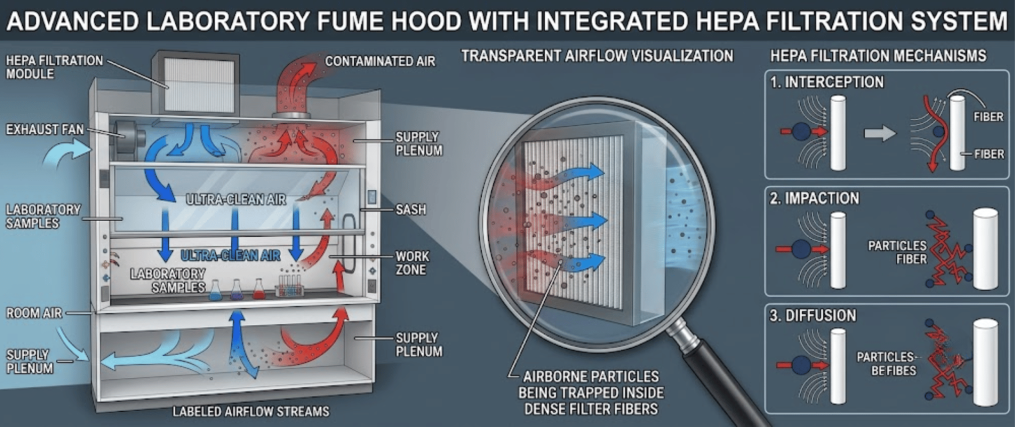
To understand how High-Efficiency Particulate Air (HEPA) filtration prevents cross-contamination within a laboratory hood, it helps to distinguish between a standard chemical fume hood and a ducted, recirculating, or biosafety enclosure.
Standard chemical hoods pull air away from the user to vent chemical fumes outside. However, when specialized hoods incorporate HEPA filters, they actively target micro-particles, bacteria, and fungal spores.
By forcing air through a dense mat of randomly arranged borosilicate glass fibers, a HEPA filter captures at least 99.97% of particles down to a diameter of 0.3 microns. In a recirculating or laminar flow configuration, the hood continuously floods the work surface with this ultra-clean, particulate-free air.
This constant downward or horizontal positive pressure grid creates a predictable air wall. It prevents ambient laboratory contaminants from entering the workspace while simultaneously ensuring that particles generated during one procedure are rapidly swept into the exhaust or filtration plenum, preventing them from settling onto adjacent samples or tools.
Key Enclosure Types and Filter Configurations
Different laboratory workflows demand specific airflow geometries. Selecting the wrong hood configuration can lead to sample contamination or operator exposure.
Best Practices for Maintaining Filter Integrity
An air protection system is only as reliable as its underlying filtration stack. To prevent bypass leaks and maintain optimal face velocities, facilities must establish rigid maintenance protocols.
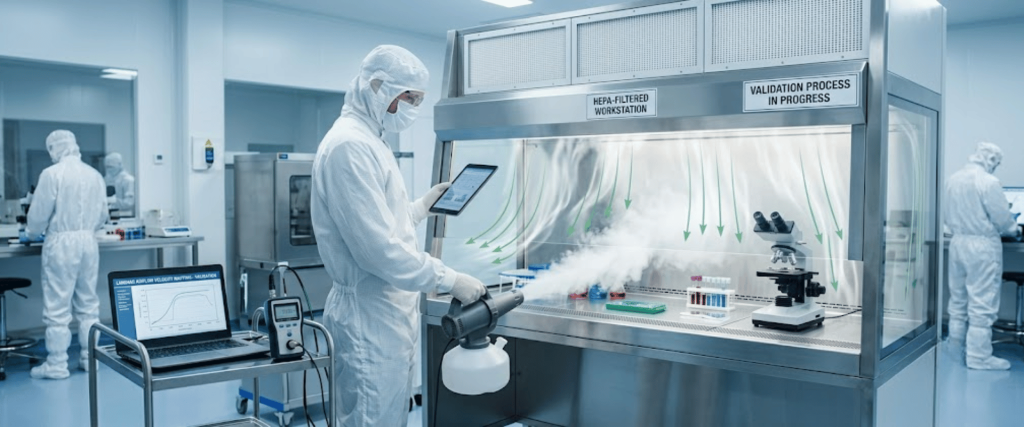
Regular Airflow Velocity Mapping
Technicians should routinely use air smoke studies or cleanroom foggers to visualize airflow vectors. This verifies that no localized turbulence is disrupting the laminar air wall.
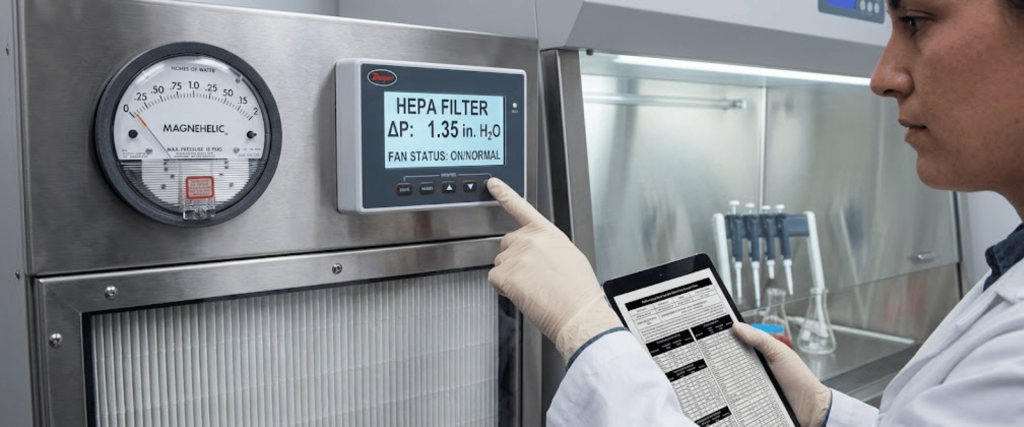
Differential Pressure Monitoring
Built-in magnehelic gauges or digital sensors measure the pressure drop across the HEPA filter. A significant rise in pressure indicates that the filter is loading with particulates and nearing the end of its operational lifespan.
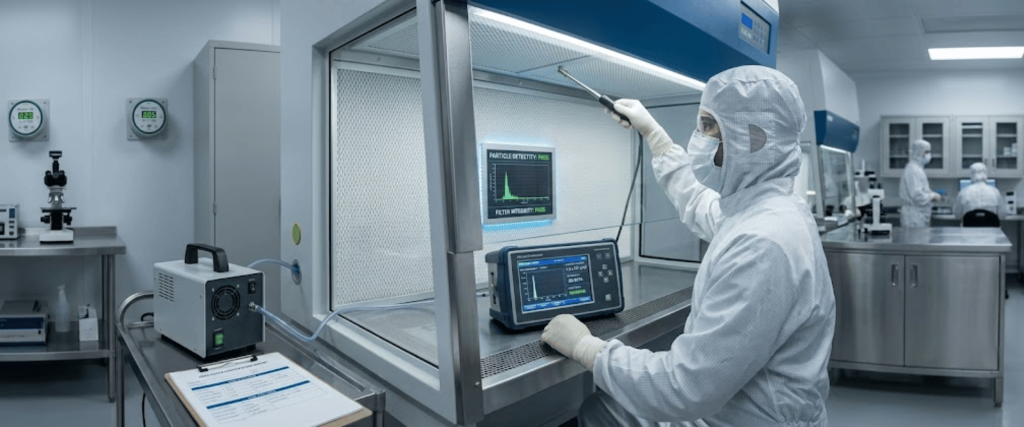
Certification and Leak Testing
Enclosures require professional certification at least annually or whenever a filter is replaced. Aerosol photometer testing ensures that no pinhole leaks exist in the filter media or along the housing gaskets.
Conclusion
HEPA filtration stands as a foundational defense against particulate cross-contamination in modern laboratories.
By utilizing precise fiber physics to trap sub-micron particles, filtered hoods establish a reliable barrier that protects both sensitive scientific workflows and personnel.
Investing in high-quality containment systems, monitoring airflow patterns, and sticking to strict certification timelines ensures long-term operational accuracy, high sample yields, and unwavering regulatory compliance.
Frequently Asked Questions (FAQs)
1. What is the difference between a HEPA filter and an ULPA filter?
HEPA filters remove at least 99.97% of airborne particles down to 0.3 microns in size. Ultra-Low Penetration Air (ULPA) filters deliver higher efficiency, capturing at least 99.999% of airborne particulates down to a smaller threshold of 0.12 microns, making them common in advanced semiconductor manufacturing.
2. How often should HEPA filters in lab hoods be replaced?
Under typical laboratory conditions, a HEPA filter lasts between 3 and 5 years. However, this timeline varies based on total operating hours, room air cleanliness, and whether adequate pre-filters are used to trap larger dust particles before they reach the main HEPA matrix.
3. Do standard chemical fume hoods always have HEPA filters?
No. Standard chemical fume hoods are designed to exhaust toxic gases, vapors, and fumes safely outside the building through ductwork, meaning they typically do not require particulate filtration. HEPA filters are utilized when the process involves dangerous particulates, biological agents, or samples that require strict protection from cross-contamination.