
Last Updated: September 30, 2026
Condensation in cleanroom environments isn’t just a minor inconvenience, it’s a contamination vector that can compromise your entire operation. When moisture accumulates on surfaces, equipment, or materials, it creates an ideal breeding ground for microbial growth and can degrade product integrity. For pharmaceutical manufacturers, semiconductor fabs, and biotech facilities, this means failed batches, regulatory violations, and costly downtime.
The problem accelerates when temperature fluctuations occur. A surface cooler than the surrounding air will collect moisture. This happens constantly in cleanrooms with inadequate thermal insulation or poor HVAC design. The result: validation failures, GMP audit findings, and equipment corrosion that spreads across your facility.
Watch Out Condensation buildup accelerates microbial colonization. Studies show that surfaces with moisture accumulation see microbial counts increase 10-100 fold within 48 hours compared to dry surfaces.
Dew point is the temperature at which air becomes saturated and water vapor condenses into liquid. It’s the foundation of preventing condensation in cleanroom testing. If your surface temperature drops below the dew point, moisture will form, regardless of how well your HVAC system performs.
Dew point depends on both temperature and relative humidity. At 72°F and 50% relative humidity, the dew point is around 52°F, any surface colder than this will collect moisture. Most operators focus on humidity setpoints but neglect to calculate surface temperature implications, creating a gap where condensation problems hide.
According to PDA guidance on cleanroom environmental parameters, standard cleanroom temperature ranges between 64°F and 77°F, while relative humidity should stay between 30% and 65%. But here’s what matters: your equipment surfaces must stay above the dew point at all times. A stainless steel workbench or ultrapure water line can easily drop 5-10°F below ambient temperature, creating condensation even when your sensors show acceptable humidity levels.
The practical fix requires three steps:
Pro Tip Use a handheld infrared thermometer to spot-check surface temperatures on equipment, pipework, and product contact surfaces. Compare these readings to your calculated dew point. If any surface sits within 5°F of dew point, you’re at risk.
ISO 14644 cleanroom classification doesn’t mandate specific humidity ranges, that’s determined by your process requirements and product specifications. But the standard does require you to document, control, and validate whatever humidity range you establish.
For most pharmaceutical and semiconductor applications, industry best practice guidelines from AC&H Engineering recommend maintaining relative humidity between 30% and 60% to prevent both condensation and static electricity buildup. Many facilities operate more conservatively at 40-60% relative humidity, which balances moisture control with electrostatic discharge (ESD) risk.
The challenge: the lower your humidity target, the higher your static electricity risk. The higher your humidity target, the greater your condensation risk. Finding that sweet spot requires understanding your specific process needs.
GMP compliance means documenting your humidity control strategy and proving it works. This includes:
USP standards for sterile compounding environments specify that facilities must maintain environmental conditions suitable for their specific operations. For many compounding pharmacies, this means 45-55% relative humidity. Drift below 30% or above 70% triggers investigation and corrective action.
The key insight most guides miss: your humidity target isn’t arbitrary. It should be tied directly to your dew point calculation and your equipment’s thermal characteristics. If your facility has significant temperature variations or cold surfaces, a higher humidity setpoint might actually increase condensation risk, not decrease it.
Preventing condensation in cleanroom testing requires humidity management, temperature stability, and airflow design working together.
Most cleanrooms maintain relative humidity between 30% and 50% according to Smart Fog industry analysis, which balances moisture prevention with static electricity control. The optimal range for your facility depends on your specific process, but this band works for most high-tech and life sciences applications.
Hitting this target requires proper dehumidification and humidification equipment. Your HVAC system must actively remove moisture during humid conditions and add moisture during dry periods. Many facilities underinvest in this capability, relying on passive humidity control that can’t respond to rapid changes.
Key strategies: install dedicated dehumidification separate from cooling, use desiccant dehumidifiers for dry climates, implement redundant humidification, set alarm limits at 35% and 65%, and validate quarterly under worst-case conditions.
Key Takeaway The difference between 50% and 55% relative humidity might seem small, but it can shift your dew point by 3-5°F, enough to trigger condensation on cold surfaces. Tighter control prevents this drift.
Temperature fluctuations drive condensation when surface temperatures lag behind ambient swings. A 5°F drop in 30 minutes can push surfaces below dew point despite stable humidity. This occurs during shift changes, equipment cycles, seasonal transitions, and door openings.
The solution is tight temperature control. Condair guidance on cleanroom climate control documents that many high-tech and life sciences facilities require ±2°F temperature stability to prevent condensation. This is tighter than most general HVAC systems can achieve, requiring dedicated precision climate control.
Specific tactics:
Airflow patterns directly influence where condensation forms. Poor air distribution creates stagnant zones where moisture accumulates. Laminar flow design prevents this by ensuring continuous air movement across all surfaces.
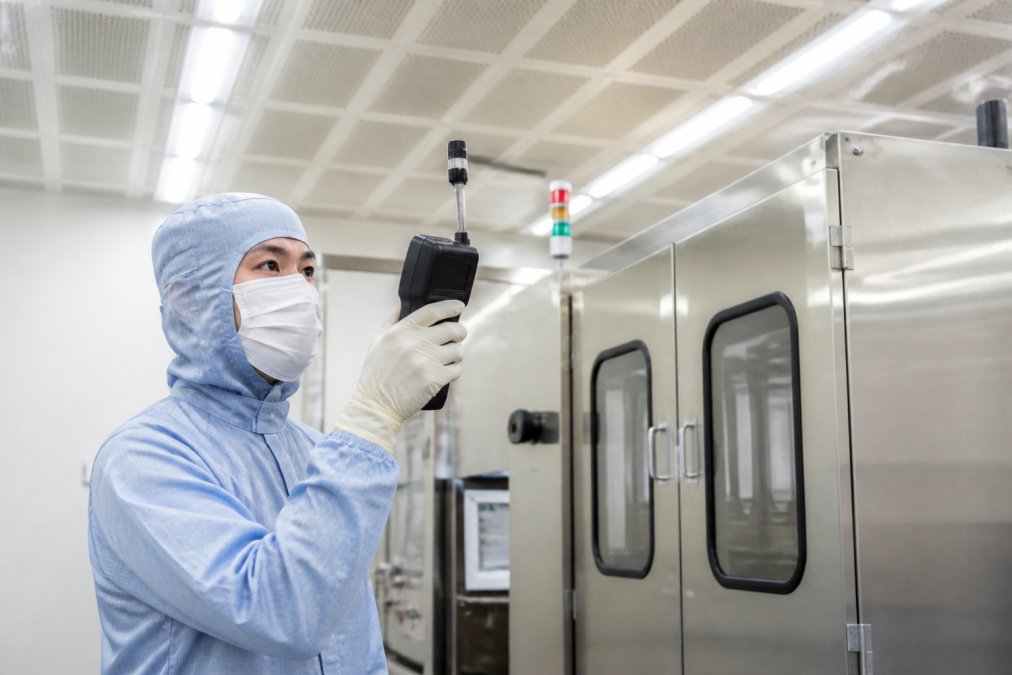
Technician using handheld particle counter device inside a cleanroom environment with visible airflow patterns and stainless steel equipment, professional lighting highlighting the measurement process
Airflow visualization tools let you see these patterns in real time. Smoke or fog tracers reveal dead zones, short-circuits, and turbulent regions where moisture can collect. This is where Applied Physics cleanroom foggers excel, they generate fog that shows airflow without interfering with your process or leaving residue.
Sensor placement is critical. Most facilities deploy a single central sensor, missing humidity gradients of 10-15% between zones and localized cold spots where condensation forms.
Deploy sensors at: supply air zones (verify dew point target), equipment zones within 6 inches of cold surfaces (condensation hotspots), return air zones (measure humidity load), and pressure-sensitive areas near doors. A 2,000-5,000 sq ft cleanroom requires 4-6 sensors minimum; larger facilities need 8-12. Sensor cost ($200-500 per unit) is negligible versus condensation event costs.
Real-time IoT systems with wireless sensors, cloud-based monitoring, and configurable alerts are essential. Set alert thresholds 3-5°F above calculated dew point to allow HVAC response before condensation forms. For example, if dew point is 48°F, alert at 51-53°F. Escalation protocols should notify facility manager, then HVAC technician, then trigger automatic corrective action (increase airflow, raise temperature setpoint).
Building management systems like Honeywell or Johnson Controls can automatically increase dehumidification or raise temperature setpoints when humidity approaches critical levels, preventing condensation during off-hours.
Automated corrective actions include: increase dehumidification by 20-30% for 30 minutes, raise temperature by 2-3°F, boost airflow to 110% for 15 minutes, and isolate affected zones. All actions are logged with timestamp, duration, and outcome for GMP compliance.
A single condensation event can destroy product. IoT monitoring systems can help prevent incidents.
Pro Tip Configure your IoT system to send alerts to your HVAC technician’s mobile device, not just email. Mobile alerts are checked within 5 minutes; emails may not be reviewed for hours. The 15-30 minute response window is critical.
HVAC design is critical. Laminar flow (parallel streams at uniform velocity) sweeps moisture away and prevents cold spots; turbulent flow creates stagnant eddies where condensation forms. Good design balances moisture control against energy costs.
According to ScienceDirect research on cleanroom air-conditioning design, pressure design serves as a primary factor in controlling internal temperature and humidity values. Cascading airflow design uses pressure differentials to maintain consistent conditions throughout the space.
Key design principles:
Watch Out Undersized return air capacity is a common mistake. If return air can’t keep up with supply, pressure builds and air bypasses critical zones. This creates stagnant pockets where condensation collects. Size return air capacity at least 10% larger than supply capacity.
Aggressive humidity control increases energy costs significantly. Dehumidification consumes energy through: cooling-then-reheating (3-5% increase per 1% humidity reduction), desiccant regeneration (20-30% of HVAC budget), and increased air changes (33% fan energy increase per 5 ACH increase). A 5,000 sq ft cleanroom with desiccant dehumidification costs $8,000-15,000 monthly in energy alone.
Most cleanrooms are oversized for dehumidification, cycling inefficiently. Staged capacity is more cost-effective: primary dehumidification sized for baseline load (50-60% of worst-case), plus secondary capacity activating when humidity approaches setpoint. This reduces energy 20-30% versus oversized single-stage systems. Example: 3,000 sq ft cleanroom with 15 lbs/hr baseline and 25 lbs/hr peak should have primary (15-18 lbs/hr) plus secondary (10-12 lbs/hr). Upfront cost $5,000-8,000; annual savings $15,000-25,000. Implementing these modular controls provides a scalable framework to reduce room humidity across various environments, including residential spaces where similar principles of load management apply.
Lower humidity setpoints increase energy costs non-linearly: 50% to 45% RH increases energy 8-12%; 45% to 40% increases another 10-15%. Most facilities operate at 45-55% RH, balancing condensation prevention (10-15°F dew point margin), ESD control, and energy efficiency. Below 40% RH causes unintended consequences: increased ESD failures, product degradation, equipment corrosion, and operator discomfort.
Condensation doesn’t only form on visible surfaces; it also forms inside HVAC ductwork. Cold supply ducts passing through warm spaces (like unconditioned attics or exterior walls) can develop condensation on the inside, which drips onto product or equipment below.
Duct insulation requirements:
A common failure: ducts routed through attics or mechanical rooms without adequate insulation. In summer, a 55°F supply duct in a 95°F attic will sweat profusely. The condensation drips into the cleanroom below, creating contamination. Proper insulation prevents this entirely.
Key Takeaway The most cost-effective condensation prevention strategy combines moderate humidity control (45-55% RH), staged dehumidification capacity, proper duct insulation, and real-time monitoring. This approach costs 20-30% less to operate than aggressive single-stage dehumidification while maintaining equivalent condensation prevention.
Cold equipment surfaces are condensation magnets. Thermal insulation reduces temperature differentials and keeps surfaces closer to ambient air temperature. This simple principle prevents most surface condensation problems.
Priority areas for insulation:
Insulation materials matter. Use closed-cell foam or fiberglass rated for cleanroom use, materials that don’t shed particles or support microbial growth. Vapor barriers on the outside of insulation prevent moisture from penetrating the insulation itself.
Stainless steel equipment deserves special attention. Steel conducts heat rapidly, so a stainless steel workbench or equipment frame can drop 10-15°F below ambient temperature if exposed to cold air currents. Wrapping these components with thermal insulation or redirecting airflow around them prevents condensation without compromising cleanliness.
Even with perfect design, condensation occasionally occurs. Real-time monitoring catches it fast. Post-condensation remediation protocols ensure you respond correctly and prevent product loss.
Applied Physics offers solutions designed specifically for this challenge. The Cleanroom Monitoring System (CRMS) provides continuous monitoring of temperature, humidity, and particle counts. When humidity spikes or temperature drops, you get immediate alerts before condensation forms. For facilities requiring sub-10nm particle detection, the Handheld Condensation Particle Counter Model 3800 delivers precision measurements.
Remediation steps when condensation occurs:
The critical timeline: most microbial growth takes 4-6 hours after moisture forms. If you detect and remediate condensation within 2 hours, contamination risk drops dramatically.
| Response Action | Timeline | Impact |
|---|---|---|
| Detect condensation via monitoring | 0-15 minutes | Prevents product contact |
| Isolate affected area | 15-30 minutes | Limits contamination spread |
| Increase airflow and adjust setpoints | 30-60 minutes | Removes moisture before microbial growth |
| Microbial sampling (if needed) | 2-4 hours | Confirms contamination status |
| Resume operations after verification | 4-6 hours | Minimizes downtime |
GMP facilities must validate their condensation prevention strategy. This means documented evidence that your humidity control, temperature stability, and airflow design actually prevent condensation under normal and worst-case conditions.
Validation includes:
The Microbial Air Sampler 3080 Series supports validation by detecting airborne contamination that might result from condensation events. Regular sampling provides objective evidence of environmental control.
Documentation requirements:
Most facilities underestimate the documentation burden. Your validation report should be 50-100 pages, not 10. Regulators expect detailed evidence, not a summary.
Preventing condensation in cleanroom testing isn’t a one-time project, it’s an ongoing operational discipline. Temperature stability, humidity control, airflow design, and real-time monitoring work together to keep moisture off your surfaces and your processes on track. Applied Physics provides the monitoring and visualization tools that turn this discipline into measurable results. Contact us today to discuss how cleanroom airflow visualization and precision particle metrology can strengthen your contamination control strategy and support your GMP compliance.
Condensation forms when air temperature drops below the dew point, causing water vapor to condense on surfaces. In cleanrooms, this occurs when warm, humid air contacts cold equipment, pipes, or chamber walls. Temperature fluctuations, inadequate HVAC control, and relative humidity above 65% accelerate condensation risk. Preventing condensation in cleanroom testing requires maintaining stable temperature (64-77°F) and controlling relative humidity between 30-60% to keep surfaces above the dew point.
Dew point is the temperature at which air becomes saturated and water condenses. If your cleanroom maintains 50% relative humidity at 72°F, the dew point is approximately 52°F. Any surface cooler than 52°F will accumulate moisture. Preventing condensation requires calculating the dew point for your current temperature and humidity, then ensuring all equipment surfaces remain above it. Real-time monitoring systems alert operators when dew point approaches equipment temperature, enabling corrective action before condensation occurs.
ISO 14644 standards specify that cleanrooms maintain relative humidity between 30% and 65%, with most high-tech and life sciences facilities operating at 40-60% to balance static electricity control and condensation prevention. Humidity below 30% increases electrostatic discharge risk on sensitive materials, while levels above 65% promote microbial growth and condensation. The PDA (Parenteral Drug Association) recommends 30-50% for optimal cleanroom performance, particularly in pharmaceutical manufacturing and semiconductor fabrication where moisture-sensitive materials are processed.
Use continuous environmental monitoring systems that track temperature, relative humidity, and dew point in real time. The Cleanroom Monitoring System – Model CRMS integrates particle counters, differential pressure sensors, and environmental probes to provide immediate alerts when conditions approach condensation thresholds. Handheld devices like the Handheld Condensation Particle Counter – Model 3800 allow spot checks of moisture levels. Airflow visualization tools help identify cold spots where condensation accumulates. Regular validation with these tools catches problems before they compromise GMP compliance or product integrity.
APPLIED PHYSICS TECHNICAL RESOURCE
Airflow visualization, smoke studies, tracer delivery, particle monitoring and controlled-environment validation. Product and standards references should be interpreted for the actual instrument, facility, protocol and configuration.

Enter your details below to save your shopping cart for later. And, who knows, maybe we will even send you a sweet discount code :)
Allow notifications to get real-time updates about your shopping cart and who knows, you may even receive a sweet discount code 😊