Description
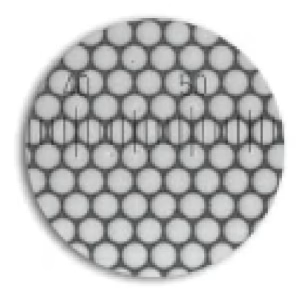
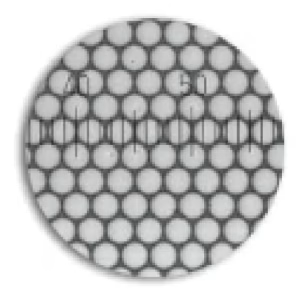
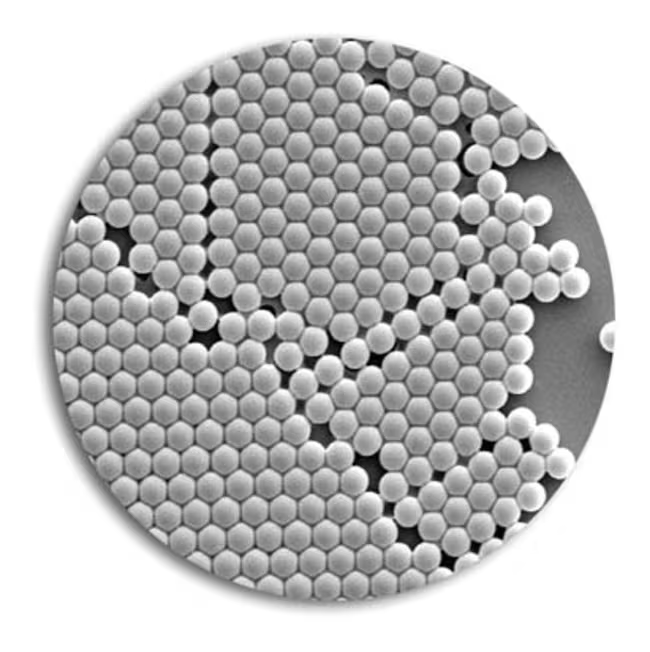
The 7000 Series consists of economical, high-concentration copolymer microsphere suspensions for experimental modeling, process validation, filtration challenges, and pilot-scale testing where calibration-grade standards are not required.
The particles are manufactured from polystyrene cross-linked with 4% to 8% divinylbenzene (DVB). This cross-linking provides mechanical rigidity and resistance to alcohol washes, moderate shear, and vacuum- or air-drying procedures.
The suspensions contain 10% solids by weight in water, providing high particle counts per milliliter for large-volume testing, flow visualization, acoustic levitation, and fluid-transport studies.
Use limitation: The 7000 Series has broader size distributions, with a coefficient of variation below 20%. It is intended for experimental fluid dynamics and filter testing, not instrument calibration or diagnostic release testing. Those applications require narrower standards, such as the 2000, 3000, or 4000 Series.
Key features
- High particle concentration: 10% solids by weight in water for large-volume tests and challenge studies.
- Cross-linked PSDVB durability: 4% to 8% divinylbenzene improves mechanical rigidity and resistance to common laboratory alcohols and mild solvents.
- Near water-density behavior: A particle density of 1.05 g/cm3 helps reduce rapid buoyancy separation and excessive settling in aqueous flow experiments.
- Washable and recoverable: Particles can be filtered, rinsed with alcohol, and dried by air or vacuum.
- Flexible package volumes: Available in 15 mL bottles and 100 mL or 1000 mL bulk formats.
Specifications
| Parameter | Specification |
|---|---|
| Particle material | Polystyrene cross-linked with 4%–8% divinylbenzene (PSDVB) |
| Available diameters | 3.2, 6, 7.9, 12, 17, 19, 25, 45, 55, 71, 90, 97, 134, and 222 µm |
| Concentration | 10% solids by weight |
| Suspending medium | Deionized water with trace surfactant |
| Particle density | 1.05 g/cm3 |
| Refractive index | 1.59 at 589 nm, 25∘C |
| Size distribution | Uniformity peak, CV<20% |
| Available fill volumes | 15 mL, 100 mL, and 1000 mL |
| Storage temperature | 2∘C to 8∘C |
| Freezing | Do not freeze |
Part numbers and volume suffixes
Specify the base part number followed by the bottle-volume suffix:
- A: 15 mL
- B: 100 mL
- C: 1000 mL
| Base part number | Nominal diameter | Distribution | Solids concentration | Available volumes |
|---|---|---|---|---|
| AP7503 | 3.2 µm | CV<20% | 10% | 15 mL (A), 100 mL (B), 1000 mL (C) |
| AP7505 | 6.0 µm | CV<20% | 10% | 15 mL (A), 100 mL (B), 1000 mL (C) |
| AP7508 | 7.9 µm | CV<20% | 10% | 15 mL (A), 100 mL (B), 1000 mL (C) |
| AP7510 | 12.0 µm, approximately 11–12 µm | CV<20% | 10% | 15 mL (A), 100 mL (B), 1000 mL (C) |
| AP7516 | 17.0 µm | CV<20% | 10% | 15 mL (A), 100 mL (B), 1000 mL (C) |
| AP7520 | 19.0 µm | CV<20% | 10% | 15 mL (A), 100 mL (B), 1000 mL (C) |
| AP7525 | 25.0 µm | CV<20% | 10% | 15 mL (A), 100 mL (B), 1000 mL (C) |
| AP7545 | 45.0 µm | CV<20% | 10% | 15 mL (A), 100 mL (B), 1000 mL (C) |
| AP7550 | 55.0 µm | CV<20% | 10% | 15 mL (A), 100 mL (B), 1000 mL (C) |
| AP7575 | 71.0 µm | CV<20% | 10% | 15 mL (A), 100 mL (B), 1000 mL (C) |
| AP7590 | 90.0 µm | CV<20% | 10% | 15 mL (A), 100 mL (B), 1000 mL (C) |
| AP7602 | 97.0 µm | CV<20% | 10% | 15 mL (A), 100 mL (B), 1000 mL (C) |
| AP7640 | 134.0 µm | CV<20% | 10% | 15 mL (A), 100 mL (B), 1000 mL (C) |
| AP7725 | 222.0 µm | CV<20% | 10% | 15 mL (A), 100 mL (B), 1000 mL (C) |
Ordering examples
AP7503A: 3.2 µm, 15 mLAP7503B: 3.2 µm, 100 mLAP7503C: 3.2 µm, 1000 mL
Applications
- Filtration evaluation: Challenge woven-wire meshes, membrane filters, porous ceramics, and depth media to assess retention ratings and pore-size cutoffs.
- Fluid mechanics and PIV: Use as optical tracers for particle image velocimetry, turbulent-mixing models, and laser Doppler anemometry.
- Acoustic and optical systems: Model light scattering, acoustic levitation, and ultrasound backscattering.
- Dispersion and sedimentation studies: Evaluate mixing behavior, slurry transport, and settling rates in pilot-scale reactors.
Handling and storage
- Store upright at 2∘C to 8∘C.
- Keep the bottle tightly closed when not in use.
- Do not freeze. Freezing can disrupt the suspension and cause irreversible particle clumping.
- Before dispensing, gently invert the bottle 15 to 20 times or roll it to resuspend settled particles.
- A vortex mixer or brief, gentle ultrasonic treatment may be used to produce a homogeneous suspension.
- Dilute with deionized water, compatible mild surfactants, or short-chain alcohols such as ethanol and isopropanol according to the requirements of the test protocol.
Product relationship
Available Through Applied Physics
Applied Physics supplies and supports quotation of this product. Product branding and manufacturer information, where stated on the product page or supporting documentation, remain authoritative.
Applied Physics portfolio: Particle
Catalog relationship: Available Through Applied Physics
Related Applied Physics resources
Continue through the Particle portfolio
Use these technical and portfolio pages to compare applications and related equipment. To keep this exact product attached to an RFQ, use the product’s existing Request a Quote or Add To Order control.