
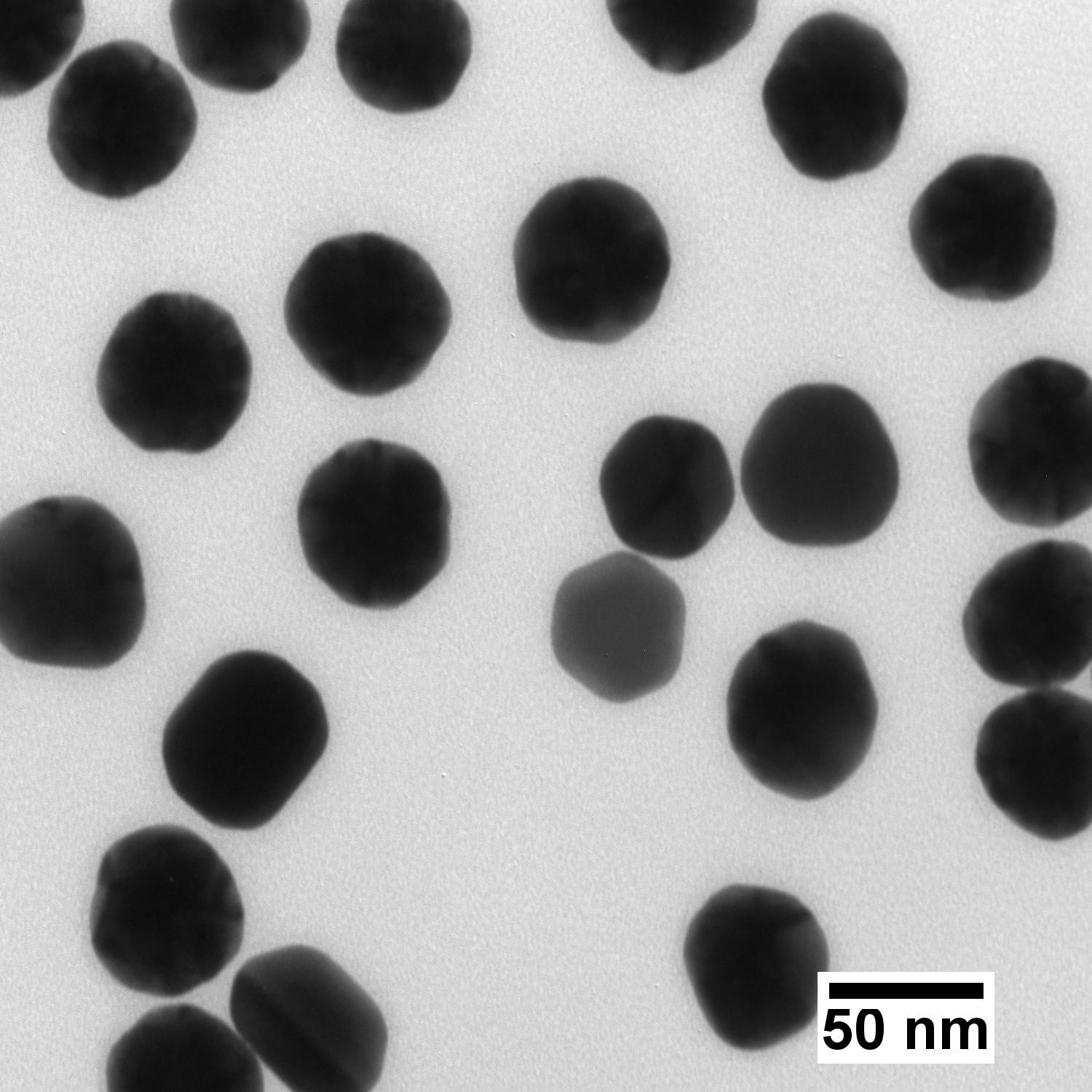
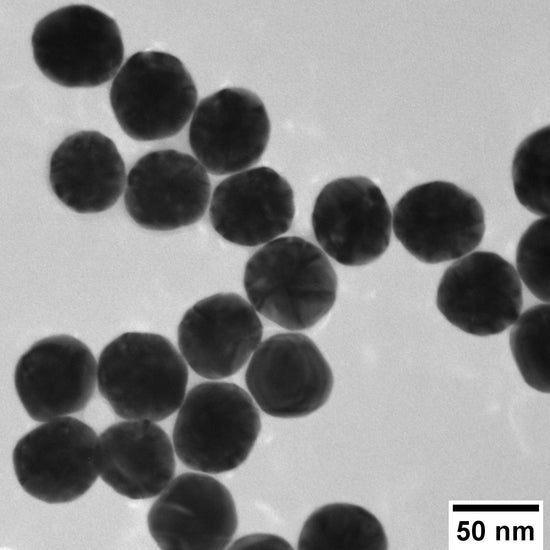
Description
Gold Nanospheres, BPEI-Coated
BPEI-coated gold nanospheres provide a stable, positively charged colloidal gold platform for cellular uptake, nucleic-acid delivery, molecular conjugation, and bio-nanotechnology applications.
The particles are coated with branched polyethylenimine (BPEI), a polycationic polymer containing primary, secondary, and tertiary amine groups. This shell gives the particles a strongly positive surface charge and provides two main functions:
- Electrostatic complexation: The positive surface binds negatively charged DNA, RNA, siRNA, mRNA, oligonucleotides, and related biomolecules.
- Covalent coupling: The abundant amine groups provide reaction sites for amine-reactive crosslinkers and for coupling to carboxyl-containing molecules through EDC/NHS chemistry.
The particles are supplied at 1.0 mg/mL in USP-purified water with an endotoxin limit of ≤1 EU/mL.
Key features
- Strongly cationic surface: Zeta potential of at least +25 mV supports binding to anionic biomolecules and negatively charged cell membranes.
- High amine density: The BPEI coating provides multiple functional groups for covalent bioconjugation.
- Gene-delivery compatibility: Forms condensed nanoplexes with DNA, RNA, siRNA, mRNA, and oligonucleotides.
- Low-endotoxin formulation: Endotoxin level is controlled at ≤1 EU/mL for sensitive in vitro studies.
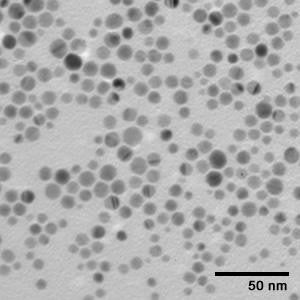
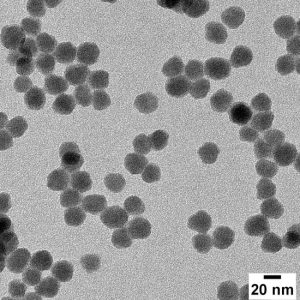
- Monodisperse gold cores: Narrow size distributions support consistent surface area, loading behavior, and optical response.
- Broad size range: Available core diameters from 10 nm to 50 nm.
Specifications
| Parameter | Specification |
|---|---|
| Core material | Pure metallic gold, Au0 |
| Surface coating | Branched polyethylenimine, BPEI |
| Available nominal diameters | 10, 20, 30, 40, and 50 nm |
| Size distribution | CV≤15% |
| Hydrodynamic diameter, DLS | Core TEM diameter plus approximately 15–40 nm |
| Gold concentration | 1.0 mg/mL |
| Suspending medium | USP-purified water, 18.2 MΩ⋅cm |
| Zeta potential | ≥+25 mV |
| Endotoxin level | ≤1 EU/mL |
| Solution pH | 7.0–8.5 |
| Storage temperature | 2∘C to 8∘C |
| Freezing | Do not freeze |
| Shelf life | 12 months from delivery when unopened and refrigerated |
Size and optical variants
| Nominal core size | TEM core diameter | LSPR peak | Primary optical behavior | Available volumes |
|---|---|---|---|---|
| 10 nm | 10±2 nm | Approximately 518–522 nm | High absorption, minimal scattering | 1, 5, and 25 mL |
| 20 nm | 20±2 nm | Approximately 520–524 nm | Clear ruby-red absorption | 1, 5, and 25 mL |
| 30 nm | 30±3 nm | Approximately 524–528 nm | Strong plasmonic absorption | 1, 5, and 25 mL |
| 40 nm | 40±4 nm | Approximately 526–530 nm | High visible contrast | 1, 5, and 25 mL |
| 50 nm | 50±4 nm | Approximately 528–535 nm | Strong extinction with increased scattering | 1, 5, and 25 mL |
Functional mechanisms and conjugation
1. Nucleic-acid complexation
Dilute the BPEI-coated gold nanospheres in a low-salt medium, such as:
- Sterile water
- 10 mM HEPES, pH 7.2–7.4
Add the negatively charged nucleic acid gradually while gently mixing. Test a range of nitrogen-to-phosphate ratios:
N/P≈5–20
Allow the mixture to assemble for approximately 20 to 30 minutes at room temperature.
The positively charged BPEI layer condenses the nucleic acid onto the nanoparticle surface. Depending on the formulation and cell system, this may help protect nucleic acids from nuclease degradation and support endosomal escape through the proton-sponge effect.
2. Covalent coupling to carboxyl-containing molecules
For coupling proteins or antibodies containing carboxylic acid groups:
- Activate the carboxyl groups with EDC and Sulfo-NHS in MES buffer at approximately pH 5.5–6.0.
- Remove excess reagents or quench as appropriate.
- Introduce the activated molecule to the BPEI-coated gold particles in a neutral buffer at approximately pH 7.2–7.6.
- Allow the BPEI amines to react with the activated carboxyl groups to form amide bonds.
3. Amine-to-amine crosslinking
The BPEI amines can also be coupled to primary amine-containing ligands using crosslinkers such as:
- Glutaraldehyde
- Bis-NHS esters, including BS3
- Other validated homobifunctional amine-reactive crosslinkers
The selected crosslinker and reaction conditions should be optimized for the target biomolecule to limit crosslinking, loss of biological activity, and nanoparticle aggregation.
Applications
- Nonviral gene delivery: Transport of siRNA, microRNA, plasmid DNA, mRNA, and antisense oligonucleotides.
- Cellular uptake studies: Positively charged, electron-dense tracers for membrane binding and endocytosis research.
- Biosensing: Covalent immobilization of antibodies, aptamers, and capture probes.
- Lateral flow assays: Attachment of detection molecules through amine-directed coupling.
- SERS: Positively charged plasmonic platforms for capturing negatively charged analytes.
- Transmission electron microscopy: High-contrast biological labeling and tracking of intracellular trafficking.
- Molecular delivery research: Evaluation of polymer-assisted nanoparticle transport and intracellular localization.
Handling and storage
- Store upright at 2∘C to 8∘C.
- Protect from light.
- Do not freeze. Freezing can disrupt the hydrated BPEI layer and cause irreversible gold aggregation and precipitation.
- Gently swirl or invert the container before sampling.
- Avoid prolonged high-energy probe sonication.
- Use sterile, disposable pipette tips and low-binding microcentrifuge tubes.
- Keep the container tightly capped when not in use.
Buffer and salt considerations
BPEI provides both steric and electrostatic stabilization, but high concentrations of multivalent anions can neutralize the positive surface and promote flocculation. Examples include concentrated phosphate and sulfate solutions.
For initial dilution, use:
- Deionized water
- Low-salt HEPES
- Low-molarity Tris
- A validated physiological solution added immediately before use
Check the dispersion visually and, where appropriate, by UV-Vis spectroscopy after transferring the particles into a new buffer. Sudden turbidity, color change, or broadening of the plasmon peak may indicate aggregation.
Product relationship
Available Through Applied Physics
Applied Physics supplies and supports quotation of this product. Product branding and manufacturer information, where stated on the product page or supporting documentation, remain authoritative.
Applied Physics portfolio: General
Catalog relationship: Available Through Applied Physics
Related Applied Physics resources
Continue through the General portfolio
Use these technical and portfolio pages to compare applications and related equipment. To keep this exact product attached to an RFQ, use the product’s existing Request a Quote or Add To Order control.

Reviews
There are no reviews yet.