
Overcoming PSL Bead Agglomeration: Proper Sonication and Redispersal in Metrology

Monodisperse Polystyrene Latex (PSL) microspheres serve as the primary benchmark for calibrating optical particle counters and semiconductor wafer inspection systems. During storage, natural settling causes these beads to cluster into doublets and triplets that skew sensor calibration curves and fail ISO compliance audits. Attempting to disperse these aggregates through vigorous shaking or harsh immersion probe […]
The Science of PSL Spheres: Improving SSIS Accuracy in Metrology
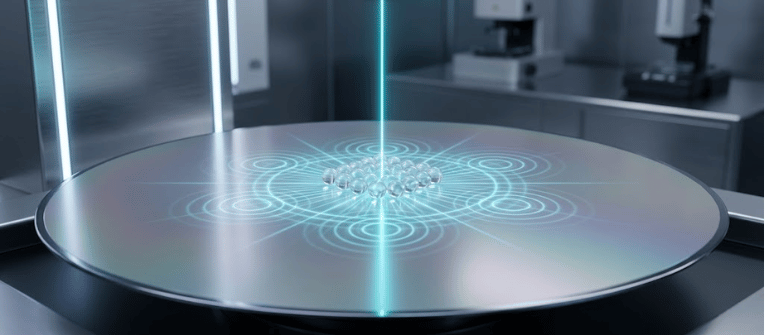
In the world of semiconductor manufacturing and cleanroom validation, the margin for error is nonexistent. As microchips become smaller and more complex, the ability to detect and quantify sub-micron particles on silicon wafers is critical. This is where PSL (Polystyrene Latex) Spheres, the gold standard for metrology calibration, play a pivotal role. Understanding the science […]
Silica vs. PSL Spheres: Why Silica Particles Are Better in High‑Temperature
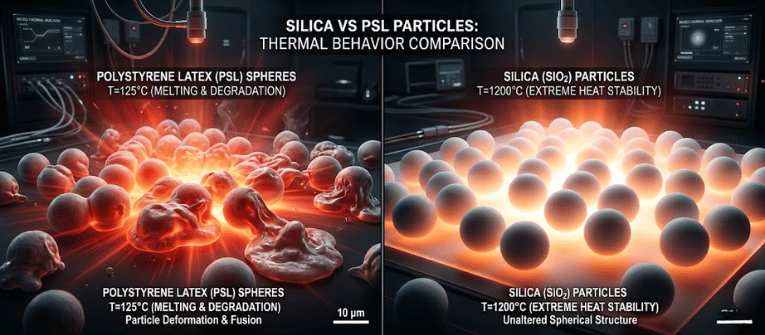
In the world of precision metrology and cleanroom validation, accuracy is non-negotiable. For decades, Polystyrene Latex (PSL) spheres have been the industry standard for calibrating particle counters and inspecting wafers. However, as semiconductor and pharmaceutical manufacturing processes push into higher temperature ranges, the limitations of PSL have become apparent. Enter Silica (SiO2) particles. While both […]