
Overcoming Sedimentation and Agglomeration in 2.0 Micron PSL Sphere Calibration

The physical behavior of monodisperse 2.0-micrometer polystyrene latex suspensions is governed by a critical hydrodynamic transition in which gravitational sedimentation, dictated by Stokes’ Law, rapidly supersedes Brownian kinetic diffusion, while short-range London-van der Waals attraction overcomes electrokinetic double-layer repulsion, accelerating irreversible agglomeration. Fluid Dynamics, Aerosol Physics, and Colloidal Mechanics of the 2.0 µm Boundary Calibrating […]
The Science of PSL Spheres: Improving SSIS Accuracy in Metrology
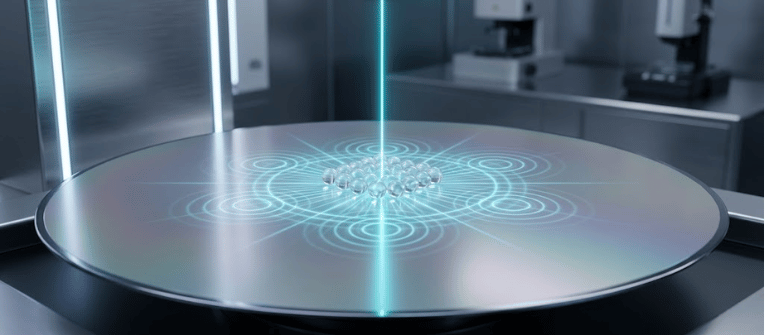
In the world of semiconductor manufacturing and cleanroom validation, the margin for error is nonexistent. As microchips become smaller and more complex, the ability to detect and quantify sub-micron particles on silicon wafers is critical. This is where PSL (Polystyrene Latex) Spheres, the gold standard for metrology calibration, play a pivotal role. Understanding the science […]
Silica vs. PSL Spheres: Why Silica Particles Are Better in High‑Temperature
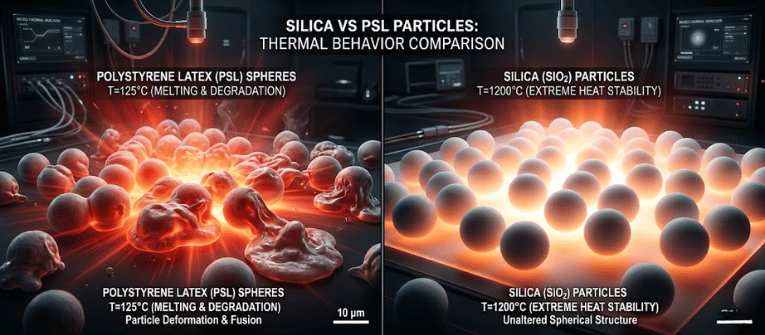
In the world of precision metrology and cleanroom validation, accuracy is non-negotiable. For decades, Polystyrene Latex (PSL) spheres have been the industry standard for calibrating particle counters and inspecting wafers. However, as semiconductor and pharmaceutical manufacturing processes push into higher temperature ranges, the limitations of PSL have become apparent. Enter Silica (SiO2) particles. While both […]