
Handling highly volatile reagents, concentrated strong acids, and alkalis in cleanroom or laboratory environments requires advanced containment systems.
Traditional steel structures degrade rapidly under severe chemical stress, risking operator safety and structural failure.
The FH1000 PL fume hood technology provides a reliable, engineered alternative designed explicitly for extreme corrosive resistance.
How FH1000 PL Technology Prevents Corrosive Chemical Exposure
The FH1000 PL system delivers full isolation and active neutralization of hazardous fumes through three primary engineering mechanics.
Controlled Inward Negative Pressure
By generating a continuous face velocity across the operational sash, the unit creates an airtight aerodynamic envelope.
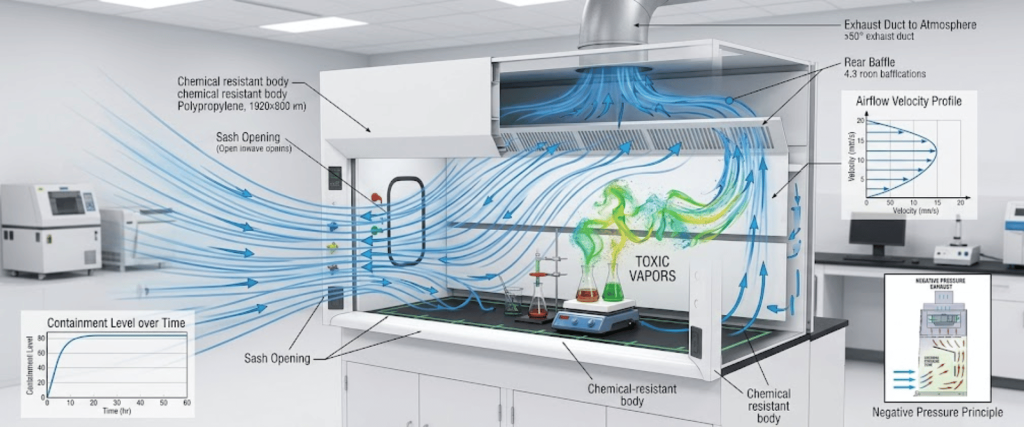
This continuous draft ensures that contaminated fumes are safely contained inside the work table area and routed exclusively through the exhaust path.
Integrated Polypropylene Body Construction
The entire chassis is manufactured using 8mm thick porcelain white polypropylene (PP) plates that are integrally welded.
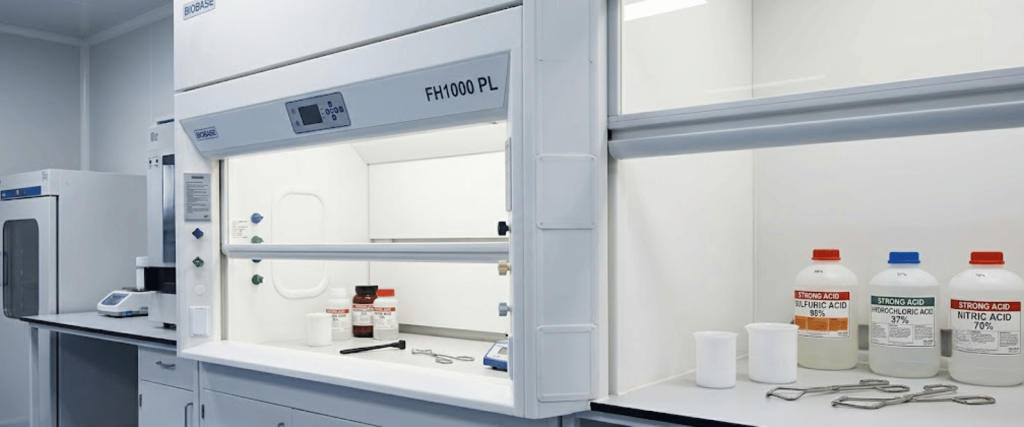
This material is chemically inert and fully resistant to pitting, rusting, or severe structural degradation caused by harsh materials like perchloric acid, nitric acid, or hydrochloric acid.
Active Spray Neutralization System
Behind the internal deflector, the system integrates an automated alkaline water circulation spray mechanism.
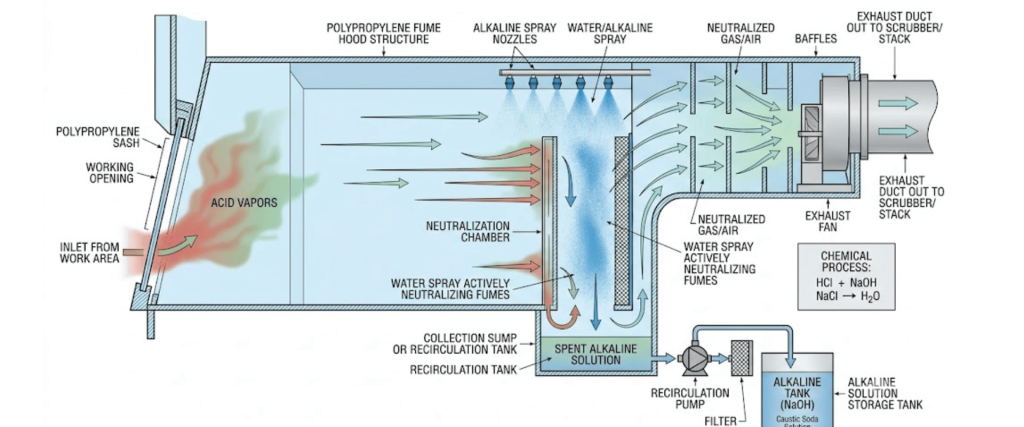
As aggressive acid vapors pass through the deflector, the wet spray neutralizes the acidic components within the exhaust column before they can accumulate, dramatically dropping explosive and thermal hazards.
Structural Core Specifications of the FH1000 PL System
To ensure precise workflow planning and compatibility with cleanroom equipment layouts, the FH1000 PL follows standardized spatial and mechanical footprints.
| Technical Parameter | Specification Detail |
|---|---|
| Model | FH1000PL |
| External Dimensions (W × D × H) | 1047 mm × 800 mm × 2450 mm |
| Internal Dimensions (W × D × H) | 787 mm × 500 mm × 700 mm |
| Chassis Material | 8 mm thick porcelain white polypropylene (PP) |
| Worktop Surface | Chemical-resistant phenolic resin; optional ceramic or epoxy surface |
| Airflow Velocity Range | 0.3 m/s to 0.8 m/s |
| Exhaust Air Volume | 560 m³/h |
| Operational Noise Level | ≤ 68 dB(A) |
| Exhaust Duct Diameter | 250 mm, PVC material |
Key Engineering Safety Features
Beyond its base material composition, the FH1000 PL includes specialized components that secure continuous laboratory uptime and reliable containment.
- Microprocessor Control Unit: The system monitors and adjusts airflow metrics in real-time, displaying air volumes, power recovery memory, and lighting statuses on a digital interface.
- Corrosion-Proof Centrifugal Blower: Traditional metal blowers fail under persistent chemical exhaust. The FH1000 PL utilizes an integrated polypropylene centrifugal fan to move heavy acid vapors safely through a 4.3-meter PVC duct.
- Ergonomic Safety Window: The front sash consists of 5mm thick toughened glass that resists chemical etching and impacts. It is manually adjustable to alter physical aperture while maintaining precise face velocity limits.
Primary Industrial Applications
The structural profile of the FH1000 PL makes it essential for specific high-risk workflows.
- Acid Digestion & Wet Etching: Essential for semiconductor validation and materials testing involving volatile chemical acids.
- Pharmaceutical Quality Control: Used during heavy solvent extraction protocols where explosive or corrosive vapor buildup is likely.
- Analytical Chemistry Testing: Ideal for institutional and research centers handling concentrated reagents requiring active, zero-recirculation ducted extraction systems.
Conclusion
The FH1000 PL fume hood technology provides a reliable solution for laboratories handling highly aggressive acids and chemical reagents.
By combining a heavy-duty, 8mm thick polypropylene body with an active wet neutralization spray system and precise negative pressure control, this system successfully prevents hazardous vapor leaks.
Investing in this dedicated setup ensures long-term equipment durability and keeps laboratory operators fully protected from severe chemical exposure.
Frequently Asked Questions (FAQs)
1. What makes the FH1000 PL highly resistant to severe corrosion?
The entire chassis is constructed from 8mm thick porcelain white polypropylene (PP). Unlike standard steel hoods, this material is completely inert and will not rust, pit, or degrade when exposed to concentrated acids or alkalis.
2. How does the active spray system protect the operator?
The system features an automated water circulation spray mechanism behind the internal deflector. This spray actively neutralizes aggressive acid vapors inside the exhaust column before they can accumulate or escape into the workspace.
3. What is the recommended airflow velocity for this unit?
The FH1000 PL maintains a safe inward face velocity range of 0.3 m/s to 0.8 m/s. This continuous negative pressure ensures that all toxic fumes are pulled away from the operator and routed directly into the exhaust duct.
4. Can this fume hood be used for acid digestion procedures?
Yes. Its acid-proof polypropylene construction, durable chemical-resistant worktop, and integrated PP centrifugal blower make it ideal for high-risk applications like acid digestion, wet etching, and liquid processing.