
Last Updated: October 3, 2026
Neutral fogger output is fog that remains suspended in air at the same density as the surrounding environment, neither sinking nor rising due to gravity or thermal effects. This suspension allows you to visualize actual airflow patterns in cleanrooms without distortion from droplet behavior.
Most cleanroom managers think any fog works for airflow testing. It doesn’t. Non-neutral fog sinks or floats, masking the real air currents you need to validate for GMP compliance. According to Persistence Market Research’s 2026 cleanroom technology analysis, the global cleanroom technology market is valued at $6.6 billion, with organizations increasingly investing in precision tools to meet ISO 14644-3 standards. At Applied Physics, we’ve worked with facilities across pharmaceutical, semiconductor, and biotech sectors. The difference between neutral and non-neutral fog is the difference between seeing what’s actually happening and guessing.
Contamination control depends on validating that your airflow patterns match your design specifications. If your fog falls or rises, you’re not testing airflow, you’re testing fog behavior. USP 797 and USP 800 standards explicitly require accurate airflow visualization. The stakes are regulatory compliance, product safety, and facility certification.
Neutral buoyancy occurs when fog droplet density matches the density of the surrounding air. When this balance exists, gravity and thermal forces cancel out, and droplets move only with the air current itself.
The physics is straightforward. A droplet that’s heavier than air sinks. A droplet that’s lighter rises. Only when mass and volume create identical density to air does the droplet stay put and follow the airflow. This is why Applied Physics technical documentation on cleanroom foggers emphasizes that neutral buoyancy is non-negotiable for accurate smoke studies.
Several factors affect whether your fog achieves neutrality:
ISO 14644-3 defines the requirements for testing and monitoring cleanroom air currents. The standard explicitly requires that airflow visualization media must not introduce artifacts that distort the true flow pattern.
This means your fog must be neutral. Non-neutral fog creates false readings that can pass inspection while your actual airflow remains inadequate. According to Degree Controls, Inc. technical guidance on cleanroom fogger compliance, cleanroom foggers are essential for demonstrating NSF/ANSI 49 compliance in biosafety cabinets and laboratory fume hoods.
The standard requires you to document fog media type, verify droplet size distribution, record temperature and humidity conditions, validate visualization distance, and confirm airflow pattern consistency across multiple test runs. If your fog isn’t neutral, you’re not validating the airflow patterns the standard demands, that’s a compliance gap disguised as compliance.
Droplet size directly determines whether fog stays suspended or falls. Smaller droplets (2-5 microns) remain airborne longer. Larger droplets (10+ microns) drop rapidly, creating false readings of downward airflow.
The challenge is controlling droplet size during generation. Ultrasonic foggers produce finer droplets than traditional atomizers, but variability remains. According to Applied Physics research on ultrasonic fog generation, the CRF2 ultrasonic fogger produces 0.26 cubic meters of pure fog per minute with consistent micro-droplet distribution.
Droplet size affects evaporation rate, fall velocity, visibility range, and thermal response. You can’t assume neutrality with any fogger, you need equipment designed to produce droplet distributions that achieve neutral buoyancy under your facility’s conditions.
Measuring neutral fogger output requires quantitative metrics (fog volume, runtime, droplet size, density consistency) and qualitative observation (vertical behavior, air current tracking, visibility persistence).
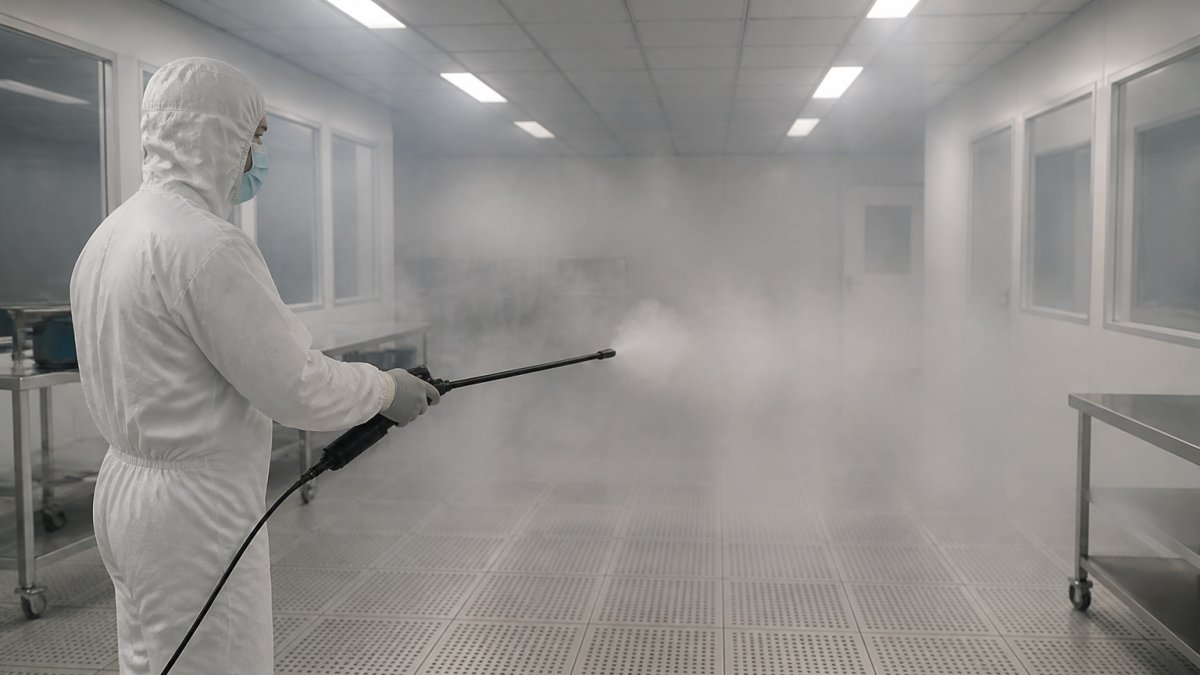
Cleanroom technician using a handheld fog visualization wand in a controlled cleanroom environment, with fog dispersing evenly through the air space to show airflow patterns
Quantitative measurements include:
Qualitative checks include observing whether fog remains level, follows air currents without lag, maintains visibility, and matches expected airflow patterns. Calibration before each test cycle verifies correct output volume and droplet distribution. Applied Physics equipment includes wireless remote controls for real-time output adjustment without interrupting the test.
Most fogging failures stem from three root causes: media selection mismatches, environmental instability, and equipment miscalibration.
Diagnostic Framework: The Fog Behavior Matrix
When fog behaves unexpectedly, start by observing three characteristics:
Your answers map to specific root causes:
| Observed Behavior | Most Likely Cause | Primary Fix |
|---|---|---|
| Fog sinks rapidly | Droplets too large; temperature too cold; humidity too low | Reduce nozzle pressure; warm environment to 72-76°F; increase humidity to 50-60% |
| Fog rises and disperses | Warm air currents; droplets too fine; thermal gradient from ceiling lights | Check HVAC discharge temperature; verify ultrasonic frequency output; shield heat sources |
| Fog visible but erratic | Environmental instability; equipment vibration; competing air currents | Stabilize temperature within ±2°C; isolate fogger from vibration sources; identify and block cross-drafts |
| Fog fades too quickly | Evaporation in dry conditions; droplets too fine; inadequate fog volume | Increase humidity to 55-65%; verify ultrasonic nozzle is not clogged; check cfm output against space volume |
| Fog visible but non-neutral | Media contamination; mineral deposits in nozzle; incorrect media type | Drain and flush reservoir with DI water; soak nozzle in distilled water for 30 minutes; confirm media is pharmaceutical-grade DI water |
Error Class 1: Media and Contamination Issues
Symptom: Fog appears yellowish or leaves residue; behaves unpredictably.
Root cause: Glycol-based or tap-water fog introduces contaminants that alter droplet density.
Troubleshooting: Verify pharmaceutical-grade deionized water (≥18 MΩ·cm resistivity). If previously used glycol, flush the system three times with DI water. Inspect nozzles for mineral deposits under 10× magnification; soak in distilled water for 30 minutes if needed. Test a small fog volume before resuming full testing.
Prevention: Assign one fogger to DI water only; label clearly. Never refill with tap water or alternative media.
Error Class 2: Environmental Instability
Symptom: Fog behavior is inconsistent across test runs.
Root cause: Temperature or humidity fluctuations exceed ±2°C and 45-65% RH window required for neutral buoyancy.
Troubleshooting: Install a calibrated thermohygrometer; record conditions at start, middle, and end of each test. If temperature varies >2°C, delay testing and stabilize HVAC for 30 minutes. If humidity drifts below 45%, activate humidification; if above 65%, increase air exchange. Identify and shield thermal sources (ceiling lights, equipment exhaust). Seal gaps and isolate test area from cross-drafts.
Prevention: Schedule tests during stable periods (early morning, after HVAC stabilization). Avoid testing after facility cleaning or during high occupancy.
Error Class 3: Equipment Miscalibration and Degradation
Symptom: Fog volume is lower than expected; output becomes inconsistent over time.
Root cause: Nozzle wear, mineral buildup, or ultrasonic frequency drift reduces efficiency.
Troubleshooting: Measure fog output volumetrically (60 seconds into a container); compare against specification (±10% of rated cfm). Check water level in reservoir. Inspect nozzles for clogging; soak in distilled water for 30 minutes if needed. Verify ultrasonic frequency (108-120 kHz for DI water); frequency drift indicates transducer aging. Re-pair wireless remotes.
Prevention: Maintain a weekly log during active testing. Record fog output, nozzle condition, and deviations.
Error Class 4: Space-Specific Challenges
Symptom: Fog works in small rooms but fails in large cleanrooms.
Root cause: Equipment output is undersized for space volume.
Troubleshooting: Calculate space volume (length × width × height ÷ 500) to determine minimum foggers needed. For glove boxes, use portable ultrasonic foggers positioned near entry. For large cleanrooms, use fan-assisted systems centered 3-5 feet above floor.
Prevention: Match equipment to space size before purchasing.
Two primary media dominate cleanroom fogging: deionized water and nitrogen-based fog. Each has distinct advantages, trade-offs, and regulatory implications.
DI Water Fogging: The Industry Standard for GMP Environments
Deionized water produces ultra-fine droplets (0.5-5 microns) with zero residue. It is the default choice for pharmaceutical, biotech, and medical device manufacturing because it leaves no contamination and meets USP 797 and USP 800 requirements without exception.
Advantages:
Disadvantages:
Best for:
Nitrogen-Based Fogging: For Large Spaces and Extended Visibility
Nitrogen fog (typically generated by evaporating liquid nitrogen or pressurized nitrogen gas mixed with a carrier liquid) produces larger, more visible droplets. It is preferred for large open spaces, semiconductor fabs, and situations where visualization distance is critical.
Advantages:
Disadvantages:
Best for:
Decision Matrix: Choosing the Right Media for Your Facility
| Facility Type | Cleanroom Class | Regulatory Standard | Recommended Media | Rationale |
|---|---|---|---|---|
| Pharmaceutical compounding | ISO 6 (Class 100) | USP 797 | DI Water | Zero-residue requirement; explicit USP permission |
| Hazardous drug handling | ISO 6 (Class 100) | USP 800 | DI Water | Zero-residue requirement; explicit USP permission |
| Biotech manufacturing | ISO 6-7 (Class 100-10,000) | FDA GMP | DI Water | Regulatory alignment; no residue risk |
| Medical device assembly | ISO 6-7 (Class 100-10,000) | FDA QSR | DI Water | Standard practice; proven compliance |
| Semiconductor fab | ISO 5-6 (Class 100-1,000) | SEMI standards | Nitrogen | Large-space coverage; particle count impact acceptable |
| Research & development | ISO 7-8 (Class 10,000-100,000) | None (non-GMP) | Either (DI Water preferred) | Cost and simplicity favor DI water |
| Validation of existing system | Any | Any | DI Water | Standard for baseline airflow mapping |
Cost-Benefit Analysis Over 5 Years
DI Water System:
Nitrogen System:
Selecting the right fogger requires matching equipment specifications to your facility’s needs and regulatory requirements. Consider space size, applicable standards (USP 797, USP 800, ISO 14644-3, NSF/ANSI 49), required fog visibility duration, and budget.
When evaluating any fogger, verify droplet size specifications, output consistency, maintenance requirements, compliance documentation, and vendor training and support.
Applied Physics offers ultrasonic DI water foggers and portable fog systems with wireless remote controls for real-time adjustment and support accessories for elevated ceiling zones. Our equipment meets ISO 14644-3 standards and supports USP 797 and USP 800 compliance. Contact Us to discuss your specific testing requirements.
Equipment degradation is inevitable. Mineral deposits, nozzle wear, and component aging all affect fog quality. Maintenance prevents costly validation failures mid-cycle.
Establish a maintenance schedule:
Keep detailed logs of:
Degraded equipment produces non-neutral fog that invalidates your airflow tests.
Applied Physics equipment is designed for extended service life, but regular maintenance is non-negotiable. Our wireless remote controls and support accessories help operators maintain consistent output. When you detect degradation, replace components immediately rather than working around the problem.
Validating cleanroom airflow is non-negotiable for GMP compliance and product safety. Non-neutral fog creates false readings that pass inspection while your actual airflow remains inadequate. Applied Physics provides precision cleanroom foggers with consistent micro-droplet distribution, wireless remote controls for real-time output adjustment, and support accessories for hard-to-reach spaces. Our equipment meets ISO 14644-3 standards and supports USP 797 and USP 800 compliance across pharmaceutical, biotech, and semiconductor sectors. Contact Us today to discuss your airflow visualization requirements and ensure your cleanroom validation is built on accurate data.
Neutral buoyancy means fog droplets remain suspended in air at the same density as the surrounding air, neither sinking nor rising. This is critical for accurate airflow visualization because non-neutral fog distorts the true path of cleanroom air currents. When droplets have neutral buoyancy, they move with the air stream, allowing you to observe actual laminar flow patterns and turbulence without gravity interference. This directly supports ISO 14644-3 airflow testing requirements and validates cleanroom certification.
Non-neutral fog output produces misleading results. Droplets that are too heavy sink, masking actual airflow patterns, while light droplets rise and create false flow indicators. Neutral output ensures your smoke study data reflects genuine cleanroom air currents, which is essential for GMP compliance validation, contamination control verification, and identification of dead zones. Semiconductor fabrication facilities and pharmaceutical cleanrooms depend on this accuracy to maintain USP 797/800 compliance.
Droplet size directly determines settling velocity and buoyancy behavior. Smaller droplets achieve neutral buoyancy more easily because they experience less gravitational pull relative to air resistance. Larger droplets settle faster and deviate from true airflow paths. Cleanroom fogger droplet size distribution must be controlled and measured to ensure consistency. Equipment specifications should detail the micron range produced, which supports neutral output in standard cleanroom conditions with proper humidity and thermal equilibrium.
Verify that the equipment meets ISO 14644-3 standards and produces documented neutral buoyancy output. Check the droplet size distribution range (aim for 2-5 microns for most applications), fog volume capacity (measured in cfm), and runtime performance. For sterile cleanroom fogger equipment, confirm zero-residue formulation and compatibility with your facility’s air exchange rate. Applied Physics offers ultrasonic foggers with adjustable fog volume and wireless remote control for precise airflow visualization. Request technical specifications.

Enter your details below to save your shopping cart for later. And, who knows, maybe we will even send you a sweet discount code :)
Allow notifications to get real-time updates about your shopping cart and who knows, you may even receive a sweet discount code 😊