
Red fluorescent polystyrene microspheres help researchers visualize particles, develop bead-based assays, and study transport in biological and fluid systems.
Their usefulness depends on more than brightness: the particles must remain dispersed, retain their fluorescent dye, and behave predictably in the working medium.
When beads clump, bind where they should not, or lose dye, results can become difficult to interpret.
This guide explains common problems with fluorescent polystyrene microsphere suspensions, how to investigate them, and what to check before changing your protocol.
Always follow the documentation for the exact bead formulation; handling conditions are not interchangeable across products.
What Are Red Fluorescent Polystyrene Microspheres?
Red fluorescent polystyrene microspheres are polymer particles containing fluorescent dye. In internally dyed products such as FluoSpheres™, the dye is incorporated into the polystyrene matrix rather than simply attached to its surface. This helps protect the fluorophore from environmental effects that can cause quenching or photobleaching, although it does not guarantee stability under every experimental condition.
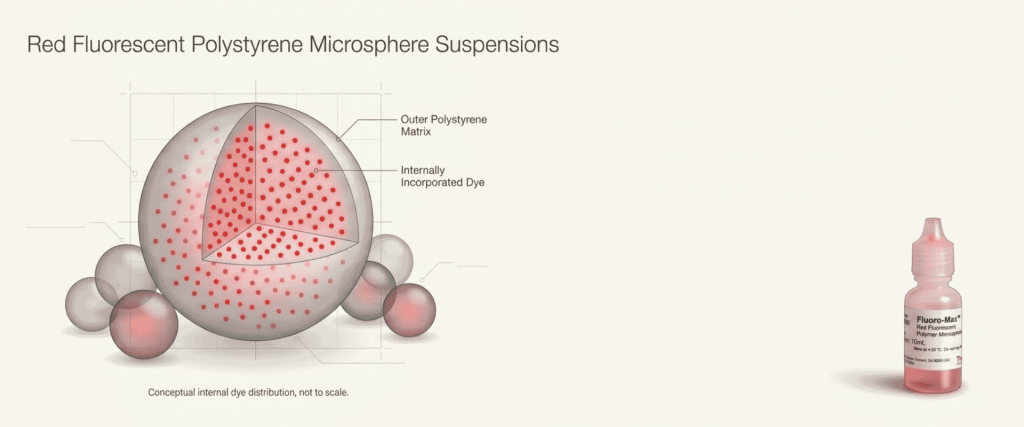
Our list includes Red Fluorescent Polystyrene Microsphere Suspensions with selectable diameters from 0.025 to 3.0 µm. Before ordering, confirm the exact variant’s surface chemistry, concentration, preservative, fluorescence spectrum, and package volume. The listing contains specifications for different configurations that should not be assumed to apply to every option.
Common Problems at a Glance
| Problem | Possible cause | Practical first step |
|---|---|---|
| Clumping or aggregation | Unsuitable buffer, surface-charge changes, protein bridging, or freezing | Check storage history and test dispersion in a compatible buffer |
| Weak or inconsistent fluorescence | Spectral mismatch, uneven sampling, unsuitable concentration, or dye instability | Verify the spectrum and compare a fresh dilution with a reference sample |
| Fluorescence outside the expected particle location | Free or leached dye | Include a validated particle-free control |
| High background or nonspecific binding | Interactions between bead surfaces, proteins, cells, or assay materials | Evaluate surface chemistry and compatible blocking conditions |
| Poor recovery after washing | Inappropriate separation method or a pellet that will not redisperse | Use a size-specific washing protocol |
| Loss of performance during storage | Freezing, contamination, or incompatible storage medium | Follow the product-specific storage instructions |
Manufacturer guidance documents aggregation, nonspecific binding, washing difficulties, and storage-related damage. Research also shows that dye leakage can produce misleading signals in particle-uptake experiments.
1) Aggregation and Clumping
Why Microspheres Aggregate
Polystyrene particles retain some hydrophobic character even after surface modification. Their stability also depends on surface charge. Changes in pH or electrolyte concentration can reduce the repulsion that keeps particles separated, while proteins can bridge neighboring beads. Manufacturer FAQs also note that smaller microspheres have a greater tendency to aggregate.
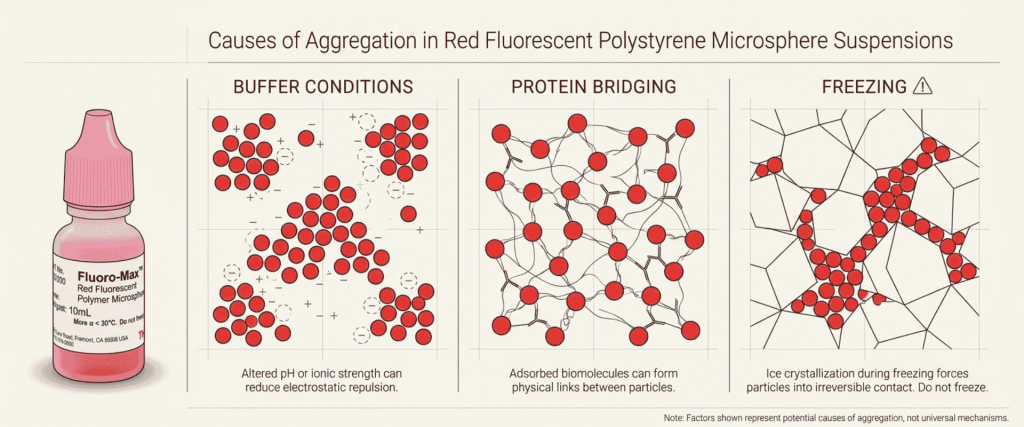
Freezing is a separate concern. Even brief freezing can cause irreversible aggregation and distort bead shape; it should not be treated as ordinary, reversible clumping.
Practical Solutions
- Check the storage history first. Do not rely on frozen material when the manufacturer advises against using it.
- Review the working buffer. Confirm that its pH and ionic composition suit the bead’s surface chemistry.
- Test changes on a small aliquot. Manufacturer guidance identifies dilution, pH adjustment, or reduced ionic strength as possible ways to recover some agglomerated suspensions.
- Use the approved dispersion method. Bath sonication or vortexing may be appropriate for certain FluoSpheres formulations. The manufacturer warns against probe sonication because it can damage the particles.
Do not add a surfactant automatically. A dispersant suitable for a cell-free assay may be unsuitable for a live-cell experiment.
2) Weak or Inconsistent Fluorescence
Check Optical Compatibility Before Changing the Beads
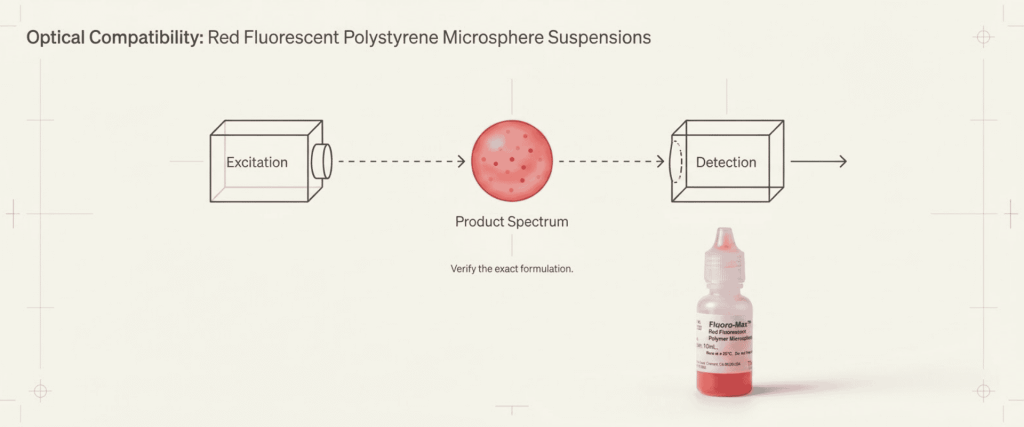
Red fluorescence is not a complete instrument specification. The manufacturer’s guide lists a red FluoSpheres dye with excitation and emission maxima of 580/605 nm, alongside other distinct fluorescent colors. Confirm the spectrum for your exact catalog number rather than choosing settings from the color name alone.
Practical Solutions
Use a short, controlled troubleshooting sequence:
- Confirm that the excitation source and emission filter match the product’s spectrum.
- Redisperse the stock using the approved method before preparing a fresh dilution.
- Compare the fresh sample with a known reference under identical instrument settings.
- Test a dilution series rather than increasing detector gain immediately.
- Include a bead-free blank to identify background from the medium or sample.
Internal dye loading improves protection against some causes of fluorescence loss, but it does not make every formulation immune to photobleaching, solvent effects, or other environmental changes.
3) Dye Leakage and Misleading Particle-Tracking Results
Why Fluorescence Alone May Not Prove Particle Uptake
A fluorescent signal does not always show where an intact particle is located. A study involving fluorescent polystyrene beads and Daphnia magna found that dye leaching could explain fluorescence in lipid droplets, creating a misleading impression of particle translocation. This demonstrates an experimental risk, not a defect established for every fluorescent bead product.
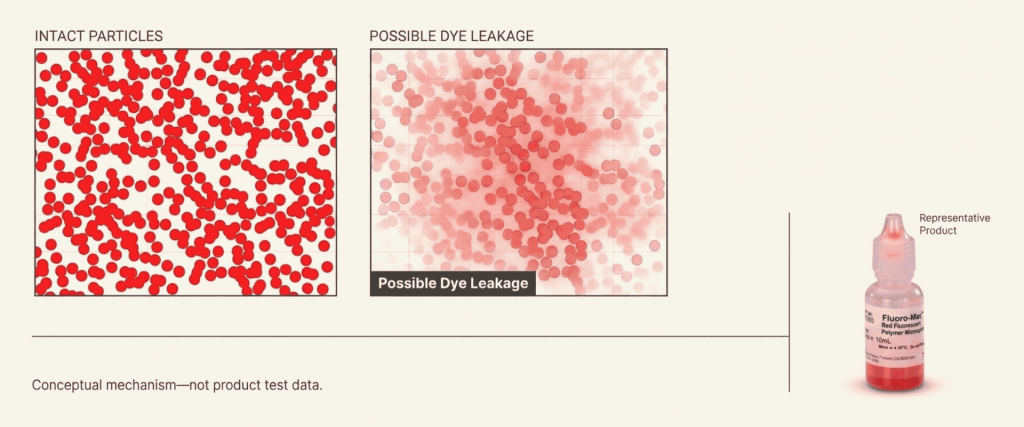
Solvent exposure also matters. Thermo Fisher’s troubleshooting guidance warns that prolonged storage in alcohol-containing solutions can promote dye leakage from its fluorescent polystyrene microspheres.
Practical Solutions
- Test fluorescence stability in the actual exposure medium.
- Include a particle-free fraction prepared using a validated separation method.
- Compare fresh and incubated suspensions under the same conditions.
- Where possible, support fluorescence observations with an independent method of locating particles.
- Check solvent compatibility before introducing alcohol or changing the storage medium.
For uptake studies, distinguish between detecting fluorescence and confirming intact particles. Those are different experimental claims.
4) Nonspecific Binding and High Background
Microspheres may bind to proteins, cells, or other surfaces even when that interaction is not intended. The FluoSpheres user guide identifies nonspecific binding as a common problem and explains that surface modification reduces, but does not eliminate, the hydrophobic characteristics of polystyrene.
Practical Solutions
Match the surface chemistry to the experiment. Carboxylate-modified particles can support covalent attachment of biomolecules, but their behavior differs from unmodified or amine-modified beads. For some applications, compatible additives such as BSA or dextran can help reduce nonspecific binding.
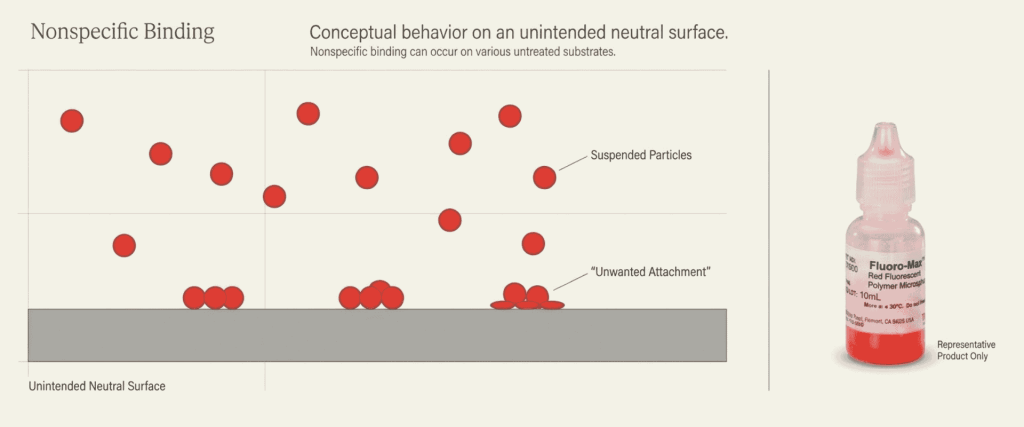
Evaluate blocking conditions on a small scale. Include a control without the intended binding partner so that background adhesion can be separated from the interaction being measured.
If clumping begins during protein coating, review both protein and particle concentrations. Manufacturer guidance notes that protein bridging can contribute to aggregation during adsorption.
5) Particle Loss During Washing
Washing can remove unwanted components, but it can also reduce particle recovery. Manufacturer FAQs describe difficulty redispersing some pelleted microspheres and address alternative separation approaches for small particles.
Practical Solutions
Use a washing method validated for the bead diameter and formulation. Do not transfer a centrifugation protocol from a different particle size without checking recovery.
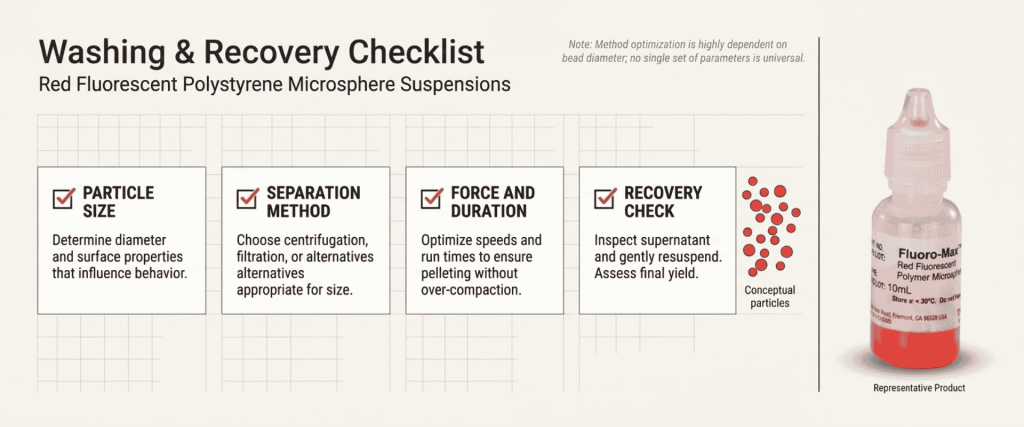
When following a protocol, confirm the required relative centrifugal force, rotor conditions, and duration, not just an RPM value. After washing, assess both particle recovery and redispersion before continuing with a larger experiment.
If centrifugation performs poorly, ask the manufacturer whether dialysis or an appropriate filtration method is suitable for the material and the component being removed.
6) Storage and Preservative Compatibility
Storage problems can be mistaken for instrument or assay failures. Freezing can permanently damage susceptible suspensions, while microbial contamination can make stored material unusable.
Manufacturer guidance notes that many formulations contain preservatives, but their presence does not eliminate every contamination risk.
Practical Solutions
Follow the storage instructions for the exact product, use clean handling practices, and record when the bottle was opened or the suspension was modified.
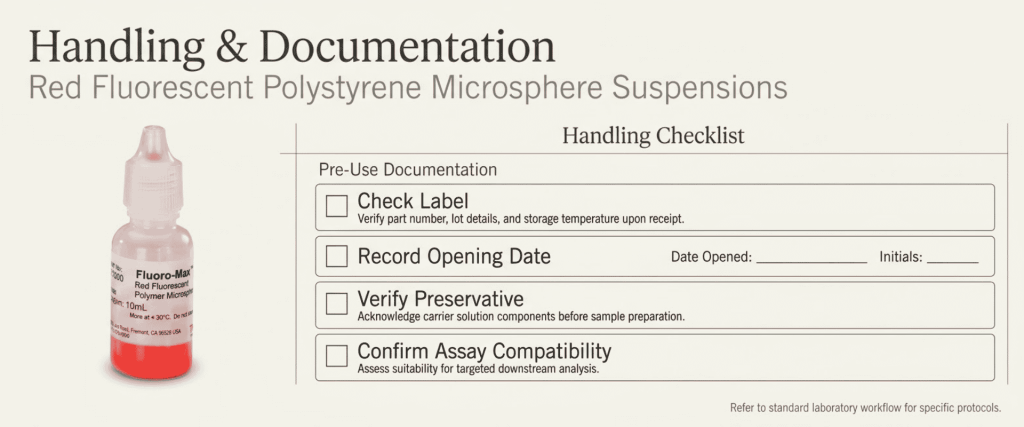
For biological experiments, verify whether sodium azide or another preservative is present. If a preservative is incompatible with the assay, obtain a suitable formulation or use a manufacturer-recommended removal procedure. Do not assume that routine dilution makes it acceptable.
Choosing the Right Suspension Before You Order
Before selecting red fluorescent polystyrene microspheres, confirm:
- Particle diameter: Does it suit the experimental question and detection method?
- Surface chemistry: Is passive adsorption or covalent coupling required?
- Excitation and emission spectrum: Can the instrument detect the specified dye?
- Concentration: Is it reported as solids content, particle count, or another measure?
- Medium and preservative: Are they compatible with the assay?
- Documentation: Are product-specific handling instructions and supporting specifications available?
For the US listing, request confirmation of these details for the selected variant before finalizing the protocol.
Conclusion
Reliable results with red fluorescent polystyrene microspheres begin with the correct formulation and a controlled preparation method.
Investigate aggregation, optical compatibility, dye stability, nonspecific binding, and washing recovery separately rather than changing several conditions at once.
Start with the product-specific documentation, test adjustments on small aliquots, and use controls that distinguish bead behavior from background fluorescence.
These steps help protect samples and make experimental conclusions easier to defend.
Frequently Asked Questions (FAQs)
1. Why do red fluorescent polystyrene microspheres clump?
Common causes include unsuitable pH, high electrolyte concentration, protein bridging, and freezing. The appropriate remedy depends on the formulation and whether the aggregation is reversible.
2. Can fluorescent microspheres be sonicated?
Some formulations can be dispersed using bath sonication. Follow the manufacturer’s instructions; Thermo Fisher warns against probe sonication for the microspheres addressed in its FAQ.
3. Does red fluorescence prove that particles entered a cell or tissue?
No. Free or leached dye can produce misleading fluorescence. Particle-uptake studies need suitable controls and, where possible, independent confirmation of particle location.
4. Can I freeze the suspension?
Do not freeze it unless the exact product documentation permits freezing. For the FluoSpheres products addressed in the manufacturer FAQ, even brief freezing can cause irreversible damage.
5. Are all red fluorescent microspheres excited at the same wavelength?
No. Check the excitation and emission specifications for the exact dye and catalog number rather than relying on the word red.