
Description
BioReady Magnetic Gold Nanoshells
BioReady Magnetic Gold Nanoshells combine magnetic separation with plasmonic optical detection in a single spherical nanoparticle platform.
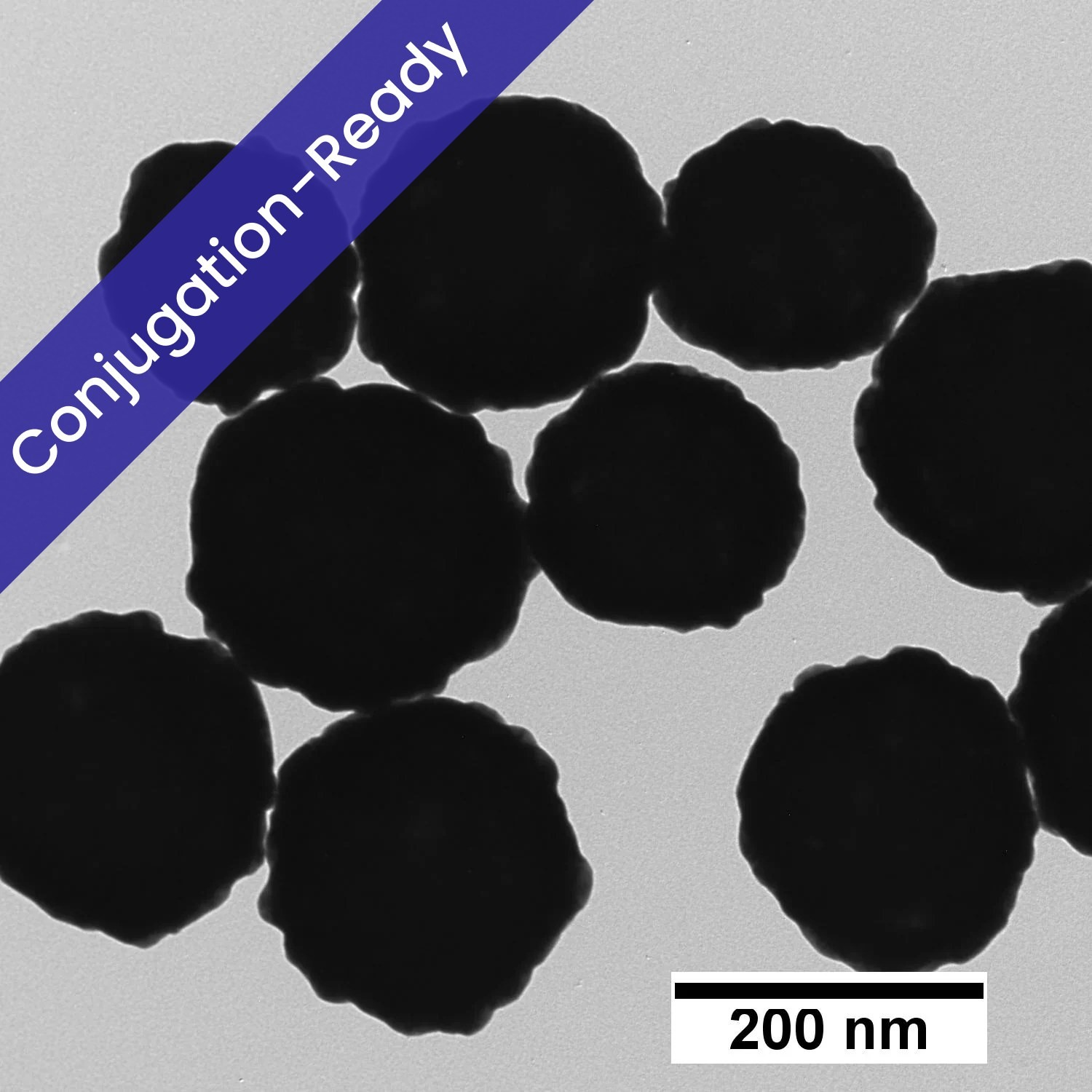
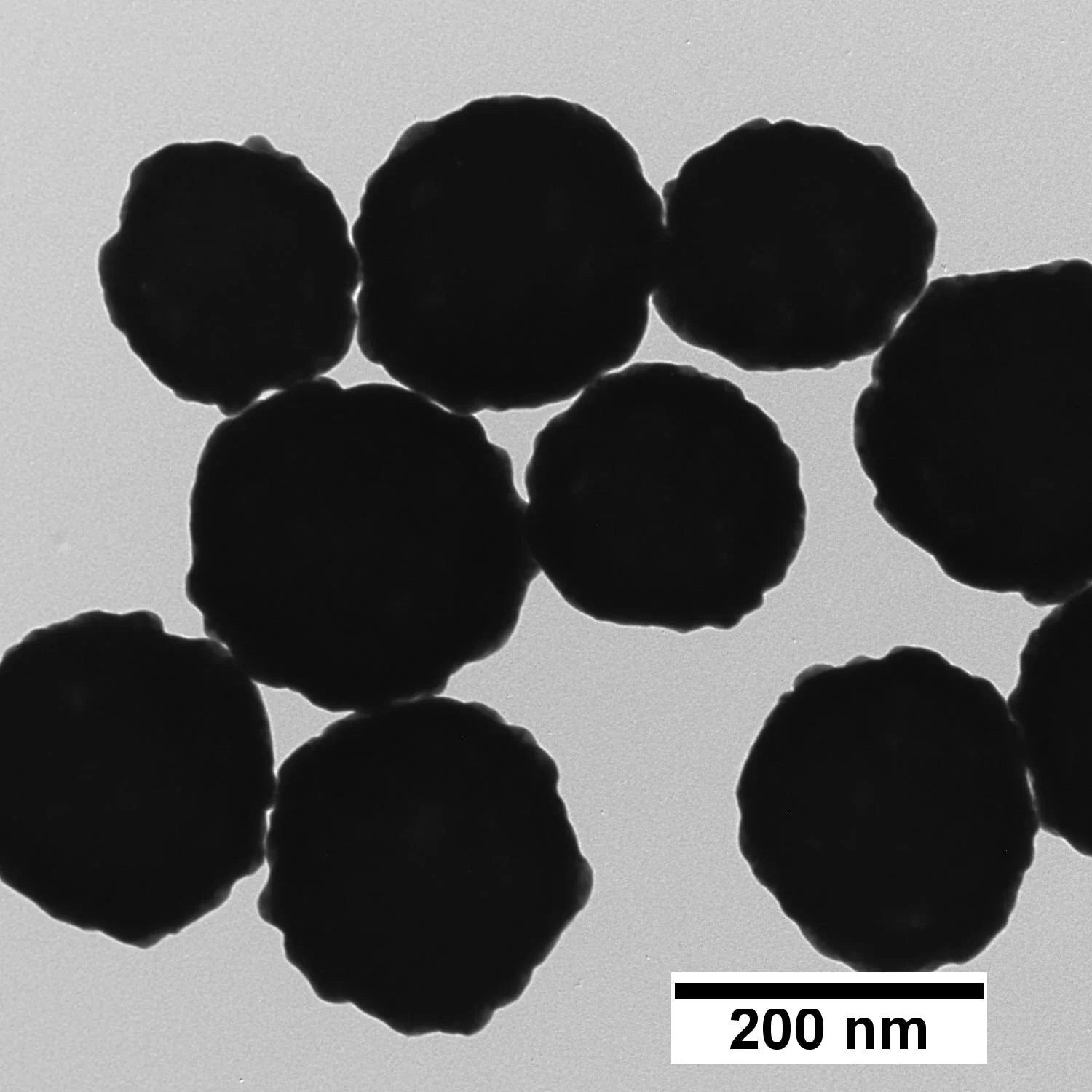
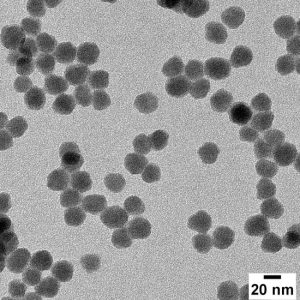
Each particle contains a superparamagnetic iron oxide core surrounded by a uniform metallic gold shell. The nominal total diameter is approximately 200 nm, with a measured diameter of 205±20 nm.
The iron oxide core enables magnetic capture, concentration, washing, and removal of matrix interferents. Once the external magnetic field is removed, the particles are designed to redisperse without permanent magnetic remanence.
The gold shell produces a strong near-infrared localized surface plasmon resonance (LSPR), with an extinction peak from approximately 780 nm to 890 nm. The particles generate dark slate-blue to black optical signals for visual and instrument-based detection.
The gold surface is functionalized with a lipoic acid monolayer that presents carboxylic acid groups. These groups support covalent attachment of antibodies, enzymes, oligonucleotides, and other primary amine-containing ligands using EDC/NHS chemistry.
Key features
- Dual magnetic and optical functionality: Enables magnetic enrichment followed by high-contrast optical detection.
- Covalent surface chemistry: Lipoic acid provides carboxyl groups for stable attachment of primary amine-containing biomolecules.
- Near-infrared response: The LSPR range of 780–890 nm helps reduce visible-background interference in biological samples.
- High-concentration stock: Supplied at 10 OD for flexible assay development and low-volume addition.
- Superparamagnetic behavior: Particles respond rapidly to magnetic gradients and can redisperse after magnet removal.
- Strong colloidal stability: A strongly negative zeta potential supports dispersion before functionalization.
Specifications
| Parameter | Specification |
|---|---|
| Core material | Superparamagnetic iron oxide, Fe3O4 |
| Shell material | Pure metallic gold, Au0 |
| Surface chemistry | Carboxylic acid, −COOH, from lipoic acid |
| Total diameter, TEM | 205±20 nm |
| Nominal product diameter | Approximately 200 nm |
| Size distribution | CV≤15% |
| Optical density | 10 OD at λmax |
| LSPR extinction peak | 780–890 nm, NIR |
| Zeta potential | ≤−40 mV |
| Suspending medium | 0.02 mM aqueous potassium carbonate, K2CO3 |
| Solution pH | 7.0–9.0 |
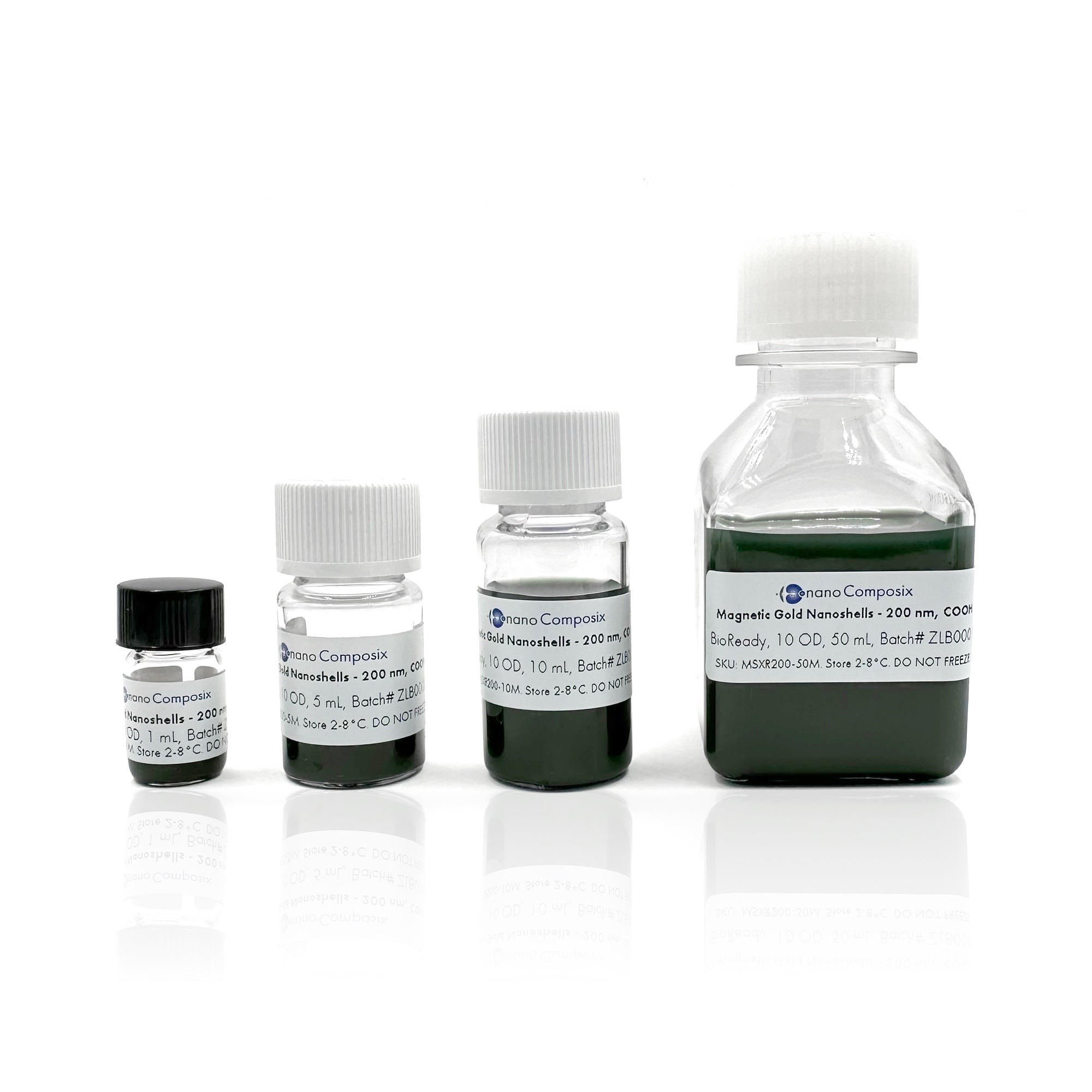
| Available volumes | 1, 5, 10, and 50 mL |
| Storage temperature | 2∘C to 8∘C |
| Freezing | Do not freeze |
| Shelf life | 12 months from delivery when unopened and refrigerated |
Part numbers and volume selection
| Part number | Nominal diameter | Surface chemistry | Concentration | Volume | Container |
|---|---|---|---|---|---|
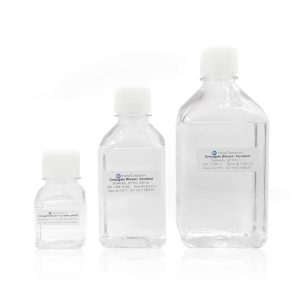
| AP-MSXR200-1M | Approximately 200 nm | Carboxyl, lipoic acid | 10 OD | 1 mL | Amber, low-binding glass vial |
| AP-MSXR200-5M | Approximately 200 nm | Carboxyl, lipoic acid | 10 OD | 5 mL | Amber, low-binding vial |
| AP-MSXR200-10M | Approximately 200 nm | Carboxyl, lipoic acid | 10 OD | 10 mL | Amber, low-binding bottle |
| AP-MSXR200-50M | Approximately 200 nm | Carboxyl, lipoic acid | 10 OD | 50 mL | Amber, high-density container |
EDC/NHS conjugation protocol
1. Prepare the activation buffer
Dilute the nanoshells into an activation buffer such as:
10 mM MES,pH 5.5–6.0
Avoid primary-amine-containing buffers, including Tris, during activation. High phosphate or high-salt concentrations should also be avoided at this stage.
2. Activate the carboxyl groups
Add freshly prepared EDC and Sulfo-NHS to convert the surface carboxylic acids into amine-reactive NHS-ester intermediates.
Incubate for approximately 15 to 30 minutes at room temperature with gentle mixing.
3. Perform magnetic separation and washing
Place the tube on a magnetic separation rack for approximately 5 to 10 minutes. After a visible magnetic pellet forms, carefully remove the supernatant containing excess crosslinkers.
4. Couple the ligand
Immediately redisperse the activated nanoshells in a physiological coupling buffer, such as:
- 1×PBS
- HEPES buffer
Use a pH of approximately 7.2–7.6. Add the primary antibody or other amine-containing biomolecule and incubate:
- 1 to 2 hours at room temperature, or
- Overnight at 4∘C
5. Quench and block
Add a suitable blocking or quenching reagent, such as:
- BSA
- PEG
- Hydroxylamine
- Glycine
This consumes residual active esters and reduces nonspecific binding.
6. Clean up and store
Use a magnetic rack to collect the conjugated particles. Remove the wash solution and resuspend the particles in a suitable storage buffer, for example:
1×PBS,1% BSA,0.05% sodium azide
Store the finished conjugate at 2∘C to 8∘C.
Actual reagent concentrations, incubation times, magnetic separation conditions, and washing steps should be optimized for the specific biomolecule and assay.
Applications
- Magnetic lateral flow immunoassays: Enrich low-abundance targets from serum, urine, saliva, and other clinical fluids before lateral flow detection.
- SERS: Magnetically capture trace chemical, bacterial, or biological targets while providing plasmonic enhancement for Raman detection.
- Automated immunoassays: Integrate into robotic liquid handling and magnetic bead separation systems.
- Nucleic-acid workflows: Support hybridization assays, viral capture, and biomarker extraction.
- Biosensors: Amplify mass and optical signals on electrochemical electrodes, QCM platforms, and SPR chips.
- Photothermal research: Use NIR absorption for localized heating and photothermal-response studies.
Handling and storage
- Store upright at 2∘C to 8∘C in a dark environment.
- Keep the bottle tightly closed.
- Do not freeze. Freezing can cause irreversible aggregation and loss of magnetic redispersibility.
- Because of the high density of the iron oxide-gold structure, slow settling may occur during storage.
- Gently invert or swirl the bottle before use until the suspension is homogeneous.
- A low-power ultrasonic bath for 10 to 15 seconds may be used if needed.
- Use rare-earth, such as neodymium, magnets for rapid separation.
- Avoid leaving the particles exposed to a strong magnetic field longer than necessary, since this can make redispersion more difficult.
- Use sterile, low-binding pipette tips.
- Keep the container sealed to reduce evaporation and particulate contamination.
Product relationship
Available Through Applied Physics
Applied Physics supplies and supports quotation of this product. Product branding and manufacturer information, where stated on the product page or supporting documentation, remain authoritative.
Applied Physics portfolio: General
Catalog relationship: Available Through Applied Physics
Related Applied Physics resources
Continue through the General portfolio
Use these technical and portfolio pages to compare applications and related equipment. To keep this exact product attached to an RFQ, use the product’s existing Request a Quote or Add To Order control.

Reviews
There are no reviews yet.