Description
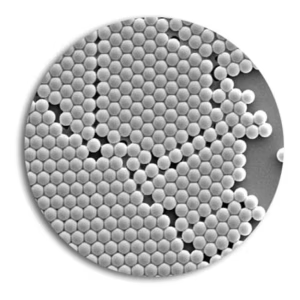
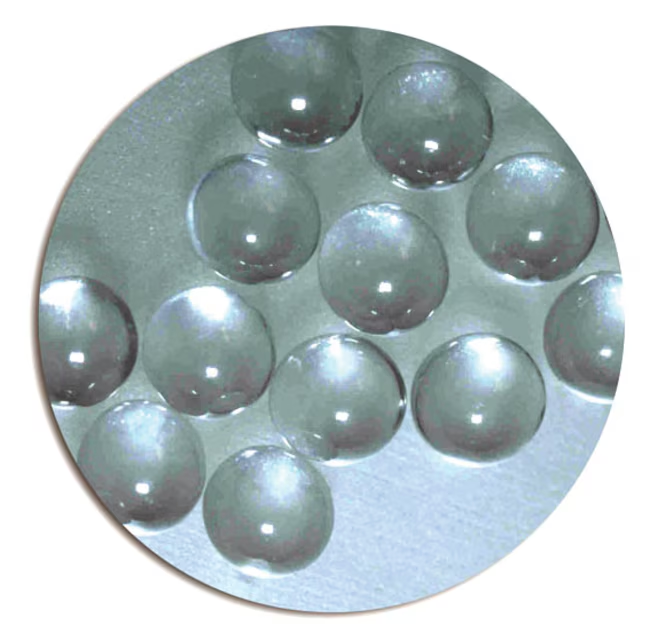
The 9000 Series provides dry, highly spherical glass microspheres for calibration and metrology applications where polymeric, such as polystyrene, spheres are unsuitable.
Glass microspheres offer:
- High mechanical rigidity
- Resistance to elevated temperatures
- Chemical resistance to harsh solvents, resins, and organic matrices
- Reduced shape-related measurement errors compared with irregular dusts or ground minerals
Diameters are certified as traceable to the National Institute of Standards and Technology (NIST) through calibrated optical and electron microscopy methods.
Material ranges
| Nominal diameter range | Material | Refractive index | Density |
|---|---|---|---|
| 2 µm to 20 µm | Borosilicate glass | n=1.56 | 2.50–2.55 g/cm3 |
| 30 µm to 2000 µm | Soda-lime glass | n=1.51 | 2.40–2.50 g/cm3 |
Each standard is supplied as a dry powder in a 1-gram glass vial. Lot-specific documentation includes the mean diameter, size distribution, and uncertainty limits.
Key features
- NIST traceability: Calibrated against NIST Standard Reference Materials, with the certified mean diameter and size distribution documented on the certificate.
- Dry powder formulation: Supplied as 1 gram of dry, unagglomerated spheres for direct dry dispersion or suspension in a selected solvent.
- Thermal and solvent stability: Suitable for organic solvents, high-shear processing, and elevated temperatures where polymer latex spheres may soften or dissolve.
- Narrow size distribution: Low coefficient of variation supports sharp calibration peaks in microscopy, light scattering, and particle-counting applications.
- Precision spacers: Uniform diameters support accurate bond-line thickness control in optical cells, epoxy joints, display panels, and related assemblies.
Specifications
| Parameter | 2 µm to 20 µm | 30 µm to 2000 µm |
|---|---|---|
| Material composition | Borosilicate glass | Soda-lime glass |
| Physical form | Dry spherical powder | Dry spherical powder |
| Package quantity | 1.0 g | 1.0 g |
| Density | 2.50–2.55 g/cm3 | 2.40–2.50 g/cm3 |
| Refractive index | 1.56 at 589 nm, 25∘C | 1.51 at 589 nm, 25∘C |
| Traceability | NIST Standard Reference Materials | NIST Standard Reference Materials |
| Storage temperature | 15∘C to 30∘C | 15∘C to 30∘C |
Part numbers and variants
| Part number | Nominal diameter | Material | Form | Quantity |
|---|---|---|---|---|
| AP-9002 | 2 µm | Borosilicate glass | Dry powder | 1 gram |
| AP-9005 | 5 µm | Borosilicate glass | Dry powder | 1 gram |
| AP-9008 | 8 µm | Borosilicate glass | Dry powder | 1 gram |
| AP-9015 | 15 µm | Borosilicate glass | Dry powder | 1 gram |
| AP-9020 | 20 µm | Borosilicate glass | Dry powder | 1 gram |
| AP-9030 | 30 µm | Soda-lime glass | Dry powder | 1 gram |
| AP-9040 | 40 µm | Soda-lime glass | Dry powder | 1 gram |
| AP-9050 | 50 µm | Soda-lime glass | Dry powder | 1 gram |
| AP-9060 | 60 µm | Soda-lime glass | Dry powder | 1 gram |
| AP-9070 | 70 µm | Soda-lime glass | Dry powder | 1 gram |
| AP-9080 | 80 µm | Soda-lime glass | Dry powder | 1 gram |
| AP-9090 | 90 µm | Soda-lime glass | Dry powder | 1 gram |
| AP-9100 | 100 µm | Soda-lime glass | Dry powder | 1 gram |
| AP-9110 | 110 µm | Soda-lime glass | Dry powder | 1 gram |
| AP-9120 | 120 µm | Soda-lime glass | Dry powder | 1 gram |
| AP-9140 | 140 µm | Soda-lime glass | Dry powder | 1 gram |
| AP-9170 | 170 µm | Soda-lime glass | Dry powder | 1 gram |
| AP-9200 | 200 µm | Soda-lime glass | Dry powder | 1 gram |
| AP-9230 | 230 µm | Soda-lime glass | Dry powder | 1 gram |
| AP-9280 | 280 µm | Soda-lime glass | Dry powder | 1 gram |
| AP-9330 | 330 µm | Soda-lime glass | Dry powder | 1 gram |
| AP-9400 | 400 µm | Soda-lime glass | Dry powder | 1 gram |
| AP-9480 | 480 µm | Soda-lime glass | Dry powder | 1 gram |
| AP-9550 | 550 µm | Soda-lime glass | Dry powder | 1 gram |
| AP-9650 | 650 µm | Soda-lime glass | Dry powder | 1 gram |
| AP-9750 | 750 µm | Soda-lime glass | Dry powder | 1 gram |
| AP-9950 | 950 µm | Soda-lime glass | Dry powder | 1 gram |
| AP-91000 | 1000 µm, 1.0 mm | Soda-lime glass | Dry powder | 1 gram |
| AP-92000 | 2000 µm, 2.0 mm | Soda-lime glass | Dry powder | 1 gram |
Applications
- Microscopy calibration: Ocular micrometers, stage graticules, and image-analysis software for optical and confocal microscopes.
- Laser diffraction and particle-size analysis: Calibration of dry-powder dispersion systems and wet sample cells requiring nonpolymeric standards.
- Precision spacing: Control of gap thickness in liquid-crystal displays, adhesive bond lines, gas-discharge cells, and filter-membrane support meshes.
- Sedimentation and fluid-flow studies: Modeling Stokes’ law settling behavior using glass densities from 2.40 to 2.55 g/cm3.
- Solvent-intolerant systems: Instrument verification in ketones, aromatic solvents, chlorinated solvents, and hot oils where polystyrene spheres may degrade.
Handling and storage
- Store at room temperature, from 15∘C to 30∘C.
- Keep the vial tightly closed to limit moisture uptake and airborne contamination.
- Disperse dry particles directly into air streams or suspend them in clean liquids.
- For water or organic-solvent suspensions, add a small amount of wetting agent or sonicate briefly to reduce clustering.
- Use clean spatulas or antistatic dispensing tools when weighing small aliquots.
Product relationship
Available Through Applied Physics
Applied Physics supplies and supports quotation of this product. Product branding and manufacturer information, where stated on the product page or supporting documentation, remain authoritative.
Applied Physics portfolio: Particle
BOROSILICATE GLASS STANDARD
Confirm density and distribution requirements with the sizing method
Nominal size rangeDistribution widthParticle densityDry or suspension useMeasurement method
Glass particles can be useful where a denser and more durable reference is appropriate. They should not be substituted for PSL solely because the nominal diameter is similar.
Product family: Particle Standards › Borosilicate GlassCatalog relationship: Available Through Applied Physics
Related Applied Physics resources
Continue through the Particle portfolio
Use these technical and portfolio pages to compare applications and related equipment. To keep this exact product attached to an RFQ, use the product’s existing Request a Quote or Add To Order control.