
Last Updated: August 31, 2026
Manual wafer alignment tools have dominated semiconductor fabrication for decades, but they’re increasingly becoming a bottleneck for facilities pursuing sub-10nm precision and higher throughput. When your process depends on repeatable, sub-micrometer accuracy, the inconsistencies introduced by manual positioning become impossible to ignore. This guide examines the top alternatives to manual wafer alignment tools, from fully automated systems to semi-automated solutions that balance cost and capability. At Applied Physics, we’ve worked with semiconductor facilities across multiple nodes, and we’ve seen firsthand how the right alignment approach transforms yield and reduces validation downtime.
The shift away from manual methods isn’t optional anymore, it’s a competitive necessity. As nodes shrink and device complexity increases, the tolerance stack tightens. Manual operators, even highly trained ones, introduce drift, fatigue, and positional variance that accumulate across a production run. The alternatives available today address different facility sizes, production volumes, and precision requirements, so choosing the right one depends on understanding what each approach actually delivers.
Manual wafer alignment relies on operator skill, visual feedback, and mechanical repeatability that simply cannot match the demands of modern semiconductor manufacturing. An operator positions a wafer using manual adjustments, often with reference marks or optical feedback, then locks it in place. The process is slow, operator-dependent, and introduces systematic errors that compound across batches.
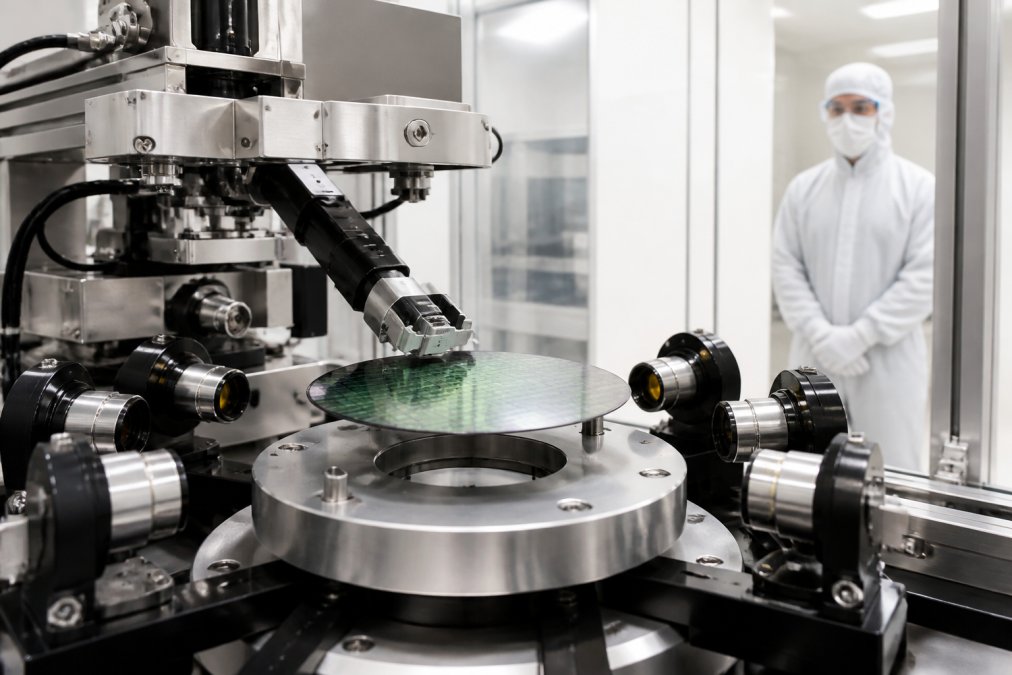
Professional illustration showing Robotic for wafer alignment tools
The core problem isn’t incompetence, it’s physics. Human reaction time, visual acuity limits, and the mechanical play in manual adjustment mechanisms all contribute to positional uncertainty. A trained operator might achieve repeatability within 2-5 micrometers, which was acceptable at 90nm nodes (peer-reviewed research). At 7nm and below, that tolerance window has shrunk by orders of magnitude. The cost of misalignment isn’t just scrap wafers; it’s the validation downtime required to prove the process is still capable after each drift event.
Manual methods also create workflow friction. Alignment isn’t a single operation, it’s a repeatable step that occurs multiple times across a fabrication sequence. Each manual intervention is an opportunity for variation, and each variation requires investigation and correction.
The real cost isn’t the labor, it’s the lost throughput and the validation overhead that follows every suspected misalignment event.
Fully automated wafer alignment systems eliminate operator intervention by using precision motors, closed-loop feedback, and vision-based positioning to place wafers with repeatability measured in tenths of micrometers (peer-reviewed research). These systems read alignment marks on the wafer using optical or laser-based sensors, calculate the required positional correction, and drive stepper motors to achieve target placement. Once positioned, the system locks the wafer and signals readiness to the next process step.
The appeal is straightforward: consistency. An automated system performs the same alignment sequence identically for every wafer, every shift, every month. There’s no drift from fatigue, no variation from operator interpretation, no retraining required when personnel change. For facilities running high-volume production or processing critical device layers, this consistency translates directly to higher yield and reduced scrap.
Automated systems also integrate seamlessly with fab automation frameworks. They accept commands from the manufacturing execution system (MES), report position data and alignment confidence metrics back to the process control system, and trigger alerts if alignment confidence falls below threshold. This closed-loop feedback enables real-time process adjustment and statistical process control that simply isn’t possible with manual methods.
The tradeoff is upfront capital and integration complexity. A fully automated alignment system requires mechanical installation, electrical integration, software configuration, and process validation before it’s production-ready. Facilities typically invest in these systems when they’ve reached production volumes or precision requirements that make manual alignment economically unsustainable. For smaller operations or prototype environments, the fixed cost may not justify the throughput gain.
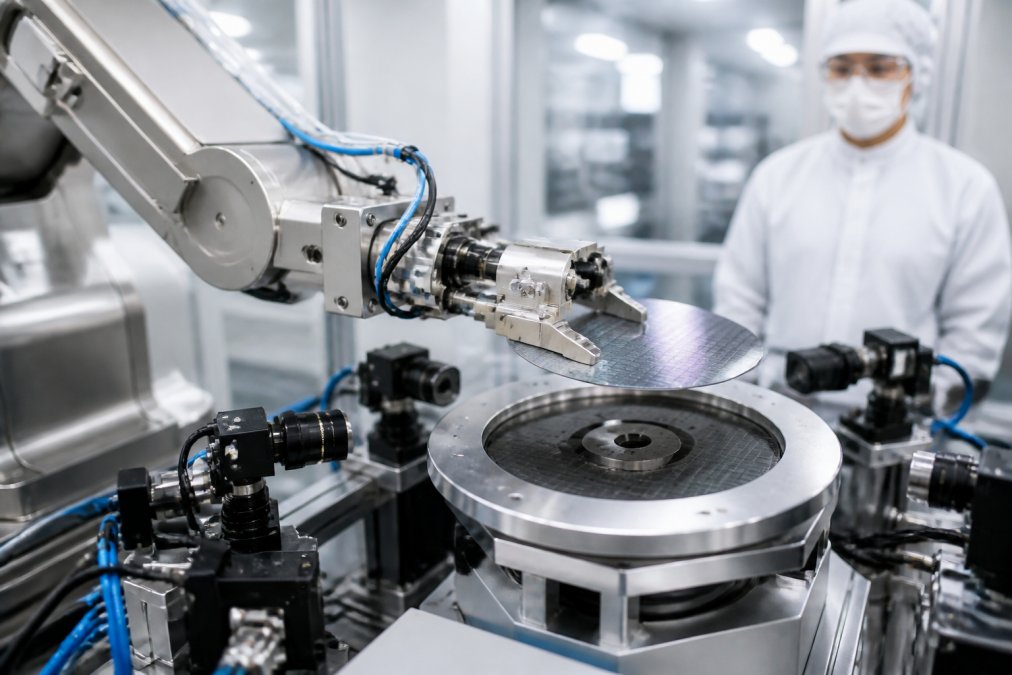
Robotic precision arm positioning a semiconductor wafer onto an alignment platform in a cleanroom environment, with multiple optical sensors visible and technician monitoring in background
Applied Physics calibration wafer standards support the validation of automated alignment systems by providing traceable reference marks and material properties that allow facilities to confirm alignment repeatability independently of production wafers. This is critical for GMP compliance, you need documented evidence that your alignment system is performing within specification, not just anecdotal reports of “things look better.”
Semi-automated systems split the difference: they automate the precision positioning step while keeping the wafer loading and initial orientation manual. An operator places the wafer in a fixture, initiates the alignment sequence, and the system takes over from there. The operator returns when the alignment is complete to retrieve the wafer or transfer it to the next process station.
This hybrid approach reduces operator fatigue and decision-making burden while keeping capital investment lower than fully automated systems. It’s particularly effective in facilities running multiple product types or process flows, where the flexibility of manual loading outweighs the throughput gain from full automation. An operator can load a wafer, start the alignment, and move to another station, the alignment happens in parallel with other work.
Semi-automated systems also introduce fewer integration points into the fab infrastructure. They don’t require extensive MES coupling or advanced process control feedback loops. A simple interface, start button, status indicator, completion signal, is often sufficient. This makes them easier to retrofit into existing workflows and faster to validate for GMP compliance.
The limitation is consistency of the initial wafer placement. If the operator consistently loads the wafer in slightly different orientations, the automated system must correct for larger angular deviations, which increases positioning time and reduces effective throughput. Operator training becomes critical, you need consistency in the manual portion to get the full benefit of the automated portion.
Semi-automated systems work best when operator loading can be standardized through fixture design or when the wafer’s own geometry provides self-aligning features. Facilities running consistent product types and moderate volumes often find this approach optimal.
Repeatability is the metric that separates viable alignment approaches from inadequate ones. Repeatability, the ability to return to the same position across multiple cycles, is what drives yield consistency and reduces scrap. A system with 0.5 micrometer repeatability is fundamentally different from one with 5 micrometer repeatability, even if both can achieve the target position on the first attempt.
Precision and repeatability are often conflated, but they’re distinct. Precision is how close you get to the intended position on the first attempt. Repeatability is how consistently you return to that same position across subsequent cycles. For alignment, repeatability matters more than absolute precision, a system that’s consistently 0.2 micrometers off is more valuable than one that’s sometimes dead-on and sometimes 2 micrometers away.
Measuring repeatability requires a calibration standard, a wafer or artifact with known, traceable alignment marks. You run the alignment system multiple times on the same wafer, record the positional data, and calculate the standard deviation of the measurements. This is where calibration wafer standards become essential. Applied Physics provides calibration wafer standards across multiple diameters (75mm through 300mm) that are manufactured to traceable specifications, allowing you to validate your alignment system’s performance independently and document that validation for regulatory audits.
The repeatability specification you need depends on your process requirements. At 90nm nodes, repeatability within 1 micrometer is often sufficient. At 7nm and below, repeatability within 0.1 micrometer becomes critical for maintaining device yield (peer-reviewed research). Understanding your actual precision requirements, not just what the tool vendor claims, is essential before selecting an alignment approach.
Automated wafer handling systems, which include alignment as one component, deliver benefits that extend beyond positioning accuracy. When alignment is integrated into a broader wafer handling automation framework, you gain consistency across multiple process steps, reduced wafer surface contact, and lower contamination risk.
Manual handling introduces multiple contamination vectors: fingerprints, dust from the cleanroom environment, particles from worn fixtures, and microcontamination from repeated wafer contact. Each manual touch is an opportunity for defect introduction. Automated handling systems minimize contact, use cleaned and controlled fixtures, and reduce the total number of times a wafer is physically moved between process steps.
For pharmaceutical manufacturing and sterile compounding environments, this contamination control is critical for USP 797 and USP 800 compliance. Automated wafer handling reduces the risk of cross-contamination between batches and provides audit trails that demonstrate process control.
Throughput improvement is the secondary benefit. When alignment, positioning, and wafer transfer are automated and parallelized, the total cycle time per wafer decreases significantly.
The integration challenge is real. Automated handling systems require mechanical interfaces with existing equipment, software integration with process control systems, and validation that the new system doesn’t introduce new failure modes. But for facilities running high-volume production or processing sensitive materials, the contamination control and throughput gains justify the integration effort.
Calibration wafer standards are the foundation of any alignment validation program. These are specially manufactured wafers with precision-etched alignment marks, known material properties, and traceable dimensional specifications. They allow you to measure how well your alignment system is actually performing, independent of production wafer results.
The validation process is straightforward: run your alignment system on the calibration wafer multiple times, measure where the system positioned the wafer each time, calculate the standard deviation, and compare it against your process requirements. If repeatability meets specification, you have documented evidence that the system is capable. If it doesn’t, you have a clear signal that something is drifting, either in the alignment system itself or in the fixturing that holds the wafer.
Applied Physics calibration wafer standards are available in multiple diameters to match your production equipment: 75mm, 100mm, 125mm, 150mm, 200mm, and 300mm. Each standard is manufactured to consistent specifications, allowing you to validate alignment systems across your entire fab or compare performance across multiple tools.
The calibration marks themselves are critical. They need to be visible to your alignment system’s sensors (whether optical, laser-based, or other modalities), stable across multiple measurement cycles, and traceable to a known reference frame. Poor calibration standards introduce measurement noise that masks real alignment drift, leading to false confidence in system capability.
For GMP compliance, calibration validation must be documented and repeatable. You need to demonstrate that your calibration standards themselves haven’t drifted, that your measurement methodology is sound, and that your alignment system’s performance is stable over time. This requires a validation protocol, documented procedures, and records that show the results of calibration runs at defined intervals.
The transition from manual to automated alignment isn’t just a hardware swap, it’s a process redesign. Your existing workflow assumes manual positioning at specific points in the sequence. Automated systems change the timing, the operator interaction model, and the data flow through your MES.
The integration challenge breaks into three categories: mechanical, electrical, and software. Mechanical integration means physically installing the alignment system into your existing equipment layout, ensuring it doesn’t interfere with other process steps, and designing wafer transfer interfaces that are compatible with your existing handling equipment. Electrical integration means providing power, environmental controls (cleanroom compatibility, thermal management), and sensor interfaces. Software integration means connecting the alignment system to your MES, configuring it to accept commands from your process control system, and ensuring it reports position data and alignment status back to your quality system.
Most facilities underestimate the software integration burden. An automated alignment system generates continuous data, position readings, alignment confidence metrics, cycle times, error codes. That data needs to flow into your MES for statistical process control, into your quality system for audit trails, and into your maintenance system for predictive maintenance signals. Without proper data integration, you have a fast, consistent alignment system that’s invisible to your process control infrastructure.
The validation effort is also significant. You need to qualify the new alignment system against your process requirements, run validation batches to confirm that product quality hasn’t changed, and document the entire validation protocol for regulatory review. This typically requires 4-8 weeks of production downtime, depending on your product complexity and regulatory requirements.
For facilities with mature, stable processes, this integration effort is manageable and justified by the yield improvement and throughput gain. For facilities in early-stage production or running highly customized processes, the validation burden may outweigh the benefits until production volume justifies the investment.
Alignment systems are considered critical process equipment in GMP-regulated environments. This means your system selection, validation, and ongoing control must meet regulatory expectations for process control and quality assurance.
The regulatory requirement is straightforward: you must demonstrate that your alignment system is capable of consistently delivering product that meets specifications, and you must have documented evidence of that capability. For manual systems, this evidence is typically anecdotal, operator reports, scrap rates, customer complaints. For automated systems, you have objective data: position measurements, alignment confidence metrics, repeatability statistics.
Regulators expect this data. When you transition to automated alignment, you’re expected to provide validation studies showing that the new system meets or exceeds your previous capability. This includes alignment repeatability measurements, product quality comparisons between manual and automated runs, and statistical process control data showing that the automated system maintains consistent performance over time.
The documentation burden is real. You need written procedures for system operation, maintenance, and calibration. You need training records showing that operators understand the new system. You need validation protocols and results. You need statistical evidence that the system is in control. For facilities accustomed to manual processes with minimal documentation, this shift to data-driven process control can feel burdensome.
But it’s also an opportunity. Automated systems with proper data integration provide visibility into process performance that manual methods cannot. You can detect drift earlier, trigger preventive maintenance before failures occur, and make data-driven decisions about process adjustments. This actually simplifies regulatory compliance because you have objective evidence of process control, not subjective operator assessments.
USP 797 and USP 800 compliance for sterile compounding environments adds specific requirements around contamination control and personnel safety. Automated systems that minimize manual handling and provide closed-loop processing support these compliance objectives. Applied Physics cleanroom solutions are designed specifically to support USP 797 compliance through precision airflow visualization and contamination control.
The economic case for automation depends on production volume, precision requirements, and your current scrap rate. For low-volume, prototype-stage facilities, manual alignment may remain the most economical approach indefinitely. For high-volume production or processes with tight precision requirements, automation typically pays for itself within 12-24 months through scrap reduction and throughput improvement.
The direct cost comparison is straightforward: a fully automated alignment system typically costs 2-4 times more than a semi-automated system, which costs 2-3 times more than manual positioning fixtures. But direct cost is only part of the equation. You also need to consider:
Validation and integration costs, typically 15-25% of hardware cost for automated systems, less for semi-automated approaches Training and personnel, automated systems require less operator skill but more technical expertise for maintenance and troubleshooting Scrap reduction, the difference between a 2% and 0.5% scrap rate on high-value wafers can justify automation quickly Throughput improvement, fewer cycles required per wafer means more wafers processed per shift Downtime reduction, automated systems eliminate drift-related requalification cycles
For facilities processing high-value products (advanced semiconductor nodes, specialty materials, pharmaceutical compounds), the scrap reduction alone often justifies automation. For facilities with moderate volumes and less stringent precision requirements, semi-automated approaches often provide the best economic balance.
The hidden cost is validation downtime. When you transition from manual to automated alignment, you need to halt production while you validate the new system. This typically requires 4-8 weeks, depending on your product complexity and regulatory requirements. The longer your validation window, the longer your facility is running below capacity. This cost should be factored into the economic analysis.
Applied Physics calibration wafer standards reduce the validation burden by providing traceable reference artifacts that accelerate the qualification process. Instead of running extended production batches to prove alignment capability, you can run calibration studies on reference wafers, accumulate statistical evidence of repeatability, and compress the validation timeline significantly.
| Alignment Approach | Capital Cost | Validation Time | Repeatability | Best For |
|---|---|---|---|---|
| Manual positioning | Low | Minimal | 2-5 micrometers | Prototype, low-volume, flexible processes |
| Semi-automated | Moderate | 2-4 weeks | 0.5-2 micrometers | Moderate volume, mixed products |
| Fully automated | High | 4-8 weeks | 0.1-0.5 micrometers | High volume, consistent products, sub-7nm nodes |
The most frequent mistake is underestimating the software integration burden. Facilities purchase an automated alignment system, install it mechanically, and then discover that getting it to communicate properly with their MES, quality system, and process control infrastructure takes far longer than expected. This delay extends the validation timeline and pushes the payback period further out.
The second common mistake is validating only with production wafers. Facilities run extended production batches to prove the new system works, but this approach conflates alignment performance with product quality. If a batch shows good results, you can’t distinguish between “the alignment system is working well” and “we got lucky with this batch.” Using calibration wafer standards for alignment validation, separate from product quality validation, provides clearer evidence of system capability and accelerates the qualification process.
A third mistake is insufficient operator training. Automated systems change how operators interact with the equipment. Operators who were making alignment decisions now monitor system status and handle exceptions. This is a fundamentally different skill set. Facilities that treat this as a minor retraining exercise often encounter higher-than-expected scrap rates and downtime as operators struggle with the new workflow.
The fourth mistake is not planning for maintenance and support. Automated systems are more complex than manual fixtures. They require calibration, preventive maintenance, and technical expertise for troubleshooting. Facilities that don’t establish maintenance procedures or don’t have access to qualified technical support often experience higher downtime and lower reliability than they expected.
Finally, facilities sometimes automate without actually understanding their precision requirements. They assume “more automation = better results,” but if your process doesn’t actually require sub-micrometer repeatability, you’re paying for capability you don’t need. Understanding your actual precision requirements before selecting an alignment approach prevents over-investment and ensures you choose a solution that’s economical for your specific application.
The decision framework is built around three questions: What precision do you actually need? What production volume justifies the investment? What integration complexity can your team handle?
Start with precision requirements. Run a capability study on your current manual process. Measure wafer positions across multiple cycles, calculate the standard deviation, and compare it against your actual process requirements. Many facilities discover that their precision requirements are less stringent than they assumed, which changes the economic case for automation. Conversely, some facilities discover that their manual process is already operating at its limit, which makes automation an urgent necessity rather than a nice-to-have.
Next, assess production volume. Automation is economical when the throughput gain and scrap reduction justify the capital and validation costs. For facilities running fewer than 100 wafers per week, manual or semi-automated approaches are typically more economical. For facilities running 500+ wafers per week, fully automated systems usually pay for themselves within 18-24 months.
Then evaluate integration complexity. Facilities with mature, stable MES and process control infrastructure can integrate automated systems relatively quickly. Facilities with legacy systems or minimal process control infrastructure face a steeper integration challenge. Be realistic about your team’s capability to execute the integration and support the system long-term.
For most semiconductor facilities pursuing advanced nodes and high-volume production, the answer is clear: fully automated wafer alignment systems with integrated process control and statistical monitoring are the standard approach. The precision, consistency, and data visibility they provide are non-negotiable for sub-7nm production.
For pharmaceutical and sterile compounding environments, the decision often hinges on contamination control and USP 797 compliance. Automated systems that minimize manual handling and provide closed-loop processing support these objectives, making them economically justified even at lower volumes.
For facilities in transition, ramping up production volume or moving to more demanding process nodes, semi-automated solutions often provide the optimal balance. They reduce operator burden and introduce more consistency than fully manual approaches, but without the full integration complexity and capital investment of fully automated systems.
Applied Physics provides calibration wafer standards that support validation of any alignment approach. Whether you’re validating a manual process, qualifying a semi-automated system, or certifying a fully automated installation, calibration wafer standards give you objective evidence of alignment repeatability and provide the traceable reference data that regulatory audits require. Our standards are available in multiple diameters to match your production equipment, and they’re manufactured to specifications that support sub-10nm precision requirements.
The transition to automated or semi-automated alignment isn’t just about faster wafer positioning, it’s about building repeatable, data-driven processes that support GMP compliance, reduce scrap, and enable production at advanced nodes. The right alignment solution depends on understanding your specific requirements and choosing an approach that balances precision, cost, and integration complexity for your facility’s situation.
Manual alignment methods have served the semiconductor industry for decades, but they’ve reached their practical limit for advanced node production and high-volume manufacturing. The alternatives, from semi-automated systems to fully automated platforms with closed-loop process control, address the precision and consistency requirements that modern fabrication demands. Applied Physics has supported semiconductor facilities, cleanroom operations, and pharmaceutical manufacturers since 1992 with calibration wafer standards and precision metrology solutions that enable reliable process validation and GMP compliance. Whether you’re validating alignment repeatability, qualifying new equipment, or building statistical evidence of process control, Applied Physics calibration wafer standards provide the traceable reference data your facility needs. Contact us to discuss how calibration wafer standards can accelerate your alignment validation and support your path to advanced node production.
Automated wafer alignment eliminates human error, reduces cycle time, and maintains consistent positioning. Manual methods introduce variability that compounds across production runs, affecting yield and requiring rework. Automated systems also reduce operator fatigue and enable 24/7 operation without precision degradation, critical for high-volume semiconductor fabrication and sub-10nm node production.
Semiconductor fabrication requires wafer alignment repeatability within specific tolerances depending on the process node. Advanced fabs targeting 5nm and below demand sub-10nm repeatability. These standards are verified using calibration wafer standards that match your production wafer diameter. Repeatability testing must be documented for GMP audits and integrated circuit yield certifications.
Wafer handling automation reduces particle contamination, prevents mechanical damage, and eliminates alignment drift. Each manual touch point introduces risk of defects that propagate through subsequent processing steps. Automated systems maintain consistent environmental conditions and positioning, directly improving first-pass yield. This translates to lower rework costs and faster time-to-market for new products.
Yes, semi-automated solutions are available for constrained spaces. These systems use compact robotic arms or motorized stages that fit within standard glove boxes and smaller clean benches. However, precision may be lower than full-scale fab equipment. Verify footprint requirements and alignment repeatability specifications before deployment. Applied Physics calibration wafer standards are available in multiple sizes (75mm to 300mm) to match your equipment footprint.
APPLIED PHYSICS TECHNICAL RESOURCE
Wafer inspection, SSIS calibration, particle deposition references, process control and semiconductor measurement workflows. Product and standards references should be interpreted for the actual instrument, facility, protocol and configuration.

Enter your details below to save your shopping cart for later. And, who knows, maybe we will even send you a sweet discount code :)
Allow notifications to get real-time updates about your shopping cart and who knows, you may even receive a sweet discount code 😊