
Last Updated: September 26, 2026
ISO 14644-1 is the international standard that defines how cleanrooms and controlled environments are classified by airborne particle concentration. It sets the cleanroom classification framework from ISO 1 to ISO 9 and specifies the testing methods used to verify that a facility meets its designated class. This guide from Applied Physics breaks down what that means in practice for facility managers, QA officers, and process engineers who answer to auditors.
The standard matters because it is the common language between your facility and every regulator, client, and auditor who walks through the door. When a pharmaceutical plant claims an ISO Class 5 space, ISO 14644-1 is the document that defines what “Class 5” actually means: no more than 3,520 particles ≥0.5µm per cubic meter, according to Envigilance’s 2026 cleanroom compliance guidance.
Here’s the part most summaries skip. Classification is a snapshot, not a guarantee. A room can pass its particle count on classification day and still fail operationally if recovery time, airflow patterns, or gowning protocols are off. The standard tells you how to measure; it does not tell you how to run the room.
Below, we cover the full classification table, the three operational states, validation procedures, testing equipment, and the implementation mistakes that trip up facilities during audits.
The ISO 14644-1 cleanroom classification table assigns a class number based on the maximum allowable concentration of particles at specified sizes. ISO 1 is the cleanest; ISO 9 is the least stringent. Each class defines limits for particles ≥0.1µm, ≥0.2µm, ≥0.3µm, ≥0.5µm, ≥1µm, and ≥5µm, and the limits are cumulative, meaning a Class 5 room must satisfy every size channel, not just the 0.5µm column most people quote.
| ISO Class | ≥0.1µm | ≥0.2µm | ≥0.3µm | ≥0.5µm | ≥1µm | ≥5µm | Typical Use |
|---|---|---|---|---|---|---|---|
| ISO 1 | 10 | 2 | , | , | , | , | Advanced semiconductor RD |
| ISO 2 | 100 | 24 | 10 | 4 | , | , | Leading-edge wafer fab |
| ISO 3 | 1,000 | 237 | 102 | 35 | 8 | , | Nanotechnology, wafer fab |
| ISO 4 | 10,000 | 2,370 | 1,020 | 352 | 83 | , | High-density device manufacturing |
| ISO 5 | 100,000 | 23,700 | 10,200 | 3,520 | 832 | 29 | Sterile compounding, pharma fill |
| ISO 6 | 1,000,000 | 237,000 | 102,000 | 35,200 | 8,320 | 293 | Clean device assembly |
| ISO 7 | , | , | , | 352,000 | 83,200 | 2,930 | Operating rooms, IV prep |
| ISO 8 | , | , | , | 3,520,000 | 832,000 | 29,300 | Medical device assembly |
| ISO 9 | , | , | , | 35,200,000 | 8,320,000 | 293,000 | Controlled industrial space |
All concentrations are maximum permitted particles per cubic meter. The dash indicates that no limit is specified at that size for that class, not that the limit is zero. This is a frequent point of confusion: ISO 7 and ISO 8 simply do not carry sub-0.5µm limits, so a counter reporting only 0.3µm data on an ISO 7 space is testing against a channel the standard does not define.
The jump from ISO 5 to ISO 7 is roughly a hundredfold increase in allowable particulate matter at 0.5µm. That gap explains why a sterile compounding pharmacy cannot simply “clean harder” to move from ISO 7 to ISO 5. It requires different HEPA filtration coverage, higher air change rates, and stricter gowning.
Particle concentration limits scale logarithmically, not linearly. Each successive class permits roughly ten times the particle count of the class above it at any given size. The 2015 revision formalized this by defining the class limit formula as Cn = 10^N × (0.1/D)^2.08, where N is the class number and D is the particle size in micrometers. That exponent, 2.08, is why the limits do not simply double or halve between sizes; they follow a power curve.
This is why cleanroom design decisions cascade. Choosing ISO 5 over ISO 7 changes your HVAC load, your filter count, and your energy bill. A facility that over-specifies by one class may pay for it in fan energy and filter replacement for the life of the room, while a facility that under-specifies will fail classification and face retrofit costs that dwarf the original savings.
A particle counter measures across multiple size channels simultaneously. The 0.5µm threshold drives most classifications, but ISO 1 through ISO 5 also carry limits at 0.1µm and 0.2µm, and ISO 5 is the last class with a ≥5µm limit. For semiconductor work heading toward 5nm nodes, the sub-0.1µm range becomes the deciding factor, and standard optical particle counters may not resolve it, condensation particle counters (CPCs) are typically required below 0.1µm.
For pharmaceutical and medical device facilities, the practical threshold is usually 0.5µm and 5µm, because those are the sizes referenced by USP 797, USP 800, and the EU GMP Annex 1 framework that many U.S. facilities align to voluntarily. Knowing which size channels your regulator actually cites prevents over-testing and keeps your sampling plan defensible.
Watch Out Measuring only at 0.5µm and ignoring smaller size channels is a common audit finding. If your process requires ISO 5 at 0.1µm, a counter calibrated only for 0.5µm will not produce defensible data. Confirm your counter’s lower detection limit against the smallest size channel your class specifies before you write the sampling plan.
ISO 14644-1 requires classification under three distinct operational states, and each state has its own particle limits. As-built is the empty room with systems running but no equipment or personnel. At-rest adds installed equipment but no occupants. Operational is the room in normal production with staff, equipment, and processes running.
InformationBoxTicket Lifestyles
Confusing these states is one of the most common sources of failed audits. A facility may hold ISO 5 at-rest and only ISO 7 operational. Both can be true. The question is which state your regulatory requirement specifies. USP 797 sterile compounding, for example, references specific states for different zones, and a QA officer needs to know which one applies before scheduling a validation.
The practical takeaway: document which operational state each classification claim refers to. An unqualified “ISO 5 cleanroom” statement on a certificate means very little without that context.
Cleanroom validation procedures follow a defined sequence: establish the sampling plan, determine sampling locations and volume, collect particle counts with a calibrated counter, and compile the results into a classification report. The report is what auditors review, and its methodology must match ISO 14644-1 requirements exactly.
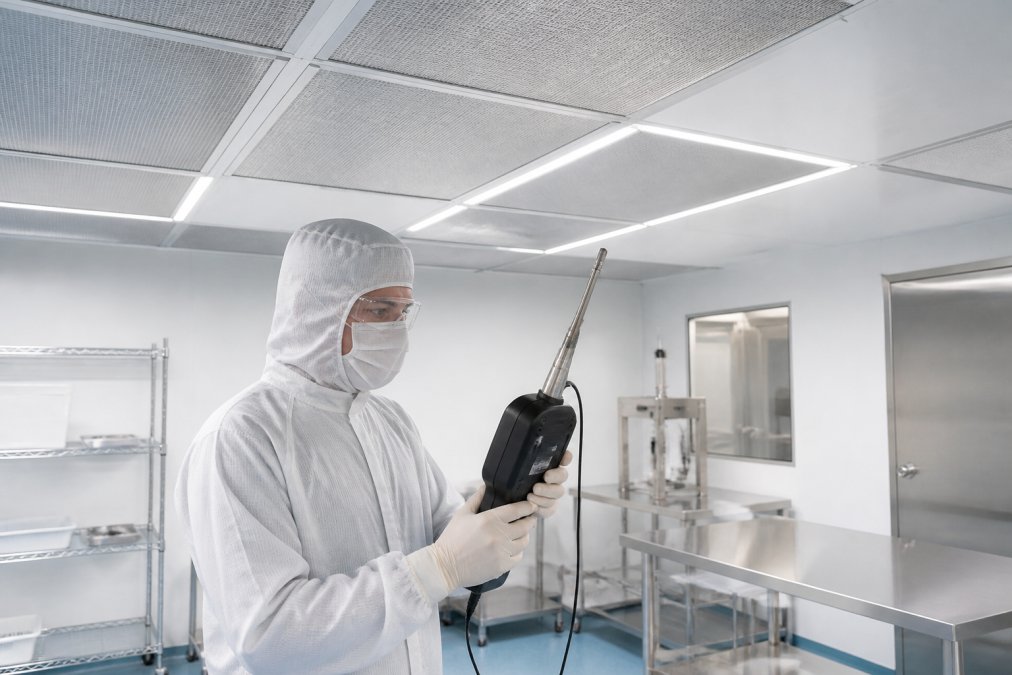
A cleanroom technician in full sterile gowning operating a particle counter inside an ISO Class 5 cleanroom, with HEPA-filtered ceiling panels visible above
The number of sampling locations depends on the cleanroom’s floor area, not on a fixed count. Larger rooms require more sample points to achieve statistical confidence. Each location must be sampled for a minimum volume that ensures the count is meaningful rather than noise.
Sampling volume is calculated so that at least 20 particles would be counted at the class limit, with a minimum sample time of one minute per location. This is where a lot of facilities cut corners. Short sampling times produce low counts that look like a pass but do not meet the statistical basis the standard requires.
A 2026 study published through Springer Link on cleanroom performance evaluation demonstrated integrating ISO 14644-3 qualification tests with computational fluid dynamics modeling to verify pharmaceutical cleanroom performance, an approach that catches airflow problems a particle count alone would miss.
Pro Tip
Run recovery testing alongside your classification. A room that returns to its at-rest particle level quickly after a disruption is a well-designed room. Recovery data also strengthens your audit file when a regulator questions operational performance. ::: Maintaining this level of environmental control provides a robust foundation for your broader
.
The core instruments for ISO 14644-1 compliance are a calibrated particle counter, an aerosol photometer for HEPA filter integrity testing, a microbial air sampler, and airflow measurement tools. Each plays a distinct role, and calibration status on every instrument is a documented requirement.
For facilities running continuous oversight rather than periodic spot checks, the Kanomax [Cleanroom Monitoring(/products/cleanroom-monitoring-system-model-crms/) System | appliedphysicsusa.com] provides turnkey monitoring of particle counts, differential pressure, temperature, and humidity against ISO 14644 and GMP requirements. Applied Physics supplies this system along with microbial air samplers built for ISO 14698-1 microbial sampling at a stable 100 L/min flow rate.
Equipment calibration is the quiet failure point. A particle counter with expired calibration produces data no auditor will accept, regardless of how clean the room actually is. Track calibration dates as rigorously as you track your classification schedule.
ISO 14644-2 sets the testing and monitoring intervals that keep a classification valid between full re-certifications. It specifies a maximum time interval between tests and requires a risk-based monitoring plan tailored to the facility’s operations. The standard does not hand you a single universal schedule, it gives you a framework: define the interval, justify it, and monitor continuously enough to detect drift before it becomes a compliance problem.
The default maximum interval in ISO 14644-2 is 12 months for the core classification and filter integrity tests, but the standard explicitly allows extending or shortening that window based on a documented risk assessment. A semiconductor fab running continuous production may justify a 6-month interval; a low-traffic research lab with stable processes may justify 24 months. What auditors reject is an interval with no written rationale behind it.
| Test | Default Max Interval | Purpose |
|---|---|---|
| Particle count classification | 12 months | Confirm class holds |
| HEPA filter integrity (leak) | 12 months | Detect leaks and gasket failures |
| Airflow volume and air change rate | 12 months | Verify ventilation performance |
| Differential pressure | 12 months | Confirm pressure cascade |
| Recovery test | 12 months | Verify contamination recovery |
| Continuous monitoring | Ongoing | Detect drift between tests |
ISO 14644-2 distinguishes between periodic testing and continuous monitoring, and the two serve different purposes. Periodic tests prove the room meets its class on a given day. Continuous monitoring proves the room stays within limits between those days. A monitoring system typically tracks particle counts at critical locations, differential pressure between adjacent zones, temperature, and relative humidity, the parameters that most often drift and most often trigger deviations.
The practical rule most facilities follow: monitor the parameters that, if they drifted, would invalidate your classification or your product. For a sterile fill line, that means particle counts at the fill point and pressure differentials at every boundary. For a device assembly room, it may mean fewer particle points but tighter humidity control.
Monitoring data is only as good as the instrument producing it. Particle counters used for ISO 14644-1 classification are typically calibrated annually against a reference standard, and the calibration certificate must trace to a national metrology institute. A counter with expired calibration produces data no auditor will accept, regardless of how clean the room actually is.
A common pattern is to align calibration cycles with the classification schedule so that every annual re-certification is performed with freshly calibrated instruments. Facilities that stagger calibration and classification often discover mid-audit that their most recent data came from an out-of-calibration counter, a finding that can invalidate the entire monitoring record for that period.
Build a single compliance calendar that tracks classification dates, filter integrity tests, airflow measurements, and instrument calibration side by side. When one date slips, you can see immediately which downstream records are affected. Facilities that manage these as separate schedules are the ones that discover gaps during an audit rather than before it.
A 2026 framework integrating cleanroom qualification tests with numerical modeling, reported through Springer Link’s pharmaceutical cleanroom study, shows how continuous data supplements the periodic test cycle rather than replacing it. The periodic test establishes the baseline; the continuous data proves the baseline holds.
The 2015 revision of ISO 14644-1 changed how sampling locations are selected and how classification is calculated. The most significant shift was the move to a statistical method for determining sample locations based on room area, replacing the older table-based approach.
For facility managers, the practical impact was a change in the sampling plan document. Facilities that built their validation templates before 2015 may still be using outdated location tables. Auditors now expect the statistical method, and a plan built on the old tables will draw questions.
ISO also continues to expand the series. The ISO 14644-14:2026 standard now specifies methodology for assessing equipment suitability in controlled environments, and ISO 14644-13 covers surface cleaning to defined cleanliness levels. The series is a living framework, not a single document.
The most frequent ISO 14644-1 failures trace back to process gaps, not equipment gaps. Facilities buy capable instruments, then undermine the data with inconsistent procedures.
Key Takeaway Classification is the entry ticket, not the destination. The facilities that pass audits cleanly are the ones treating validation as an ongoing monitoring discipline, not an annual event.
ISO 14644-1 is the international standard that defines cleanroom classification by airborne particle concentration. It establishes nine classes, ISO 1 through ISO 9, each with a maximum allowable number of particles at specific sizes per cubic meter. The standard also specifies how to test, sample, and report results. ISO Class 5, for example, permits no more than 3,520 particles at 0.5 micrometers or larger per cubic meter. It remains the governing framework for cleanroom classification worldwide.
Classification depends on measuring airborne particle concentration at specific sizes, typically 0.1 and 0.5 micrometers and larger. A certified particle counter samples a calculated volume of air at defined locations. Results are compared against the cleanroom classification table in ISO 14644-1. If the measured concentration stays at or below the limit for a given ISO class, the room earns that classification. A formal report documents the sampling locations, volumes, and results for auditors.
ISO 5 allows a maximum of 3,520 particles at 0.5 micrometers or larger per cubic meter, while ISO 7 permits 352,000 at the same size. That is a 100-fold difference in allowable airborne contamination. ISO 5 environments suit aseptic filling and critical semiconductor processes. ISO 7 works for less critical zones like cleanroom gowning rooms or secondary packaging areas. The gap between them drives major differences in HEPA filtration coverage, air change rates, and operating cost.
ISO 14644-2 sets testing frequency based on the installation’s risk level and operational state. Most regulated facilities test particle concentration every six to twelve months, with continuous monitoring in critical zones. Facilities under GMP or USP 797 requirements often test more frequently. Any change to the facility, HVAC system, or equipment layout triggers a full reclassification. Recovery testing, which measures how fast a room returns to its classified state after contamination, is also part of periodic validation.
APPLIED PHYSICS TECHNICAL RESOURCE
Airflow visualization, smoke studies, tracer delivery, particle monitoring and controlled-environment validation. Product and standards references should be interpreted for the actual instrument, facility, protocol and configuration.

Enter your details below to save your shopping cart for later. And, who knows, maybe we will even send you a sweet discount code :)
Allow notifications to get real-time updates about your shopping cart and who knows, you may even receive a sweet discount code 😊