
Last Updated: September 26, 2026
ISO cleanroom certification testing tools are specialized instruments used to verify that controlled environments meet strict air quality and contamination standards required by regulatory bodies. These tools measure particle counts, airflow patterns, filter integrity, and microbial contamination to ensure facilities comply with ISO 14644 classifications and regulatory frameworks like 21 CFR Part 11 and cGMP.
The cleanroom testing market is projected to reach $3.5 billion by 2032, growing at a compound annual growth rate of 6.21% from 2026 to 2032 (Verified Market Research, 2026). A single certification failure can halt production, trigger regulatory audits, and compromise product safety. The difference between passing and failing often comes down to using the right tools with proper calibration and traceability.
Pro Tip Most facilities underestimate the cost of downtime during re-certification.
ISO 14644 defines cleanroom classifications based on airborne particulate concentration, establishing nine classes from ISO Class 1 (most stringent) to ISO Class 9 (least stringent), each specifying maximum particles allowed per cubic meter at specific sizes.
Classification testing requires precise particle counting equipment to measure non-viable particle concentrations. ISO Class 5 or lower cleanrooms require testing every six months, while ISO Class 6-8 cleanrooms require testing at least annually (SCI Safety Alliance, 2026). Your facility’s ISO classification determines which testing equipment you need and how frequently you must validate your environment.
Key Takeaway Your facility’s ISO classification is determined by your product requirements and regulatory obligations. The testing tools you choose must have sensitivity ranges that match your classification requirements.
Particle counting is the foundation of cleanroom certification. Non-viable particle counters detect and quantify airborne particles using light-scattering technology or condensation-based methods to count particles typically ranging from 0.3 to 10 micrometers in diameter.
The Handheld Condensation Particle Counter Model 3800 detects particles as small as 0.01 micrometers with measurement ranges from 0 to 100,000 particles per cubic centimeter, making it suitable for ISO Class 5 environments. Weighing 3.75 pounds, the Model 3800 is portable enough for field use across multiple cleanroom zones. The device stores up to 10,000 samples and transfers data via USB for documentation and reporting. Battery operation (6 AA batteries for up to 8 hours) or AC adapter power provides flexibility for extended certification campaigns.
The ±10% accuracy makes handheld condensation counters ideal for initial certification surveys and ongoing compliance monitoring.
Continuous monitoring systems provide 24/7 environmental oversight without manual intervention. The Cleanroom Monitoring System Model CRMS integrates particle counting with differential pressure, temperature, and humidity monitoring to deliver comprehensive facility compliance data.
The CRMS operates as a turnkey solution with modular hardware options. You can configure it with AirCare Automation for local server control and integrated fan filter unit management, or with Elemental Machines for wireless sensor connectivity and cloud-based access. Real-time monitoring captures data that manual testing cannot detect, enabling proactive corrective action before certification failures occur.
Best For Facilities operating continuous production schedules or those with multiple cleanroom zones requiring simultaneous monitoring across distributed locations.
HEPA filter integrity testing verifies that high-efficiency particulate air filters maintain their 99.97% or 99.995% efficiency ratings. A single breach in filter seal or media can compromise an entire cleanroom’s classification.
The Aerosol Photometer BAP-350 measures leakage rates from 0.0001% to 100% with sensitivity of 1% of readings across the range. The 5-inch color touch screen displays real-time leakage data and pump sampling speed. The BAP-350 supports both PAO and DOP reagents and complies with NSF 49 and ISO 14644 standards. Its 1 cubic foot per minute flow rate with ±5% accuracy ensures consistent testing results. Portable scanning probe capability allows technicians to test filter integrity across the entire HEPA array without relocating the main instrument.
Filter integrity testing typically occurs during initial certification and annually thereafter. A failed filter means immediate production shutdown until replacement and re-certification.
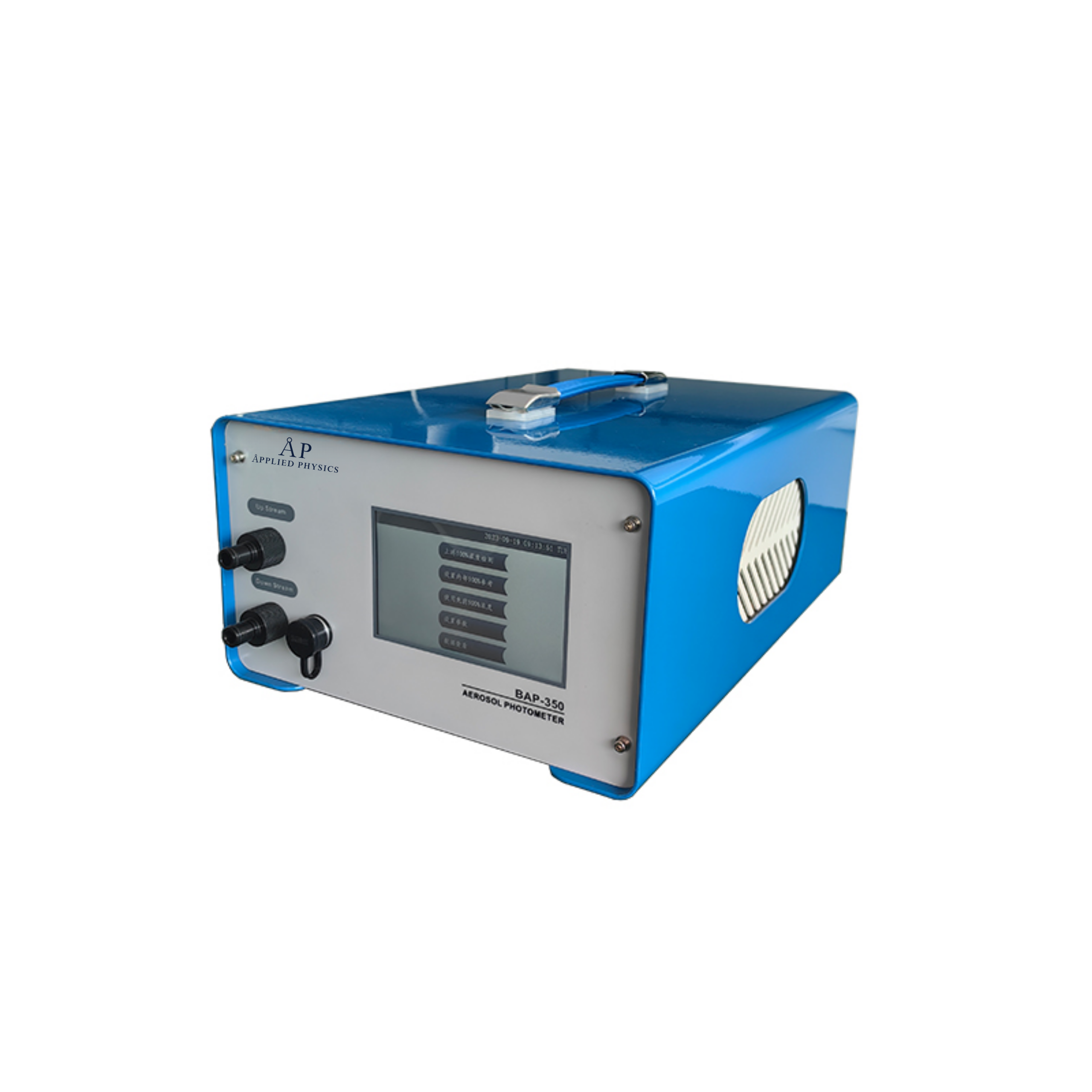
Aerosol Photometer BAP-350
Laminar airflow is the foundation of cleanroom design. Air moves downward (or horizontally) at uniform velocity without turbulence. Airflow visualization tools confirm that laminar flow patterns are maintained and that dead zones or recirculation areas do not exist where particles could accumulate.
Smoke or fog visualization uses visible tracers to show airflow patterns in real time. Applied Physics specializes in cleanroom foggers. Airflow velocity and uniformity testing measures air change rates and ensures velocity remains within specification. Typical laminar flow cleanrooms maintain velocities between 0.3 and 0.5 meters per second, with uniformity within ±20% of the average.
Recovery time testing measures how quickly a cleanroom returns to its baseline particle count after a disturbance. This metric directly correlates to your facility’s ability to resume operations after personnel entry or equipment maintenance.
Watch Out Airflow visualization should be performed during initial certification and after any significant facility modification, not just annually. A single misplaced workbench can disrupt laminar flow patterns and compromise your ISO classification.
Non-viable particle counting measures total airborne contamination, but regulatory frameworks like USP 797 and USP 800 also require viable microbial monitoring. The Microbial Air Sampler 3080 Series uses inertial impaction to collect airborne microorganisms onto culture media for growth-based quantification.
The sampler draws air at a stable 100 liters per minute with ±2.5% accuracy, directing microorganisms onto Petri dishes or contact plates. The stainless steel sampling head (SUS316 construction) minimizes contamination during collection. An internal exhaust filter (ISO Class 3) ensures safe containment of sampled air. The 4.3-inch color touch screen provides intuitive operation with multi-language support and remote controller capability.
Viable sampling typically occurs monthly or quarterly, depending on facility classification and regulatory requirements. Results identify microbial contamination sources and validate the effectiveness of environmental controls.
A comprehensive certification campaign requires systematic execution of multiple testing protocols.
| Testing Protocol | Frequency | Equipment | Expected Duration |
|---|---|---|---|
| Particle count baseline | Initial + annual | Handheld particle counter | 2-4 hours |
| Airflow velocity mapping | Initial + after modifications | Anemometer or smoke visualization | 4-6 hours |
| HEPA filter integrity | Initial + annual | Aerosol photometer | 2-3 hours |
| Pressure differential | Continuous monitoring | Pressure sensor | Ongoing |
| Viable microbial sampling | Monthly to quarterly | Microbial air sampler | 1-2 hours |
| Recovery time testing | Initial + periodic | Particle counter | 1-2 hours |
| Documentation and reporting | After each test | Data management software | 1-2 hours |
Essential steps for certification:
Most certification campaigns take 1-2 weeks depending on facility size and complexity.
Calibration traceability is non-negotiable for regulatory compliance. Every measurement instrument must have documented calibration traceable to NIST (National Institute of Standards and Technology) national standards. Without proper traceability, certification results lack legal defensibility during FDA inspections or product recalls.
Particle counters and aerosol photometers do not maintain accuracy indefinitely. Optical components degrade, sensor sensitivity drifts, and flow rate calibration shifts over time. A handheld condensation particle counter operating at 0.3 micrometer sensitivity may drift by 5-15% annually depending on usage intensity.
Calibration verification establishes a baseline performance standard and measures deviation from that standard. When a particle counter is calibrated, a certified reference aerosol is introduced, and the instrument’s response is compared to the expected value. Measurement uncertainty quantifies the range of error around any reported value. A particle counter with ±10% accuracy and a reading of 1,000 particles per cubic centimeter means the true count is somewhere between 900 and 1,100 particles per cubic centimeter. Maintaining this level of precision requires that the physical environment remains free of contaminants that could skew sensor readings, a necessity that aligns with the rigorous standards set forth in OSHA cleaning guidelines.
NIST maintains primary standards for particle size and concentration. Calibration laboratories accredited by A2LA (American Association for Laboratory Accreditation) maintain secondary standards traceable to NIST. Your facility’s instruments are calibrated against those secondary standards, creating an unbroken chain of traceability from your particle counter back to NIST’s primary reference.
Calibration intervals depend on equipment type and usage intensity. Particle counters typically require annual calibration. Pressure sensors and temperature probes may require calibration every 6-12 months. Aerosol photometers need calibration annually or after significant use.
Modern cleanroom certification increasingly relies on 21 CFR Part 11-compliant data collection systems that generate electronic documentation for testing and certification results. These systems ensure data integrity, prevent unauthorized modification, and maintain complete audit trails required by pharmaceutical regulations.
A 21 CFR Part 11-compliant system must record all measurements with timestamps and operator identification, prevent retroactive data modification, maintain calibration records linked to measurements, generate audit trails for all system access, and implement role-based access controls. Without 21 CFR Part 11 compliance, your certification documentation may not satisfy FDA expectations.
Before deploying any particle counter or aerosol photometer for certification testing, the instrument must pass Installation Qualification (IQ) and Operational Qualification (OQ). IQ verifies that the equipment was delivered in working condition and installed correctly. OQ confirms that the instrument performs within specification under actual operating conditions.
A particle counter that passes IQ but fails OQ must be returned to the manufacturer for repair before use. Deploying an unqualified instrument invalidates all subsequent certification results.
Pro Tip Schedule calibration maintenance during planned downtime rather than emergency situations. A calibration certificate dated within the last 12 months is your proof of compliance; expired calibration invalidates all subsequent testing until the instrument is recertified.
Applied Physics provides calibration validation services (IQ/OQ) for handheld and portable particle counters.
Some facilities attempt internal cleanroom assessments to avoid the cost of professional certification services. This approach carries significant technical and regulatory risk.
Internal cleanroom monitoring and professional certification require fundamentally different equipment. A basic handheld particle counter costs $8,000-$15,000 for periodic spot checks. But comprehensive certification testing requires instruments most facilities cannot justify owning.
An aerosol photometer costs $25,000-$45,000. A condensation particle counter capable of detecting sub-micrometer particles costs $35,000-$60,000. A microbial air sampler runs $12,000-$22,000. A complete continuous monitoring system costs $50,000-$150,000 depending on facility size.
DIY assessment relies on facility personnel who may lack specialized training in particle counting methodology, calibration verification, and regulatory documentation requirements. Probe positioning and sampling strategy are critical, ISO 14644 specifies a grid-based sampling pattern with minimum dwell times at each location. Environmental conditions during testing affect particle counts. Professional technicians account for these variations; internal teams often miss these subtleties.
Aerosol photometry interpretation requires understanding the relationship between leakage rate, filter area, and acceptable limits. Viable microbial sampling interpretation requires understanding contamination sources and the difference between environmental monitoring and product contact surface sampling.
USP 797 and USP 800 require documented cleanroom certification by qualified personnel. FDA guidance suggests third-party certification provides stronger defensibility during inspections. If your facility manufactures FDA-regulated products, professional certification is not optional, it is a regulatory requirement.
An FDA investigator reviewing your cleanroom records will ask: Who conducted the testing? What is their training and experience? What is the traceability of the equipment used? If answers are “our maintenance technician,” “on-the-job training,” and “we don’t have calibration certificates,” the investigator will likely invalidate your certifications.
Internal monitoring between professional certifications can be cost-effective for facilities with stable operations, experienced personnel, proper equipment, documented procedures, and regulatory flexibility.
Certain situations require professional certification regardless of cost: FDA-regulated manufacturing, facility modifications, certification failures, regulatory audits or inspections, product recalls or investigations, and first-time certification.
Best For Internal monitoring between professional certifications works for facilities with stable operations, experienced personnel, and regulatory flexibility. If your cleanroom undergoes modifications, you’re uncertain about testing procedures, or you manufacture FDA-regulated products, professional certification is the safer and often more defensible choice.
Applied Physics provides validation services to qualify internal testing programs.
Certification failures rarely indicate a single catastrophic problem. High particle counts in localized areas typically signal HEPA filter bypass or duct leakage. Aerosol photometry pinpoints the exact location of filter breaches. Uneven airflow patterns suggest equipment obstruction or personnel positioning issues. Smoke visualization reveals dead zones where particles accumulate. Pressure differential failures indicate supply or exhaust system problems. Viable microbial contamination spikes during high-traffic periods suggest personnel gowning deficiencies. Recovery time exceeding specification indicates inadequate air change rates or poor airflow distribution.
The most common mistake is treating certification failures as one-time events rather than symptoms of systemic issues. Proper troubleshooting requires understanding the relationship between airflow, particle generation, filtration, and environmental controls.
Cleanroom certification is not a compliance checkbox, it’s the foundation of product safety and operational reliability. The testing tools you choose directly impact your ability to maintain ISO compliance, pass regulatory audits, and avoid costly production shutdowns. Applied Physics has delivered precision contamination control solutions since 1992, providing particle metrology equipment and airflow visualization tools. Our Handheld Condensation Particle Counter Model 3800, Cleanroom Monitoring System Model CRMS, and Aerosol Photometer BAP-350 integrate seamlessly with your existing validation protocols while maintaining 21 CFR Part 11 compliance and calibration traceability. Contact our team to discuss how our cleanroom certification testing tools can simplify your validation process and ensure consistent regulatory compliance.
Cleanroom air quality testing relies on multiple specialized instruments. Particle counters measure airborne particulate concentrations to verify ISO class compliance. Aerosol photometers assess HEPA filter integrity by detecting leakage rates. Microbial air samplers collect viable organisms on culture media. Pressure differential gauges monitor room pressurization. Air velocity meters confirm laminar or turbulent flow patterns. The Handheld Condensation Particle Counter Model 3800 detects particles as small as 0.01 micrometers with concentrations from 0 to 100,000 particles/cm³, making it essential for ISO 14644 compliance verification.
Recertification frequency depends on ISO class. ISO Class 6-8 cleanrooms require testing at least annually for compliance. ISO Class 5 or lower cleanrooms require testing every six months as the industry standard. However, most facilities test more frequently, quarterly or semi-annually, to maintain operational excellence and catch contamination issues before they affect production. The Cleanroom Monitoring System Model CRMS enables continuous real-time monitoring of particle counts, differential pressure, temperature, and humidity, reducing reliance on periodic testing alone.
Non-viable particle testing measures total airborne particulates regardless of whether they contain living organisms. Particle counters and aerosol photometers detect these using optical or condensation methods. Viable particle testing identifies only living microorganisms, bacteria, fungi, spores, using microbial air samplers that collect samples on culture media for growth-based quantification. Both are required for comprehensive cleanroom certification. The Microbial Air Sampler 3080 Series draws air at 100 L/min with ±2.5% accuracy, using inertial impaction to capture microorganisms onto Petri dishes or contact plates under ISO 14698-1 protocols.
21 CFR Part 11 establishes FDA requirements for electronic records and signatures in regulated industries. For cleanroom certification, this means all testing data, measurements, and certification reports must be collected, stored, and reported using validated electronic systems with audit trails, user authentication, and data integrity controls. Modern testing equipment must support 21 CFR Part 11-compliant data management. The Cleanroom Monitoring System CRMS integrates with AirCare Automation or Elemental Machines hardware, both supporting 21 CFR Part 11 compliance for pharmaceutical and biotech facilities requiring FDA-auditable documentation.
Internal assessment is possible if your facility has trained personnel and calibrated equipment, but external third-party certification is often required by regulatory bodies and customers for formal compliance documentation. Internal testing using tools like the Handheld Condensation Particle Counter Model 3800 can support ongoing monitoring and troubleshooting. However, formal ISO 14644 certification reports typically require accredited external services that provide independent verification and auditable documentation. Many facilities combine internal monitoring with periodic external certification to balance cost and regulatory confidence.
APPLIED PHYSICS TECHNICAL RESOURCE
Airflow visualization, smoke studies, tracer delivery, particle monitoring and controlled-environment validation. Product and standards references should be interpreted for the actual instrument, facility, protocol and configuration.

Enter your details below to save your shopping cart for later. And, who knows, maybe we will even send you a sweet discount code :)
Allow notifications to get real-time updates about your shopping cart and who knows, you may even receive a sweet discount code 😊