
Maintaining strict measurement precision in semiconductor metrology, cleanroom validation, and optical particle counter calibration requires highly reliable reference materials.
Among these, 47 nm polystyrene microspheres serve as a critical nanometer-scale baseline for Surface Inspection Systems (SSIS) and aerosol research.
However, working with monodisperse particles at the sub-50 nm threshold presents distinct technical challenges.
Because of high surface-area-to-volume ratios and strong van der Waals forces, fine polymer suspensions are exceptionally sensitive to improper storage, thermal shifts, and inadequate redispersion protocols.
Understanding the Challenges of Nanoscale Microsphere Handling
When handling aqueous polymer standards in the nanometer range, laboratories frequently encounter performance hurdles that skew calibration results.
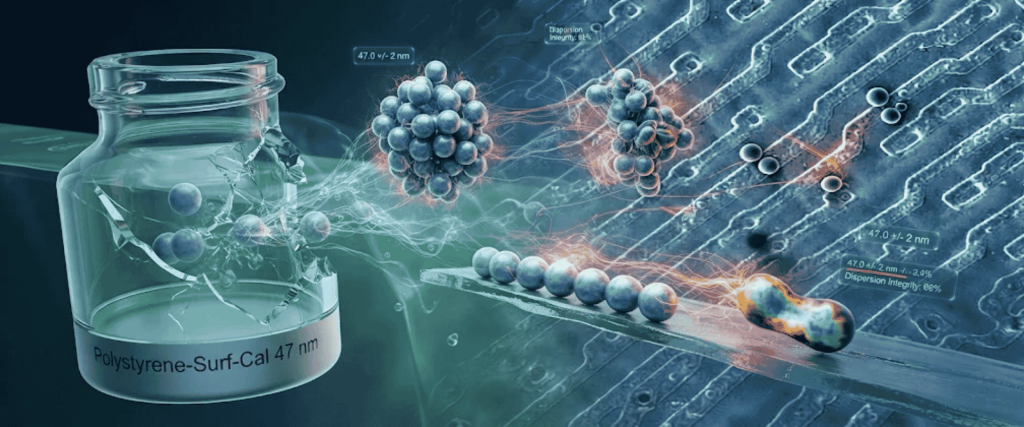
Identifying these operational pain points is the first step toward establishing a robust handling workflow.
- Particle Agglomeration: Due to intense surface energy, 47 nm polystyrene spheres readily form clusters or cauliflower-like agglomerates if the vial sits undisturbed for extended periods.
- Wall Adsorption: Ultra-fine nanoparticles possess a high affinity for container boundaries. Over time, particles can adhere to glass or plastic vessel walls, progressively lowering the effective concentration of the working solution.
- Thermal Shock and Freezing Damage: Exposing aqueous latex suspensions to sub-zero temperatures triggers irreversible polymer coalescence, destroying monodispersity.
- Surfactant Degradation: Suspensions rely on controlled residual surfactants to maintain stability. Improper chemical exposure or bacterial contamination can destabilize the aqueous medium, leading to rapid settling.
Protocol for Proper Storage and Temperature Control
Protecting the physical integrity of nanometer standards begins long before the vial is opened for dilution or wafer deposition.
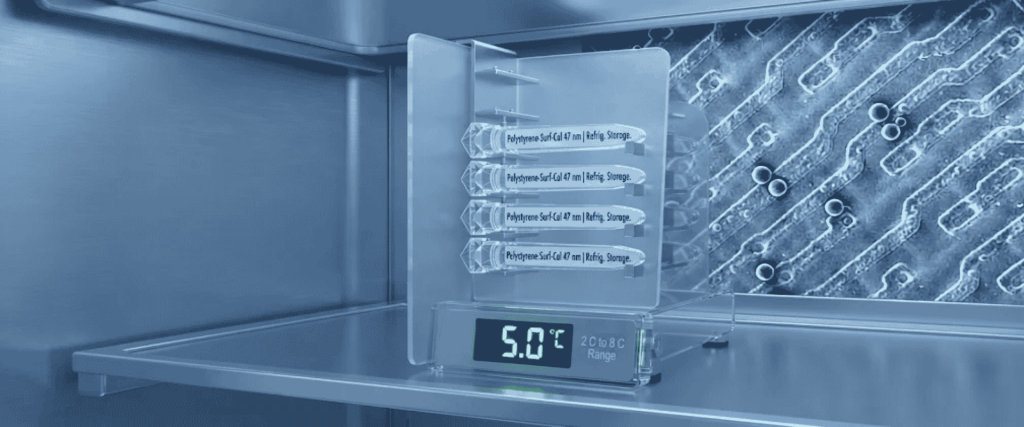
- Refrigerated Storage: Store all polystyrene microsphere standards strictly between $2^\circ\text{C}$ and $8^\circ\text{C}$ immediately upon receipt. Never store them at room temperature for long periods, as elevated temperatures accelerate microbial growth and agglomeration.
- Absolute Freeze Prevention: Position vials away from cooling elements inside the refrigerator. Freezing causes water expansion and mechanical stress that permanently aggregates 47 nm particles into unusable clumps.
- Vertical Orientation: Keep bottles upright to minimize the surface area of contact between the liquid meniscus and cap liners, reducing the risk of permanent nanoparticle drying along the threads.
Effective Sonication and Dispersing Techniques
Before drawing samples for calibration, breaking down temporary micro-clusters is essential. However, aggressive mechanical energy can damage delicate nanostructures.
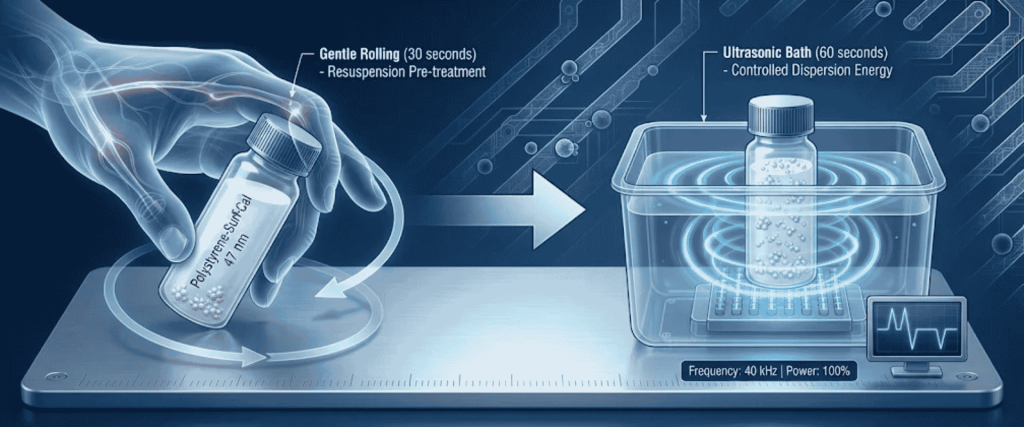
- Gentle Mechanical Roll/Inversion: Prior to sonication, gently roll or invert the vial several times. Avoid vigorous manual shaking, which introduces air bubbles and foam into the surfactant solution.
- Controlled Ultrasonic Bath Treatment: Place the vial in an ultrasonic cleaning bath for 3 to 5 minutes. Ensure the water level in the bath matches the liquid level inside the vial for uniform acoustic energy transfer.
- Avoiding Over-Sonication: Limit ultrasonic exposure times. Excessive thermal buildup from prolonged sonication can melt or warp ultra-fine polymer spheres, altering their precise diameter below the 50 nm threshold.
Comparison of Handling and Preparation Methods
| Parameter | Recommended Best Practice | Risky / Incorrect Practice | Operational Impact |
| Storage Temperature | $2^\circ\text{C}$ to $8^\circ\text{C}$ in a dedicated lab fridge | Leaving vials on open lab benches at ambient room temp | Accelerates particle agglomeration and microbial growth. |
| Resuspension | Gentle rolling followed by brief bath sonication | Vigorous manual shaking or high-power probe disruption | Generates foam or induces thermal damage to fine spheres. |
| Dilution Medium | Ultrapure deionized (DI) water with matching surfactant | Unfiltered tap water or incompatible organic solvents | Causes immediate flocculation and chemical degradation. |
Conclusion
Mastering the storage, sonication, and dispersion of 47 nm polystyrene microspheres is vital for maintaining repeatable, defensible quality control data in high-tech manufacturing and research environments.
By keeping standards refrigerated, utilizing controlled ultrasonic agitation, and preventing thermal shock, metrology teams can eliminate particle agglomeration errors and ensure absolute calibration accuracy.
Frequently Asked Questions (FAQs)
1. 4.1 Why do 47 nm polystyrene particles clump together over time?
At the nanometer scale, high surface energy and van der Waals forces naturally draw particles together. Without proper surfactant balance and periodic gentle agitation, these forces cause individual spheres to cluster.
2. 4.2 Can I use a probe sonicator instead of an ultrasonic bath?
Probe sonicators deliver concentrated energy that can easily overheat or rupture ultra-fine 47 nm polymer spheres. An ultrasonic bath is strongly recommended for safe, uniform acoustic distribution.
3. 4.3 What should I do if I suspect the suspension has frozen during transit?
If a vial shows any evidence of ice formation or freezing, discard it immediately. Freezing causes irreversible polymer coalescence, rendering the calibration standard inaccurate.