Description
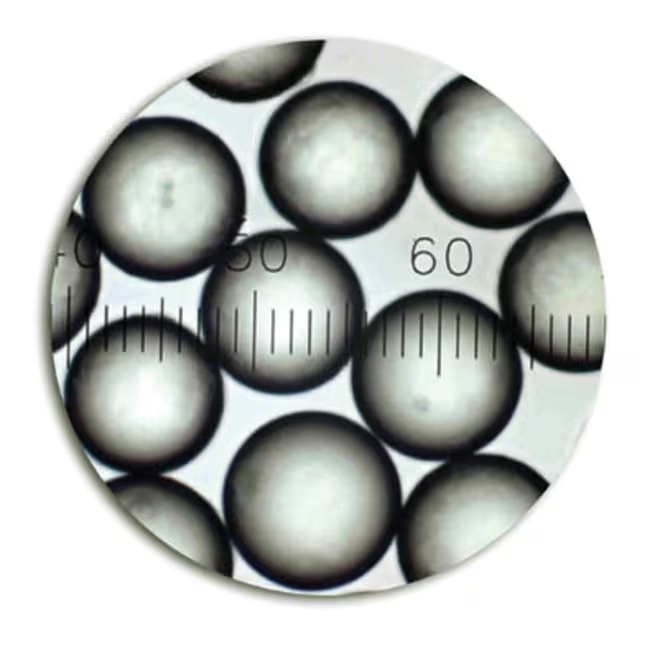
The 2000 Series Uniform Polymer Particles meet the calibration requirements of laser diffraction and light-scattering systems that struggle with extremely narrow, monodisperse size standards. Highly monodisperse particles can produce sharp, localized diffraction patterns that illuminate only a few detector diodes, leading to signal saturation or unrepeatable curve fitting.
By incorporating a controlled, slightly wider size distribution (typically 5% to 12% CV), the 2000 Series distributes scattered light evenly across adjacent detector arrays. This distribution mimics real-world industrial and biological particle distributions while maintaining strict linear traceability to National Institute of Standards and Technology (NIST) Standard Reference Materials.
Formulated from cross-linked polystyrene divinylbenzene (PSDVB), these particles possess high structural rigidity and chemical resistance to common organic dispersing solvents. Suspensions are packaged in convenient 15 mL dropper-tip bottles at approximately 1% solids by weight, pre-formulated with trace surfactant to ensure long-term colloidal stability.
Key Features
Optimized for Laser Diffraction: Controlled distribution widths (~5–12% CV) spread light scatter across multiple detector diodes for consistent, repeatable instrument response.
Direct NIST Traceability: Every production lot is calibrated against NIST transfer standards, with mean diameter and distribution metrics documented on the Certificate of Traceability.
Cross-Linked PSDVB Matrix: Polystyrene cross-linked with divinylbenzene provides mechanical durability and solvent resistance superior to standard polystyrene latex.
Real-World Particulate Simulation: Serves as a practical benchmark for industrial powders, pigments, emulsions, and pharmaceutical suspensions.
Dropper-Tip Dispensing: 15 mL pre-cleaned bottles allow drop-wise addition directly into instrument sampling cells without risk of stock bottle contamination.
Specifications
| Parameter | Specification |
| Material | Polystyrene cross-linked with Divinylbenzene (PSDVB) |
| Available Diameters | 5 µm, 6 µm, 7 µm, 8 µm, 9 µm, 10 µm, 11 µm, 14 µm, 15 µm, 20 µm, 25 µm, 30 µm, 40 µm |
| Concentration | ~1% solids by weight (aqueous suspension) |
| Suspending Medium | Deionized water with trace dispersing surfactant and antimicrobial preservative |
| Density | 1.05 g/cm³ |
| Refractive Index | 1.59 @ 589 nm ($25^\circ\text{C}$) |
| Packaging | 15 mL dropper-tipped dispensing bottle |
| Traceability | Calibrated against NIST Standard Reference Materials (SRM) |
| Storage Temperature | Room temperature (15°C to 30°C) or refrigerated (2°C to 8°C); do not freeze |
Part Number & Variant Selection
| Part Number | Nominal Diameter | Typical Standard Deviation (s) | Typical Coefficient of Variation (CV) | Concentration | Bottle Volume |
| AP2005A | 5 µm | 0.60 μm | 12.0% | < 1% solids | 15 mL |
| AP2006A | 6 µm | 0.30 μm | 9.8% | < 1% solids | 15 mL |
| AP2007A | 7 µm | 0.40 μm | 5.7% | < 1% solids | 15 mL |
| AP2008A | 8 µm | 0.62 μm | 7.8% | < 1% solids | 15 mL |
| AP2009A | 9 µm | 0.80 μm | 8.9% | < 1% solids | 15 mL |
| AP2010A | 10 µm | 0.90 μm | 9.3% | < 1% solids | 15 mL |
| AP2011A | 11 µm | 1.00 μm | 9.2% | < 1% solids | 15 mL |
| AP2014A | 14 µm | 1.40 μm | 9.8% | < 1% solids | 15 mL |
| AP2015A | 15 µm | 1.10 μm | 7.5% | < 1% solids | 15 mL |
| AP2020A | 20 µm | 1.90 μm | 9.0% | < 1% solids | 15 mL |
| AP2025A | 25 µm | 1.70 μm | 6.8% | < 1% solids | 15 mL |
| AP2030A | 30 µm | 2.20 μm | 7.3% | < 1% solids | 15 mL |
| AP2040A | 40 µm | 3.60 μm | 9.1% | < 1% solids | 15 mL |
Applications
Laser Diffraction Particle Size Analyzers: Calibrating and verifying forward-scattering and multi-angle light diffraction instruments without detector saturation.
Liquid Particle Counters (LPC): Testing resolution and channel boundaries under dynamic flow conditions.
Industrial & Environmental Quality Control: Benchmarking quality control routines in paints, coatings, milled minerals, and agricultural slurries.
Flow Visualization & Tracer Studies: Providing density-matched ($1.05\text{ g/cm}^3$) spherical tracers for acoustic, optical, and hydrodynamic flow profiling.
Handling & Storage
Storage Conditions: Store upright at room temperature or refrigerate (2°C to 8°C). Keep bottle tightly capped when not in use. Do not freeze, as ice crystallization destabilizes the suspension and causes irreversible particle clustering.
Resuspension: Invert the bottle gently 8 to 10 times before use. If particles settle after extended standing, place the bottle in a mild ultrasonic bath for 15 to 30 seconds to re-establish a uniform suspension.
Dispensing: Dispense directly using the dropper tip into clean sample cells or diluent. Avoid touching the dropper tip to surfaces or fluids to prevent cross-contamination.
Product relationship
Available Through Applied Physics
Applied Physics supplies and supports quotation of this product. Product branding and manufacturer information, where stated on the product page or supporting documentation, remain authoritative.
Applied Physics portfolio: Particle
Catalog relationship: Available Through Applied Physics
Related Applied Physics resources
Continue through the Particle portfolio
Use these technical and portfolio pages to compare applications and related equipment. To keep this exact product attached to an RFQ, use the product’s existing Request a Quote or Add To Order control.