
Description
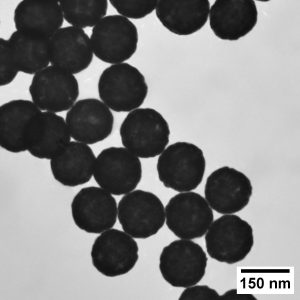
Amine-Functionalized Silica Nanoparticles, 1 wt% Ethanol Dispersion, are monodisperse, ultra-high-purity, spherical silica nanoparticles supplied as a ready-to-use colloidal suspension.
The non-porous silica cores, SiO2, are synthesized using a controlled Stöber sol-gel process. The particle surfaces are covalently functionalized with 3-aminopropyltriethoxysilane, APTES, introducing terminal primary amine groups, −NH2.
Protonation of the surface amines produces a positive zeta potential in ethanol. This supports colloidal stability, electrostatic attraction to negatively charged surfaces and biomolecules, including DNA, RNA, and anionic proteins, and covalent crosslinking through NHS-ester, EDC/NHS, or glutaraldehyde chemistries.
The particles are transferred directly into pure ethanol through specialized washing and filtration without an intermediate drying step. This wet-transfer process preserves single-particle dispersion and eliminates the multi-hour sonication protocols often required for redispersion of dry silica powders.
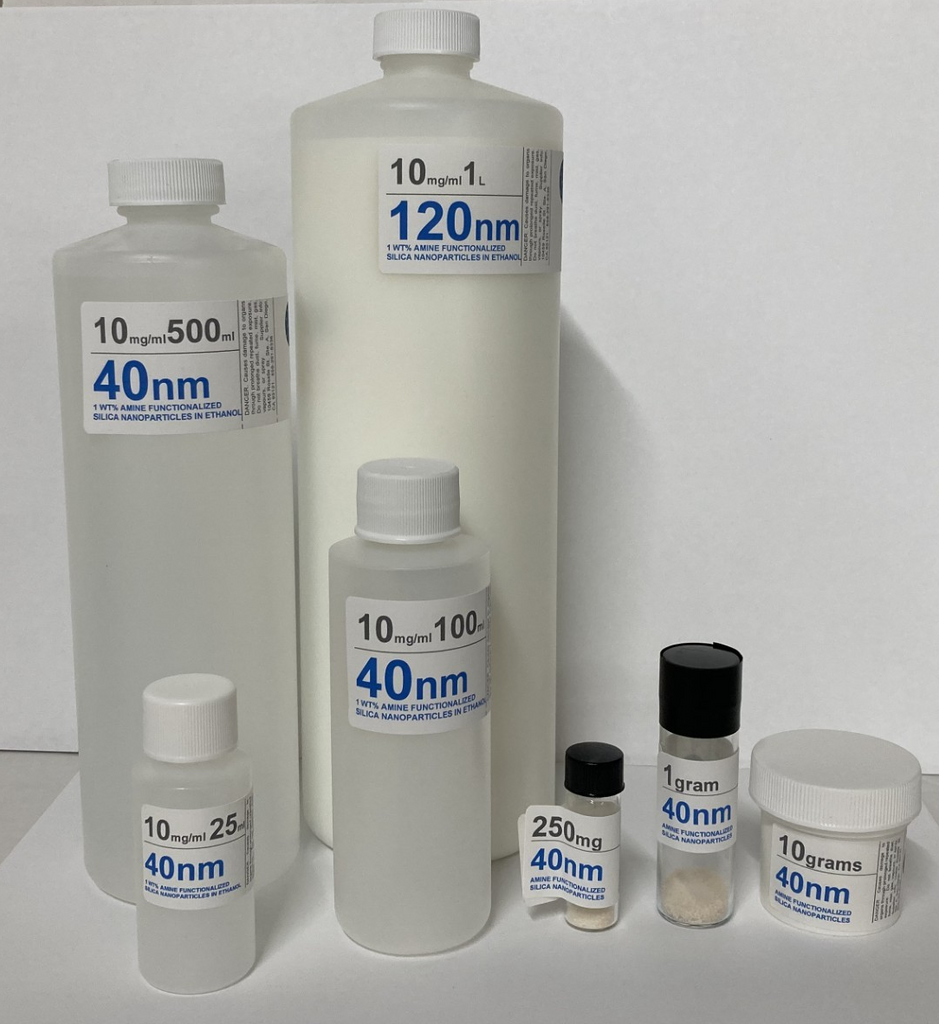
The suspension is supplied at an exact concentration of 1 wt%, equivalent to 10 mg/mL, in nominal diameters from 20 nm to 1000 nm.
Key features
- Pre-dispersed monodispersity: Specialized wet filtration into pure ethanol preserves single-particle dispersion and eliminates multi-hour powder sonication.
- Ultra-high purity: Purity greater than 99.999%, produced by precision Stöber sol-gel chemistry.
- Non-porous silica spheres: Uniform, spherical particles free of metallic or surfactant contaminants.
- APTES amine functionalization: Covalently bound 3-aminopropyltriethoxysilane provides reactive primary amines, −NH2.
- Positive surface charge: Protonated amine groups produce a positive zeta potential in ethanol and support electrostatic assembly onto negatively charged glass, silicon, and biological substrates.
- Standardized concentration: Supplied at 1 wt%, equivalent to 10 mg/mL, across 14 nominal diameters and four fill volumes.
- Ready-to-use format: Eliminates dry-powder handling and initial sonication before application.
Specifications
| Parameter | Specification |
|---|---|
| Core material | Non-porous amorphous silica, SiO2 |
| Synthesis method | Stöber sol-gel process |
| Purity | >99.999% |
| Surface functionalization | Primary amine, −NH2, via 3-aminopropyltriethoxysilane, APTES |
| Physical form | Monodisperse liquid suspension |
| Concentration | 1 wt%, 10 mg/mL |
| Suspending solvent | Ethanol, EtOH |
| Surface charge / zeta potential | Positive |
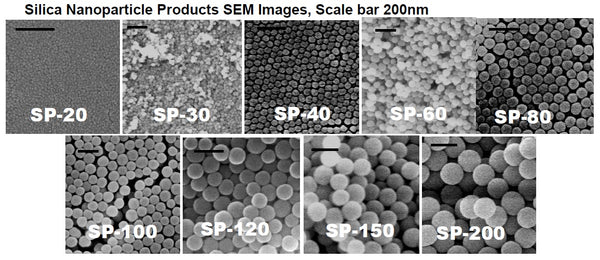
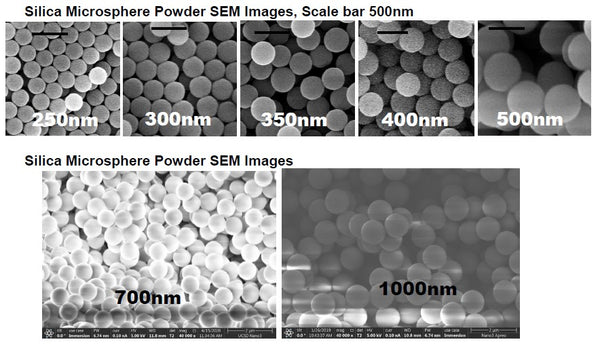
| Available nominal diameters | 20 nm, 30 nm, 40 nm, 60 nm, 80 nm, 100 nm, 120 nm, 150 nm, 200 nm, 400 nm, 500 nm, 600 nm, 800 nm, 1000 nm |
| Particle morphology | Uniform, non-porous spheres |
| Particle density | Approximately 1.8–2.0 g/cm3 |
| Refractive index | Approximately 1.44–1.46 at 589 nm |
| Available fill volumes | 25 mL, 100 mL, 500 mL, 1000 mL |
| Documentation included | Batch-specific Certificate of Analysis, CoA, and Safety Data Sheet, SDS |
| Storage conditions | Ambient room temperature, 15∘C to $30^\circ\text{C}$; keep tightly sealed; do not freeze |
Product variants and packaging
| Nominal diameter | Surface chemistry | Concentration | Carrier solvent | Available fill volumes |
|---|---|---|---|---|
| 20 nm | Aminated, −NH2 | 1 wt%, 10 mg/mL | Ethanol | 25 mL, 100 mL, 500 mL, 1000 mL |
| 30 nm | Aminated, −NH2 | 1 wt%, 10 mg/mL | Ethanol | 25 mL, 100 mL, 500 mL, 1000 mL |
| 40 nm | Aminated, −NH2 | 1 wt%, 10 mg/mL | Ethanol | 25 mL, 100 mL, 500 mL, 1000 mL |
| 60 nm | Aminated, −NH2 | 1 wt%, 10 mg/mL | Ethanol | 25 mL, 100 mL, 500 mL, 1000 mL |
| 80 nm | Aminated, −NH2 | 1 wt%, 10 mg/mL | Ethanol | 25 mL, 100 mL, 500 mL, 1000 mL |
| 100 nm | Aminated, −NH2 | 1 wt%, 10 mg/mL | Ethanol | 25 mL, 100 mL, 500 mL, 1000 mL |
| 120 nm | Aminated, −NH2 | 1 wt%, 10 mg/mL | Ethanol | 25 mL, 100 mL, 500 mL, 1000 mL |
| 150 nm | Aminated, −NH2 | 1 wt%, 10 mg/mL | Ethanol | 25 mL, 100 mL, 500 mL, 1000 mL |
| 200 nm | Aminated, −NH2 | 1 wt%, 10 mg/mL | Ethanol | 25 mL, 100 mL, 500 mL, 1000 mL |
| 400 nm | Aminated, −NH2 | 1 wt%, 10 mg/mL | Ethanol | 25 mL, 100 mL, 500 mL, 1000 mL |
| 500 nm | Aminated, −NH2 | 1 wt%, 10 mg/mL | Ethanol | 25 mL, 100 mL, 500 mL, 1000 mL |
| 600 nm | Aminated, −NH2 | 1 wt%, 10 mg/mL | Ethanol | 25 mL, 100 mL, 500 mL, 1000 mL |
| 800 nm | Aminated, −NH2 | 1 wt%, 10 mg/mL | Ethanol | 25 mL, 100 mL, 500 mL, 1000 mL |
| 1000 nm, 1.0 μm | Aminated, −NH2 | 1 wt%, 10 mg/mL | Ethanol | 25 mL, 100 mL, 500 mL, 1000 mL |
Product codes were not provided in the source information.
Applications
Covalent bioconjugation and immunoassays
The uniform silica spheres can be used for coupling:
- Antibodies
- Enzymes
- Peptides
- NHS-activated fluorescent dyes
Applications include diagnostic assays and bio-imaging.
Nucleic acid capture and gene delivery
The positively charged amine surfaces support electrostatic binding of:
- Plasmid DNA
- RNA
- Oligonucleotides
Potential workflows include nucleic acid purification and cellular transfection.
Optical coatings and spin-cast films
The ethanol dispersion can be used to deposit:
- Anti-reflective layers
- Photonic crystals
- Functional monolayers
The volatile carrier solvent supports direct coating and spin-casting workflows.
Microfluidics and lab-on-a-chip systems
Applications include:
- Coating microchannels
- Creating packed-bed stationary phases
- Biological separations
- Sensing platforms
Nanomaterial and catalyst synthesis
The monodisperse particles can serve as core templates for:
- Core-shell architectures
- Supported metal nanocatalysts
Handling, storage, and solvent exchange
Storage
Store the suspension upright in tightly sealed containers at ambient room temperature, 15∘C to 30∘C.
- Keep away from ignition sources and direct sunlight.
- Do not freeze.
- Keep containers tightly capped when not actively dispensing.
Resuspension before use
Larger particles, particularly those with diameters of 400 nm to 1000 nm, settle more rapidly under gravity during extended storage.
Before sampling:
- Shake vigorously, vortex, or stir the container.
- Continue mixing until the suspension is completely uniform.
- Withdraw the required aliquot promptly.
Evaporation control
Ethanol is volatile. Keep bottles tightly capped when not actively dispensing to prevent solvent loss and concentration drift.
Transfer to aqueous buffers
To transfer the particles into water or physiological buffers, such as PBS or MES:
- Remove the required aliquot.
- Pellet the particles by centrifugation.
- Aspirate the ethanol supernatant.
- Immediately resuspend the pellet in the target aqueous buffer.
- Use brief vortexing or mild bath sonication to assist dispersion.
Do not allow the pellet to dry completely during solvent exchange.
Compatibility and usage notes
- The product is supplied in ethanol at 1 wt%, equivalent to 10 mg/mL.
- Protonated amine groups produce a positive zeta potential in ethanol.
- NHS-ester, EDC/NHS, and glutaraldehyde chemistries may be used for covalent crosslinking, subject to application-specific optimization.
- Larger particle variants may settle during storage and should be fully resuspended before sampling.
- Ethanol handling requires appropriate controls because the solvent is volatile and flammable.
- Dispersion, solvent-exchange, and conjugation conditions should be optimized and validated for the selected particle diameter and intended application.
Product relationship
Available Through Applied Physics
Applied Physics supplies and supports quotation of this product. Product branding and manufacturer information, where stated on the product page or supporting documentation, remain authoritative.
Applied Physics portfolio: General
Catalog relationship: Available Through Applied Physics
Related Applied Physics resources
Continue through the General portfolio
Use these technical and portfolio pages to compare applications and related equipment. To keep this exact product attached to an RFQ, use the product’s existing Request a Quote or Add To Order control.

Reviews
There are no reviews yet.