
Description
Silica-Shelled Gold Nanospheres, Au@SiO2
Silica-shelled gold nanospheres are designed for plasmonic, diagnostic, optical-material, and spectroscopy applications requiring physical separation of the metallic gold core.
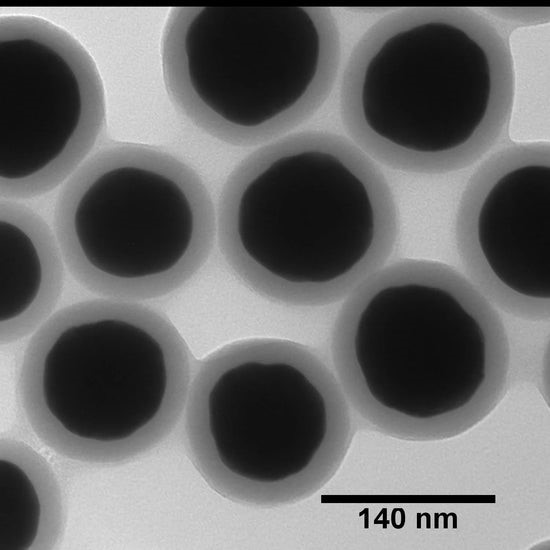
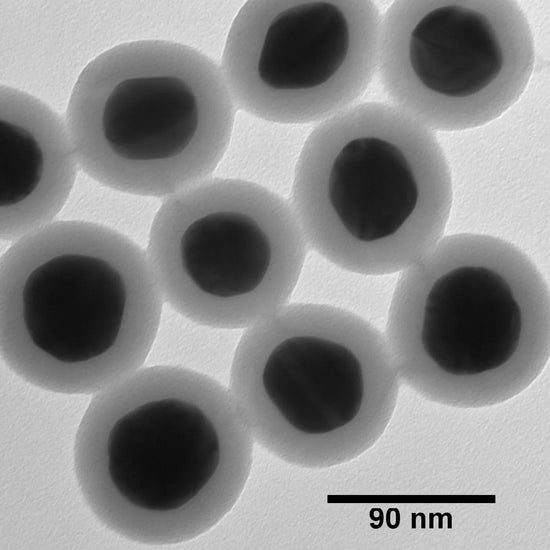
Each particle consists of a spherical gold core enclosed by a concentric, nonporous amorphous silica shell. The shell has a nominal thickness of 20±5 nm, creating a rigid dielectric spacer between neighboring gold cores.
This core-shell structure helps preserve the optical response during drying, substrate deposition, solvent exchange, thin-film formation, and incorporation into polymer or sol-gel matrices.
Key features
- Rigid dielectric shell: A 20±5 nm silica layer prevents direct contact between gold cores.
- Stable plasmonic response: Physical separation reduces aggregation-related red shifts, peak broadening, and localized quenching.
- Broad solvent compatibility: Supplied in ethanol and suitable for sol-gels, optical polymers, organic resins, and selected aqueous systems.
- Chemical and thermal protection: The silica layer helps protect the gold core from oxidation, chemical etching, and photothermal deformation.
- Silanol surface chemistry: Terminal silanol groups support functionalization with APTES, MPTES, PEG-silanes, and other organosilanes.
- Controlled core-shell geometry: Concentric particles provide reproducible optical behavior and defined total particle dimensions.
Specifications
| Parameter | 50 nm core variant | 100 nm core variant |
|---|---|---|
| Core material | Pure metallic gold, Au0 | Pure metallic gold, Au0 |
| Shell material | Nonporous amorphous silica, SiO2 | Nonporous amorphous silica, SiO2 |
| Gold core diameter, TEM | 50±4 nm | 100±8 nm |
| Silica shell thickness, TEM | 20±5 nm | 20±5 nm |
| Total particle diameter | Approximately 90 nm | Approximately 140 nm |
| Size distribution | CV≤15%, total diameter | CV≤15%, total diameter |
| Gold concentration | 1.0 mg/mL | 1.0 mg/mL |
| Suspending solvent | Ethanol | Ethanol |
| Surface chemistry | Silanol, Si-OH, nonfunctionalized | Silanol, Si-OH, nonfunctionalized |
| Zeta potential | ≤−10 mV | ≤−10 mV |
| LSPR extinction peak | 535–545 nm | 570–590 nm |
| Particle morphology | Concentric core-shell spheres | Concentric core-shell spheres |
| Storage temperature | 2∘C to 25∘C | 2∘C to 25∘C |
| Freezing | Do not freeze | Do not freeze |
Variant selection
The 20 nm gold-core variant has been discontinued and is no longer listed as an active product.
| Product SKU | Gold core diameter | Shell thickness | Total diameter | Gold concentration | Carrier solvent | Package sizes |
|---|---|---|---|---|---|---|
| AP-AUSH-50 | 50 nm | 20 nm | Approximately 90 nm | 1.0 mg/mL | Ethanol | 1, 5, and 25 mL |
| AP-AUSH-100 | 100 nm | 20 nm | Approximately 140 nm | 1.0 mg/mL | Ethanol | 1, 5, and 25 mL |
Surface functionalization
The silanol-terminated silica surface can be modified through standard organosilane condensation chemistry. Examples include:
- APTES: Introduces amine groups.
- MPTES or other mercaptosilanes: Introduces thiol groups.
- PEG-silanes: Adds hydrophilic or antifouling polymer layers.
- Specialty silanes: Introduces functional groups for biological targeting, fluorophore attachment, or composite-material integration.
Functionalization conditions should be optimized for the selected silane, solvent, water content, catalyst system, and intended application.
Applications
- Surface-enhanced Raman spectroscopy: Provides controlled core spacing and helps reduce direct analyte contact with the gold surface.
- Optical coatings and plasmonic thin films: Incorporation into glass coatings, sol-gels, waveguides, and polymer films with reduced aggregation during drying.
- Photothermal metrology: The silica shell helps limit core coalescence during pulsed laser exposure and localized heating studies.
- Multimodal imaging: Optical contrast probes for electron microscopy, darkfield microscopy, and correlative imaging.
- Flow tracing: Use in nonaqueous flow loops and solvent-compatible particle-tracking experiments.
- Custom silane chemistry: Functionalization for bioconjugation, polymer grafting, and nanocomposite fabrication.
Handling and storage
- Store upright in a tightly sealed container at 2∘C to 25∘C.
- Refrigerated or controlled-room-temperature storage is suitable.
- Protect from light.
- Do not freeze. Freezing can damage the suspension matrix and cause irreversible phase separation.
- Particles may settle slowly during extended storage. Gently invert or swirl the vial before sampling.
- A mild ultrasonic bath for 10 to 20 seconds may be used if needed for redispersion.
- Keep the vial tightly capped because ethanol is volatile. Solvent evaporation can change the particle concentration.
Transfer from ethanol to water
For aqueous transfer:
- Pellet the particles using gentle centrifugation.
- Carefully remove the ethanol supernatant.
- Immediately redisperse the particles in deionized water or a water-ethanol mixture.
- Avoid allowing the pellet to dry completely, since a hard, difficult-to-redisperse cake may form.
Product relationship
Available Through Applied Physics
Applied Physics supplies and supports quotation of this product. Product branding and manufacturer information, where stated on the product page or supporting documentation, remain authoritative.
Applied Physics portfolio: General
Catalog relationship: Available Through Applied Physics
Related Applied Physics resources
Continue through the General portfolio
Use these technical and portfolio pages to compare applications and related equipment. To keep this exact product attached to an RFQ, use the product’s existing Request a Quote or Add To Order control.

Reviews
There are no reviews yet.