
Description
Portable Cleanroom Fogger in Smoke Studies
Portable Clean Room Fogger for Fume Hoods and Airflow Hoods. Find the highest quality CRF2 clean room fogger machine & portable fogger from Applied Physics, Inc. Request a quote for our cleanroom fogger machines used in sterile rooms for smoke studies of airflow turbulence. The portable cleanroom fogger is used in smoke studies with DI Water or WFI water to generate about 0.26 cubic meters of fog per minute. Fog density is about 57 milli-liters consumption per minute. The CRF2 is a low cost fogger that operates for a typical 50 minutes per water fill cycle. The CRF2 fogger produces a constant fog density, thus the fog volume produced is also constant. The fog vapor is composed of water droplets that are about 8-10 microns in diameter; thus as the fog vapor travels thru the airflow, it begins to evaporate. The visual fog evaporates after about 7-8 feet. No particle contaminants are created or left in the airflow. No cleanup is required other than a general wipe down of pure moisture. And the fog is composed of the same elements that we breathe, so walking thru a clean room fog is nearly identical to fog encountered in weather. Clean room foggers use deionized water, sterile water or water for injection; thus the water is quite pure. The fog can easily visualize turbulence and airflow patterns in an ISO suite. Balance of air pressure can be visually described between two clean areas, such as a barrier isolator and sterile room. Bio-safety cabinets and glove boxes can be tested for proper airflow.
CRF2 Clean Room Fogger ≈ 0.26 cubic meters fog / minute, ≈ 50 minutes operation, ≈ 57 ml Fog Density / minute, ≈ 7 – 8 feet visibility with 1 fog output
The CRF2 will support low cost requirements for smoke studies in small area environments. This small, easy to use
will support your requirements to test airflow in fume hoods, and similar sized areas to visually describe airflow and turbulence in controlled zones. Most Engineers and technicians in the pharmaceutical industry use testing guidelines, such as ISO 14644-3, Annex B.7 Airflow Direction Test and Visualization. Another guideline is USP 797 Insitu Airflow Analysis. Semiconductor companies are now starting to use the same ISO 14644 guidelines for airflow tests. The CRF2 can also be used to evaluate how fast a clean room recovers from a particle challenge, as guided by ISO 14644-3, Annex B12 Airflow Recovery Test. Polystyrene latex spheres are used, which normally are provided with a very specific size peak between 0.5 microns and 2.0 microns. The CRF2 is used to create the aerosol particle challenge into the sterile room or ISO suite, then air particle counters are used to monitor how quickly the clean room returns to normal after introduction of the particle challenge.
Ultrasonic DI Water foggers can be easily compared in fog performance per dollar cost by calculating the actual fog density over time!
Fog volume, fog density and visual airflow distance are the 3 major elements of a fogger, yet rarely discussed by companies producing clean room smoke machines. Fog density is a measure of how many liters of liquid is converted to a visual fog per minute. The diameter of the fog droplets is equally important, and always controlled by the fog technique used to create the water vapor. Ultrasonic foggers, operating by cavitation in water, typically provide water droplet diameter from 7-10 microns in diameter. Ultrapure foggers typically provide much smaller diameter, thus a more dense fog. Fog density then is determined by measuring the water volume consumed per minute, typically measured in milli-liters per minute. Ultrasonic foggers are designed with 5 to 35 piezo devices. The CRF2 uses 9 high performance piezos generating 57 ml of fog density and 0.26 cubic meters of fog per minute. The CRF4 uses 35 high performance piezos generating 187 ml of fog density and 1.25 cubic meters of fog per minute. The CRF2 fog travels about 7-8 feet in a typical clean room airflow velocity of 90 fpm with a typical humidity of 40%, while the CRF4 fog travels a typical 10-15 feet. It is the fog density that controls the fog volume and visual distance of any fogger. As the fog travels through the airflow, it gradually evaporates to the same air we breathe.
Clean Room Fogger, CRF-2 Features – Click here for Clean Room Fogger video
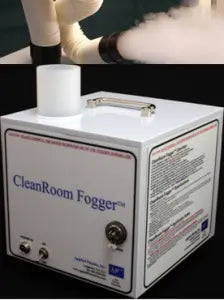
- 9 piezo devices produce 0.26 cubic meters of fog per minute for typical 50 minutes operation
- About 0.57 milli-leters per minute of fog density provides a typical 7-8 feet visual airflow
- Easy Fill Water Port with a fill level of 3.75 liters of Deionized water, sterile water or water for injections
- Water Level Fill Indicator is provided on left panel
- Operating instructions are provided on the right panel
- Power On and water drain are provided on the front panel
- Carry Handle provided on top for operator convenience
- Polypropylene enclosure offers a clean, lightweight enclosure
- Optional Fog Curtain Wand converts fog stream output to a wide fog pattern, plugs into Fog Hose
- Optional Remote Power Cable/Switch operates fogger inside Barrier Isolator or behind closed walls
- Optional Rolling Carry and Storage Case
- 2″ Diameter (50.8 mm), white fog hose is included, extending from 28″ (71.1 cm) to 82″ (208 cm)
- Power Supply (120VAC or 220VAC) included along with a 3 meter, power cable
- Easy to use fogger requiring a typical 30 seconds to fill water and start fogging
- Constant on operation with instant On fog production
- Paperless operation with Instructions and Applications labeled on right side of enclosure
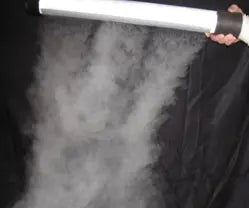
Pharmaceutical Suites, Semiconductor Clean Rooms
- Supports ISO 14644-3, Annex B.12 airflow recovery tests
- Supports airflow visualization tests guided by ISO 14644-3, ANNEX B.7
- Supports airflow visualization tests for NSF 49 National Safety Foundation
- Supports USP 797 Insitu Airflow Analysis in ISO suites, sterile rooms and barrier isolators
- Supports SEMI Standards Clean Room Guidelines
- Airflow balancing
- Leak detection in ducts
- Laminar flow tests
- Wet bench exhaust optimization
- Personal safety exhaust verification
- Chemical process equipment ventilation tests
- Pressure balancing between rooms and spaces
- Visualization of airflow patterns and turbulence
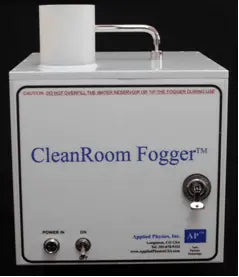
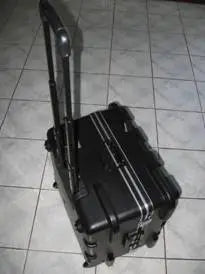 | OPTIONAL Carrying Case |
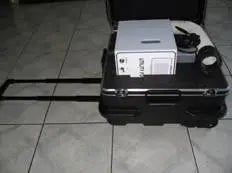 |
Specifications, Clean Room Fogger
(Details)
| Metric CRF2 Cleanroom Fogger CRF4 Cleanroom Fogger FOG Duration about 50 minutes about 45 minutes FOG Volume Output 0.26 cubic meters / minute, constant output 1.25 cubic meters per minute, adjustable fog volume and adjustable flow rate Total FOG Volume about 12.5 cubic meters, pure fog, during 50 minute cycle about 56.25 cubic meters, pure fog, during 45 minute cycle Fog Density (ml/minute) supports visible fog distance 57 milliliters water per minute converted to 8-10 micron fog droplets 187 milliliters water per minute converted to 7-8 micron fog droplets Visible Fog Distance 7-8 feet visible airflow distance 10-15 feet visible airflow distance FOG Type Ultrasonic Fog using DI water, sterile water WFI water Ultrasonic Fog using DI water, sterile water WFI water Class of Clean Room Use Class 10 to 10,000 Class 1 to 10,000 Compatible Guidelines USP 797 Insitu Airflow Analysis, ISO 14644-3 Annex B7, Federal Standards 209E in Semiconductor Clean rooms USP 797 Insitu Airflow Analysis, ISO 14644-3 Annex B7, Federal Standards 209E in Semiconductor Clean rooms Type of Room Fume hoods, airflow hoods, small glove boxes Clean Rooms, Sterile Rooms, ISO Suites, Medical Rooms Water volume 3.75 liters 9.5 liters Usable Water Volume 2.85 Liters 7.5 Liters Method of Operation Direct Switch Control, Cable Remote Control Touchpad Control or Wireless Remote Control Method of Movement Hand Carry Enclosure Hand Carry Enclosure Liquid Weight 3.78 Kg Water, 8.34 lbs 10 Kg Water, 22.05 lbs Standard Power Requirements 110 VAC, 50/60 Hz, 10A 110VAC, 50/60 Hz, 10A Optional Power 220VAC, 50/60 Hz, 15A; 100VAC 50HZ, 15A 220 VAC, 50/60 Hz, 10A; 100VAC 50HZ, 10A Dimensions, Inches 10″ H x 9″ W x 11″ L 11.5″ H x 12.5″ W x 22.5″ L Dimensions, Metric 254 mm H x 227 mm W x 280 mm D 305 mm H x 330 mm W x 572 mm D Empty Fogger Weight 12.5 lb. 45 lbs | ||
| Metric | CRF2 Cleanroom Fogger | CRF4 Cleanroom Fogger |
| FOG Duration | about 50 minutes | about 45 minutes |
| FOG Volume Output | 0.26 cubic meters / minute, constant output | 1.25 cubic meters per minute, adjustable fog volume and adjustable flow rate |
| Total FOG Volume | about 12.5 cubic meters, pure fog, during 50 minute cycle | about 56.25 cubic meters, pure fog, during 45 minute cycle |
| Fog Density (ml/minute) supports visible fog distance | 57 milliliters water per minute converted to 8-10 micron fog droplets | 187 milliliters water per minute converted to 7-8 micron fog droplets |
| Visible Fog Distance | 7-8 feet visible airflow distance | 10-15 feet visible airflow distance |
| FOG Type | Ultrasonic Fog using DI water, sterile water WFI water | Ultrasonic Fog using DI water, sterile water WFI water |
| Class of Clean Room Use | Class 10 to 10,000 | Class 1 to 10,000 |
| Compatible Guidelines | USP 797 Insitu Airflow Analysis, ISO 14644-3 Annex B7, Federal Standards 209E in Semiconductor Clean rooms | USP 797 Insitu Airflow Analysis, ISO 14644-3 Annex B7, Federal Standards 209E in Semiconductor Clean rooms |
| Type of Room | Fume hoods, airflow hoods, small glove boxes | Clean Rooms, Sterile Rooms, ISO Suites, Medical Rooms |
| Water volume | 3.75 liters | 9.5 liters |
| Usable Water Volume | 2.85 Liters | 7.5 Liters |
| Method of Operation | Direct Switch Control, Cable Remote Control | Touchpad Control or Wireless Remote Control |
| Method of Movement | Hand Carry Enclosure | Hand Carry Enclosure |
| Liquid Weight | 3.78 Kg Water, 8.34 lbs | 10 Kg Water, 22.05 lbs |
| Standard Power Requirements | 110 VAC, 50/60 Hz, 10A | 110VAC, 50/60 Hz, 10A |
| Optional Power | 220VAC, 50/60 Hz, 15A; 100VAC 50HZ, 15A | 220 VAC, 50/60 Hz, 10A; 100VAC 50HZ, 10A |
| Dimensions, Inches | 10″ H x 9″ W x 11″ L | 11.5″ H x 12.5″ W x 22.5″ L |
| Dimensions, Metric | 254 mm H x 227 mm W x 280 mm D | 305 mm H x 330 mm W x 572 mm D |
| Empty Fogger Weight | 12.5 lb. | 45 lbs |
INFORMATION The Clean Room Fogger is used in smoke studies and often called a smoke generator. Although often referred to as a smoke generator, the output is a pure fog and does not require any cleanup after use. Operating instructions are noted on the right panel of enclosure. Theory of Operation: Ultrasonic cavitation using DI water or Pharmaceutical WFI Water. Use of any other liquids or chemicals will void the warranty. The transducer life is ~5000 hours, which is protected from electrical damage when water level is too low. The water level sensor will interrupt the input voltage to the transducer module, should the water level drop to a low level to . This ensures long life and reliability. Notes:
- The clean room fog generated by this device contains microscopic droplets of DI water. AVOID USING IN IMMEDIATE VICINITY OF ELECTRICAL APPLIANCES, WATER SENSITIVE PRODUCTS AND EQUIPMENT.
- The fan will operate with no water in the reservoir with the power switch in the ON position. This will aid in drying when the chamber is drained.
- To increase drain plug tension, remove the plug, rotate clockwise (CW) the front latch while holding the rear metal disk.
- The clean room fogger is intended to be used on a flat surface, on its feet. Tipping the fogger with water in the reservoir will damage the fogger. DO NOT OVERFILL OR TIP THE FOGGER.
Portable Fogger, CRF2 Cleanroom Fogger
The CRF-2 provides portability using the carry handle on top of the fogger. While carrying the fogger in this manner, it is important not to slosh the water around inside the water chamber. Should you need to move the fogger while water is inside the water container, mover the fogger with slow movements, so that water does not splash inside the fogger.
What Does My Smoke Study Require to Visualize Airflow Turbulence?
Product relationship
Available Through Applied Physics
Applied Physics supplies and supports quotation of this product. Product branding and manufacturer information, where stated on the product page or supporting documentation, remain authoritative.
Applied Physics portfolio: Particle
Catalog relationship: Available Through Applied Physics
Related Applied Physics resources
Continue through the Particle portfolio
Use these technical and portfolio pages to compare applications and related equipment. To keep this exact product attached to an RFQ, use the product’s existing Request a Quote or Add To Order control.