
Maintaining strict ISO Class 1 air cleanliness traditionally required expensive physical enclosures or bulky laminar flow hoods that restricted worker mobility.
The Table-Koach Model T-500-F transforms contamination control by establishing an ultra-pure, localized clean zone directly on open laboratory workbenches.
Utilizing advanced FERENA filtration and opposed laminar airflow, it creates an invisible aerodynamic barrier that continuously pushes ambient dust away from critical work areas.
This technical breakdown explores how the T-500-F achieves high-purity air quality without physical walls, detailing its specifications, operational benefits, and key industry applications.
The Challenge of Traditional Cleanroom Isolation
Traditional cleanrooms use walls, curtains, or glass enclosures to prevent air contamination. However, they require high investment, large space, and continuous HVAC energy.
Laminar-flow hoods and biosafety cabinets provide clean air but can restrict movement, tool access, and comfort during long work periods.

Precision work, such as semiconductor handling, optical assembly, and micro-robotics, needs particle-controlled air without barriers that limit hand movement or equipment access.
How the Table-Koach Model T-500-F Achieves Open ISO Class 1 Purity
The Table-Koach Model T-500-F eliminates physical side walls by utilizing opposed laminar airflow technology.

Equipped with high-efficiency FERENA filter systems, the system projects two opposing streams of ultra-clean air across an open benchtop surface.
Opposed Airflow Aerodynamics
Instead of relying on a sealed box, the T-500-F positions two compact filtration units facing each other across a standard laboratory table. Clean air exits both units at uniform velocity, collides near the center of the workspace, and flows outward toward the operator and background environment.
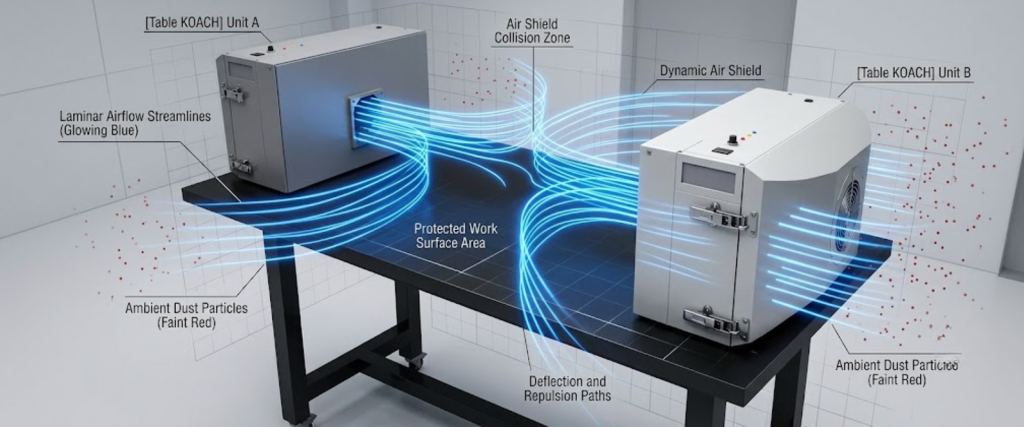
This continuous outward air displacement forms an aerodynamic barrier that prevents ambient dust, skin flakes, and room particles from entering the central work zone.
FERENA High-Efficiency Particle Filtration
The unit incorporates specialized FERENA filters capable of capturing airborne particulates down to 0.1 microns.
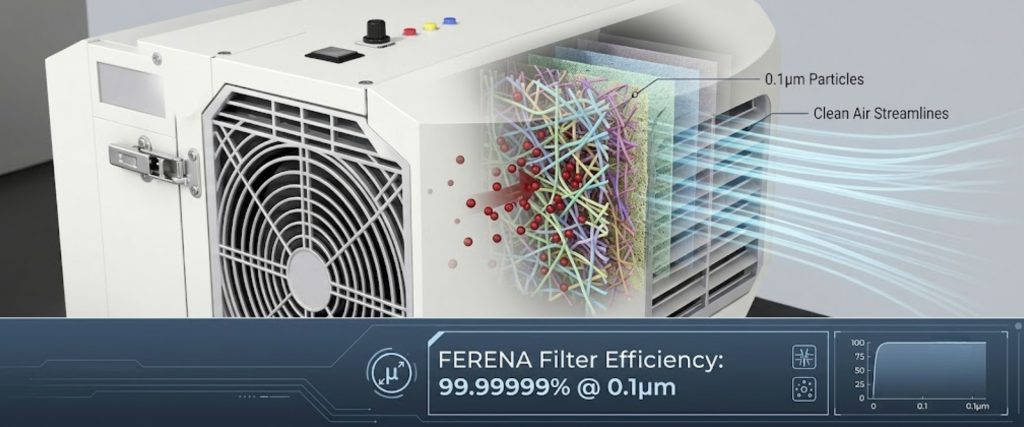
This filtration performance clears the space between the two blowing units within seconds of activation, maintaining an ISO Class 1 cleanliness level (fewer than 10 particles $\ge 0.1\,\mu\text{m}$ per cubic meter of air).
Core Operational Advantages
Unobstructed Operator Ergonomics
Without acrylic sashes or side panels, technicians can approach the work area from multiple angles.
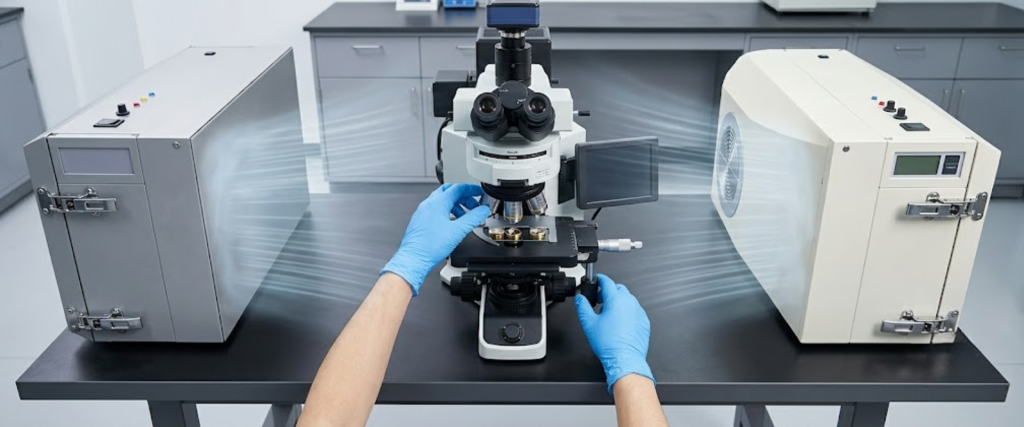
Large diagnostic instruments, microscopes, or automated inspection tools can be placed directly between the two units without custom retrofitting or enclosure modifications.
Rapid On-Demand Cleanliness
Unlike large cleanrooms that run HVAC blowers continuously to maintain air balance, the T-500-F achieves ISO Class 1 conditions almost immediately upon activation.
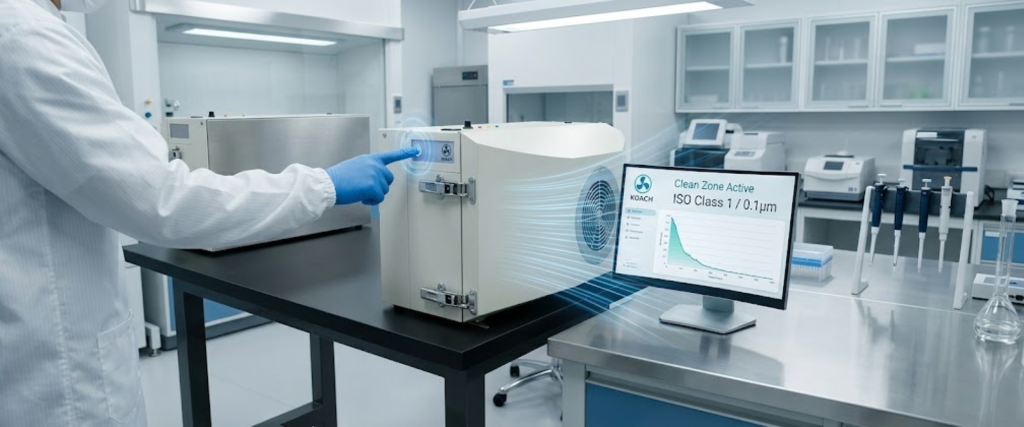
Users can turn the system on for specific assembly tasks and power it down afterward, significantly reducing overall electricity usage.
Flexible Layout Integration
The modular desktop footprint allows facilities to convert standard laboratory tables, ESD workbenches, or mobile carts into clean zones instantly.
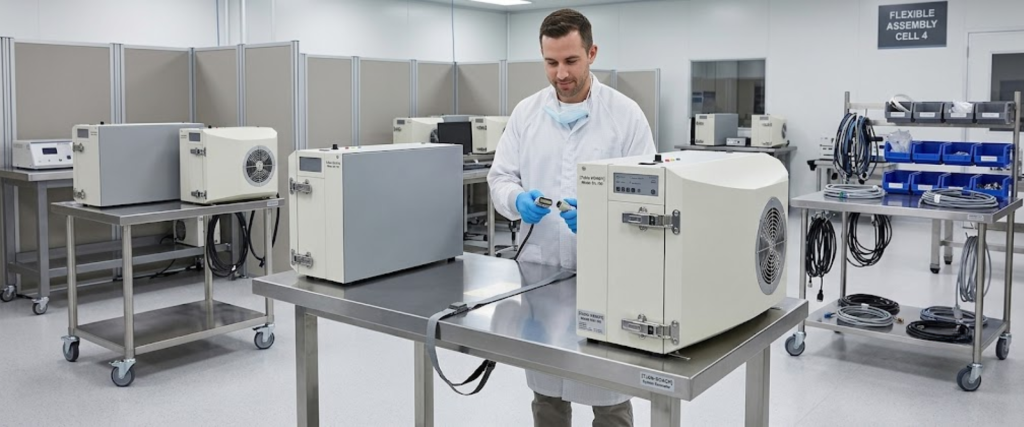
If production lines reconfigure, the units can be repositioned across the facility without structural building alterations.
Technical Performance & Specification Comparison
The table below outlines the core operational parameters and physical characteristics of the Table-Koach Model T-500-F alongside standard cleanroom equipment.
| Specification / Feature | Table-Koach Model T-500-F | Standard Laminar Flow Hood | Softwall Cleanroom Booth |
| Air Cleanliness Rating | ISO Class 1 | ISO Class 5 | ISO Class 7 to 8 |
| Enclosure Requirement | None (Open-bench design) | Acrylic / Glass Sash | Vinyl Curtains / Rigid Walls |
| Portability | High (Desktop units, ~13.5 kg per hood) | Low (Fixed heavy cabinet) | Moderate (Requires frame assembly) |
| Setup Time | Instant (Plug-and-play) | Fixed installation | Hours to days |
| Filter Efficiency | 99.9999% @ 0.1 $\mu\text{m}$ (FERENA) | 99.99% @ 0.3 $\mu\text{m}$ (HEPA) | 99.99% @ 0.3 $\mu\text{m}$ (HEPA) |
| Operator Access Angle | 360-degree unobstructed access | Front sash slot only | Entry door/strip curtains |
Operating Best Practices
- Bench Surface Preparation: Wipe down the worktable surface with isopropyl alcohol before starting airflow to remove settled particulate matter.
- Unit Alignment: Ensure the opposing blower units face each other directly and maintain parallel alignment across the recommended separation distance (typically 500 mm to 1,000 mm depending on table dimensions).
- Airflow Clearance: Keep large obstacles clear of the primary air discharge louvers to maintain laminar velocity profiles across the active working zone.
- Filter Maintenance: Routinely inspect filter pressure differentials and schedule FERENA filter replacements according to operational hours and environmental dust loads.
Conclusion
The Table-Koach Model T-500-F presents a practical alternative to rigid cleanroom enclosures by utilizing opposed laminar airflow mechanics.
By establishing an open ISO Class 1 environment directly on existing workbenches, it removes physical spatial constraints, improves operator dexterity, and lowers the capital barrier for high-purity processing.
Frequently Asked Questions (FAQs)
1. How does the Table-Koach maintain ISO Class 1 air without side walls?
It projects opposing streams of filtered air inward toward the center of the bench. The converging air currents push ambient room air outward, creating a continuous pressure boundary that blocks room contaminants from entering the work zone.
2. What is the filtration efficiency of the FERENA filter?
The FERENA filter captures particles down to 0.1 microns with an efficiency exceeding 99.9999%, surpassing standard HEPA filtration specifications and achieving ULPA-level performance.
3. Can the Table-Koach T-500-F be moved between workbenches easily?
Yes. Each unit is compact and lightweight, allowing operators to move and reconfigure the system across different workstations or research labs without specialized tools or structural installations.
4. Do room air currents affect the performance of an open clean zone?
While the opposed airflow generates a strong protective barrier, high ambient room cross-drafts (such as direct HVAC supply vents blowing straight at the bench) should be minimized to maintain peak laminar stability.