
An industrial dehumidifier relies entirely on its humidity sensor.
If readings drift high, the unit wastes energy by over-drying; if they drift low, unmonitored moisture leads to corrosion, powder clumping, electrostatic issues, and audit failures.
Even a perfectly sized system will fail when its feedback loop is compromised.
Because sensing elements must remain directly exposed to process air, sensor drift is inevitable. The goal is not eliminating drift, but detecting deviations early through routine, risk-aligned calibration.
What Causes Relative Humidity Sensor Drift
Most industrial RH probes use a capacitive polymer film. Water vapor changes the film’s dielectric constant; the electronics convert that change into % RH. Anything that changes the film, or blocks vapor from reaching it—shifts the reading.
Contaminants and chemical vapors
Cleaning agents, alcohols, solvents, floor coatings, and process fumes can adsorb onto the sensing film.
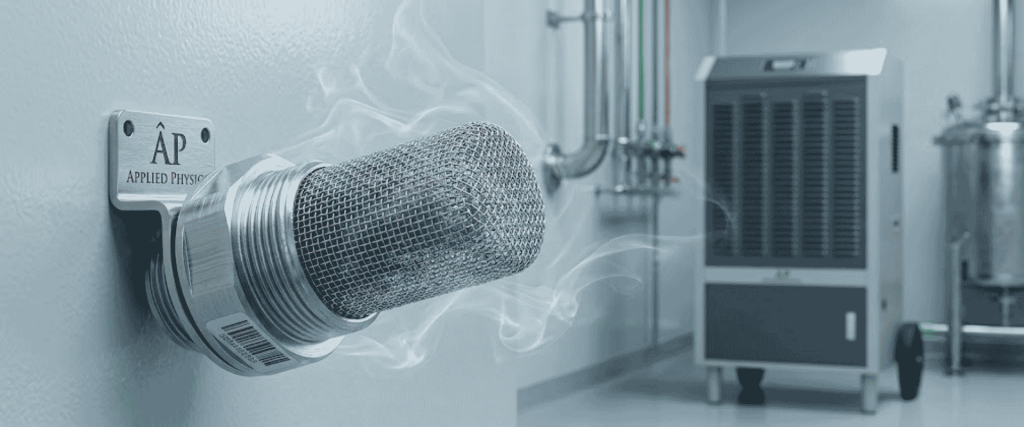
Strong odors are a practical warning: if staff can smell a chemical in the zone, the sensor is likely seeing it too. Contaminant-driven drift is often an offset error that grows after maintenance or construction work.
Condensation and liquid water
When the probe cools below the local dew point, liquid water can sit on the sensor.
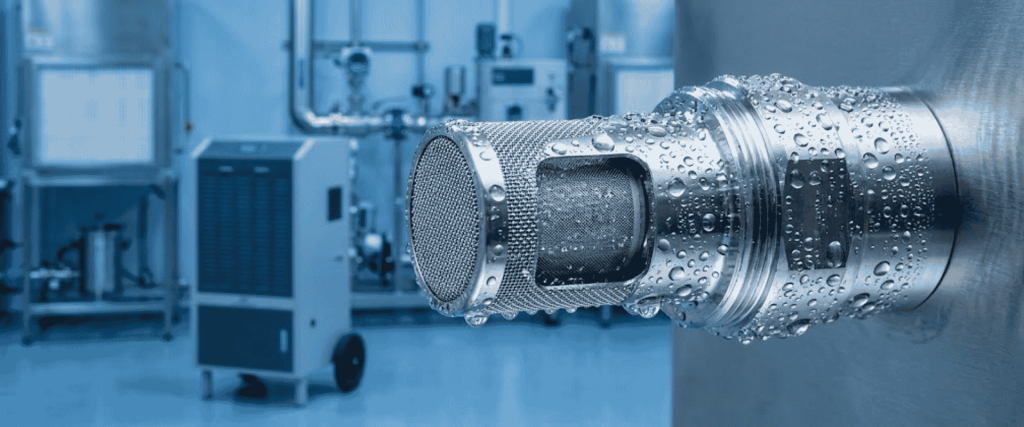
Short events may recover. Repeated wetting ages the film and can leave a lasting bias. Cold walls, uninsulated duct mounts, and rapid temperature swings raise this risk.
Dust and particulate loading
Dust does not always break a sensor at once. It slows vapor exchange, lengthens response time, and can bias readings in dirty production areas.

Filters and probe caps help until they clog; then the reading lags real room conditions.
Temperature stress and aging
RH is temperature-dependent. Poor temperature compensation, heat from nearby equipment, or wide daily temperature cycles add error on top of true humidity change.
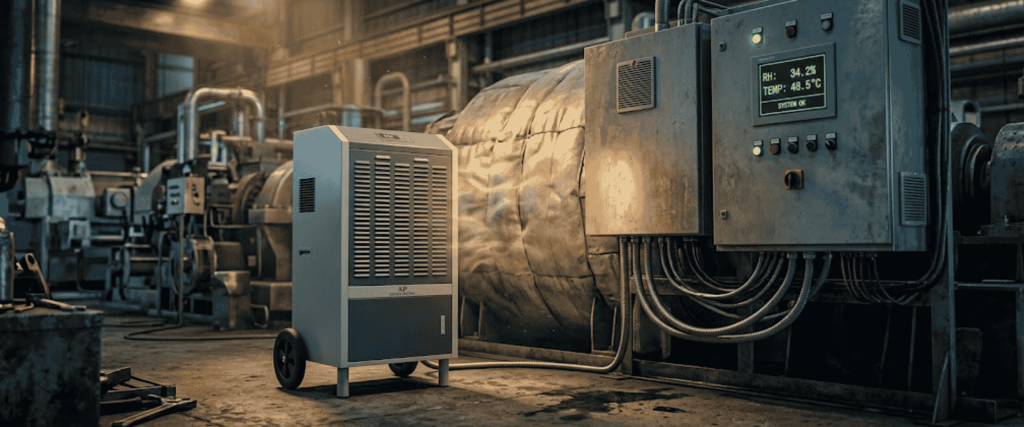
Even in clean air, capacitive sensors typically show long-term drift on the order of a few tenths of a percent RH per year; harsh rooms move much faster.
Placement error (often mistaken for sensor failure)
A probe in stagnant air, in the dehumidifier discharge stream, against an exterior wall, or above a wet floor measures a microclimate, not the occupied zone.

The number looks wrong even when the sensor is still within calibration.
How to Prevent RH Sensor Drift in Critical Systems
1) Specify the sensor for the room, not only the unit
Match probe type and protection to chemicals, dust, and condensation risk.
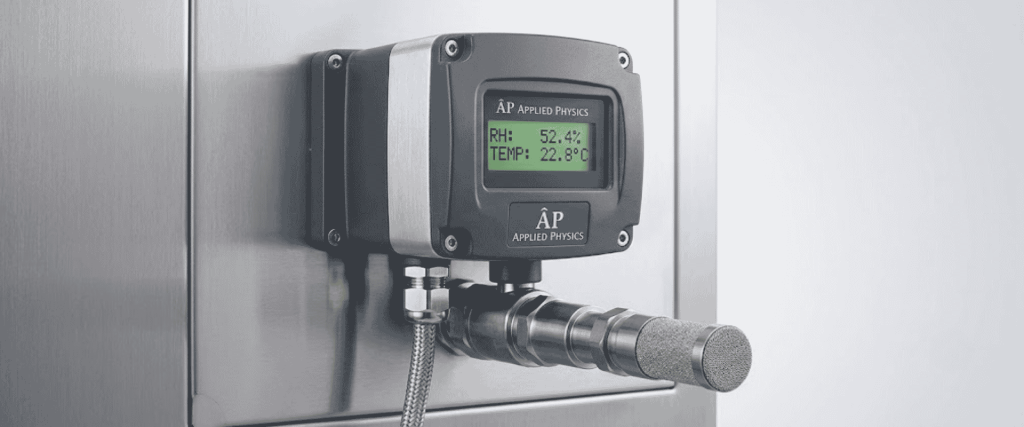
In harsher zones, use industrial transmitters with replaceable or serviceable heads, sintered filters, and documented long-term stability, not only the board-level sensor inside a portable unit.
2) Place probes where control decisions should be made
Mount the control sensor at process height in representative airflow, away from.
- Supply discharge and coil face
- Doors, docks, and exterior walls
- Steam sources, wash-down paths, and open tanks
- Direct sun or hot equipment skins
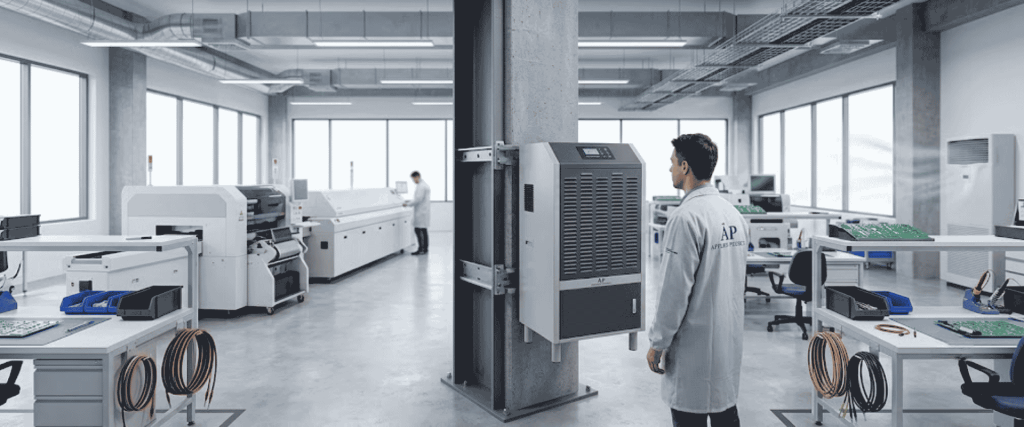
If one unit serves a large hall, confirm the probe location still represents the product zone after layout changes.
3) Keep vapors and wet cleaning off the sensing element
During floor stripping, solvent wipe-downs, or fogging, remove probes, cap them, or power down and isolate per manufacturer guidance. Do not store open chemicals next to the transmitter.
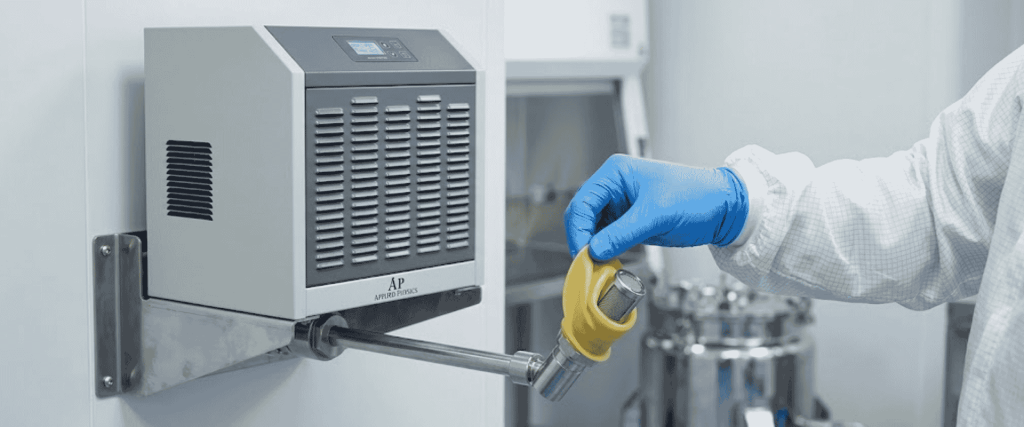
After heavy cleaning, compare the unit reading to a reference hygrometer before trusting automatic control again.
4) Manage condensation risk
Avoid mounting on cold surfaces. Use probe orientation and shielding recommended by the maker.
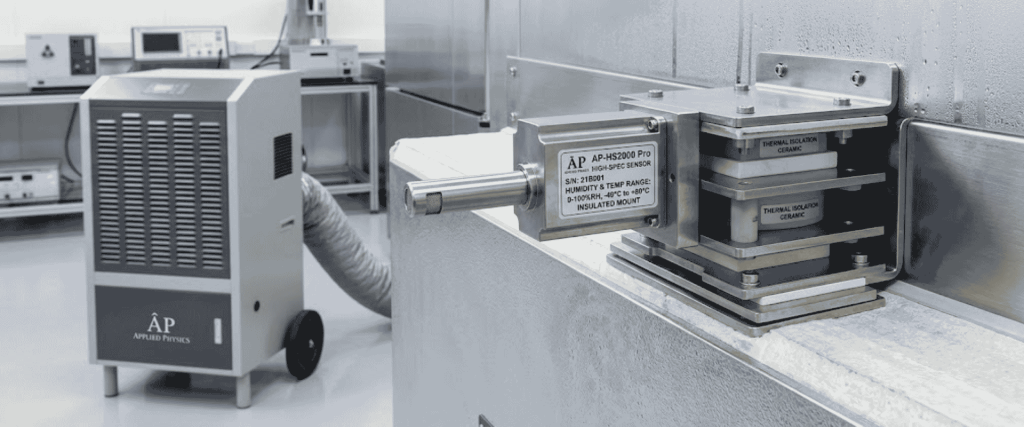
If the space regularly approaches dew point, choose sensors rated for condensation recovery and allow dry-out time before relying on tight control.
5) Calibrate on a risk-based interval
Clean, stable rooms may support annual checks. Dirty, chemical, or high-humidity rooms often need quarterly or semi-annual verification. Critical records (batch, audit, customer spec) should use a traceable reference standard, not only a second uncalibrated display.

As-found / as-left data matters. If as-found error is already outside process tolerance, shorten the interval and investigate placement and contamination, not only the electronics.
6) Use a reference check in normal operation
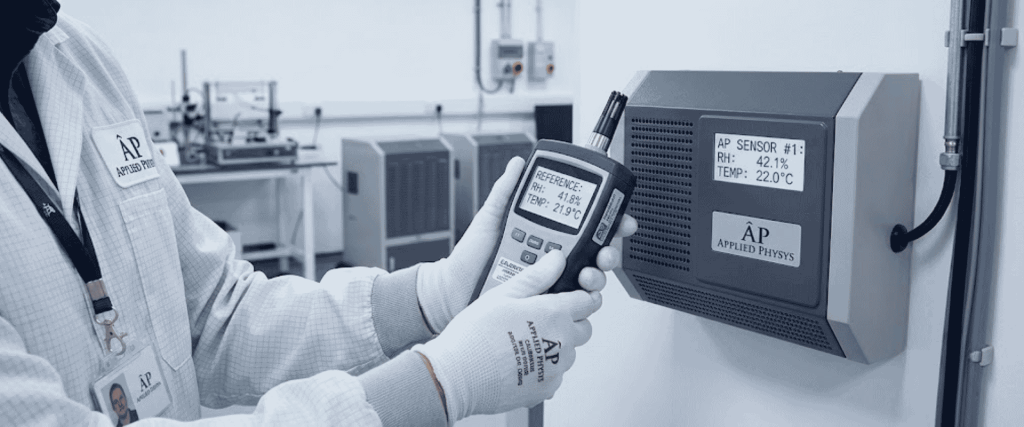
Keep a calibrated handheld or fixed reference hygrometer for spot checks at the control point. Log unit RH vs reference RH. A growing gap is drift or placement error showing up before product quality does.
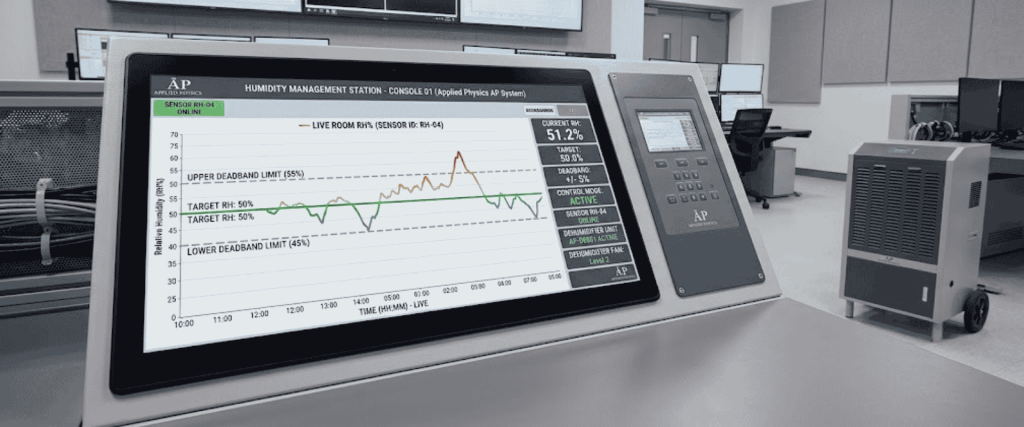
7) Design the control loop to tolerate small error
Practical steps.
- Set deadband and alarms that match real sensor uncertainty
- Avoid chasing noise with overly tight PID on a slow RH loop
- Consider dual sensors or voting in high-impact rooms
- Tie major deviations to maintenance work orders, not only operator resets
8) Maintain the dehumidifier so the sensor is not compensating for hardware faults
Blocked filters, iced coils, full drains, and failing fans change local humidity at the unit.
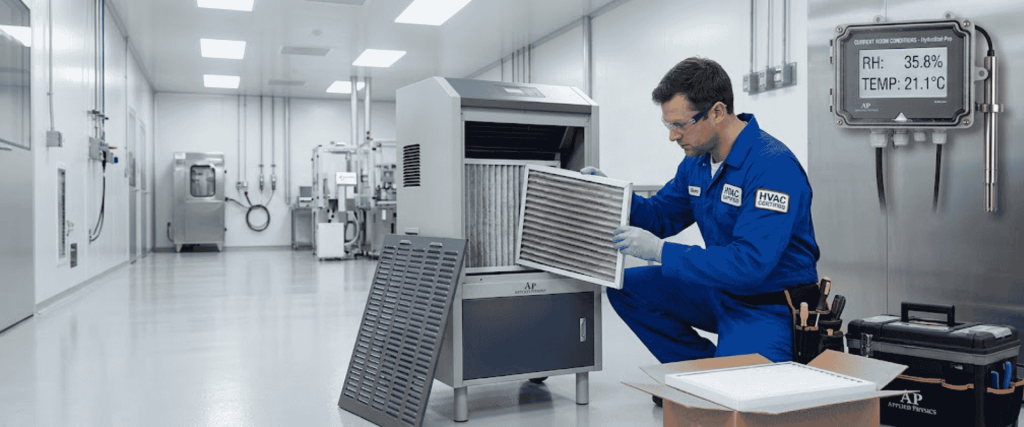
Operators then blame the sensor when airflow and coil performance are the root cause. Keep intake clear, confirm drain flow, and verify auto defrost is completing in cool rooms.
How Sensor Drift Shows Up on a Dehumidifier System
Watch for these plant-floor signals.
- Setpoint unchanged, but room feels damper or drier than the display
- Runtime climbs or falls with no process or weather change
- Two nearby instruments disagree by more than their combined tolerance
- Alarms chatter around the same RH band every shift
- After cleaning day, RH readings shift and do not return
- Logged RH is stable while product moisture defects rise
When control precision is specified at ±5% RH, an extra 3–5% of uncorrected sensor drift can push the real room outside the band the team thinks it is holding.
Practical Verification Routine
A short routine that fits most industrial dehumidifier sites.
- Confirm probe is clean, dry, and in the correct location
- Compare unit RH to a calibrated reference at the same point (allow both to stabilize)
- Note temperature on both devices; large temperature disagreement undermines RH comparison
- Record as-found error; adjust or replace per manufacturer limits
- Force a small setpoint step and confirm the unit responds in the right direction
- After service, record as-left values and next due date
If error exceeds tolerance and cleaning or offset adjustment is not allowed or not effective, replace the probe. Do not fix a critical room by shifting the setpoint to mask a bad sensor without documenting the offset and fixing the root cause.
Linking Sensor Care to Unit Selection
Hardware still matters. A correctly sized industrial dehumidifier reduces how hard the control loop must work and limits extreme wet/dry cycling that stresses sensors.
When you size or replace a unit, capture
- Room volume and moisture load (people, doors, product, ingress)
- Target RH and allowed band
- Lowest and highest expected dry-bulb temperature
- Available power (220 V vs 380/480 V)
- Drain method (tank vs continuous pipe)
- Whether the RH signal feeds only the local controller or also a BMS / quality record
Models in the BKDH class (about 7–20 L/h removal, 2,000–5,600 m³/h airflow, ±5% RH control indication) fit many production and storage floors when matched to area and power. Sensor discipline is what keeps that capacity pointed at the real room condition.
Conclusion
Critical dehumidification fails quietly when the RH sensor drifts. Contaminants, condensation, dust, heat, aging, and bad placement all pull the displayed humidity away from the true value.
The dehumidifier then overworks, underworks, or both, while dashboards still look fine.
Preventing drift is a system habit: right probe, right location, protection during chemical work, risk-based calibration, reference checks, and mechanical maintenance that keeps airflow and drainage honest.
Pair that discipline with a unit sized for the space and moisture load, and RH control stays inside the band your process actually needs.
Stable humidity is not only a compressor and a coil. It is a measurement you can still trust on the worst day of the month.
Frequently Asked Questions (FAQs)
1. What is relative humidity sensor drift?
It is a gradual or step change in RH reading away from the true humidity, caused by contamination, condensation, dust, temperature stress, aging, or poor placement, even when the dehumidifier itself is running.
2. How often should I calibrate an industrial dehumidifier RH sensor?
Base the interval on risk. Clean, stable areas often use annual checks. Rooms with chemicals, dust, wash-down, or tight product specs usually need quarterly or semi-annual verification against a traceable reference.
3. Can I fix drift by changing the setpoint?
A temporary offset can keep product safe for a short time, but it hides the fault. Document any offset, then clean, relocate, calibrate, or replace the sensor so the displayed RH matches the room again.
4. Where should the humidity sensor be mounted?
At a height and location that represent the product or process air, with steady mixing, away from discharge air, doors, wet floors, exterior walls, and hot equipment.