
Last Updated: August 6, 2026
A portable cleanroom fogger is a precision instrument that generates visible fog to track airflow patterns, turbulence, and dead zones in controlled environments. You can’t measure what you can’t see, a cleanroom passing visual inspection might harbor hidden vortexes, stagnant pockets, or uncontrolled turbulence that compromises product safety.
Applied Physics has been helping manufacturers solve this problem since 1992, delivering foggers that turn invisible airflow into visible evidence. A portable cleanroom fogger lets you validate your environment on demand without shutting down production for weeks. Ultrapure LN2 technology leaves zero residue, eliminating contamination risk and cleanup.
The stakes are high. A single contamination event in pharmaceutical compounding compromises an entire batch. In semiconductor fabrication, particle intrusion at sub-10nm nodes destroys wafers worth thousands of dollars. A portable cleanroom fogger is insurance against invisible failure.
Smoke studies using cleanroom foggers are the gold standard for visualizing airflow patterns in controlled environments. When you introduce fog into a cleanroom, it becomes a visual tracer following actual air currents, revealing exactly how air enters, circulates, and exits your space.
This differs fundamentally from theoretical modeling or static certification. A smoke study shows real-world behavior under actual operating conditions, with your equipment running, personnel in position, and processes active. The fog reveals laminar flow patterns where they should exist, identifies turbulence where it shouldn’t, and exposes dead zones where contamination can accumulate.
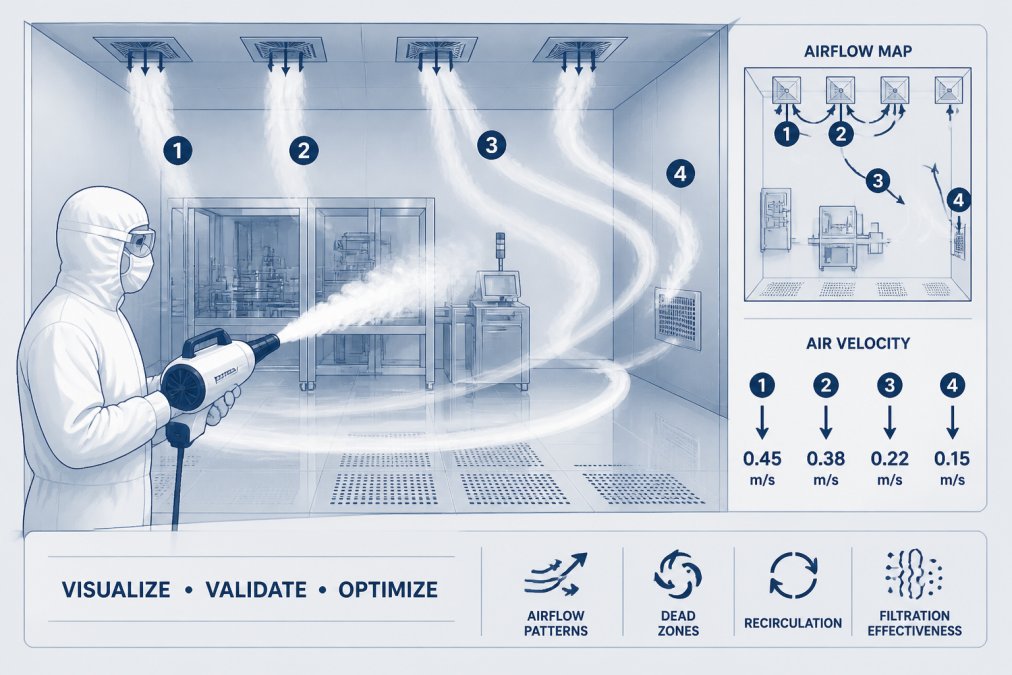
Technician in full cleanroom protective gear using a handheld portable fogger to visualize airflow patterns, with visible fog trails showing air movement through a pharmaceutical manufacturing area under bright controlled lighting
You introduce fog from a strategically chosen point, typically near the air supply inlet or at a potential problem area. As the fog disperses, you observe its trajectory. Ideal laminar flow moves in straight, parallel lines from ceiling to floor. Turbulent flow swirls and eddies. Dead zones show fog stalling, indicating poor air exchange.
According to ISO 14644-3 international standards for cleanroom airflow testing, smoke studies must document fog behavior across the entire room at multiple heights and locations. For USP 797 pharmaceutical compounding facilities, cleanroom airflow visualization using fog is explicitly required to demonstrate compliance with contamination control standards.
Three distinct fogger technologies dominate the market, each with specific strengths and trade-offs. Your choice depends on room size, runtime requirements, contamination sensitivity, and budget.
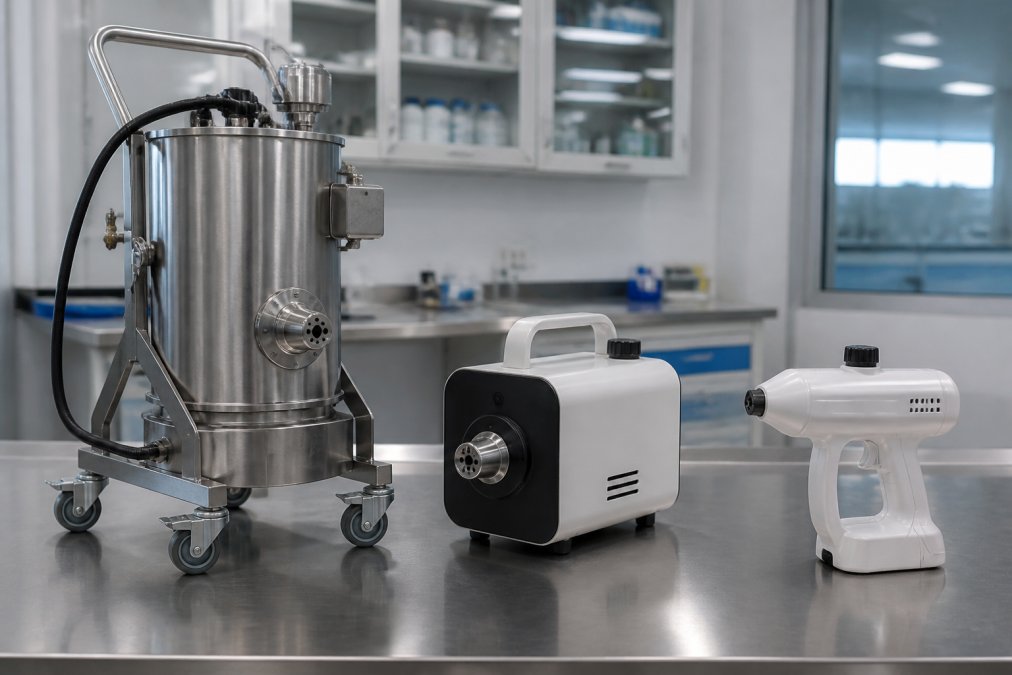
Laboratory bench displaying three different portable cleanroom fogger models side-by-side: a large stainless steel LN2 unit on a rolling cart, a compact ultrasonic device, and a small battery-powered handheld pistol-grip fogger, with clear size differentiation under clean laboratory lighting
LN2 (liquid nitrogen) foggers represent the highest performance tier. They convert liquid nitrogen and deionized water into ultrapure fog with zero residue, zero contamination risk, and exceptional density and volume.
Applied Physics manufactures two LN2 models. The AP35 generates approximately 5 cubic meters of fog per minute with 533 ml/minute fog density, providing 20 to 30 feet of visual distance for up to 75 minutes. The AP100 delivers 15.5 cubic meters per minute with 1,520 ml/minute fog density, reaching 30 to 40 feet for up to 90 minutes. Both meet ISO 14644-3 Annex B7 requirements and USP 797 in-situ airflow analysis standards.
The advantage is absolute: no glycol residue, no chemical traces, no contamination liability. For semiconductor fabs validating sub-10nm nodes or sterile compounding pharmacies under FDA scrutiny, this residue-free characteristic is non-negotiable. Fog particles are 2-3 microns in diameter, small enough to follow actual air currents without settling prematurely.
The trade-off is operational complexity. LN2 foggers require liquid nitrogen supply and deionized water. Setup takes 15-20 minutes. The units are large and heavy, though they ship on rolling frames for mobility.
Pro Tip LN2 foggers are the standard for regulatory validation in pharmaceutical and semiconductor environments. If your facility undergoes external audits or GMP inspections, this is the technology auditors expect to see.
Ultrasonic foggers use piezoelectric transducers vibrating at ultrasonic frequencies to atomize water into ultra-fine droplets. Applied Physics’s CRF2 model uses 9 ultrasonic devices to generate 0.26 cubic meters of fog per minute with 57 ml/minute fog density, providing 7-8 feet of visual distance for approximately 50 minutes.
Ultrasonic foggers are ideal for smaller spaces: fume hoods, biosafety cabinets, glove boxes, and confined areas where large LN2 units won’t fit. They turn on instantly with no warm-up time or setup complexity. The CRF2 uses chemically resistant polypropylene and is compatible with USP 797 and ISO 14644-3 standards.
The limitation is output volume and visual distance. A 7-8 foot visualization range won’t work for large cleanrooms or semiconductor fabs.
Watch Out Ultrasonic foggers leave microscopic water residue on surfaces. In ultrapure environments like semiconductor cleanrooms, this residue can be problematic. Test in a non-critical area first if you’re validating a sensitive process.
Handheld foggers trade volume for portability. Applied Physics’s Portable Glycol Fogger uses a battery-operated pistol design with fog velocity control, producing 1 ml/minute fog density with 45-60 minutes of runtime per charge. The 60 ml refillable tank holds DI water with glycol fluid. A rechargeable 15V battery (3200mAh, 48Wh, CE certified) recharges in 60 minutes.
This tool spot-checks and troubleshoots specific areas. You can carry it to problem zones, test a specific inlet or outlet, and move on. The zero-momentum fog feature visualizes very gentle air currents without introducing turbulence.
ISO 14644-3 governs cleanroom airflow testing. Part 3 specifically addresses in-situ testing methods, including smoke studies and fog visualization. Understanding these requirements ensures your validation holds up under regulatory scrutiny.
The standard requires fog particles in the 0.5 to 10 micron range. Applied Physics foggers meet this specification: ultrapure LN2 fog at 2-3 microns tracks real airflow behavior accurately.
ISO 14644-3 mandates documentation of fog behavior at multiple locations and heights throughout the cleanroom. You can’t run a single smoke study in one corner and call it validation. The standard expects systematic observation across the entire space, with particular attention to high-risk areas like transfer ports, personnel entries, and equipment access points.
Key Takeaway ISO 14644-3 compliance requires documentation. Photograph or video your smoke study. Record fog behavior at each test location with timestamps. This visual record is what auditors expect to see in your validation file.
USP 797 governs sterile pharmaceutical compounding in hospitals, pharmacies, and compounding facilities. The standard explicitly requires validation of cleanroom airflow patterns to ensure contamination control during injectable medication preparation.
USP 797 demands that cleanroom environments maintain unidirectional airflow (laminar flow) at 0.7 to 1.2 meters per second at the work surface. A portable cleanroom fogger lets you verify this velocity visually. Fog moving at the correct speed confirms adequate air exchange; fog moving too slowly or turbulently signals a problem.
The standard requires validation before initial use and annually thereafter (or whenever you modify the space). Applied Physics foggers, particularly the ultrapure LN2 models, are designed specifically for this requirement. The zero-residue fog means you can run validation studies without contaminating the compounding environment.
Your portable cleanroom fogger itself requires validation before you can use it to validate your cleanroom. This critical step is often overlooked, yet it’s exactly what FDA and GMP auditors expect to see documented in your validation file.
Before using your fogger for any production cleanroom validation, establish a baseline performance record. Document the manufacturer, model number, serial number, purchase date, and calibration certificate. Run an acceptance test in a neutral environment, a test chamber or previously certified cleanroom. Record ambient conditions: room temperature, relative humidity, barometric pressure, and HVAC operating mode. Photograph the fogger setup and fog output.
Verify fog particle size meets ISO 14644-3 requirements (0.5 to 10 microns). Applied Physics LN2 foggers produce 2-3 micron particles; ultrasonic foggers typically produce 3-5 micron particles. Reference the manufacturer’s third-party particle size analysis if available.
Run your fogger under standard conditions and measure actual runtime and fog density. For an LN2 fogger, use a fresh 100L liquid nitrogen Dewar and laboratory-grade DI water at room temperature. Record total runtime in minutes and measure fog density by observing visual distance.
Compile your validation documentation into a single file:
This package answers auditor questions about fogger validation immediately and demonstrates regulatory awareness.
If your fogger’s performance degrades between validation studies, systematic troubleshooting prevents costly downtime.
LN2 Fogger Issues:
Reduced fog output or visual distance: The most common cause is insufficient liquid nitrogen pressure. Check your nitrogen supply container. A full 100L Dewar should maintain 50-80 PSI at the regulator. If pressure is low, replace the nitrogen supply first. If pressure is adequate but fog output is still low, the issue is likely DI water contamination or a blocked nozzle. Drain the water reservoir, flush with fresh laboratory-grade DI water, and refill. If fog output remains poor, inspect the fog generation nozzle for ice buildup or mineral deposits. Disconnect the nozzle carefully and flush with warm DI water. Allow to air dry completely before reconnecting.
Fogger won’t start or produces no fog: Verify that the nitrogen supply is connected and the regulator valve is open. Check that the DI water reservoir is filled. For electric-powered LN2 foggers, confirm the power cord is connected and the power switch is ON. If power is confirmed but the fogger won’t start, the issue may be a frozen or blocked internal line. Allow the unit to warm to room temperature (30-45 minutes) and try again.
Hissing sound or visible frost on external connections: This indicates a nitrogen leak at a connection point. Immediately depressurize the system by closing the nitrogen supply valve and opening the manual pressure relief valve. Allow the system to warm to room temperature. Inspect all connection points for loose fittings or damaged seals. Tighten fittings with an appropriate wrench. If tightening doesn’t stop the leak, the seal may be damaged. Most LN2 foggers have user-replaceable seals; consult your manual for the specific seal kit and replacement procedure.
Ultrasonic Fogger Issues:
Contact Us →
Fog output drops significantly: Over time, piezoelectric transducers degrade and produce less fog. If fog density drops by more than 20% compared to your baseline, transducer replacement is likely needed. Most ultrasonic foggers are designed for user-serviceable transducer swaps. The transducer cartridge typically unscrews from the fog generation chamber. Order a replacement cartridge from the manufacturer, unscrew the old one, screw in the new one, and refill with DI water.
No fog output despite water in reservoir: First, confirm the water level is adequate. If the reservoir is low, refill with fresh DI water. If the water level is adequate, the transducer may have failed completely or the power connection may be loose. Check that the power cord is firmly connected and the unit is powered on. If power is confirmed, the transducer cartridge likely needs replacement.
Water leaking from the bottom of the unit: This typically indicates a cracked or damaged water seal. Stop using the fogger immediately to prevent water damage to electrical components. Allow the unit to dry completely (24 hours). Contact the manufacturer for a replacement seal or service.
Handheld Glycol Fogger Issues:
Battery won’t hold a charge: If the battery no longer holds a charge after a full recharge cycle, the battery has reached end-of-life. Most handheld foggers have user-replaceable battery packs. Order a replacement battery from the manufacturer and swap it out.
Fog output is weak or inconsistent: Check the glycol fluid level in the refillable tank. If the tank is low, refill with the manufacturer-recommended glycol fluid. If the tank is full but fog output is still weak, the sinter element may be clogged. Flush the tank and sinter element with fresh DI water, allow to air dry, and refill with fresh glycol fluid.
After each use: Allow the fogger to cool to room temperature before handling. For LN2 systems, this takes 30-45 minutes. Depressurize the system fully. Visually inspect fog output nozzles and hoses for residue or blockages. If you see mineral deposits or ice buildup, flush with fresh DI water and air dry.
Weekly (if used more than once per week): Inspect all visible seals and connections for wear or leakage. Check battery charge levels on handheld units and recharge if below 50%.
Monthly: Deep clean the fog generation chamber. For LN2 systems, disconnect the water inlet line and flush the internal chamber with fresh DI water. For ultrasonic foggers, drain the water reservoir, rinse thoroughly, and refill with fresh DI water.
Quarterly: If your fogger is used frequently, run a baseline performance test in a controlled environment. Compare runtime, fog density, and visual distance to your original acceptance test data. If performance has degraded by more than 10%, investigate the cause.
Annually: Professional servicing is recommended for LN2 systems, especially if used more than monthly. A technician will inspect pressure vessels for corrosion, test seals and connections under pressure, verify regulator function, and replace any worn components.
Key Takeaway Validation documentation and systematic troubleshooting are regulatory requirements. FDA and GMP auditors expect to see a clear record that your fogger was validated before it was used to validate your cleanroom. Keep this documentation organized and accessible.
The decision to rent or buy a portable cleanroom fogger is fundamentally a cost-benefit analysis over your facility’s operational lifetime. The right choice depends on validation frequency, total cost of ownership, operational flexibility, and regulatory requirements.
Rental equipment is typically available through cleanroom service providers and laboratory equipment suppliers. Typical daily rates range from $150 to $400 for handheld or ultrasonic foggers, and $400 to $800 per day for LN2 systems. Weekly rates are typically 3-4 times the daily rate; monthly rates are 8-12 times the daily rate.
Purchase prices for new equipment are typically:
Total cost of ownership includes consumables (liquid nitrogen at $150-$250 per 100L Dewar, deionized water at $10-$30 per gallon), maintenance (annual professional service at $800-$1,500 for LN2 systems), and unplanned repairs ($500-$2,000).
Break-Even Analysis:
If you validate quarterly (4 times per year) with full-day LN2 rental at $600/day, your annual rental cost is $2,400. Over 5 years, that’s $12,000 in rental fees. If you purchase an LN2 fogger for $20,000, your first-year costs are $20,000 (equipment) + $800 (consumables) + $1,200 (annual service) = $22,000. Years 2-5 cost $2,000/year. Over 5 years, total cost of ownership is $30,000.
The break-even point occurs around 15-20 validation studies. If you validate more than 3-4 times per year, purchase becomes economically favorable within 3-5 years.
Rental equipment introduces scheduling constraints. Most rental companies require 24-48 hours notice. During peak seasons, equipment may be booked weeks in advance. Different rental companies provide different models, requiring staff retraining.
Ownership provides immediate availability, standardization across validation studies, flexibility for unscheduled validation, and predictable costs for budgeting.
FDA and GMP auditors expect consistent, well-documented validation procedures. If you own equipment, your validation file shows consistent use of the same instrument across all studies, demonstrating that the equipment was accepted, maintained, and validated according to a documented procedure.
Many facilities adopt a hybrid approach: Purchase a handheld glycol fogger ($2,500-$3,500) for routine spot-checks and troubleshooting. Use it to investigate suspected airflow problems, validate new equipment installations, or check for changes after HVAC maintenance.
Rent or purchase an LN2 system for comprehensive annual validation. If you validate comprehensively only once or twice per year, rental cost ($1,200-$1,600 per study) is acceptable. If you validate more frequently, purchase becomes favorable.
Cost estimate for hybrid approach:
| Scenario | Recommendation | Rationale |
|---|---|---|
| Validate 1-2 times per year, budget-constrained | Rent LN2 system as needed | Rental cost is lower than ownership amortized over infrequent use |
| Validate 3-4 times per year, regulatory scrutiny | Purchase handheld + rent LN2 annually | Handheld for diagnostics, annual LN2 rental for comprehensive validation |
| Validate quarterly or more frequently | Purchase LN2 system | Ownership cost is lower than rental; immediate availability supports frequent validation |
| Multiple cleanrooms requiring independent validation | Purchase one LN2 + one ultrasonic | Allows simultaneous validation of different spaces |
Pro Tip If you’re uncertain about your validation frequency, rent equipment for your first 2-3 validation studies. Document your actual usage patterns. After 6-12 months, you’ll have real data to support a purchase decision.
A portable cleanroom fogger is precision equipment. Proper maintenance extends service life and ensures consistent performance across validation studies.
Post-use protocols: After each fog study, allow the fogger to cool completely before handling. For LN2 systems, wait 30-45 minutes for the Dewar to return to ambient temperature. Depressurize the system fully before disconnecting nitrogen supply lines. Inspect fog output nozzles and hoses for residue or blockages. For ultrapure LN2 foggers, mineral deposits from DI water can accumulate. Flush nozzles with fresh DI water and allow to air dry.
Storage: Store foggers in a clean, dry environment protected from temperature extremes. For LN2 systems, ensure the Dewar is empty before storage. For ultrasonic foggers, drain any remaining water from the reservoir to prevent algae growth or mineral buildup.
Periodic maintenance:
DI water quality: Use only laboratory-grade DI water with resistivity above 1 megohm. Store DI water in sealed containers to prevent recontamination. Replace the DI water supply before each use.
A portable cleanroom fogger is a strategic investment in process control and regulatory confidence. Whether you’re validating a pharmaceutical compounding facility under USP 797, certifying a semiconductor fab at sub-10nm nodes, or maintaining a biotech research cleanroom, fog visualization transforms invisible airflow into visible evidence.
Applied Physics has delivered precision contamination control solutions since 1992, with specialized expertise in cleanroom, semiconductor, and medical equipment. Our ultrapure LN2 and ultrasonic foggers are built for regulatory environments where validation is mandatory. Contact Applied Physics today to discuss which portable cleanroom fogger model fits your facility’s needs.
A portable cleanroom fogger generates visible fog to trace airflow patterns, identify turbulence, detect dead zones, and validate laminar flow in cleanrooms, biosafety cabinets, and fume hoods. It’s essential for smoke studies required by ISO 14644-3 and USP 797 compliance. The fog reveals how air actually moves through your space, helping you confirm that HVAC systems, pressure differentials, and containment measures are working as designed. Without visualization, airflow problems remain hidden until a contamination event occurs.
Portable cleanroom foggers use one of three technologies. Ultrapure LN2 foggers convert liquid nitrogen and deionized water into ultra-fine fog droplets (2-3 microns) that leave zero residue. Ultrasonic foggers use piezoelectric transducers vibrating at high frequency to atomize water into fog. Handheld glycol foggers generate fog by heating and vaporizing a glycol-water mixture. All three produce visible fog that follows airflow patterns, allowing you to see velocity, direction, and turbulence in real time. The fog density and output volume determine how far the visualization travels and how long it persists.
Yes, when used correctly. ISO 14644-3 Annex B7 specifies smoke study procedures for validating cleanroom airflow. Applied Physics foggers, including the AP35, AP100, and CRF2 models, are designed to meet ISO 14644-3 requirements and include CE Mark certification. Compliance depends on using the fogger according to protocol: proper fog density, controlled release points, and documented observation of flow patterns. The fogger itself must produce non-contaminating fog (ultrapure systems are preferred) and allow you to visualize laminar flow, turbulence, and pressure differentials. Always verify your specific model’s certification documentation before validation audits.
Applied Physics ultrapure foggers use only deionized water and liquid nitrogen, no additional fluids needed, so no SDS concerns. Ultrasonic foggers typically use distilled or deionized water. Handheld glycol foggers use a proprietary glycol-water blend. Always request the Safety Data Sheet for any fog fluid your equipment requires. The SDS specifies hazard classifications, proper handling, storage temperature, and disposal requirements. For USP 797 and GMP environments, ultrapure systems avoid fluid residue entirely, eliminating contamination risk and SDS compliance complexity. If you’re switching vendors or equipment types, review the SDS before procurement to ensure compatibility with your facility’s safety protocols and cleanroom classification.
APPLIED PHYSICS TECHNICAL RESOURCE
Airflow visualization, smoke studies, tracer delivery, particle monitoring and controlled-environment validation. Product and standards references should be interpreted for the actual instrument, facility, protocol and configuration.

Enter your details below to save your shopping cart for later. And, who knows, maybe we will even send you a sweet discount code :)
Allow notifications to get real-time updates about your shopping cart and who knows, you may even receive a sweet discount code 😊