
Liquid chromatography systems depend on ultra-pure solvent streams to maintain stable baselines and reproducible retention times.
High-performance liquid chromatography (HPLC) and ultra-high-performance liquid chromatography (UHPLC) methods detect contaminants at trace parts-per-billion (ppb) levels.
Trace organic compounds present in reagent water directly undermine analytical accuracy, producing ghost peaks, baseline drift, and elevated background noise.
Laboratories utilizing the Elga PURELAB Classic UV rely on photo-oxidation and ion-exchange polishing to generate Type I water.
Operating issues arise when non-ionic organic impurities enter mobile phase reservoirs unmonitored.
Standard resistivity meters track dissolved inorganic ions rather than neutral organics.
Resolving total organic carbon (TOC) breakthrough requires understanding photo-oxidation mechanics, diagnostic blank gradient methods, and scheduled consumable maintenance.
Total Organic Carbon Impact on HPLC Baseline Stability
Trace organic carbon molecules act as silent interferences within reverse-phase liquid chromatography (RPLC). Hydrophobic contaminants accumulate on stationary phases during low-organic equilibration periods.
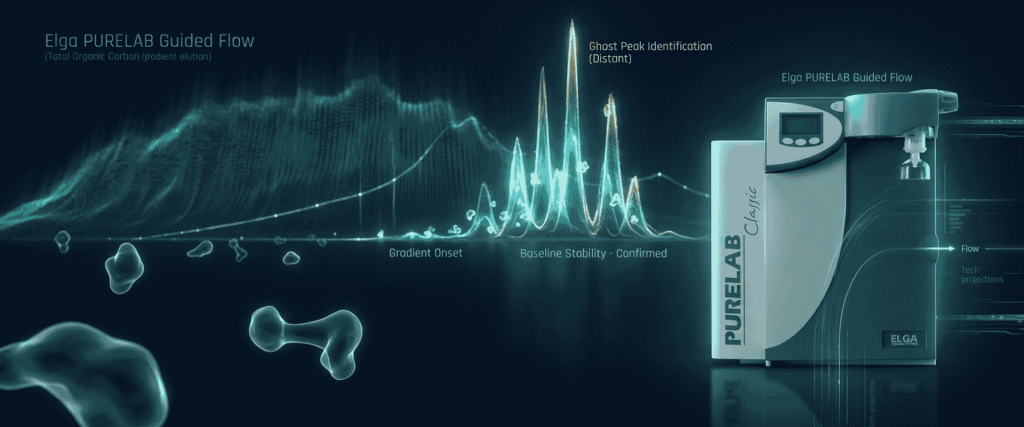
Gradient elution steps release these accumulated compounds as organic modifier concentrations increase, yielding distinct phantom peaks.
The 18.2 Megohm Fallacy
Resistivity readings of 18.2 MΩ·cm confirm the absence of ionized inorganic salts, including sodium, chloride, and heavy metals. Non-ionized organic molecules carry zero net electrical charge, allowing them to pass through resistivity measurement cells completely undetected.
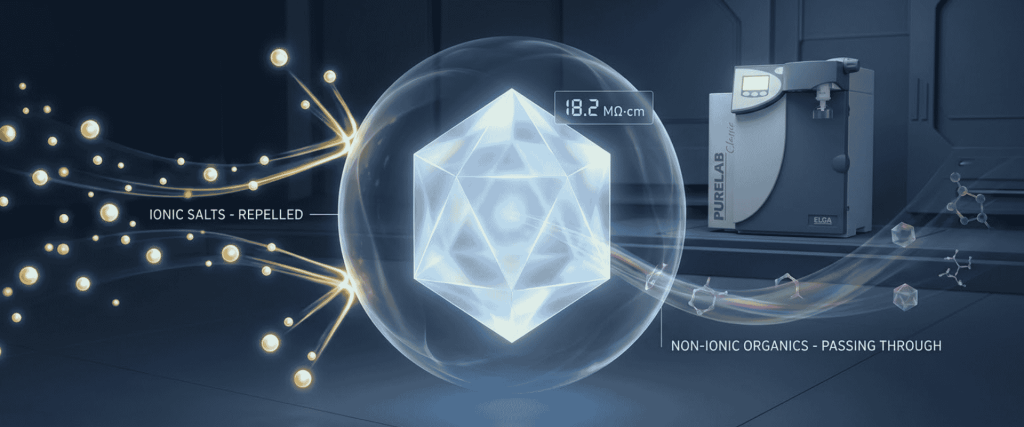
Water displaying maximum electrical resistance can harbor upwards of 50 to 100 ppb of TOC. Analytical chemists running low-wavelength UV detection (190 nm to 220 nm) or mass spectrometry (LC-MS) encounter severe spectral artifacts despite a clean display panel.
Symptoms of Organic Contamination in Chromatography
Chromatographers identify TOC contamination through distinct operational signatures:
- Gradient Ghost Peaks: Symmetrical or broad peaks appearing during blank runs without sample injection.
- Wandering Baselines: Continuous upward baseline drift during linear solvent transitions.
- Sensitivity Loss: Suppression of analyte ionization inside electrospray ionization (ESI) mass spectrometer sources.
- Column Fouling: Accelerated loss of column efficiency caused by irreversible adsorption on hydrophobic C18 ligands.
Mechanics of TOC Removal and Common Failure Points
The PURELAB Classic UV system uses dual-wavelength ultraviolet photo-oxidation paired with mixed-bed nuclear-grade deionization resin. Feedwater entering the system undergoes optical radiation before polishing cartridges bind charged fragments.
Photo-Oxidation Lamp Degradation
Dual-spectrum mercury discharge lamps emit two critical wavelengths: 254 nm and 185 nm. The 254 nm wavelength destroys microbial DNA, preventing cellular proliferation. The shorter 185 nm emission cleaves water molecules into active hydroxyl free radicals ($\cdot\text{OH}$), oxidizing complex organic chains into charged carboxylic acids and carbon dioxide ($CO_2$).
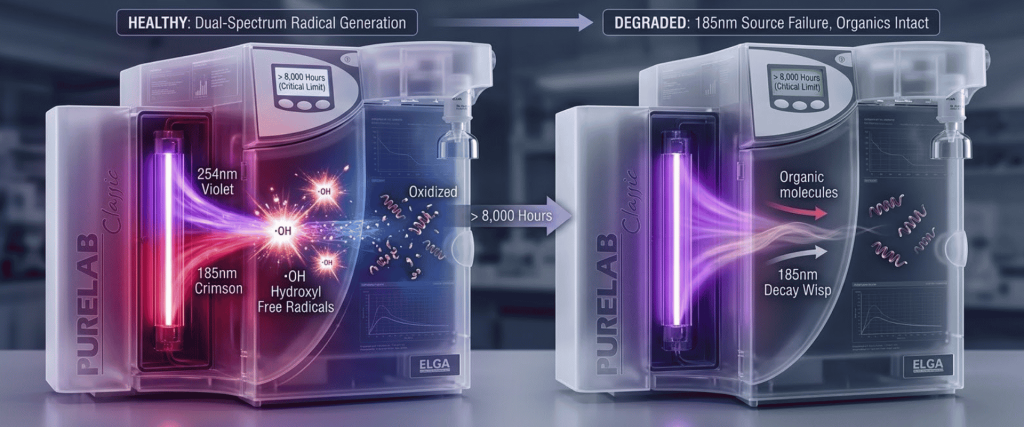
Radiation output at 185 nm decays much faster than 254 nm emission. Lamps past 8,000 to 10,000 hours of runtime illuminate with normal visible blue light while generating virtually zero hydroxyl radicals. Organic compounds travel through the chamber intact, bypassing downstream resin beds.
Synthetic Quartz Sleeve Solarization
Synthetic quartz sleeves enclose UV emitters, isolating electronic contacts from pressurized liquid streams. Mineral precipitation, dissolved iron, and photo-induced solarization gradually darken the quartz matrix.
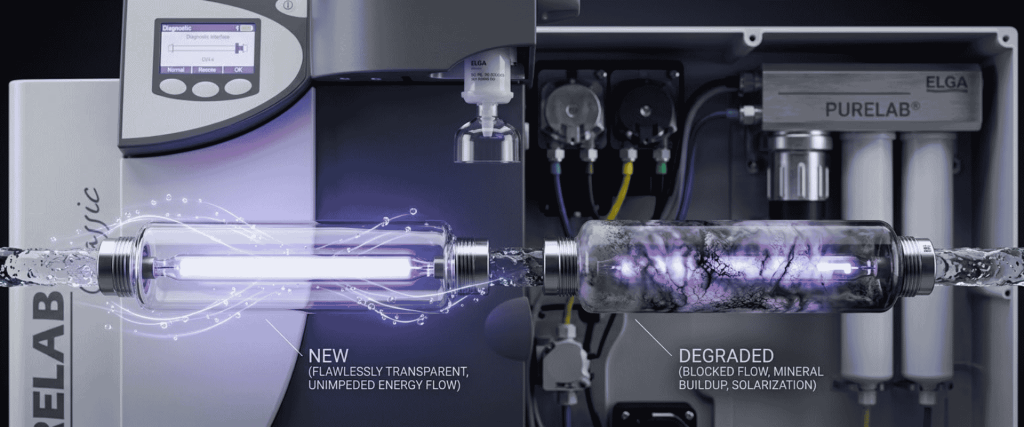
Optical transmittance declines, blocking shortwave radiation from reaching flowing feedwater.
Polishing Pack Resin Saturation
Ion-exchange resin beds hold finite binding capacities. Once positively charged and negatively charged exchange sites reach saturation, organic acids desorb back into the effluent stream.
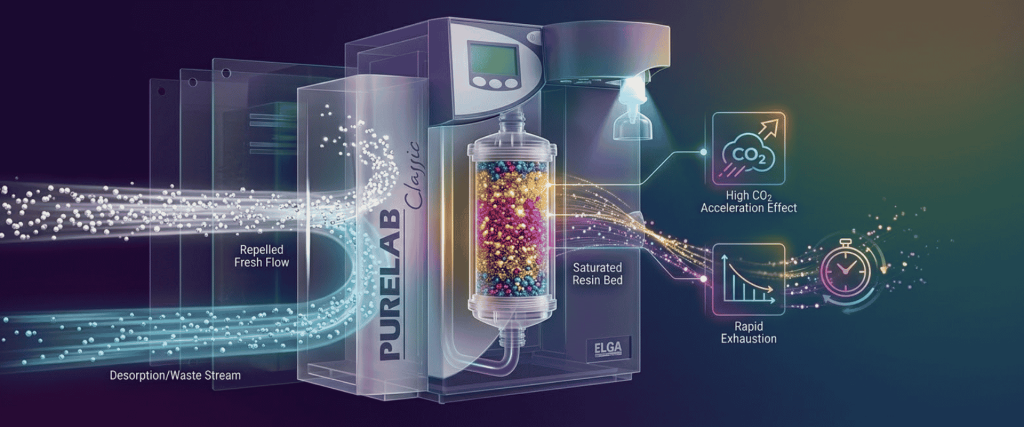
Laboratories processing feedwater with elevated carbon dioxide levels accelerate resin exhaustion, allowing trace organics to break through into dispense loops.
Diagnostic Procedures to Confirm Water-Borne TOC
Pinpointing the exact source of chromatographic interference requires isolating water purification units from instrument hardware, reagents, and collection glassware.
Gradient Blank Hold-Time Test
Analysts verify mobile phase water purity by executing comparative gradient blank runs on reverse-phase systems:
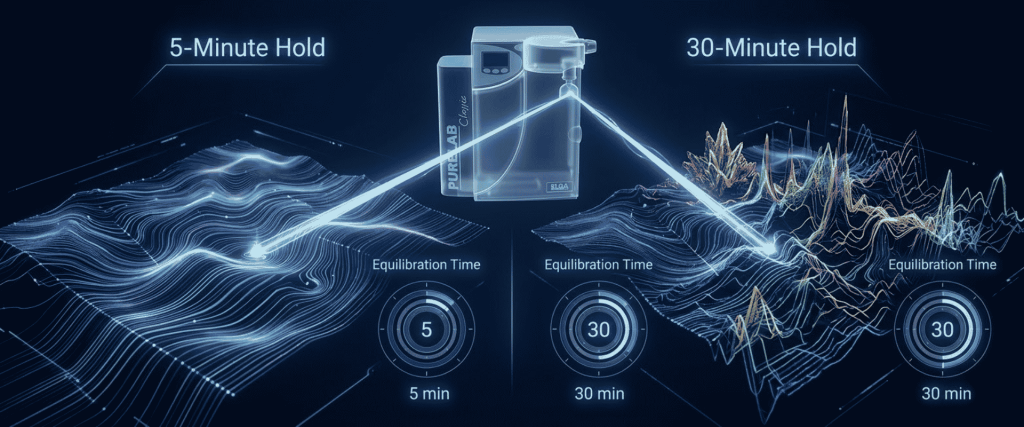
- Program an analytical method starting at 95% aqueous mobile phase and 5% organic modifier (HPLC-grade acetonitrile or methanol).
- Equilibrate the column under starting conditions for 5 minutes, then run a standard linear gradient to 95% organic modifier. Record the chromatogram.
- Re-equilibrate the same column under identical initial conditions for 30 minutes, allowing trace organics extra time to concentrate onto the column head.
- Run the identical linear gradient.
- Compare both chromatograms. Proportional increases in ghost peak heights confirm mobile phase water as the contamination source. Stable peak areas point instead to auto-sampler carryover or column bleed.
Feedwater Quality Verification
Polishing systems require properly conditioned feedwater complying with international purity baselines, such as ISO 3696 laboratory water specifications and ASTM D1193 standards.
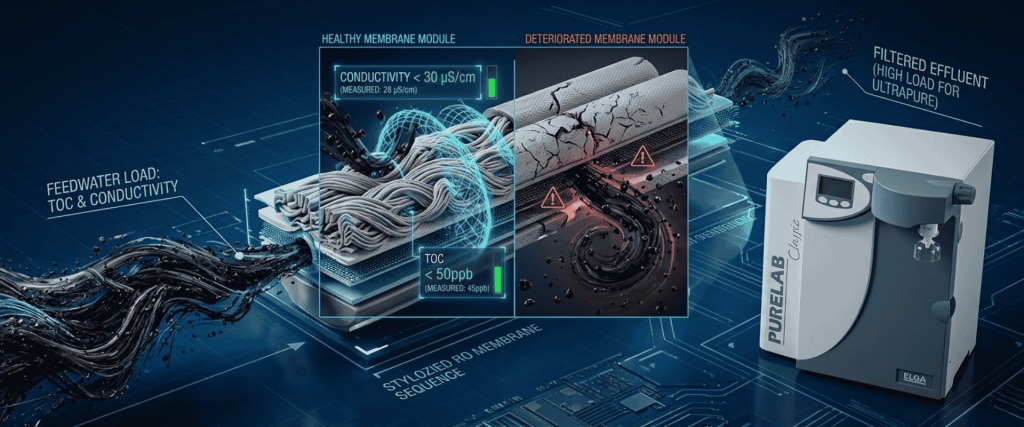
Reverse osmosis (RO) systems supplying PURELAB units must maintain conductivity below 30 µS/cm and total organic carbon under 50 ppb. Deteriorated RO membranes deliver heavy organic loads that overwhelm internal UV lamps within weeks.
Step-by-Step Restoration and Preventive Protocols
Restoring water purity requires structured mechanical remediation rather than simple power cycling. Complete the following maintenance sequence when TOC spikes occur.
Install New Dual-Spectrum UV Lamps
Disconnect main power supplies before opening internal chassis panels. Extract the spent UV lamp assembly and inspect quartz housing surfaces for physical hazing or mineral deposition.
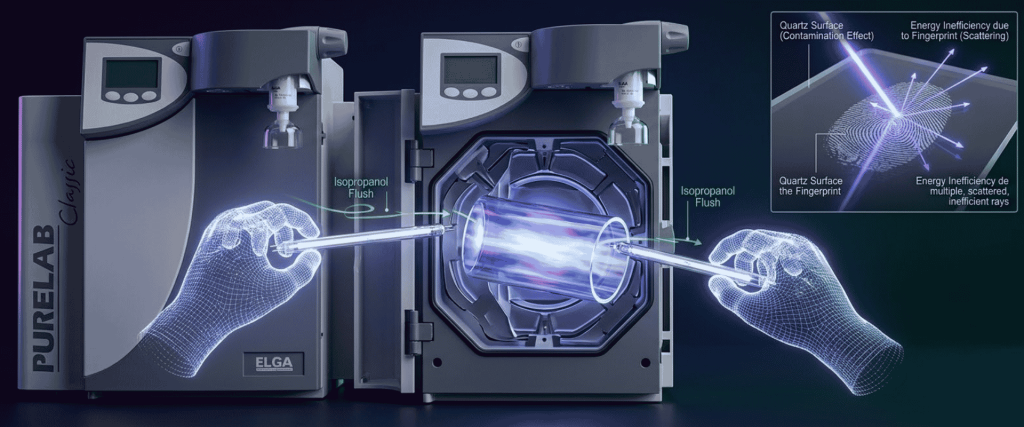
Wipe replacement lamps using lint-free optical wipes moistened with reagent-grade isopropanol. Fingerprint oils etch quartz surfaces during thermal cycling, reducing ultraviolet transmission efficiency.
Chemical Sanitization Protocol
Bacterial colonization within internal fluid lines forms persistent biofilms.
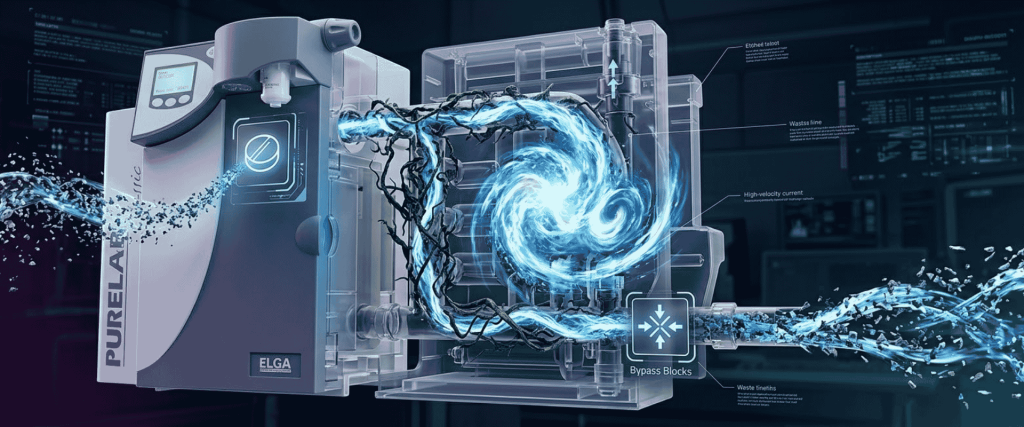
Microbial populations continually shed endotoxins, enzymes, and organic metabolic byproducts into recirculating water. Periodic chemical sanitization clears biological residues:
- Remove standard purification cartridges and insert designated sanitization bypass blocks.
- Introduce chlorine- or peroxide-based sanitization tablets into system ports following manufacturer protocols.
- Run internal circulation cycles to distribute sanitizing agents through valves, sensors, and dispense manifolds.
- Flush circuits thoroughly with fresh pre-purified water until conductivity stabilizes below baseline limits.
Replace Primary Polishing Cartridges
Install factory-sealed ion-exchange purification packs directly after sanitization flushes conclude. Pre-rinse newly installed cartridges by running system water to drain for 15 to 20 liters.
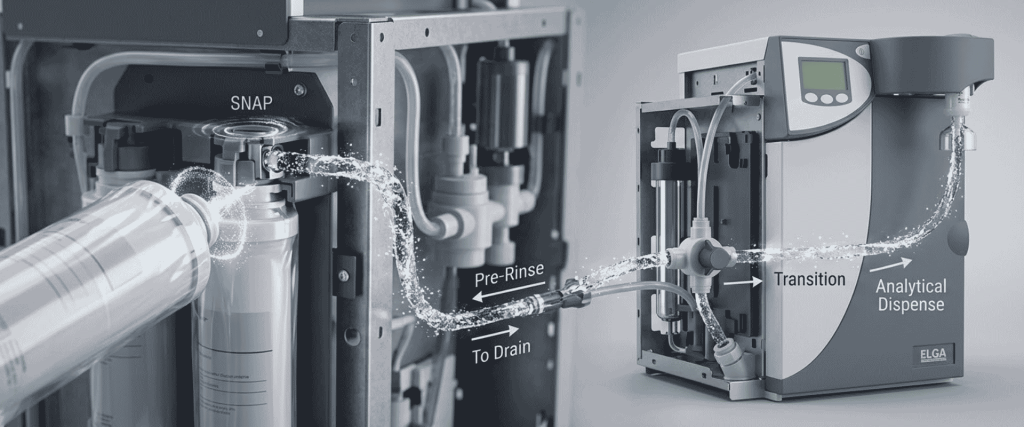
Initial rinsing washes out residual manufacturing fines and wetting agents before analytical dispensing begins.
Secure Point-of-Use Delivery Points
Point-of-use (POU) dispense assemblies represent frequent sources of secondary contamination. Airborne volatile organic compounds (VOCs), including common laboratory solvents like acetone, ethanol, and methylene chloride, readily dissolve into open dispense tips.
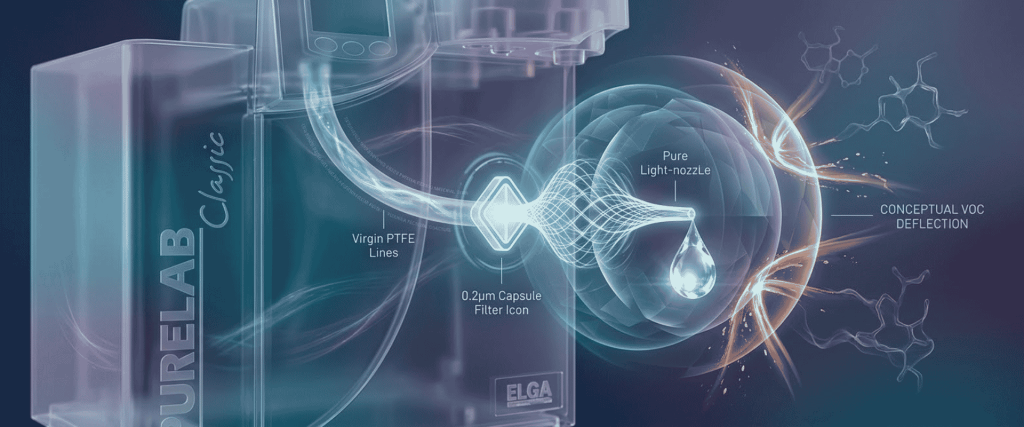
Fit clean 0.2 µm point-of-use filter capsules and replace flexible delivery tubing with virgin fluoropolymer (PTFE or PFA) lines.
Operational Thresholds and Maintenance Targets
Maintaining low TOC levels demands adherence to specific operational parameters, preventive maintenance cadences, and consumable thresholds.
| System Parameter | Operating Target | Contamination Indicator | Corrective Action |
| Resistivity | 18.2 MΩ·cm at 25°C | Reading drops below 18.0 MΩ·cm | Replace polishing purification pack |
| TOC Level | 1 to 3 ppb | HPLC baseline drift; ghost peaks | Replace UV lamp; sanitize fluid paths |
| Feedwater Conductivity | <30 µS/cm | Conductivity exceeds 50 µS/cm | Service upstream reverse osmosis system |
| Feedwater TOC | <50 ppb | Premature cartridge exhaustion | Inspect storage reservoir vent filters |
| UV Lamp Lifetime | <8,500 run hours | Front panel operational alerts | Install new 185/254 nm dual-spectrum bulb |
| Dispense Flow Rate | 1.5 to 2.0 L/min | Flow drops below 1.0 L/min | Replace point-of-use 0.2 µm capsule filter |
Conclusion
Securing reproducible chromatographic data requires absolute control over mobile phase solvent purity.
While resistivity monitors confirm inorganic salt removal, controlling total organic carbon demands active, verified photo-oxidation and proactive consumable management.
Laboratories experiencing ghost peaks, fluctuating baselines, or signal suppression can trace these anomalies to aged UV emitters, exhausted resin packs, or unmonitored storage contamination.
Systematic diagnostic tests, routine chemical sanitization, and scheduled replacements of dual-wavelength UV lamps safeguard HPLC instruments against silent organic breakthrough.
Sustained attention to water polishing infrastructure protects chromatographic columns, stabilizes detection baselines, and ensures regulatory compliance across all analytical workflows.
Frequently Asked Questions (FAQs)
1. Why does water show 18.2 MΩ·cm while HPLC baselines still drift?
Resistivity sensors measure only conductive inorganic ions. Non-ionic organic contaminants carry no charge, passing undetected through conductivity cells while absorbing UV light on HPLC detectors.
2. How frequently should PURELAB Classic UV lamps be replaced?
Lamps require annual replacement or renewal every 8,000 to 10,000 operational hours. Photo-oxidation efficiency at 185 nm decays well before the visible blue discharge light extinguishes.
3. Can carboy storage degrade Type I water purity?
Polyethylene and glass storage vessels leach plasticizers, oligomers, and silica into standing water within hours. Laboratories should always dispense Type I water directly into mobile phase glassware immediately prior to analysis.
4. What feedwater quality ensures optimal consumable longevity?
Feedwater should come from reverse osmosis, deionization, or distillation systems providing conductivity under 30 µS/cm, total organic carbon under 50 ppb, and operating pressure between 0.07 and 0.7 bar.