
Dry core-shell nanoparticles offer distinct shipping, storage, and shelf-life advantages over pre-diluted colloidal suspensions.
When working with polystyrene-coated silica (SiO₂@PS) powders ranging from 20 nm to 1000 nm, transitioning from dry state to stable liquid suspension introduces significant processing challenges.
Researchers and formulation engineers frequently encounter irreversible clumping, persistent agglomerate networks, and elevated polydispersity indices (PDI).
Resolving these issues demands an understanding of surface energetics, solvent polarity matching, and acoustic energy dissipation.
Implementing controlled redispersion protocols ensures consistent hydrodynamic diameters and preserves the structural integrity of the polymer shell.
Capillary bridging represents the primary force binding dry nanoparticles during manufacturing desiccation. Removal of residual moisture or processing carrier fluids forces adjacent polymer shells into intimate contact. Nanoscale surface roughness recedes under negative capillary pressure, allowing short-range van der Waals attractions to dominate.
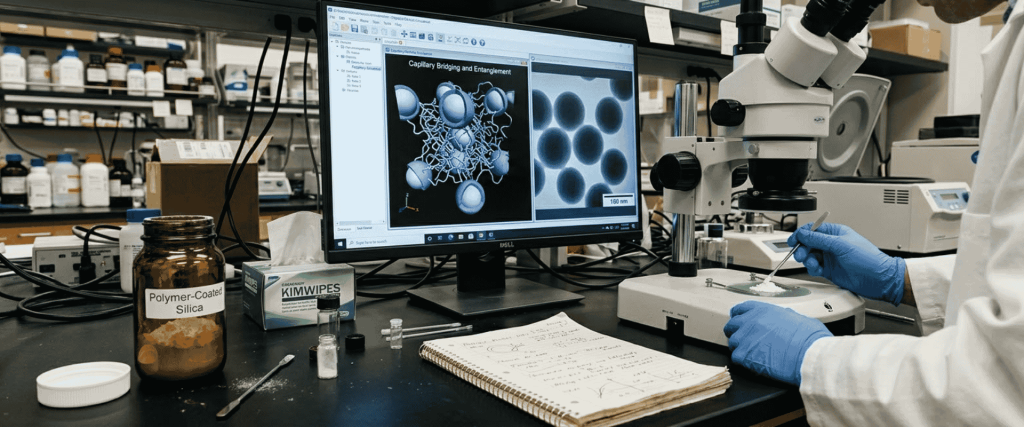
Polystyrene chains grafted or deposited onto rigid silica cores introduce steric entanglement. When dry powder rests in storage, ambient thermal fluctuations promote inter-chain interpenetration between adjoining particles. This cohesive network transforms free-flowing powders into dense aggregate clusters that resist conventional mechanical shaking.
Hydrophobic polystyrene surfaces display low critical surface tension. Exposing dry SiO₂@PS powder directly to high-polarity liquid media leads to dewetting phenomena.
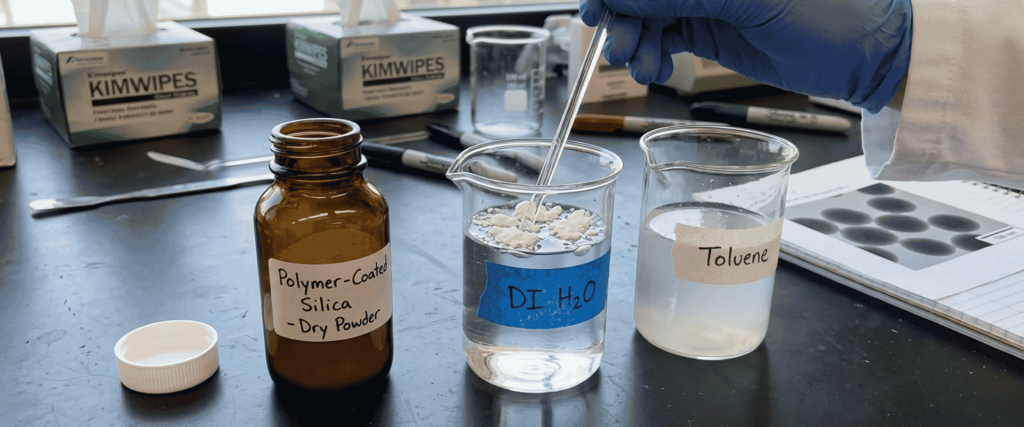
Rather than dispersing, the particles aggregate to minimize unfavorable interfacial contact with the surrounding liquid, trapping micro-air pockets within the agglomerate matrix.
Successful liquid reconstitution requires thermodynamic compatibility between the liquid carrier and the outer polystyrene shell. Solvents must actively solvate the polymer chains, promoting steric swelling rather than phase exclusion.

Engineers rely on Hansen Solubility Parameters (HSP) to predict dispersion efficiency. Polystyrene features a total solubility parameter ($\delta$) near $18.5 \text{ MPa}^{1/2}$, characterized by high dispersion forces ($\delta_d$), moderate polar interactions ($\delta_p$), and minimal hydrogen bonding ($\delta_h$).
Mechanical agitators lack the localized shear required to rupture sub-micron aggregate clusters. Acoustic cavitation, generated by ultrasonic energy, provides the primary shear mechanism to dismantle dry particle clumps.
Transient cavitation microjets generate localized shock waves and high-velocity liquid streams that impact agglomerate surfaces. These physical forces overcome inter-particle cohesion without fracturing the dense silica core.
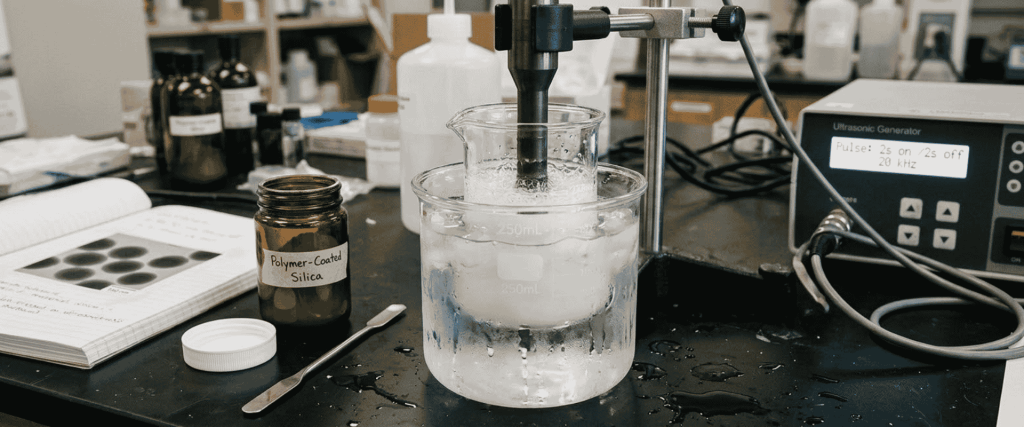
Excessive acoustic power introduces secondary failures. Localized hot spots generated during bubble collapse exceed several thousand degrees Kelvin at microscopic scales. Unchecked heat generation softens or shears the polystyrene shell, stripping the organic layer from the silica substrate and triggering irreversible re-agglomeration.
Execution of a disciplined four-stage protocol guarantees monodisperse suspensions across research and production batches.
Direct addition of dry powder to large liquid volumes produces floating aggregate rafts. Weigh the required powder aliquot into a clean borosilicate vessel.
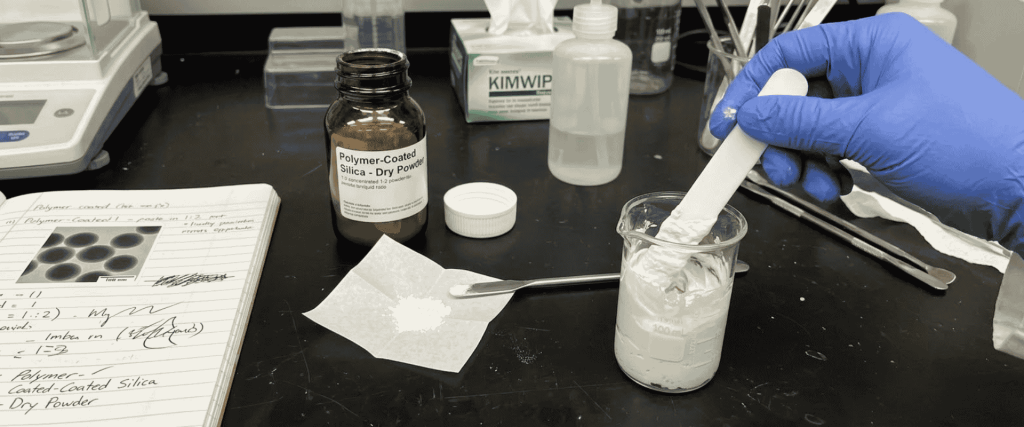
Add a minimal volume of target solvent, typically a 1:2 powder-to-liquid weight ratio, to generate a high-solids paste. Stir gently with a PTFE spatula until all dry pockets disappear.
Allow the paste to equilibrate for 10 to 15 minutes.
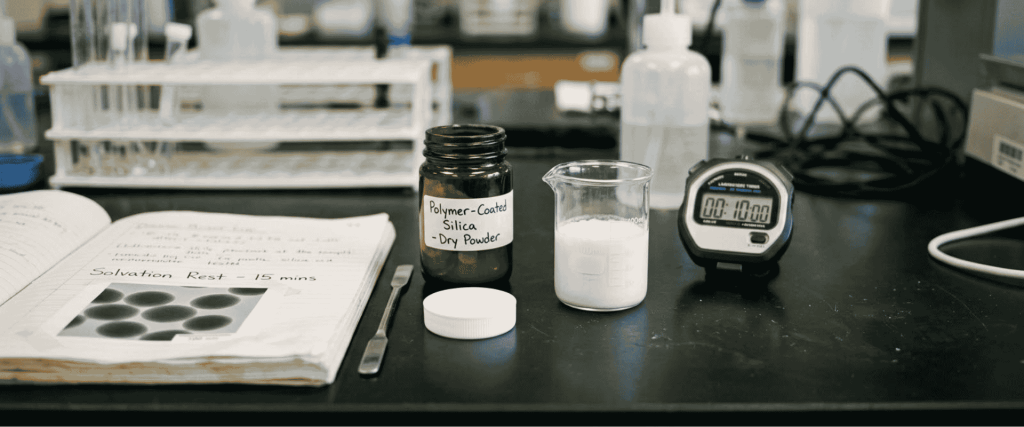
This resting stage permits solvent molecules to diffuse into the dense polystyrene shell, relaxing entangled polymer chains and loosening inter-particle junctions prior to mechanical agitation.
Dilute the paste to the final operational concentration, ideally below 1.0 wt% to prevent particle-particle collisions during processing.
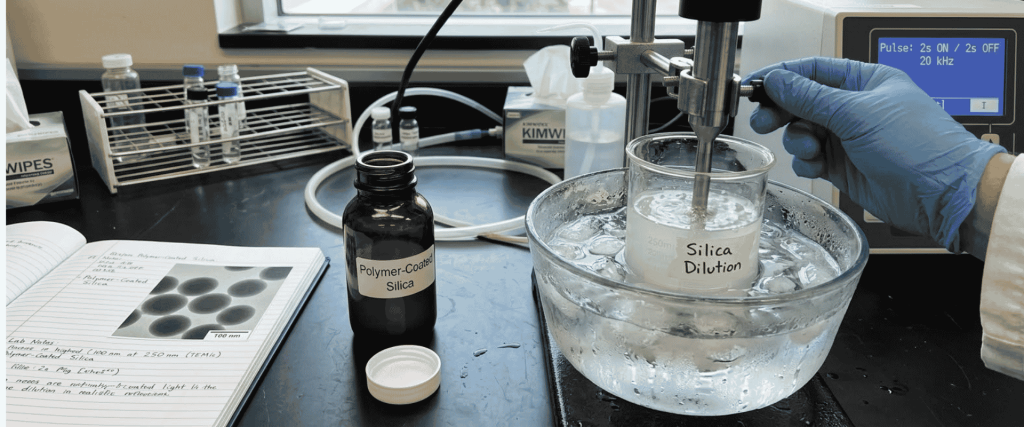
Submerge the vessel in an active ice bath. Position a titanium ultrasonic probe tip at one-third depth from the vessel floor. Execute a pulsed cycle (e.g., 2 seconds active pulse, 2 seconds rest) at 20 kHz to dissipate thermal buildup while maintaining continuous cavitation.
Minor fractions of stubborn, microscale aggregates may persist. Subject the processed suspension to low-speed centrifugation (1,000 to 1,500 RCF for 5 minutes).
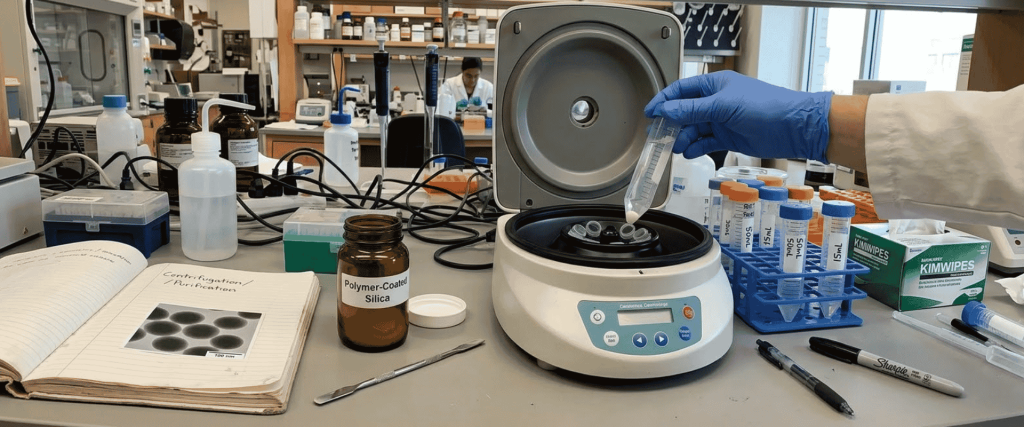
Decant the supernatant containing monodisperse core-shell particles, leaving sedimented micro-clumps behind for quantitative quality control.
Operational parameters must shift according to particle diameter to balance cluster breakup against mechanical degradation:
| Particle Size Regime | Primary Solvent Recommendation | Dispersion Method | Target Energy Density | Thermal Management Protocol |
| 20 nm – 80 nm | Toluene / THF blend | Ultrasonic Horn (Probe) | $120\text{–}150\text{ J/mL}$ | Active Ice Bath ($< 15^\circ\text{C}$), Pulsed Mode (2s on / 2s off) |
| 100 nm – 300 nm | MEK or Chloroform | High-Intensity Bath / Probe | $80\text{–}100\text{ J/mL}$ | External Water Chiller ($< 20^\circ\text{C}$), 50% Duty Cycle |
| 500 nm – 1000 nm | Toluene or Styrene Monomer | High-Shear Bath Sonication | $40\text{–}60\text{ J/mL}$ | Passive Ambient Cooling ($< 25^\circ\text{C}$), Continuous Flow |
Visual clarity alone does not confirm true deagglomeration. Sub-micron clusters often remain suspended while generating significant measurement errors in downstream applications.
Eliminating redispersion clumping in dry polystyrene-coated silica nanopowders relies on controlled processing rather than brute mechanical force. Selecting solvents aligned with polystyrene solubility parameters relaxes inter-particle chain entanglement.
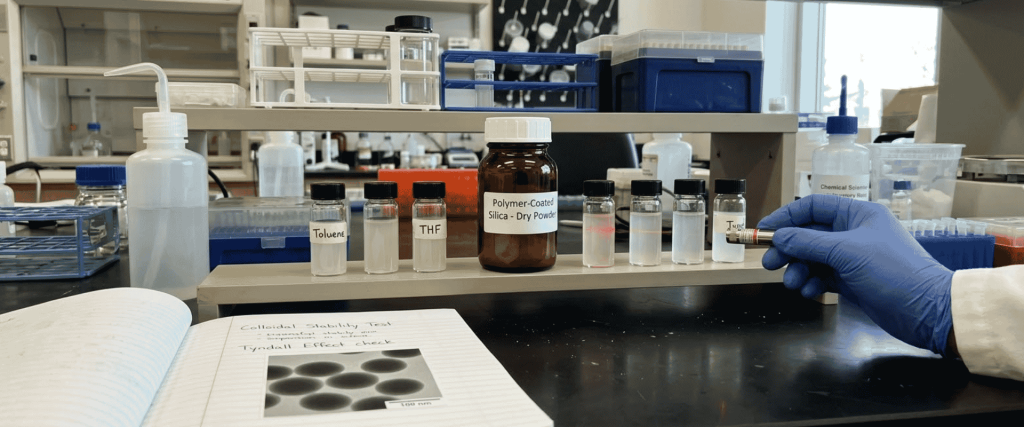
Applying pulsed ultrasonic cavitation within chilled environments prevents thermal shell degradation while cleaving aggregate structures. Adhering to structured pre-wetting workflows guarantees stable, monodisperse colloidal suspensions ready for precision nanocomposites, diagnostic assays, and thin-film coatings.
Successfully redispersing dry polystyrene-coated silica nanopowders requires solvent selection matched to polymer solubility parameters to loosen particle entanglement.
Combining staged pre-wetting with pulsed ultrasonic cavitation dismantles aggregate clusters, while active cooling prevents thermal damage to the shell.
Verifying the reconstituted suspension through dynamic light scattering ensures true monodispersity and keeps the polydispersity index strictly below 0.10.
Following this disciplined protocol guarantees stable colloidal suspensions that deliver consistent, high-yield results across sensitive nanocomposites and precision optical coatings.
Capillary pressure during drying creates tight physical contact between adjacent particles. Storage allows ambient thermal energy to cause chain entanglement between adjacent polystyrene coatings, turning free powder into bonded clusters.
Standard benchtop ultrasonic baths lack the focused acoustic energy density required to break sub-50nm aggregate networks. Processing small particles requires focused ultrasonic probe horns or high-power industrial cup horns with active temperature monitoring.
Aromatic and cyclic ether solvents like toluene, tetrahydrofuran, and methyl ethyl ketone deliver optimal stability. These media effectively solvate the polystyrene shell, establishing strong steric barriers that prevent particle agglomeration.
Uncontrolled sonication produces intense localized heat that exceeds the glass transition temperature of polystyrene. This thermal buildup causes polymer flow, shell degradation, and carbonization, which permanently strips the silica core and accelerates aggregate formation.

Enter your details below to save your shopping cart for later. And, who knows, maybe we will even send you a sweet discount code :)
Allow notifications to get real-time updates about your shopping cart and who knows, you may even receive a sweet discount code 😊