Description
Cleanroom Fogger Performance Comparisons
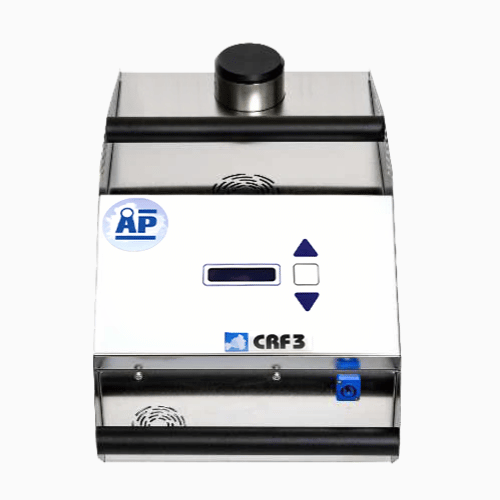
The CRF3 Cleanroom Fogger is a low-cost, ultrasonic fogger using 25 high-performance, piezo devices to create 0.89 cubic meters per minute of pure fog with a fog density of 133.57 ml fog per minute for a typical 70-minute operation. This provides about 10 feet of visual fog for smoke studies and air flow characterization in cleanrooms, BSCs, Barrier Isolators, glove boxes, fume hoods and bio-safety cabinets. The CRF3 is compatible with USP 797 Pharmaceutical In-situ Airflow Analysis; USP 800 Compound Pharmacy airflow tests; Airflow Recovery Tests in ISO 14644-3 Annex B12; Airflow Visualization Tests for ISO 14644-3 Annex B7; NSF 49 for Bio-Safety Cabinets; and Semi-Standards Clean Room Guidelines, Federal Standard 209E.
CRF3 Cleanroom Fogger produces ≈ 0.89 cubic meters of fog/minute, ≈ 123 ml fog density/minute, ≈ 70 minutes of operation, ≈ 10 feet visual fog distance, 1 80mm fog output.
The CRF3 Cleanroom Fogger is typically used in fume hoods and airflow hoods to generate 0.26 cubic meters of pure fog per minute to visualize airflow patterns and turbulence in smoke tests of ISO suites and semiconductor clean rooms. USP 797 In-situ Airflow Analysis and ISO 14644-3, B7 guidelines support smoke studies. Airflow Recovery tests using PSL spheres and the CRF3 Cleanroom Fogger are guided by ISO 14644-3, B-12. The CRF3 would typically be used in medium-sized airflow areas, such as fume hoods, airflow hoods and small glove boxes using ISO 14644-3 Annex B7 or USP 797 in smoke studies.
Cleanroom Fogger, CRF3 Features
- 25 transducers converting DI Water or WFI water directly to 0.89 cubic meters of pure fog for about 70 minutes
- Quick refill of DI water or WFI water for continuous fog use
- Easy to fill 9.5 liters of DI water, sterile water, or WFI water
- Hold Handle provides easy carry of the tool
- Stainless steel enclosure is particulate-free, no fingerprints, sturdy design
- Fog Curtain Wand, optional, plugs into the end of Fog Hose to create a wide fog wall, while reducing the fog velocity and maintaining a constant fog output
- 80mm fog hose, 5 meters in length
- Fog Tube, internal power supply (120VAC, 100VAC or 220VAC compatible) and 10 foot power cable provided
- Easy to use, quick operation, set up, instant On/Off fogging operation
- Rolling Carry Case, optional, for carry and storage of Cleanroom Fogger
- Remote Control Key FOB with an ON/OFF switch to operate the fogger behind closed walls or in a barrier isolator
- PDF Manual – instructions and applications
In 2001, cleanroom foggers were developed and since then, Applied Physics has supported smoke studies and smoke tests using a variety of cleanroom foggers. You can review the cleanroom fogger performance for your smoke study. Our CRF3 portable fogger is low-cost, using ultrasonic piezo devices to visualize airflow and turbulence in fume hoods, airflow hoods, glove boxes, etc. The CRF3 is our newest, low-cost smoke machine due to its portability and adjustable fog output. Fog volume is a primary requirement for a customer when purchasing a smoke machine. Fog density is adjustable, as well as fog velocity, controlled on the CRF3 control panel. The CRF3 clean room fogger uses 9.5 liters of purified water with 25 piezo devices to produce a pure fog that can be used in cleanrooms, BSCs and Barrier Isolators to visualize airflow and air balance. 123 ml of water per minute can be converted into fog to produce a very good fog density. Up to 0.89 cubic meters of fog per minute can be produced for smoke studies during a typical 70 minutes of operation.
The Cleanroom Fogger is a low-cost device and is typically used in fume hoods, airflow ducts and similar small areas. The Cleanroom Fogger uses sterile water, de-ionized water, or WFI water to produce a pure fog to visually describe airflow movement, imbalance and areas with poor air movement in semiconductor clean rooms, pharmaceutical ISO suites, bio-safety cabinets, compound pharmacies,s and medical rooms. This low-cost, CRF3 fogger is used in Pharmaceutical fume hoods, flow hoods, glove boxes and similar small areas. The Cleanroom Fogger uses DI water, Sterile water, or WFI water to produce a pure fog to visually describe airflow movement, imbalance and areas with poor air movement in semiconductor cleanrooms, pharmaceutical ISO suites, bio-safety cabinets, compound pharmacies and medical rooms.
This low-cost, CRF3 clean room fogger is used in Pharmaceutical fume hoods, flow hoods, glove boxes and similar small areas. The CRF3 is used in smoke studies and often referred to as a smoke generator or smoke machine used to model airflow movement and visualize airflow patterns and turbulence in fume hoods, airflow hoods, glove boxes, etc. used in ISO 3, ISO 5, ISO 7 and ISO 9 suites. The CRF3 provides instant on and instant off operation, plus adjustable fog volume and adjustable fog velocity, perfect to tune the fog output to your smoke study requirements.
Smoke Studies in Cleanrooms, ISO Suites, Bio Safety Cabinets, Sterile Rooms
- Supports 100:1 Airflow Recovery Test, as defined in ISO 14644-3, B12
- Supports airflow visualization tests supporting ISO 14644-3, B7
- Supports airflow visualization analysis, USP 797 Guidelines
- Supports airflow tests, NSF 49 National Safety Foundation
- Supports airflow visualization, USP 800 Hazardous Drug Compounding
- Supports Semiconductor Semi-Standards Guidelines
- Air flow and pressure balance between two clean areas
- Leak detection of exhaust ducts
- BSC (Bio Safety Cabinets), Barrier Isolator and laminar flow tests
- Wet bench exhaust tests
- Air Balance tests between walk areas and clean rooms
- Chemical process equipment, exhaust ventilation tests
Compare Cleanroom Fogger (Details)
| Product Model | CRF6 Portable Cleanroom Fogger | CRF3 Cleanroom Fogger | 2001 LN2 Fogger |
| FOG Minutes | ~ 35 minutes through two 80mm fog outlets | ~ 70 minutes through one 80mm fog outlet | ~ 20-40 minutes through one 60mm fog outlet |
| FOG Volume Meters/Min. | ~ 2.0 cubic meters/minute | ~ 0.89 cubic meters/minute | ~ 0.8 to 1.5 cubic meters/minute |
| Total FOG Volume | ~ 64.25 cubic meters | ~ 40 cubic meters | ~ 16 to 50 cubic meters |
| Fog Density (ml/minute) | ~ 213.7 mL/minute | ~ 133.57 mL/minute | ~ 150ml to 260 mL/minute |
| Visual Fog Distance | ~ 15 feet using Dual Fog Hose output | ~ 10 feet | ~ 10 feet |
| Adjustable Fog Volume | Yes, through the touch pad and wireless remote control | Yes, through the touch pad and wireless remote control | No fog volume control |
| Adjustable Airflow Velocity | Yes, through the touch pad and wireless remote control | Yes, through the touch pad and wireless remote control | No airflow control |
| Fogger Technology | Ultrasonic with DI, WFI, or Sterile Water | Ultrasonic with DI, WFI, or Sterile Water | LN2 and DI Water fog production |
| Liquids Used | DI (De-Ionized) Water, WFI, or Sterile water | DI Water, WFI, or Sterile water | LN2 + DI Water |
| Typical Use | Cleanroom, BSC, Barrier Isolator, ISO Suite | Clean room, sterile room, ISO suite, Fume Hood, Airflow hood | Clean room, sterile room, ISO suite |
| Compatible Guidelines | USP 797 | USP 797 | USP 797 |
| Compatible Guidelines | ISO 14644-3, Annex B7 | ISO 14644-3, Annex B7 | ISO 14644-3, Annex B7 |
| Compatible Guidelines | Federal Standards 209E | Federal Standards 209E | Federal Standards 209E |
| Compatible Guidelines | ISO Standard 14644-1, 14644-2 | ISO Standard 14644-1, 14644-2 | ISO Standard 14644-1, 14644-2 |
| DI / WFI Water Volume | 9.0 liters | 9.5 liters | 2 liters |
| LN2 Volume | No LN2 used | No LN2 used | 9 liters |
| Operator Control | Touch pad control of fog volume & airflow | Touch pad control of fog volume & airflow | Power Switch, no fog controls |
| Remote Control | Wireless Remote control of fog volume and velocity | Wireless Remote control of fog volume and velocity | No Wireless Remote Control of fog |
| Handling | Carry Handle (top and front) | Carry Handle (top and front) | Carry Handle |
| Enclosure | 316L Stainless Steel, electro-polish | 316L Stainless Steel, electro-polish | Stainless Steel |
| Power VAC | 120, 220, 100 VAC | 120, 220, 100 VAC | 120, 220, 100 VAC |
| Full Weight w/ Water | ~ 65 lbs | ~ 55 lbs | ~ 85 lbs |
| Accessories | 1-12 Accessories | 1-12 Accessories | 3 Accessories |
SMOKE STUDY INFORMATION The CRF3 smoke machine is used in smoke studies as a smoke generator. It is a low-cost device providing excellent volumes of fog in smoke studies. It provides a lower weight using a stainless steel enclosure. Operation instructions are stored as a PDF file, so there are no paper manuals used in the pharmaceutical ISO 9 suites, laboratory, or clean room. Theory of Operation: Ultrasonic cavitation and DI water or Pharmaceutical WFI Water. Use of any other liquids or chemicals voids the warranty. The transducer’s life is ~3,000 hours. To protect the transducers from damage, there is a level sensor that will interrupt the input voltage to the transducer module should the water level drop to a low level. This ensures long life and reliability. Notes:
- The fog generated by this device contains microscopic droplets of DI water. AVOID USING IN IMMEDIATE VICINITY OF ELECTRICAL APPLIANCES, WATER SENSITIVE PRODUCTS AND EQUIPMENT.
- The fan will operate with no water in the reservoir with the power switch in the ON position. This will aid in drying when the chamber is drained.
- Drain Water using the optional Drain pump. Dry the water cavity using the internal fan or optional Air Dry tool.
- The CRF3 is intended to be used on a flat surface, on its feet. Tipping the fogger with water in the reservoir will damage the fogger. DO NOT OVERFILL OR TIP THE FOGGER.
Which Cleanroom Fogger or Smoke Generator Is Best For Smoke Studies?
* Use Hand Gloves and Face Shield when filling LN2. Use 16 Megohm DI water or WFI Pharmaceutical Water |
16 Meg ohm De-Ionized water, WFI water, or Sterile water. Do not permit DI Water to go stagnant in the water chamber.** Use gloves when handling CO2 ice |
Fogger Technology
The three types of foggers manufactured for use in cleanrooms, Iso suites and sterile rooms are described below.
Ultrapure LN2 Fogger: LN2 foggers use liquid nitrogen and DI Water or WFI water, providing the highest fog volume, highest fog density and best level of fog purifying. Fog purity is allowing the LN2 to boil while heating the water. Nitrogen and water molecules form and combine at high rates to create a fog vapor. This process removes any bacterial agents and residual particulate matter from the water vapor. The volume of fog produced depends on the version of the LN2 fogger purchased. The AP35 Ultrapure Fogger converts 571 ml of water per minute, a high fog density, which generates 5 cubic meters of fog for about 70 minutes to visualize airflow for 20-30 feet. The AP100 LN2 Fogger converts 1520 ml of water per minute, a very high fog density, to produce 15.5 cubic meters of ultrapure fog for about 70 minutes, visualizing air flow for about 30-40 feet using 4 fog outputs. The fog is ultrapur,e leaving minimal, if any, trace particles behind. It evaporates to its gaseous hydrogen, oxygen and nitrogen components, which are natural to the cleanroom environment. LN2 foggers are used in Class 1 – 10,000 cleanrooms.
DI Water Fogger: This type of fogger has less fog density (less capability to visualize airflow) than the LN2 ultrapure foggers described above. But a DI Water Fogger has more fog density than the CO2 fogger described below. The DI water fog is generated by cavitation in water, producing a water vapor of 8-10 microns in diameter. If the facility manager operates a class 10 to Class 10000 Clean room, the use of a DI Water Fogger poses no problem. However, Cleanroom Engineers who manage facilities operating at Class 1 to Class 10 performance may desire to use an ultrapure fogger. Although some DI Water foggers are described as ultrapure, unless the DI water is heated or boiled to remove bacterial agents, the fog is not ultrapure. The 2-3 lb output pressure of a DI water fogger may also distort the airflow patterns. The temperature output is typically less than the surrounding room temperature, thus a fog generated from an ultrasonic fogger will sink momentarily in a typical 70-degree room temperature.
CO2 Fogger: This type of CO2 Smoke Generator produces an excellent volume of fog during the first minute, then begins to lose fog volume and fog density as the CO2 ice evaporates. The CO2 fogger is used for low-volume, non-process critical applications such as bench airflow testing. The fog is created using CO2 ice as the fogging agent. The fog contains elements of CO2 and the user must determine if the residual CO2 components are acceptable in a process environment operatingin Class 100 to Class 10,000. The 2-3 lb output pressure of a CO2 fogger also distorts the airflow patterns, thus adding to the turbulence. The output starts at about 3cfm and slowly decreases to 0 CFM in about 10 – 12 minutes.
Mid-range ultrasonic fog for cleanrooms and barrier-enclosure studies
CRF3 sits between the compact CRF2 and the high-output CRF6. It is the mid-range current CRF option for applications that need more delivery flexibility without automatically moving to the largest ultrasonic platform.
Barrier enclosures
Useful when the study needs controlled fog delivery into a glove box, RABS or similar enclosure.
Cleanroom studies
Mid-range option for localized-to-moderate airflow visualization and smoke-study work.
Delivery flexibility
Select hoses, wands and adapters around the injection geometry and required video view.
Hose length, diameter, bends, Y/T adapters, a restrictive injection port and enclosure pressure can all reduce or redistribute the fog that actually reaches the test area. For isolators and RABS, evaluate the intended delivery path under representative pressure conditions.
Quote with the application
Include enclosure type, approximate dimensions, port/hose arrangement, pressure relationship and required visible path.
Confirm the configuration
Use the current product sheet and the selected quote item as the final specification source for model-specific quantitative performance.
Use the product’s existing Request a Quote or Add To Order control so this model remains attached to the RFQ sent through the existing workflow.
Questions engineers and validation teams ask
Where does the CRF3 fit in the current cleanroom fogger family?
CRF3 is the mid-range ultrasonic option between the compact CRF2 and the confirmed high-output CRF6. It is useful when the application needs more fog-delivery flexibility than a compact local study.
Should CRF3 be selected from room volume alone?
No. Enclosure pressure, hose length, bends, adapters, injection-port size and the visible path required on camera can materially change delivered fog.
Does CRF3 use liquid nitrogen?
No. CRF3 is ultrasonic. For LN₂-based ultrapure fog generation, compare the Applied Physics AP Series.