Description
Dri-Cal Particle Size Standards
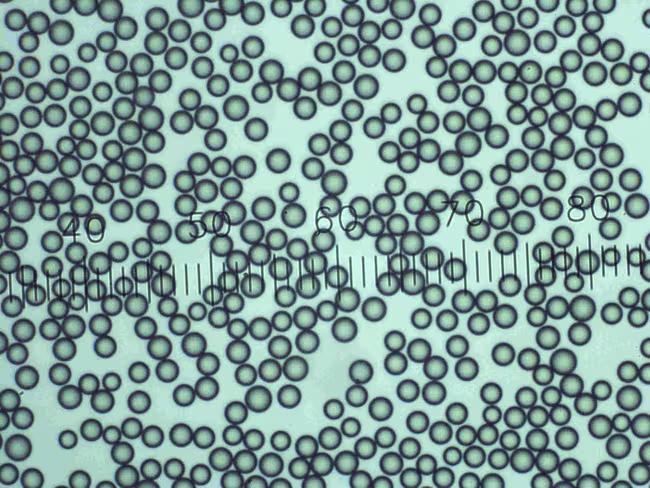
Dri-Cal Particle Size Standards are ready-to-disperse, dry spherical polymer beads with linear dimensions calibrated against National Institute of Standards and Technology (NIST) Standard Reference Materials.
Unlike conventional polystyrene standards supplied in aqueous suspension, Dri-Cal standards are designed for analytical systems that require dry particles, including dry-dispersion laser diffraction instruments, dry-aerosol spectrometers, and moisture-sensitive processes.
Each standard is supplied in a dry-dispensing squeeze bottle. Gently squeezing the bottle delivers a controlled stream of microspheres directly into an instrument’s dispersion chamber or sampling cell. This reduces the need for precision weighing and helps limit static cling, spills, and contamination.
The microspheres are made from polystyrene polymer with a refractive index of n=1.59 and a density of 1.05 g/cm3. Each bottle includes a Certificate of Calibration and Traceability stating the certified mean diameter, size distribution, and measurement uncertainty.
Key features
- NIST traceability: Particle diameters are calibrated against NIST Standard Reference Materials for documented transfer metrology and quality audits.
- Direct dry dispensing: The squeeze-bottle design enables controlled delivery into dry-dispersion nozzles and test chambers without weighing or liquid sample preparation.
- No suspending medium: Eliminates solvent evaporation, drying rings, surfactant residues, and suspension-related agglomeration effects.
- Narrow size distribution: Typical coefficients of variation range from below 3% to below 5%, producing distinct calibration peaks for channel thresholds and detector verification.
- Broad instrument compatibility: Suitable for dry-powder laser diffraction systems, time-of-flight particle sizers, aerosol instruments, and optical microscopy stages.
Specifications
| Parameter | Specification |
|---|---|
| Particle material | Polystyrene polymer microspheres |
| Available nominal diameters | 2, 3, 5, 6, 7, 8, 10, 15, 20, 25, 30, 50, and 100 µm |
| Physical form | Dry spherical polymer powder |
| Particle density | 1.05 g/cm3 |
| Refractive index | 1.59 at 589 nm, 25∘C |
| Packaging | 1-gram dry-dispensing dropper/squeeze bottle |
| Calibration methods | Optical microscopy, transmission electron microscopy (TEM), and scanning electron microscopy (SEM) |
| Traceability | Calibrated against NIST Standard Reference Materials |
| Storage temperature | 15∘C to 30∘C |
| Storage condition | Keep the bottle tightly sealed in a clean, dry area |
Part numbers and variants
| Part number | Nominal diameter | Certified distribution | Form | Package quantity |
|---|---|---|---|---|
| DC-02 | 2 µm | Monodisperse, CV<5% | Dry beads | 1-gram dispenser bottle |
| DC-03 | 3 µm | Monodisperse, CV<4% | Dry beads | 1-gram dispenser bottle |
| DC-05 | 5 µm | Monodisperse, CV<3% | Dry beads | 1-gram dispenser bottle |
| DC-06 | 6 µm | Monodisperse, CV<3% | Dry beads | 1-gram dispenser bottle |
| DC-07 | 7 µm | Monodisperse, CV<3% | Dry beads | 1-gram dispenser bottle |
| DC-08 | 8 µm | Monodisperse, CV<3% | Dry beads | 1-gram dispenser bottle |
| DC-10 | 10 µm | Monodisperse, CV<3% | Dry beads | 1-gram dispenser bottle |
| DC-15 | 15 µm | Monodisperse, CV<3% | Dry beads | 1-gram dispenser bottle |
| DC-20 | 20 µm | Monodisperse, CV<3% | Dry beads | 1-gram dispenser bottle |
| DC-25 | 25 µm | Monodisperse, CV<3% | Dry beads | 1-gram dispenser bottle |
| DC-30 | 30 µm | Monodisperse, CV<3% | Dry beads | 1-gram dispenser bottle |
| DC-50 | 50 µm | Monodisperse, CV<3% | Dry beads | 1-gram dispenser bottle |
| DC-100 | 100 µm | Monodisperse, CV<4% | Dry beads | 1-gram dispenser bottle |
Applications
- Dry-powder laser diffraction: Verification and qualification of dry sample-dispersion systems, including venturi feeders and compressed-air powder injectors.
- Optical and electron microscopy: Calibration of ocular reticles, stage micrometers, and image-analysis software without drying-ring or meniscus effects.
- Aerosol particle sizing: Generation of dry challenge aerosols for checking aerodynamic size calibration and sensor resolution.
- Time-of-flight instruments: Verification of dry-particle transport and detection performance.
- Fluid dynamics and dispersion studies: Use as low-density spherical tracers for dry-transport modeling, wind-tunnel diagnostics, and acoustic particle manipulation.
- Custom suspension preparation: Preparation of suspensions in nonaqueous solvents, carrier fluids, or oils where water and surfactants are unsuitable.
Handling and storage
- Store at room temperature, from 15∘C to 30∘C, in a clean, dry area.
- Keep the cap tightly sealed to limit moisture uptake and particle agglomeration.
- To dispense, invert the bottle over the sample target or instrument intake port and squeeze gently.
- Avoid vigorous shaking, which may increase electrostatic charging.
- If particles adhere to the dispensing tip or target surface, pass the bottle tip near an ionizing blower or static-eliminator bar before dispensing.
Product relationship
Available Through Applied Physics
Applied Physics supplies and supports quotation of this product. Product branding and manufacturer information, where stated on the product page or supporting documentation, remain authoritative.
Applied Physics portfolio: Particle
Catalog relationship: Available Through Applied Physics
Related Applied Physics resources
Continue through the Particle portfolio
Use these technical and portfolio pages to compare applications and related equipment. To keep this exact product attached to an RFQ, use the product’s existing Request a Quote or Add To Order control.