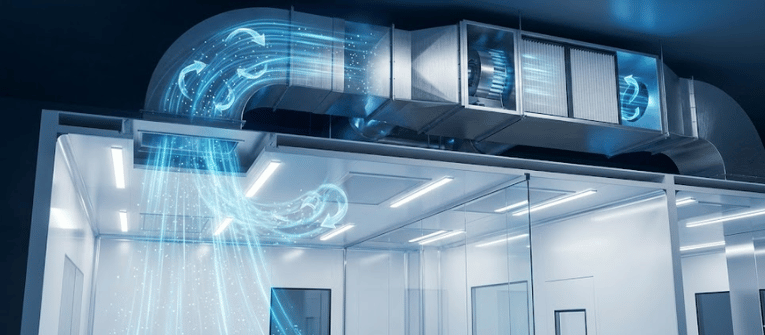
Maintaining ultra-low particulate counts in a cleanroom requires a sophisticated understanding of how microscopic particles move within turbulent air streams.
In high-velocity exhaust systems, aerosol dispersion is governed by complex fluid dynamics that dictate whether contaminants are successfully removed or inadvertently recirculated.
This article explores the mechanics of particle behavior to optimize cleanroom safety and efficiency.
To master aerosol control, one must first understand the environment of a high-velocity exhaust. Unlike the laminar (unidirectional) flow found in the main cleanroom area, exhaust ducts often experience turbulent flow.
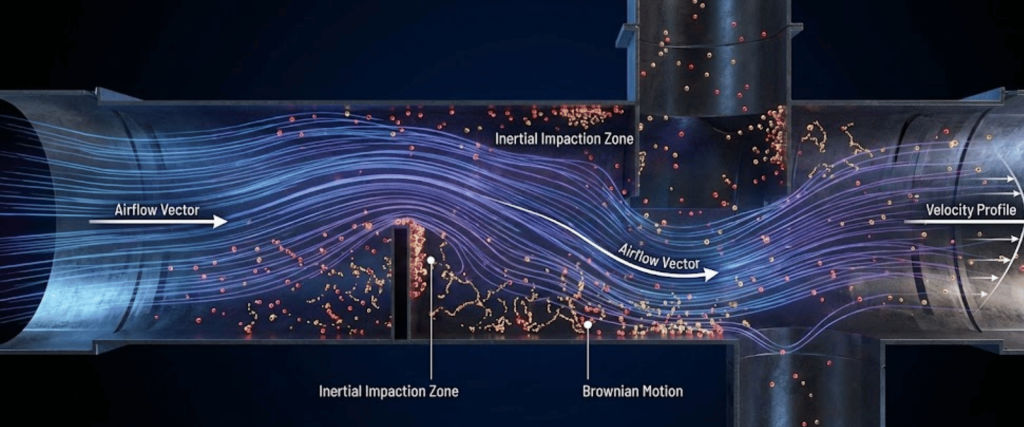
When aerosols solid particles or liquid droplets suspended in the air enter these high-velocity streams, their trajectory is influenced by several physical forces.
Velocity is the primary lever in exhaust design. If the velocity is too low, particles may settle within the ductwork, creating a buildup that can lead to slugs of contamination later.
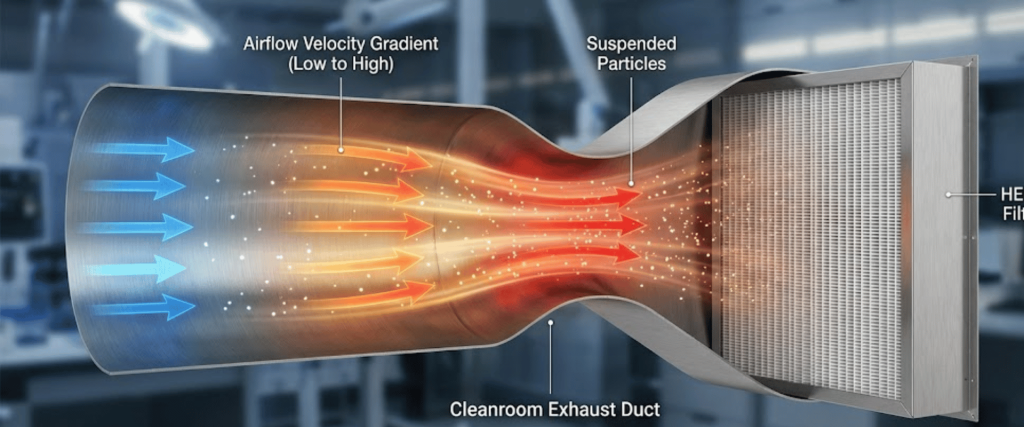
Conversely, excessively high velocity can lead to high static pressure drops and energy inefficiency.
In high-velocity systems, the creation of eddies (circular currents) can be a significant challenge. If an exhaust system is poorly designed, these eddies can trap aerosols in dead zones, allowing them to circulate within the cleanroom or ducting rather than being expelled.
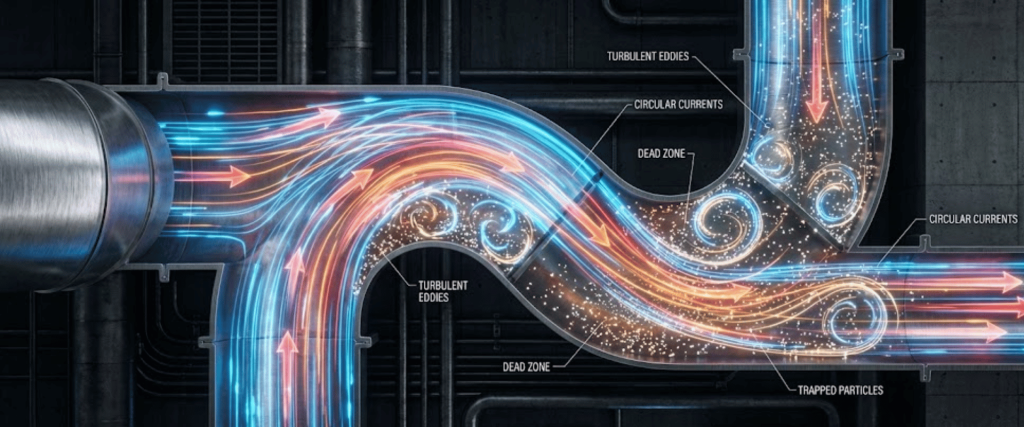
Modern cleanroom engineering uses Computational Fluid Dynamics (CFD) modeling to visualize these invisible air patterns. By simulating high-velocity exhausts, engineers can ensure that the air moves in a way that sweeps aerosols directly toward the extraction points without creating backflow.
This table explains how different aerosol sizes behave when they enter a high-velocity exhaust stream.
| Particle Size (Microns) | Primary Dispersion Mechanism | Behavior in High‑Velocity Flow | Risk Level to Cleanroom Integrity |
|---|---|---|---|
| > 5.0 μm | Inertial Impaction | Due to higher mass, particles are likely to hit duct walls or bends; easier to trap. | High (can cause physical blockage) |
| 0.5 μm – 5.0 μm | Gravitational Settling | Particles balance between airflow and gravity; needs a specific transport velocity to stay suspended. | Moderate (may settle in low‑airflow zones) |
| 0.1 μm – 0.5 μm | Interception | Particles closely follow airflow paths; require high‑efficiency HEPA or ULPA filters. | Very High (most difficult to capture) |
| < 0.1 μm | Brownian Diffusion | Random, unpredictable movement caused by molecular collisions; spread depends on diffusion. | Extreme (can pass through low‑grade filters) |
The effectiveness of the final filter (HEPA/ULPA) is heavily dependent on the uniformity of the aerosol dispersion as it approaches the filter face. High-velocity exhausts must transition into a plenum or a wider area to slow the air down before it hits the filter.
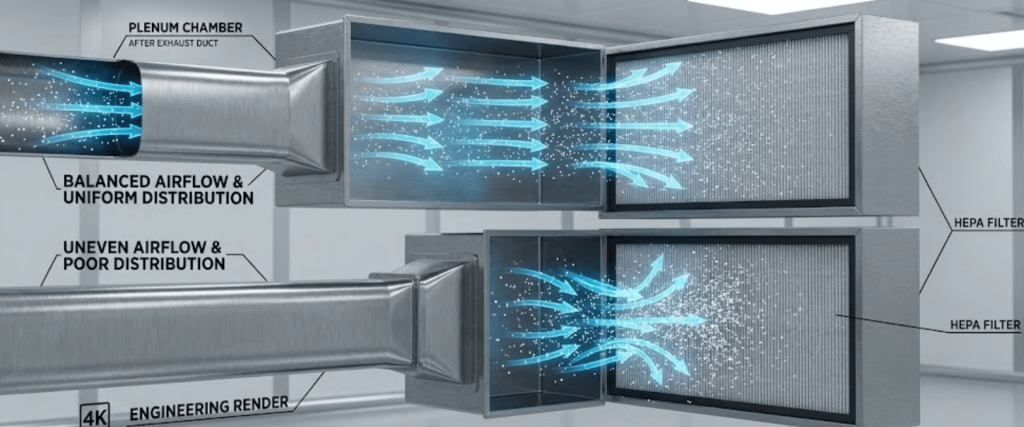
If the aerosol dispersion is uneven (concentrated in one spot due to high velocity.
Mastering the science of aerosol dispersion is essential for maintaining the rigorous air quality standards required in high-performance cleanrooms.
By strategically balancing high-velocity exhaust speeds with advanced filtration, facilities can ensure that microscopic contaminants are removed without the risk of re-entrainment.
This data-driven approach not only protects the integrity of sensitive processes but also optimizes energy efficiency and equipment longevity.
Ultimately, a well-engineered exhaust system is the foundation of a safe, compliant, and highly controlled environment.
High air velocity creates the necessary kinetic energy to keep particulates entrained or floating in the air stream. This prevents particles from settling in the ductwork, ensuring they are carried directly to the HEPA or ULPA filters for safe removal.
Dead zones are areas of low-pressure or stagnant air caused by poor exhaust design. These zones can trap aerosols and hazardous vapors, allowing them to circulate within the cleanroom rather than being expelled, which increases the risk of contamination.
Yes, if the air hits a filter too fast, it can cause uneven loading or structural damage. Engineers use plenums to widen the airflow path, slowing the air down just before it reaches the filter to ensure even dispersion and maximum filtration efficiency.
Computational Fluid Dynamics (CFD) allows engineers to see invisible airflow patterns before a cleanroom is even built. It helps identify potential turbulence and ensures that the high-velocity exhaust is positioned perfectly to sweep aerosols away from sensitive work zones.