Over the past year, the Applied Physics sales team has seen a sharp increase in questions around “neutrally buoyant fog.”
Customers across pharmaceutical, semiconductor, and regulated manufacturing environments are asking:
These are valid questions—and they deserve real, physics-based answers rather than simplified marketing claims.
In strict physical terms, perfect neutral buoyancy cannot be maintained indefinitely in any aerosol system.
True neutral buoyancy would require:
These conditions do not exist in real environments—even in ISO-certified cleanrooms.
In practice, what most professionals mean by neutrally buoyant fog is:
Fog that remains suspended long enough to accurately visualize airflow patterns before settling.
That is achievable.
Permanent suspension is not.
The single most important variable governing fog behavior is droplet diameter.
At Applied Physics, our systems are engineered to produce consistent, tightly controlled droplet ranges:
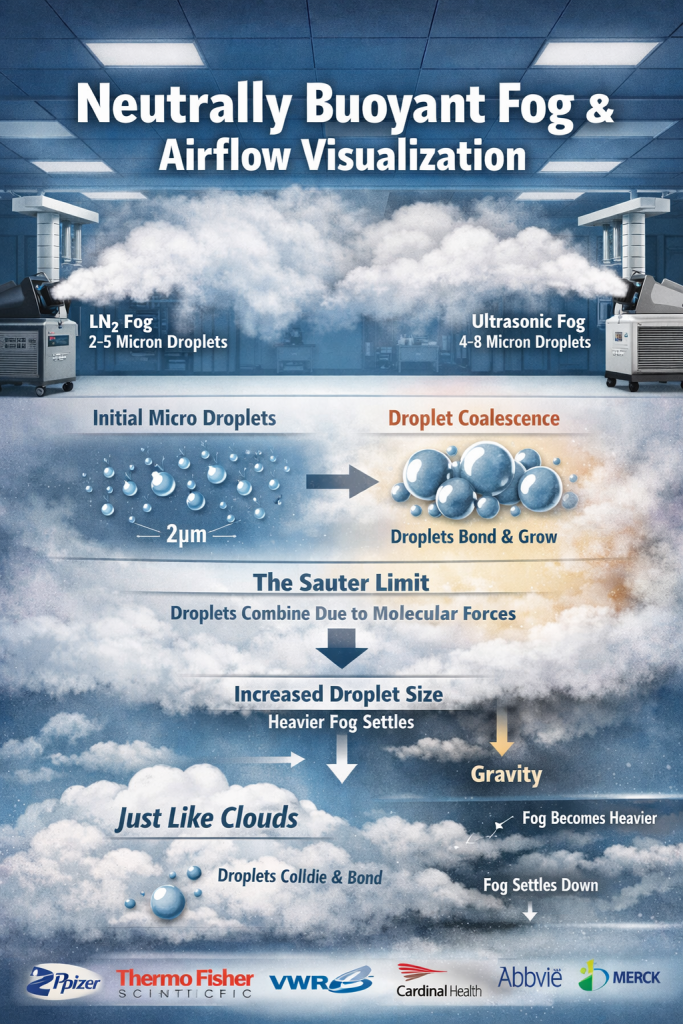
Typical droplet size: 2–5 microns
Typical droplet size: 4–8 microns
Smaller droplets:
Larger droplets:
This is why LN₂ fog often appears “lighter,” even when visually dense—it starts with a smaller droplet population.
When fog is evaluated scientifically, engineers reference the Sauter Mean Diameter (SMD).
SMD represents the droplet size that preserves the same volume-to-surface-area ratio as the entire population.
Why does this matter?
Because evaporation rate, coalescence probability, and aerodynamic behavior are all governed by surface area.
Lower SMD means:
However, aerosol physics introduces an unavoidable constraint known as the Sauter limit.
Once droplets reach sufficiently small sizes, surface energy and intermolecular attraction cause rapid recombination.
In simpler terms:
Ultra-fine droplets naturally seek each other out.
They collide.
They bond.
They grow.
This happens in every fog system.
Even if droplets begin at 2 microns, they do not remain isolated indefinitely.
Fog behaves exactly like clouds.
Clouds appear weightless, yet they are composed of microscopic droplets suspended in air.
Over time:
That’s how clouds become rain.
Fog follows the same physics.
Whether LN₂ or ultrasonic:
At that point, fog becomes visibly heavier and begins descending.
This process is unavoidable.
It is not a design flaw.
It is fundamental aerosol physics.
Applied Physics fog systems are trusted globally to visualize airflow, pressure differentials, and turbulence during ISO certification and cleanroom validation.
Our foggers are actively used by teams at:
…and many more pharmaceutical, biotechnology, and semiconductor manufacturers worldwide.
These organizations rely on Applied Physics fog technology to:
Because accurate visualization matters when compliance, safety, and product integrity are on the line.
Both technologies meet regulatory needs when properly engineered.
At Applied Physics, we design both platforms to optimize:
But neither system can override gravity or molecular attraction.
Some marketing claims imply fog can remain suspended indefinitely.
This violates basic aerosol dynamics.
What can be achieved is:
Which is exactly what Applied Physics systems provide.
But eventual settling is inevitable.
Instead of chasing an impossible definition of neutral buoyancy, professionals should focus on:
These parameters determine whether your airflow test is valid.
Not whether fog floats forever.
Our LN₂ and ultrasonic fog platforms are built around one principle:
Deliver the smallest practical droplet size with maximum visualization accuracy—while respecting real-world physics.
We don’t promise magic.
We deliver:
Because in regulated environments, physics matters more than buzzwords.
Neutrally buoyant fog is best understood as a temporary condition—not a permanent state.
All fog systems experience droplet bonding, increased mass, and gravitational settling.
This is natural.
It’s how clouds become rain.
The real measure of performance is how accurately your fog reveals airflow during its suspension window.
That’s where engineering matters.
And that’s where Applied Physics leads.
Since 1992, Applied Physics Corporation has been a leading global provider of precision contamination control and metrology standards. We specialize in airflow visualization, particle size standards, and cleanroom decontamination solutions for critical environments.