Last Updated: August 9, 2026
The choice between a cleanroom fogger and an aerosol generator determines whether your facility can effectively validate airflow patterns, detect filter leaks, and maintain ISO 14644 compliance.
A cleanroom fogger generates visible mist through mechanical or ultrasonic atomization, revealing laminar or turbulent flow characteristics. An aerosol generator produces microscopic particles using a Laskin nozzle or cold-type mechanism, generating standardized particle sizes for HEPA filter integrity testing and particle count verification.
Foggers excel at smoke studies and visual airflow pattern detection, you can literally see where air moves. Aerosol generators are built for quantitative HEPA filter leak detection and particle metrology, where precision particle size distribution and measurable particle counts drive compliance decisions.
Applied Physics has served cleanroom, semiconductor, and pharmaceutical facilities since 1992 with both technologies, offering LN2 ultrapure and ultrasonic cleanroom foggers alongside cold-type aerosol generators like the BAG-4B and BAG-6D models.
Understanding when to use each tool separates facilities that pass audits from those that struggle with contamination control and GMP validation.
| Feature | Cleanroom Fogger | Aerosol Generator | Best For |
|---|---|---|---|
| Primary Function | Airflow visualization via visible mist | Quantitative HEPA filter leak detection | Foggers: flow patterns; Generators: filter validation |
| Particle Generation | Mechanical or ultrasonic atomization | Laskin nozzle or cold-type mechanism | Depends on validation goal |
| Particle Size Range | 5-50 microns (visible droplets) | 0.3-1.0 microns (sub-micron precision) | Foggers: visual; Generators: measurement |
| Detection Method | Visual observation; smoke studies | Aerosol photometer or particle counter | Foggers: naked eye; Generators: instrumentation |
| Laminar Flow Assessment | Direct visualization of flow patterns | Indirect (via filter penetration data) | Foggers for direct observation |
| Turbulent Flow Detection | Immediate visual confirmation | Measured through particle deposition rates | Foggers for quick identification |
| Setup Time | 5-15 minutes | 10-20 minutes (with calibration) | Foggers faster for emergency validation |
| Operational Cost | Lower (consumables: water or fluid) | Higher (calibration, aerosol fluid, counters) | Foggers more economical for routine use |
| GMP Compliance Proof | Qualitative documentation (photos/video) | Quantitative data (particle counts, reports) | Generators for regulatory audits |
| Suitable for Sub-10nm Detection | No (visible range only) | Yes (with calibrated photometers) | Generators for semiconductor metrology |
Cleanroom foggers convert liquid into aerosolized droplets that become visible tracers for airflow movement. The fog particles reveal whether your HVAC system, laminar flow benches, and biosafety cabinets are distributing air as designed.
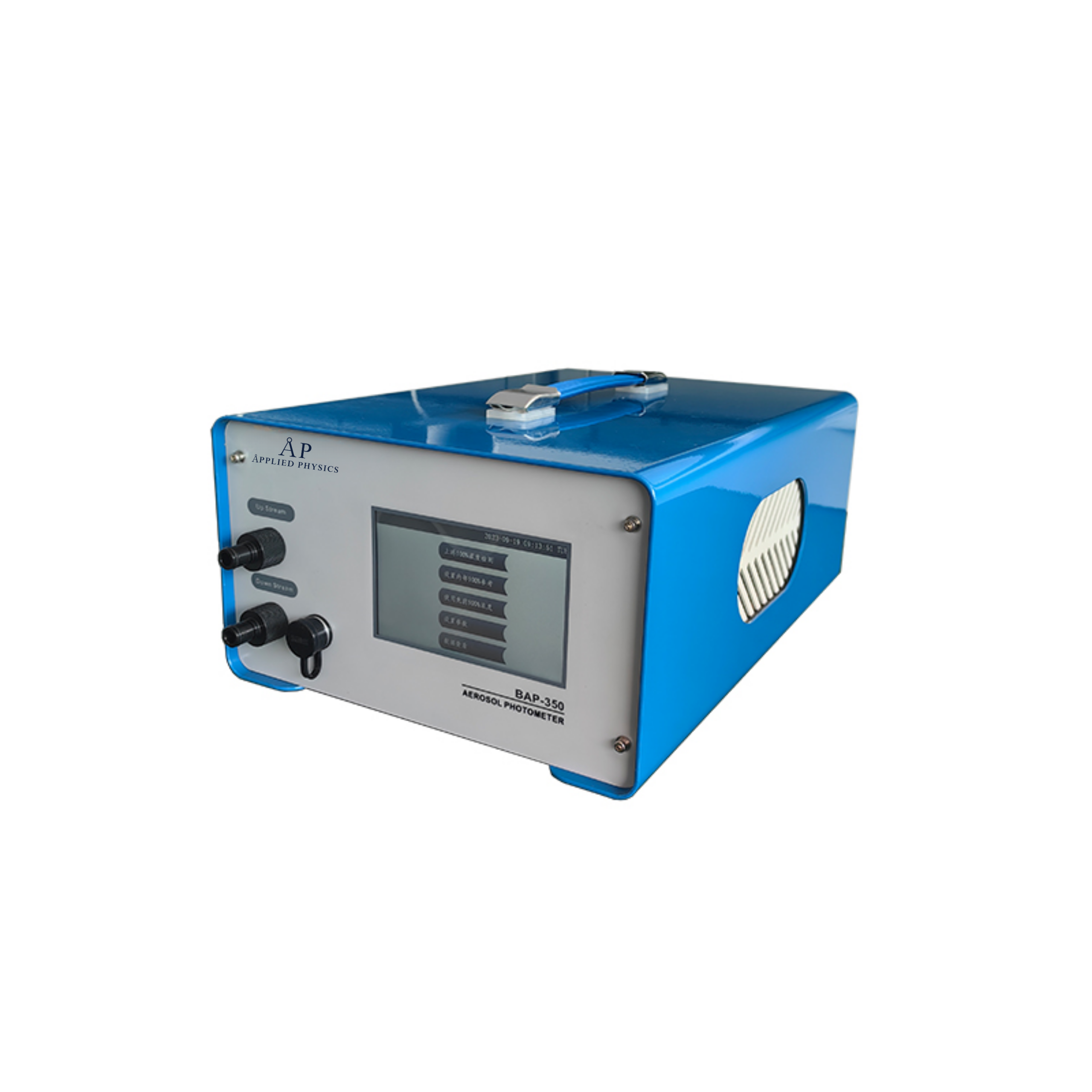
Aerosol Photometer BAP-350
Ultrasonic foggers vibrate a piezoelectric element at high frequency, breaking fluid into fine droplets through mechanical resonance. LN2-based systems use liquid nitrogen to flash-evaporate water, creating extremely fine, uniform mist. Mechanical foggers use pressure-driven nozzles to force fluid through small orifices, producing larger droplets but faster coverage.
Droplet size affects how well fog follows actual airflow. Larger droplets (20-50 microns) fall faster and don’t track laminar flows accurately. Smaller droplets (5-15 microns) remain suspended longer and follow airflow more faithfully, giving a clearer picture of circulation patterns.
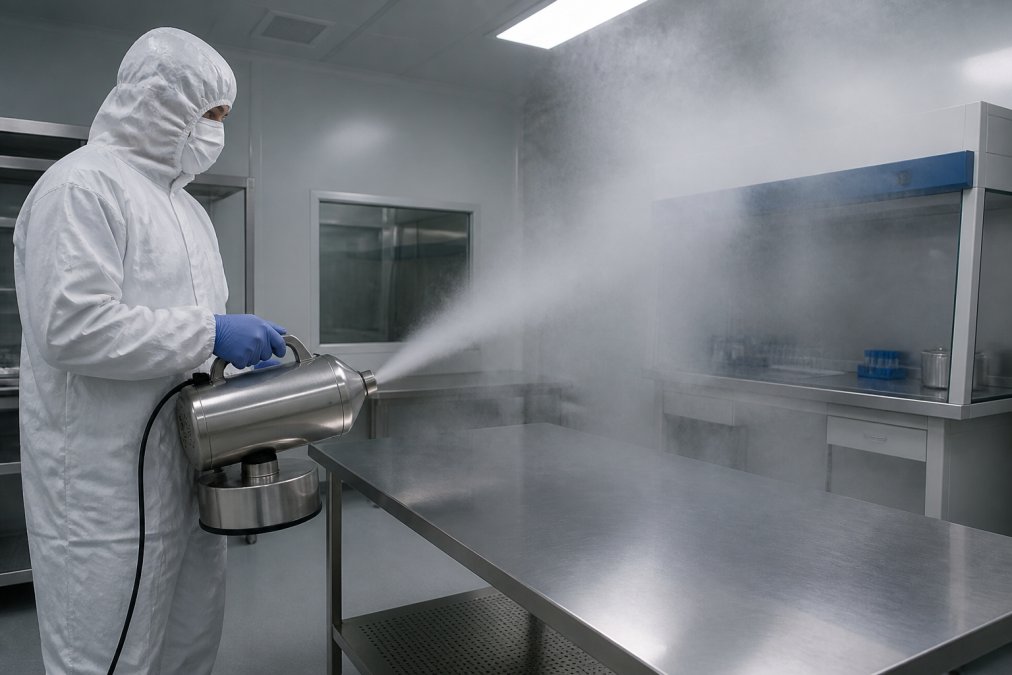
Professional technician in full protective equipment operating a cleanroom fogger in a controlled laboratory environment, with visible mist dispersing across stainless steel work surfaces under bright overhead lighting
Pro Tip Ultrasonic foggers produce the most uniform droplet size distribution and create the most visible, controllable mist patterns. For detailed smoke studies, ultrasonic is your best choice. LN2 systems are faster but require cryogenic supply management.
Droplet density, how many particles per unit volume, determines whether smoke studies reveal subtle flow problems or just obvious air currents. A dense fog shows every eddy and vortex; sparse mist misses details.
Atomization relies on surface tension and kinetic energy. When liquid breaks into droplets, surface tension pulls each into a sphere. Slower atomization yields larger droplets; faster atomization creates finer mist. Ultrasonic transducers typically generate 4-10 micron droplets because the piezoelectric vibration frequency (around 100-120 kHz) is optimized for that size. Pressure-based systems can produce 10-100 microns depending on nozzle design and pressure.
The fog particles themselves are not contaminants being removed by HEPA filters. Instead, they’re tracers showing whether laminar flow is working, whether dead zones exist, and whether air changes per hour are sufficient. If fog pools in a corner, that’s a laminar flow failure, actual contaminant particles will pool there too.
Mist typically refers to coarser droplets (15-50 microns) that settle faster and create visible clouds. Fog refers to finer particles (5-15 microns) that remain airborne longer and follow airflow more precisely.
For pharmaceutical cleanroom validation, fog is more effective because it tracks laminar flow patterns without settling prematurely. For semiconductor fab HVAC testing, mist may be sufficient for confirming air movement direction. For USP 797/800 sterile compounding pharmacies, the choice depends on glove box size and validation protocol.
Application method affects effectiveness. Continuous release creates steady fog showing sustained airflow patterns. Pulse-release (short bursts) reveals how quickly air clears contamination, important for biosafety cabinet validation. Directional release helps trace air movement from source to exhaust.
Watch Out Never use fog to validate HEPA filter integrity. Visible fog cannot tell you whether sub-micron particles are leaking through filter seams. That requires aerosol generators and particle counters. Facilities relying on visual fog inspection for filter validation will fail EPA or GMP audits.
Aerosol generators produce standardized particles in the sub-micron range (0.3-1.0 microns), making them the quantitative tool for HEPA filter leak detection and particle metrology. Unlike foggers, which you evaluate visually, aerosol generators feed particles into a test chamber where an aerosol photometer or particle counter measures how many particles pass through the filter.
Foggers show flow patterns; aerosol generators measure whether filters actually stop particles. For GMP compliance, regulatory audits, and semiconductor sub-10nm node validation, aerosol generators provide documented proof that your cleanroom environment meets specification.
Applied Physics manufactures cold-type aerosol generators including the BAG-4B (manual adjustment, Laskin nozzle) and BAG-6D (automated, enhanced precision). Both use dioctyl phthalate (DOP) or polydisperse aerosol (PSL) fluid to generate particles with known size distribution and concentration.
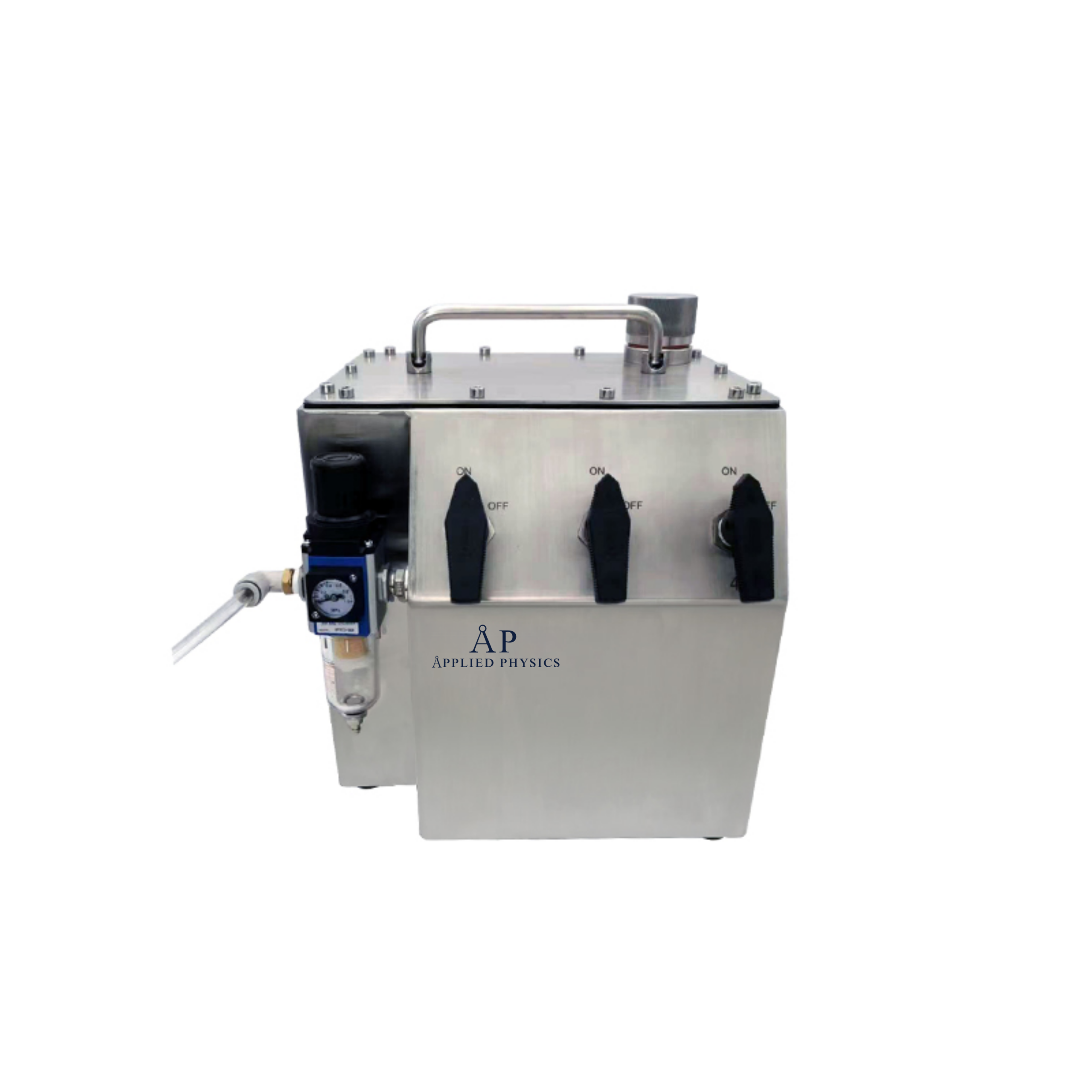
Aerosol Generator-Cold Type BAG-4B
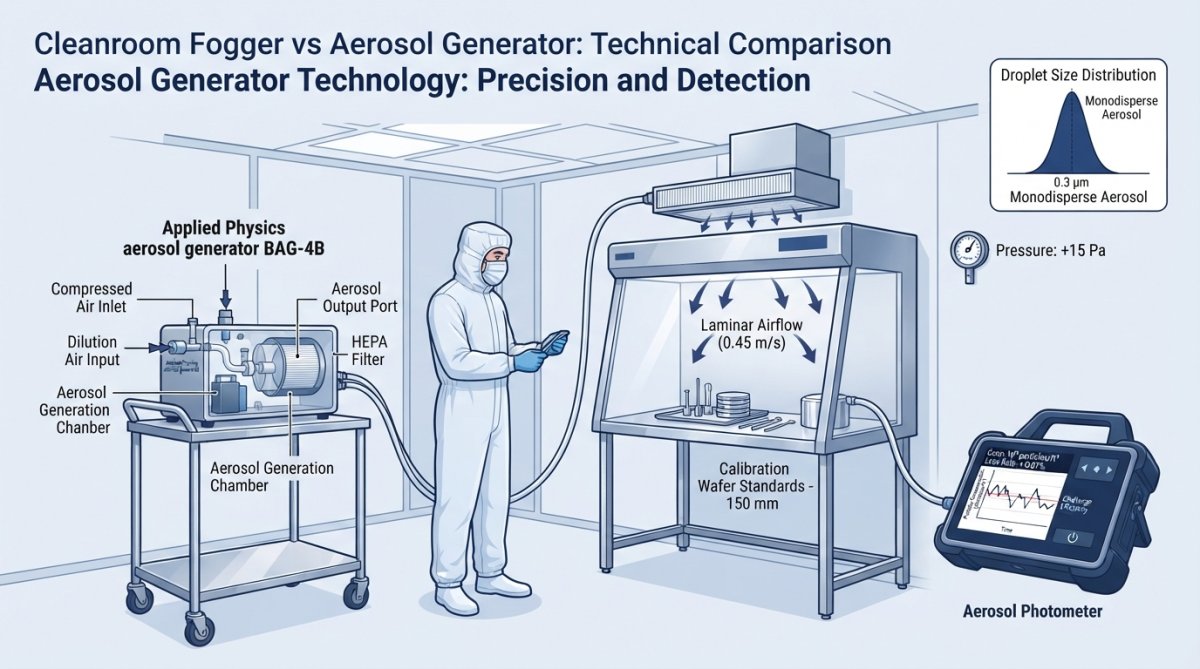
Applied Physics aerosol generator BAG-4B mounted in a pharmaceutical cleanroom setting with technician in full protective gear monitoring particle generation through a connected aerosol photometer, with laminar flow hood and stainless steel work surface visible
The Laskin nozzle converts liquid into aerosol particles. Compressed air flows through the nozzle at controlled pressure, creating a baffle system that breaks the liquid stream into fine droplets. The droplets evaporate partially, leaving solid particles in the 0.3-1.0 micron range.
Nozzle design determines particle size distribution. A properly calibrated Laskin nozzle generates particles with narrow size distribution, essential for HEPA filter testing. Particles that are too large will be stopped by the filter even if it has defects. Particles that are too small may pass through intact filters, giving false positives.
Nozzle pressure, typically 20-40 PSI for cold-type generators, directly affects particle output rate and size. Higher pressure increases particle generation but may shift size distribution slightly larger. Calibration is critical: you must validate that your nozzle produces the expected particle size range before using it for filter testing.
Cold-type generators like the BAG-4B and BAG-6D use ambient temperature operation, which is safer and more practical than heated systems. The trade-off is slightly slower particle generation, but for pharmaceutical and semiconductor applications, safety and stability advantages outweigh speed.
Microscopic particles in the sub-micron range are what actually escape contamination control failures. A HEPA filter rated for 0.3 microns at 99.97% efficiency should stop virtually all particles at that size. If your filter fails and allows 0.5-micron particles through, you have a contamination problem.
Aerosol generators test this by introducing a known concentration of 0.5-micron particles upstream of the filter, then measuring downstream particles. The ratio tells you the filter’s actual penetration rate. If a filter rated for 99.97% efficiency shows 1% penetration, you have a leak at a seam, gasket, or bypass path.
This quantitative approach is mandatory for GMP audits, FDA inspections, and ISO 14644 validation. Regulators want documented particle count data, not photos of fog patterns. An aerosol photometer connected to your aerosol generator provides that data automatically.
Semiconductor fabs extend this logic to sub-10nm particle detection. Particles smaller than 10 nanometers can contaminate wafer surfaces during photolithography. Applied Physics calibration wafer standards work with aerosol generators to validate that your metrology equipment can detect particles at your specification.
Airflow visualization testing answers a fundamental question: does your cleanroom’s HVAC system move air as designed? ISO 14644 cleanroom standards require documented evidence of laminar or turbulent flow patterns appropriate to your classification level.
Cleanroom foggers are the primary tool for this validation. You release fog and observe whether it moves in parallel lines (laminar flow), swirls and eddies (turbulent flow), or pools in corners (dead zones). Visual evidence, supported by video documentation and photographs, becomes part of your compliance file.
Smoke studies use visible fog to trace airflow patterns and identify contamination risks. In a properly functioning ISO Class 5 cleanroom with laminar flow, fog should move smoothly from ceiling to floor in parallel lines, with no turbulence or stagnation.
A smoke study reveals:
For pharmaceutical cleanrooms, dead zones are the biggest concern. If fog pools near a glovebox entry or biosafety cabinet exhaust, actual contaminant particles will pool there too. Smoke studies reveal these problem areas before you validate the room for production.
Key Takeaway Smoke studies are your first line of defense for detecting airflow problems. If your fog shows dead zones or unexpected turbulence, fix the HVAC issue before validating HEPA filters or beginning production. Fixing airflow problems is cheaper than managing contamination failures later.
Laminar flow cleanrooms move air in parallel lines from one wall to another, typically from ceiling to floor. This design minimizes particle recirculation and provides consistent contamination control. Laminar flow is required for ISO Class 3-5 cleanrooms used in pharmaceutical sterile compounding and semiconductor fabrication.
Turbulent flow cleanrooms mix air throughout the space, relying on high air change rates to dilute and remove contaminants. Turbulent flow is acceptable for ISO Class 6-8 cleanrooms used in electronics assembly and general manufacturing.
A cleanroom fogger immediately shows which type of flow you actually have. If fog moves in straight lines, you have laminar flow. If fog swirls and mixes throughout the room, you have turbulent flow. If you see both, you have a design problem that needs correction.
ISO 14644 is the international standard defining cleanroom classifications, test methods, and compliance requirements. It specifies that cleanrooms must be validated through documented testing of particle counts, airflow patterns, and filter integrity.
The standard doesn’t mandate specific equipment, but it requires that whatever equipment you use generates reproducible, measurable results. Cleanroom foggers alone don’t satisfy ISO 14644 for filter validation, you need quantitative particle count data from an aerosol generator and photometer system.
For pharmaceutical facilities, USP 797 (Sterile Compounding) and USP 800 (Hazardous Drugs) require documented airflow visualization and HEPA filter integrity testing. The documentation must include:
For semiconductor fabs, ISO 14644 validation is part of equipment qualification. Fabs typically validate cleanrooms quarterly or semi-annually to ensure particle counts remain within specification.
Applied Physics equipment supports these compliance requirements. The BAG-6D aerosol generator integrates with aerosol photometers to generate the quantitative data auditors expect. Cleanroom foggers provide visual documentation of airflow patterns.
Calibration ensures that your aerosol generator produces particles at the size and concentration you believe it does. Without calibration, your filter test results are meaningless, you might test 0.5-micron particles when you’re actually testing 1.0-micron particles.
The calibration process involves:
Contact Us →
Applied Physics provides calibration wafer standards that work with semiconductor metrology equipment to verify sub-10nm particle detection capability. This is critical for fabs moving to 5nm or smaller node production, where particle contamination becomes yield-limiting.
Pro Tip Schedule calibration before your annual audit or GMP inspection. Auditors will ask for calibration certificates showing your equipment functions within specification. Out-of-calibration equipment is a citation waiting to happen.
HEPA filter integrity testing is where aerosol generators prove their value. A single leaking HEPA filter can compromise your entire cleanroom. Testing confirms that filters actually stop particles at the rated efficiency.
Your aerosol generator produces a known concentration of 0.5-micron particles upstream of the filter. An aerosol photometer measures particle concentration downstream. The ratio tells you the filter’s actual penetration rate. A filter rated for 99.97% efficiency should show penetration of 0.03% or less.
Filter leaks typically occur at seams, gaskets, or bypass paths where the filter frame doesn’t seal perfectly against ductwork. Even a small leak (1-2% penetration) can compromise a critical cleanroom.
Detection requires precision equipment. Your aerosol generator must produce stable, reproducible particle output. Your aerosol photometer must count particles accurately across a wide concentration range. Miscalibration gives false results, either failing a good filter or passing a bad one.
Applied Physics aerosol generators like the BAG-4B and BAG-6D are designed for this precision. The cold-type mechanism produces stable particle output without heating complexity. The Laskin nozzle design ensures repeatable particle size distribution.
Particle count verification happens in two stages. First, measure upstream concentration with the filter isolated. Then measure downstream concentration with the filter in place. The difference shows how many particles the filter removed. If the filter removes fewer particles than expected, you have a leak.
For pharmaceutical cleanrooms, filter testing is typically done every 12 months or after any HVAC maintenance. For semiconductor fabs, filter testing may be quarterly because the cost of a contaminated wafer batch far exceeds testing costs.
The fluid used in your aerosol generator affects particle generation quality. DOP (dioctyl phthalate) is the traditional choice for pharmaceutical and semiconductor applications. PSL (polystyrene latex) particles are used for calibration and specialized testing.
Water used to dilute or prepare aerosol fluid must be ultrapure (UPW) or deionized (DI) water to avoid introducing contaminant particles. Tap water or standard distilled water contains dissolved minerals that interfere with particle generation and counting.
Applied Physics equipment specifications call for ultrapure water to ensure consistent particle generation. This is especially critical for sub-10nm metrology work in semiconductor fabs, where even tiny contamination variations affect calibration accuracy.
Equipment purity standards extend beyond aerosol fluid. Your aerosol generator’s internal passages, nozzles, and collection chambers must be clean and free of residual particles. Improper maintenance allows particles from previous tests to contaminate new tests.
The choice between cleanroom foggers and aerosol generators depends on what you’re validating and what regulators require for proof.
Pharmaceutical compounding pharmacies must comply with USP 797 (Sterile Compounding) and USP 800 (Hazardous Drugs) standards. Both require documented evidence that compounding areas maintain appropriate contamination control.
For USP 797 compliance, you need:
A typical pharmacy compounding cleanroom is ISO Class 5, requiring laminar flow at 0.3-0.5 meters per second. A cleanroom fogger shows whether you actually have that laminar flow. An aerosol generator confirms that your HEPA filter isn’t leaking.
USP 800 adds requirements for hazardous drug handling, including negative pressure relative to adjacent areas. A cleanroom fogger shows whether your negative pressure is working, if fog is drawn toward the exhaust, you have proper negative pressure. If fog moves toward the room entry, your pressure is reversed.
Semiconductor fabs moving to 5nm, 3nm, or smaller node production require sub-10nm particle detection capability. A single 20-nanometer particle can kill a wafer during photolithography. This demands precision far exceeding pharmaceutical requirements.
Calibration wafer standards become critical at this scale. Applied Physics calibration standards work with your metrology equipment to verify that you can actually detect particles at the size you claim. Without this validation, you might miss contamination destroying yield.
Aerosol generators are essential for this validation. You must confirm that your particle detection equipment can actually see 10-nanometer particles. A cleanroom fogger won’t help, visible mist is thousands of nanometers in size, far too large to validate sub-10nm detection.
Key Takeaway Sub-10nm particle control is not optional for advanced semiconductor production. Fabs that skip this validation will experience yield loss without knowing why. Invest in proper aerosol generation and metrology validation equipment early in your node transition.
Operating cleanroom foggers and aerosol generators safely requires proper training, protective equipment, and maintenance protocols.
Cleanroom foggers using ultrasonic or LN2 atomization are generally safe for operators. The fluid used is typically water-based or glycerin-based, non-toxic at the concentrations used. The main safety concern is ensuring adequate ventilation so operators don’t inhale excessive mist.
Aerosol generators using DOP or PSL fluid require more care. DOP is generally recognized as safe at low concentrations, but prolonged inhalation should be avoided. Operators should wear respiratory protection (N95 or better) when working directly with aerosol generators, especially during setup and calibration.
For pharmaceutical facilities, operators must follow facility-specific safety protocols. Many pharmacies require full protective equipment (gown, gloves, head covering, shoe covers) when entering ISO Class 5 compounding areas, regardless of whether validation studies are underway.
Cleanroom foggers require regular maintenance to prevent fluid buildup, nozzle clogging, and performance degradation:
Aerosol generators require more intensive maintenance because of aerosol fluid residue:
Downtime during maintenance can be minimized by maintaining backup equipment. Many facilities rotate equipment through maintenance without disrupting validation schedules.
Applied Physics equipment is designed for maintainability. The BAG-4B and BAG-6D aerosol generators use modular nozzle designs allowing quick replacement without full system recalibration.
The decision between a cleanroom fogger and an aerosol generator is not either-or. Most facilities need both.
Choose a cleanroom fogger if you need to:
Choose an aerosol generator if you need to:
The complete solution combines both technologies:
For facilities needing both capabilities, Applied Physics offers integrated solutions. The company’s cleanroom foggers (both LN2 ultrapure and ultrasonic models) work alongside aerosol generators like the BAG-4B and BAG-6D. The BAP-350 Aerosol Photometer pairs with the aerosol generators to provide quantitative particle counting.
Choosing between visualization and quantification doesn’t require compromise. Facilities that invest in both cleanroom foggers and aerosol generators achieve superior contamination control, pass audits reliably, and maintain the documentation regulators expect. Applied Physics has supported this dual-equipment approach since 1992, providing cleanroom managers and process engineers with the precision tools needed for GMP compliance and advanced manufacturing validation. Contact Applied Physics to discuss which combination of airflow visualization and particle metrology solutions fits your facility’s specific requirements.
A cleanroom fogger generates visible mist to visualize airflow patterns and detect contamination pathways through smoke studies. An aerosol generator produces microscopic particles for precise HEPA filter integrity testing and particle count verification. Foggers excel at revealing flow dynamics; aerosol generators deliver measurable particle data. Cleanroom managers typically use foggers for initial airflow visualization and aerosol generators for quantitative validation during GMP audits and ISO 14644 compliance assessments.
HEPA filters require validation against particles in the 0.3 to 0.5 micrometer range, the most penetrating particle size. Aerosol generators produce particles in this critical range with consistent particle size distribution, enabling accurate filter leak detection. Cleanroom foggers generate larger droplets (5-100 micrometers), which are less effective for detecting microscopic leaks. For USP 797/800 compliance and pharmaceutical validation, aerosol generators provide the precision needed to certify filter performance. Applied Physics aerosol generators deliver the sub-micrometer particle generation required for rigorous filter testing protocols.
Cleanroom foggers support ISO 14644 validation through airflow visualization and smoke studies, which help identify contamination control weaknesses. However, ISO 14644 requires documented particle count data and environmental monitoring. Foggers alone do not provide quantitative particle measurements. To fully meet ISO 14644 cleanroom validation requirements, facilities must pair foggers with aerosol generators and particle counters for comprehensive contamination control documentation. GMP audits typically require both visual airflow assessment and measurable particle data for complete compliance.
Aerosol generators using ultrapure water (UPW) or deionized (DI) water produce consistent, neutral-output particles without chemical residue or contamination. Low-purity water introduces variables that compromise particle size distribution and particle count accuracy. Applied Physics aerosol generators use ultrapure water to ensure repeatable results across validation studies. For semiconductor metrology requiring sub-10nm detection capability and pharmaceutical facilities needing precise particle measurements, ultrapure water is essential. Calibration wafer standards and validation protocols depend on this purity to maintain measurement integrity across multiple validation cycles.
Modern aerosol generators like the Applied Physics BAG-6D and BAG-4B feature manual adjustment controls that reduce configuration time significantly. Setup typically takes 15-30 minutes for cleanroom integration, compared to 45+ minutes for legacy equipment requiring extensive calibration. The real time savings emerge during validation downtime: streamlined aerosol generation and particle counting workflows reduce total validation study duration by 30-40%. For facilities running continuous production, faster equipment setup directly translates to reduced facility downtime and lower operational costs during GMP compliance assessments.
APPLIED PHYSICS TECHNICAL RESOURCE
Airflow visualization, smoke studies, tracer delivery, particle monitoring and controlled-environment validation. Product and standards references should be interpreted for the actual instrument, facility, protocol and configuration.
Enter your details below to save your shopping cart for later. And, who knows, maybe we will even send you a sweet discount code :)
Allow notifications to get real-time updates about your shopping cart and who knows, you may even receive a sweet discount code 😊